Overview
The Makonde (historically often transcribed as Maconde, Wamakonde or Mahonde in lusophone and older ethnographic literature) constitute an acephalous-segmented, matrilineally organised Bantu language group in East Africa. Demographic surveys and estimates put the current total population at around 1.3 to 1.5 million individuals. The primary settlement area is divided geopolitically by the Ruvuma River into two distinct but culturally closely interwoven main cohorts: The Tanzanian majority population of an estimated 1.1 to 1.2 million people settles predominantly in the south-eastern provinces of Mtwara, Lindi and Newala, while the Mozambican cohort, consisting of around 240,000 to 300,000 individuals, is historically located on the inaccessible Mueda Plateau in the northern province of Cabo Delgado. There are also smaller diaspora communities in Kenya (e.g. in Kwale County), which were recruited to work on sisal plantations in the 1930s as a result of historical labour migration. Linguistically, Kimakonde (or Shimakonde in Mozambique) is assigned to the central Bantu language family, with close structural and historical affinities to the languages of the neighbouring Yao, Mwera and Makua.
The social architecture of the Makonde is characterised by the absence of a centralised hierarchical authority. The society operates in a strictly acephalous and segmentary manner. Political, legal and ritual decision-making processes are not decreed by an aristocratic paramount chief, but are negotiated at the level of local, autonomous kinship groups (litawa or likola). The nominal head of such a kinship group (mwenyekaya) is authorised to issue directives, but primarily has an advisory and mediating function. At the macro level, there is the geographical unit of the chirambo, which is led by an elder (mkulungwa) whose authority is based on the allocation of land and the ritual appeasement of spirits, but does not imply absolute coercive power. The kinship system is rigorously matrilineal in structure, coupled with an uxorilocal or matrilocal residence rule: male individuals transfer their residence to the wife's village after marriage, and land rights are inherited primarily through the female lineage. The historical subsistence strategy is based on slash-and-burn agriculture, specifically stump cultivation, in which tree stumps are left in the fields as erosion protection and support structures for climbing plants, supplemented by hunting.
Historically, the relationship with neighbouring peoples was characterised by fluid interactions, but also by profound conflicts. The research controversies regarding the ethnic classification and historical isolation of the Makonde are significant. Classical ethnography, largely characterised by the four-volume opus Os Macondes de Moçambique (1964-1970) by Jorge and Margot Dias - which dominated the curatorial and analytical practice of European institutions such as the Museu Nacional de Etnologia in Lisbon for decades - constructed the Makonde as a largely static, isolated and homogeneous entity that sealed itself off from external influences. This Lusotropicalist interpretation has been massively deconstructed in recent research. Historians and anthropologists such as Paolo Israel (2014) and Harry West (1997) explicitly emphasise that the Makonde were never isolated. Rather, the retreat to the impassable Mueda Plateau is interpreted as a deliberate, highly dynamic political strategy to escape predation by Arab and Yao slave hunters in the 18th and 19th centuries. The dichotomy between self-designation and ascription to others also reveals a high degree of strategic flexibility: in the context of colonial labour migration, many Makonde deliberately adopted more fluid Swahili identities in order to navigate economic and legal restrictions.
Cultural context
The indigenous religious system of the Makonde is articulated through a multi-layered cosmological order which, although it has been syncretised in recent centuries by Islam (primarily in Tanzania) and Catholicism (primarily in Mozambique), remains animist in its core. At the top of the cosmological hierarchy is the creator god Nnungu, a distant, non-directly intervening entity that is primarily invoked in times of existential crisis - for example, during catastrophic droughts through collective rain rituals. However, the central operational level of the cult is dominated by the ancestors (mahoka). They act as essential intermediaries between the sphere of the living and the creator god. This order is flanked by a multitude of natural and spiritual beings (Shetani or Nnandenga) who act in a morally highly ambivalent manner. These spirits can appear as pathogens and ominous harbingers, but at the same time act as creative sources of inspiration, communicating with diviners and carvers in dreams.
The exercise of ritual authority is the responsibility of highly specialised actors. As there is no hereditary priestly caste, spiritual power is centred on divinators, healers and, in particular, circumcision specialists (mkukomela), whose expertise is passed on within strictly segregated gender-specific secret societies. A fundamental structural difference between this religious system and the patrilineal, more patriarchal neighbouring peoples (such as the Ngoni) is manifested in the prominent mythological and ritual role of women. This matriarchal focus is anchored in the anthropogony of the Makonde: the creation myth refers to the first man who, coming from the bush, carved a female figure out of wood. This sculpture became animated, came to life, gave birth to his children and, after her death, transformed into the first and most powerful revered tribal mother. These narratives not only legitimise the matrilineal social structure and land ownership, but also justify the singular protective function of female sculptures, which were carried as amulets when travelling or hunting.
The backbone of cultural and social reproduction is formed by the extremely elaborate initiation and transition rituals that mark the entry of adolescents into the status of adults. For boys (Likumbi or Jando) and girls (Ding'andu or Unyago) there are separate isolation phases in the bush (Mpolo) lasting several months. Within this liminality phase, profound physical modifications are carried out - historically this included circumcision, the insertion of ornamental scars (dinembo) by rubbing incisions with vegetable carbon and castor oil, and the insertion of lip plugs (ndona). At the same time, rigorous instruction is given in sexuality, social etiquette, genealogical knowledge and ritual dances.
The academic exegesis regarding the exact function of initiation and the role of women in the cult is the scene of one of the most profound research controversies in East African ethnography. The orthodox reading, established by Jorge and Margot Dias (1970), postulated, in line with early functionalist theories, that the Mapiko masquerade of men was primarily an instrument of patriarchal social control. The "public secret" of the masks was intended to keep women in a position of subordination and subsistence through the staged terror of the ancestral spirits. Paolo Israel (2014) and more recent Mozambican and comparative studies (e.g. Langeveld 2004 on Senegal) diametrically revise this thesis. Israel argues that the Makonde women always saw through the performative illusion and had immense ritual agency of their own. They subverted the male dances with their own provocative and feminist performance genres such as Lingundumbwe and initiated their own secret rites in which they temporarily used clay or fabric masks (shitengamatu). Museum institutions such as the Museum Rietberg (Zurich) are increasingly reflecting this re-evaluation of female agency in their provenance and exhibition contexts, by differentiating between the dichotomy of male mask production and female ritual power.
Aesthetic features
The material culture of the Makonde requires a rigorous taxonomic separation between the pre-colonial rooted, functional ritual sculpture and the ebony sculpture created after 1950 and primarily conceived for the Western art market. Overlooking this dividing line has historically led to considerable misclassification in museum and private collection practice.
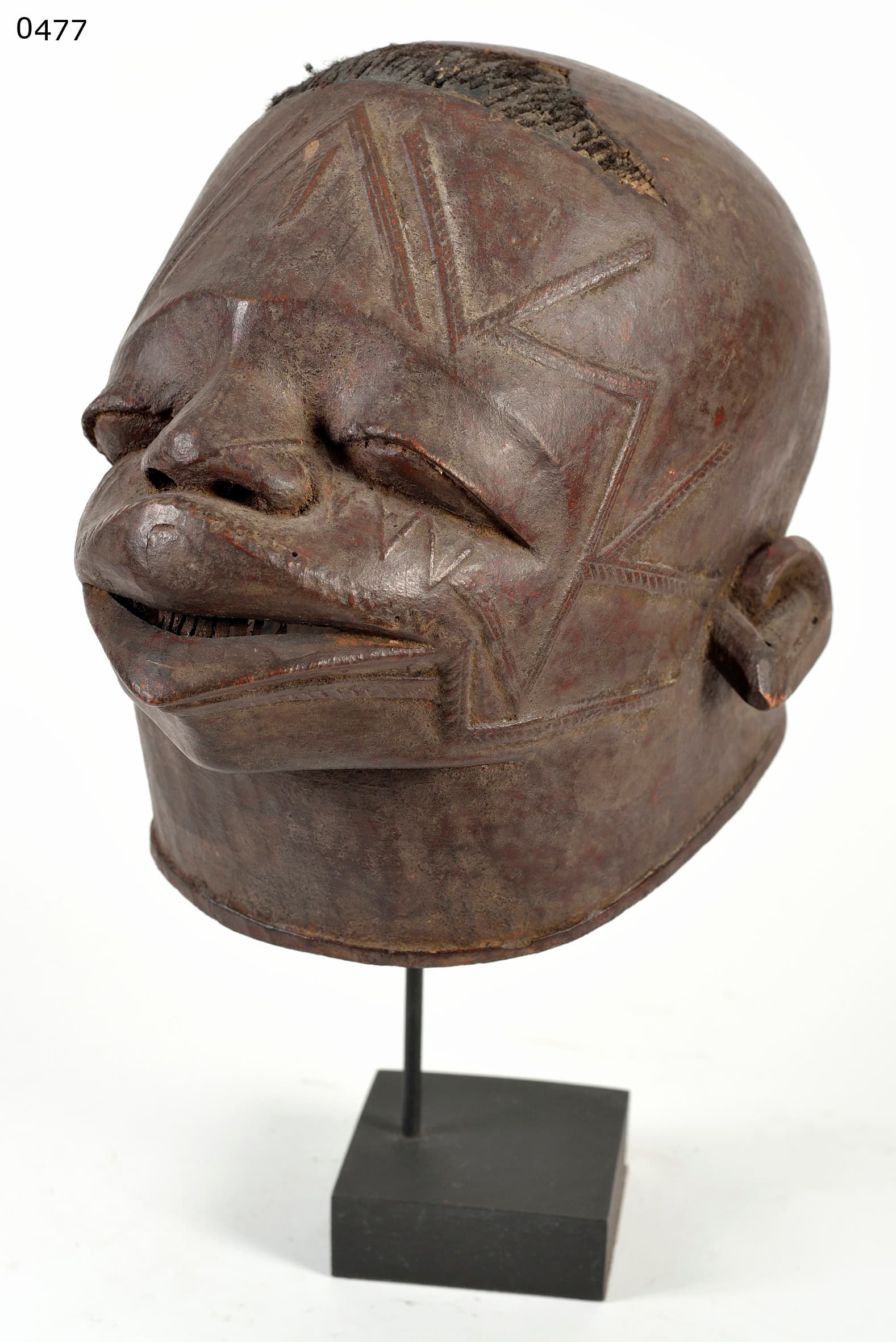
The ritual canon is dominated by the lipiko (plural: mapiko), an elaborate helmet mask made for use in initiation ceremonies and funerals. Structurally, the lipiko does not completely enclose the dancer's head vertically, but is worn tilted backwards on the top of the skull so that the performer can look through the open, sculpted mouth of the mask. Iconographically, Lipiko operates in a mode of stylised hyperrealism. In order to maximise the physical presence of the ancestors or specific characters, historical examples were often provided with real human hair, which was applied asymmetrically to the top of the skull. The facial features show realistic, often pointed teeth. A distinctive feature are the fine, geometric scarification reliefs (dinembo), which were not carved out of the wood but applied using fine strands of black beeswax, as well as the depiction of the lip plugs (ndona) on female masks. The choice of material is subject to a strict functional dictate: ritual masks are invariably made of extremely light, soft hardwood such as njala or mpapwa, as only this allows the dancer the necessary kinetic agility for hours of acrobatic performances.
A second subtype, which is less frequently documented on the international art market, is the Ndimu belly mask (amwalindembo). These wooden body masks, which depict the torso of a pregnant woman with fully modelled breasts and a massive pregnant belly, are also decorated with fine scarification marks. Interestingly, they are tied around the torso by male dancers, often complemented by a corresponding female face mask, in order to dramatise the agonies of childbirth in dances or to function as a comedic parody of the teaching older women during initiation.
In radical material and conceptual contrast to this is the market carving that emerged from around 1950 onwards, which was often falsely marketed as an ancient tradition. These objects exclusively use African grenadilla wood (Dalbergia melanoxylon), locally called mpingo or ebony, which is characterised by extreme density, hardness and a deep black to two-tone core-splint structure. This canon comprises three main typologies: The Binadamu figures depict realistic everyday scenes. The Shetani sculpture, initiated in the late 1950s by the carver Samaki Likankoa, breaks with all canons of proportion and visualises the invisible spirit world in highly abstract, asymmetrical, often one-eyed or polymorphic forms. The Ujamaa type (originally Dimoongo), invented by Roberto Yacobo Sangwani, presents massive vertical steles in which dozens of human figures intertwine as a "tree of life".
The identification of documented master hands is rare in older ritual art, as the concept of the "anonymous tribal artist" long characterised Western reception. Nevertheless, there are exceptions: The Art Institute of Chicago houses a Lipiko mask whose cheek bears the proud Swahili engraving "Wakugonga Diteka" - proof of the individual authorship of the carver Diteka in the first half of the 20th century. Masters such as Samaki, Sangwani, Chanuo Maundu or Dastan Nyedi are historiographically precisely tangible for the modern age.
Market-relevant forgery criteria focus on the patina and the wood texture of the ritual masks. As the soft Njala wood is extremely susceptible to weathering and insect damage, authentic pieces stored in the bush often show profound damage. Modern forensics uses advanced methods such as MALDI-TOF mass spectrometry to identify specific East African termite proteins (e.g. Macrotermes bellicosus) in the feeding galleries, combined with C-14 dating and infrared spectroscopy of pigments and wax applications (Gyarmati et al. 2022). Edges that have merely been artificially worn away by sandpaper or unnaturally even patina layers that are missing on the inside of the mask (where sweat and friction of the wearer should actually leave traces) are primary indicators of recent forgeries.
Ritual practice
The performance and lifecycle of a Mapiko object are strictly regulated and deeply woven into the social fabric of the Makonde. The creation process begins in strict segregation in the Mpolo, the secret bush camp of the male secret society. The felling of the tree (typically soft njala or lime wood) is accompanied by tobacco offerings to the trunk to appease the indwelling spirits. The blank is roughly finished in the forest to prevent chips or unfinished fragments from falling into the hands of the uninitiated.
The activation of the mask from a profane piece of wood to a ritually charged object (Liyoka, the spirit of a deceased ancestor) is a multi-sensory process. Ethnographic accounts document blood sacrifices in which chickens are slaughtered; the rite requires the animals to die with their bellies facing upwards, which is seen as a positive omen for fertility and the success of the initiation. The blood is applied to the bodies of the initiates and into the sacred space of the masks. The characteristic wax tattoos of the mask are ritually blackened with a mixture of vegetable carbon and castor oil (castor oil).
The actual performance on the central village square is an act of theatrical overpowering and social catharsis. The dancer is hermetically wrapped in a costume that conceals the entire body except for the hands and feet; a corset made of raffia (lutove) and iron ankle bells complete the ensemble. The choreography is driven by a complex acoustic carpet of polyrhythmic drums of different sizes, iron hoe blades and horn trumpets. The dynamics of these dances are analysed by anthropologist Paolo Israel using Gregory Bateson's concept of "schismogenesis": The ritual practice is fuelled by an extreme competitive rivalry (nyama ni nyama, "flesh is flesh") between different villages and dance groups. Each master carver and dancer strives to invent new, more fearsome or satirical characters (kwanjedya) to outdo their rivals. A highlight of the boys' initiation is that the novices must physically attack and wrestle the terrorising Mapiko dancer to the ground to symbolically conquer their fear of the spirits and attain the status of a grown man.
After the performance, the practices of deactivation and disposal diverge, which points to regional variations and an ambiguous source situation. As the Makonde historically had no conservation obsession for eternity and the soft wood deteriorated quickly anyway, the masks were often de-sacralised after the rite and deposited deep in impenetrable bush areas and left to the elements. Other sources report that masks that had become unusable or broken were ritually burnt in the Mpolo, or that they were placed in the ground as burial objects at the funerals of high-ranking secret society members. This practice of organic disposal is the primary reason why pre-colonial, activated Mapiko masks are extremely rare on the Western art market and in major collections such as the British Museum (e.g. the mask Af1957,03.70 donated by Margaret Plass) or the Musée du quai Branly.
Historical context
The historical ontogenesis of Makonde art is inextricably linked to migration dynamics, colonial interference and postcolonial identity politics. The establishment of the Makonde on the Mueda Plateau is dated in modern historiography (contrary to the older reading of the dias) as a phase of active refugee migration that culminated in the late 18th and 19th centuries in order to escape the systematic enslavement campaigns of Arab traders and the neighbouring Yao.
The encounter with Portuguese colonialism, which was only administratively consolidated in this remote region in the 1920s, initiated a profound change. On the one hand, missionaries and colonial officials began to commission realistic everyday scenes (binadamu) early on, which prompted the carvers to switch from the ritual softwood to the more durable ebony (mpingo). On the other hand, mask performance developed into a subversive instrument. As Paolo Israel (2014) reconstructs in detail, the mapiko repertoire was already rapidly modernising in the 1930s. Masters such as Nampyopyo carved masks that satirically imitated colonial tax collectors, Catholic priests or Muslim traders with kofia caps ("Warrior Theatre").
The most fundamental socio-political rupture manifested itself in the Mozambican War of Independence (1964-1974), which was largely supported by the Makonde in the north. The socialist liberation movement FRELIMO instrumentalised Makonde art strategically. On the one hand, FRELIMO forced the abandonment of traditional body modifications such as scarification and lip plugs as part of an anti-tribalist modernisation campaign, which was directly reflected in a reduction of these features in contemporary mask production. On the other hand, mask dances were used specifically for political mobilisation and agitation against the Portuguese troops.
Parallel to these military upheavals, an economic art revolution was taking shape in Tanzania, driven by labour migration. In the 1950s, the mass production of abstract Shetani and Ujamaa sculptures began in Dar es Salaam under the curatorial and logistical patronage of the Indian-born trader Mohamed Peera. This commercial market development evoked a lively controversy in Western art criticism about the concept of authenticity. For decades, traditionalist critics (such as Susan Vogel, 1991) declassified these ebony works as inauthentic "tourist art" produced for Western tastes, as they had no ritual use in the indigenous context. This view was rigorously dismantled by leading African art historians such as Sidney Kasfir (1992, 1999) and Zachary Kingdon (2002). Kasfir argued that the demand for "ritual utility" was a romanticised, colonial construct; the Shetani sculptures, although produced for an external market, were genuine and expressively authentic as they were deeply rooted in Makonde oral tradition and ontology and represented a legitimate modernist response to global economic realities.
The academic breakthrough of this segment finally came in 1989 with a groundbreaking exhibition at the Museum of Modern Art in Oxford (based on the Malde Collection), which for the first time liberated Makonde carvings from the ethnographic curiosity cabinet and presented them as sovereign contemporary artworks. For today's collectors, the greatest challenge lies in the forensic authentication of old pieces. While the ebony works are dated in a style-critical manner, the evaluation of pre-colonial lipiko masks requires complex analyses: natural heartwood cracks, the chemical nature of the patina (spectroscopy to distinguish castor oil rubs from artificial shoe polishes) and microscopic traces of specific African termites (MALDI-TOF analyses) separate authentic artefacts that have aged in a ritual context from recent workshop adaptations for the international art market.