Overview
The geographical distribution of the Toussian (also Tusian, Tusia, Tusyan) is concentrated in a narrowly defined territory in the south-west of the present-day state of Burkina Faso. The primary settlement area extends over the province of Houet and the Kénédougou region in the periphery of the economic metropolis of Bobo-Dioulasso and the administrative commune of Toussiana, which gives it its name. The most recent demographic data from the national Burkinabe census (RGPH 2019), which was collected by the Institut National de la Statistique et de la Démographie (INSD), puts the population of the commune of Toussiana at exactly 21,578 individuals.
The following table illustrates the internal demographic structure of the core population in Toussiana, based on the 2019 census data:
| Demographic Indicator | Specification / Age Group | Absolute Number | Percentage |
|---|
| Gender distribution | Male | 10,301 | 47.7 % |
| Female | 11,277 | 52.3 % |
| Age distribution | 0-14 years | 8,992 | 41.7 % |
| 15-64 years | 11,703 | 54.2 % |
| 65+ years | 883 | 4.1 % |
| Settlement structure | Rural / Urban | 21,578 | 100 % Rural |
The total number of ethnic Toussians, including the migrant populations in urban centres and border areas of Côte d'Ivoire, is estimated in the current literature at around 39,000 to 45,000, which makes them a demographic minority in the Voltaic Basin. The population density is a moderate 43.94 inhabitants per square kilometre, with an annual population growth rate of 1.9 %.
The linguistic categorisation of the Toussian is the subject of an ongoing and controversial scientific debate. The people themselves refer to their language as Wín, which also functions as an autonym (self-designation) for the ethnic group. The term "Toussian", on the other hand, is an exonym (foreign term) that was primarily coined and established by the neighbouring Dioula traders and the French colonial administration. In orthodox linguistics, based on early classifications, Wín is assigned to the Volta-Congo language family and specifically to the Gur languages (Voltaic), whereby a distinction is made between a northern and a southern dialect.
However, the source situation is ambiguous at the morphological level: recent linguistic analyses (including those by Zaugg-Coretti 2005) mark a significant research controversy here. While traditional classifications emphasise the Gur affiliation based on the suffix structures, divergent studies indicate that Wín has strong typological parallels to the Eastern Mande languages. In particular, the system of nominal classifiers for animate and inanimate objects deviates from the standard of Gur languages. For example, Wín uses specific counting and classification morphemes for human plurals and inanimata, which are almost identical in structure to those of the Mande language Busa. This hybrid linguistic position does not reflect a faulty classification, but is the direct result of centuries of interaction and lexical convergence at the contact zone between the Gur and Mande cultural areas.
The social structure of the Toussian can be described on a macro-political level as acephalous (without domination), although it is strongly stratified on a village level by ritual hierarchies, in particular by initiation societies and endogamous casts of craftsmen and musicians. A central controversy in ethnographic classification concerns the kinship system. Historically, the societies of the Volta region were often categorised in colonial monographs as strictly patrilineal in a highly simplified way. However, research by the anthropologist Françoise Héritier (1973) and later analyses of kinship organisation in the southern Bobo and Toussian region show that a system of double descent (bilineal descent) exists. In this complex system, both matrilineal and patrilineal lineages are mobilised in a context-specific manner: Land use rights and ritual offices are often inherited agnatically, while mobile property and certain spiritual affiliations are passed down uterine. In the discourse on this region, some anthropologists argue in favour of analytically applying Claude Lévi-Strauss' concept of "house societies" (sociétés à maisons), as spatial residence and belonging to the homestead (gi-ki) often generate stronger social, economic and cultic ties in practice than the pure biological lineage.
The society also comprises strictly separate castes, including the griots, who monopolise oral history and the musical accompaniment of ritual acts. Among the Toussian, this caste is strictly divided into balafon players (ɲɔ́pī) and drummers (kə̄tɔ̰̄). Membership is hereditary and non-Griots are strictly prohibited from performing these specific ritual resonance functions.
The Toussian subsistence economy is fundamentally based on extensive hacking. They primarily cultivate sorghum, millet and maize as well as yams, pumpkins, beans and, increasingly, cotton as a cash crop. Agriculture is supplemented by cattle, sheep and goat farming as well as gathering in the bush forests. The production of sorghum beer (dolo) plays a fundamental economic, social and ritual role, which is traditionally the exclusive preserve of women and is essential for all ritual libations and the signing of contracts. The relationship with neighbouring peoples - including the Senufo (Tagwana/Siamou), Seme, Bobo, Lobi and Turka - is characterised by a highly complex exchange of marriage alliances, agricultural goods and syncretic ritual practices. Ethnographic collections, such as those documented in the Musée du quai Branly, illustrate that material cultural goods (such as agricultural tools, hoes and ceramic utensils) circulate widely in this regional network and have massive formal affinities with the Senufo and Bobo, which often makes the attribution of profane everyday objects difficult.
Cultural context
The Toussian religious system is deeply rooted in a cosmological order that features a precise dichotomy between a distant creator and the natural and spiritual beings that are highly active in everyday village life. In one of the earliest systematic analyses of this religion, the French clerics and ethnographers Jean Hébert and Marcel Guilhem (1967) postulated in the scientific journal Anthropos that the Toussians worshipped a distinct, omnipotent creator god who initiated the world but then withdrew into absolute passivity as Deus otiosus. This monotheistic interpretation has been vehemently deconstructed in recent critical research. Scholars such as Michel Cartry and Anne Fournier argue that the conceptualisation of a singular, overarching creator god was heavily filtered through the early interpretative framework and theological agenda of Christian missionaries. Modern structural-analytical ethnographers focus instead on the operational level of religion: the cult of ancestors and in particular the interaction with bush spirits (génies de brousse). These invisible entities inhabit specific topographical markers - such as recent watercourses, rock formations or prominent giant trees - and are the primary, agency-owning addressees of ritual sacrifices and requests for agrarian prosperity.
Ritual authority within the Toussian settlements is not vested in a central priestly kingship, but is highly differentiated and divided between the so-called earth lords (chiefs de terre, locally called mangan), the divinators and the masters of the secret societies. The earth lord is responsible for the atonement of bloodshed and the allocation of agricultural land. However, the spiritual and social backbone of Toussian society is formed by the Do cult (also known regionally as Dwo or Lo). This secret society acts as the ultimate regulatory element: it sanctions social misbehaviour, regulates the agricultural planting and harvesting cycles and controls all rites of passage.
Formal initiation into the Do cult represents the most important ontological turning point in the life cycle of a Toussian man. The literature documents a remarkable and rare rhythmisation of this cult: while smaller initiation stages and purification rituals take place every few years, the system culminates in a monumental, cross-generational major ritual that is only held every 40 years. At this ritual, which was last documented with historical certainty in the 1930s in Toussiana and 1960 in Guena, the canonical Toussian masks dance. The neophytes, who are isolated in week-long bush camps, are given secret totem names that are associated with specific wild animals and fix their new social identity. However, the sources on the exact periodicity are ambiguous: while some field researchers such as Trost (1999) date the cycle in some northern villages to ten years, local informants in Djigouera vehemently emphasise the 40-year cycle, which is said to have last taken place in 1953. This discrepancy underlines the strong regional variance and the recent disintegration of pre-colonial cycles due to Islamisation and Christian missionary work.
One of the most striking research controversies exists with regard to the practice of divination and the specific role of women in the religious cult. Among the Toussian, divination is typically performed by consulting the bush spirits using cowries and a specific sacred black stone, which is ritually struck by the divinator with a metal bell. Guilhem and Hébert (1964) documented that among the southern Toussian, the divinatory guild is necessarily led by women, who control the initiation and the allocation of the sacred black stones. However, Anne Fournier (2021) shows in her detailed work on the neighbouring Seme, who historically adopted the exact divination practice and the Do cult from the Toussian, that women are strictly excluded from divination there, as their initiation into the Do cult is judged to be ontologically "incomplete". This structural discrepancy - matriarchal cult control and female authority among the Toussian versus strict patriarchal exclusion among the culturally closely related and adapting neighbouring Seme people - reveals fundamental differences in the conceptualisation of gender and spiritual potency in the region.
Consequently, the role of women among the Toussian is by no means limited to a peripheral position. Special initiation rites for girls prepare them for their social duties and give them an understanding of the complex, tonal surrogate language of the balafon (xylophone), which is played by the griot caste to convey ritual messages. In contrast to the strict patriarchal hierarchies of neighbours such as the Bobo, the Toussian religion is characterised by a fluid integration of the sexes in ancestor worship. Older women (especially after menopause) assume central ritual functions in the homestead as kadiko and act as intermediaries to the deceased ancestors. Historical collection files of the Royal Museum for Central Africa (RMCA) in Tervuren, which archive comparable Voltaic cult objects, document the material manifestation of this gender-specific distribution of roles in the form of gender-specific coded amulets, divination instruments and pottery, which were almost exclusively made and ritually charged by women. What structurally distinguishes this religion from neighbouring peoples is its extreme bipolarity: on the one hand, the highly restrictive, 40-year-old male do initiation, and on the other, the institutionally anchored divinatory power of women in the southern territory.
Aesthetic features
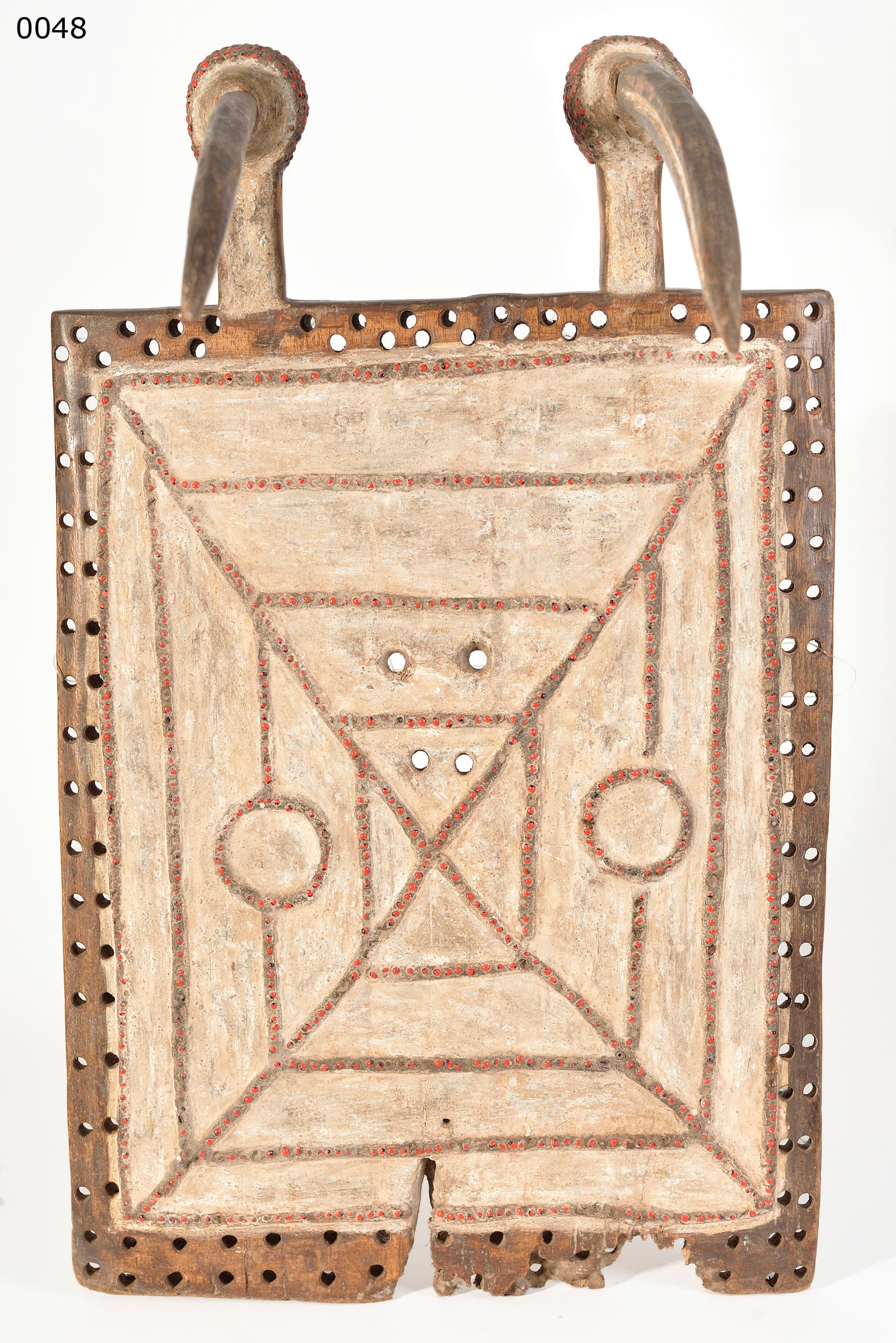
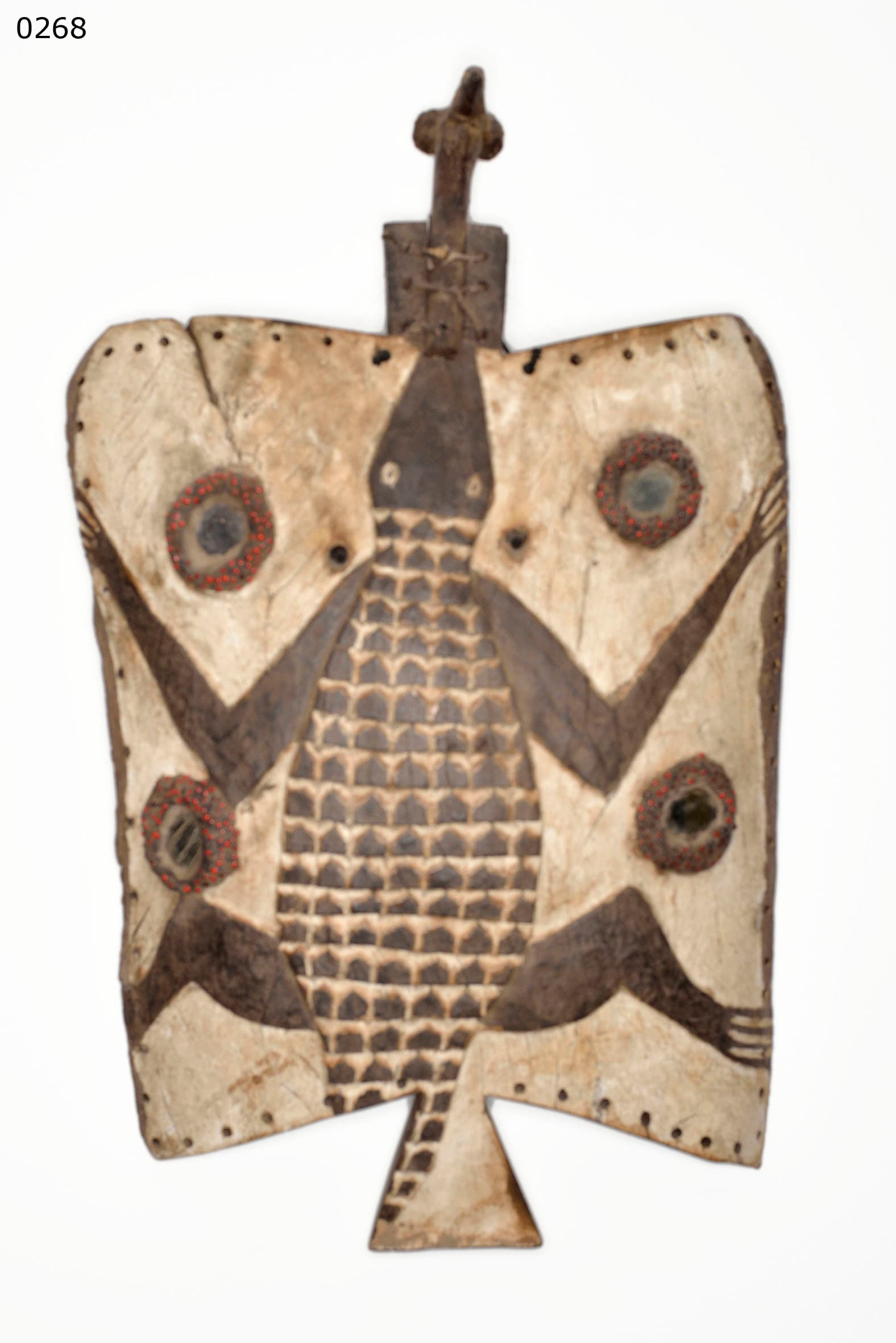
Compared to the Senufo or Mossi, the Toussian material culture has produced a canon that is narrow in scope but highly iconic in its formal abstraction. The canonical object typology is dominated by two distinct mask subtypes that enjoy the highest esteem and iconic status in the West, especially among private collectors: the flat board mask (known as Loniaken or Loniake) and the voluminous helmet mask (Kablé).
The Loniaken mask is formally an unrivalled masterpiece of geometric reduction. It usually consists of a precisely hewn, rectangular wooden board that vertically covers the wearer's face and often only has small circular or triangular perforations at eye level as viewing slits. The proportions vary considerably: the height ranges from around 40 cm for smaller examples to over a metre for masks for high-ranking dignitaries. Two deeply incised diagonal lines usually run along the flat frontal plane, crossing in the centre and forming an abstract St Andrew's cross. At the upper edge of the mask, the head of a bird (usually a grey toco or hornbill, calao) or a stylised pair of horns is almost always carved out of the same block of wood.
An essential material and colour feature of the authentic Toussian aesthetic, which sharply distinguishes it from neighbouring peoples, is the application of toxic, bright red Abrus precatorius seeds (paternoster peas). These are applied to the surface as a relief-like, encrusted patina using heated beeswax or indigenous copal resin, primarily tracing the diagonal lines or filling geometric fields. The polychromy is otherwise ascetically limited to natural earth pigments in matt red, kaolin white and coal black.
The second subtype, the Kablé helmet mask, encloses the dancer's entire head like a bell and is always crowned by prominent animal figures or horns. One of the most substantial iconographic controversies in contemporary research is centred on this type of object. The art historian Constantine Petridis (2008) argues resolutely that the backward-curved horns of the Kablé helmets necessarily and almost exclusively represent the African bush buffalo (Syncerus caffer aequinoctialis), which is regarded throughout the region as the undisputed symbol of untamed natural power, endurance and spiritual potency. This contrasts with the theses of ethnologist Daniela Bognolo (2009) and art historian Christopher D. Roy (1987), who postulate that the essays cannot be interpreted monocausally as buffaloes. They argue that these essays represent a multitude of highly personalised clan totems and individual guardian spirits (génies) that were revealed in the dreams of diviners or initiates - including panthers, wild boars, mongooses or falcons. The reduction to the buffalo therefore falls short and ignores the individualised totem bestowal during the do initiation.
The following table summarises the canonical Toussian mask types by way of comparison:
| Mask Subtype | Form Language & Proportional Canon | Primary Materials | Iconographic Meaning / Totems |
|---|
| Loniak | 2D board mask (rectangular), diagonal cross, 40-120 cm high. | Light wood, Abrus precatorius seeds, beeswax, kaolin, raffia. | Hornbill (Calao), representation of the initiation level, clan identity. |
| 3D helmet mask (bell shape), enclosing head, 50-80 cm. | Hardwood, plant fibres, animal horn applications. | Bush buffalo (Petridis) vs. divinatory revealed guardian spirits (Bognolo/Roy). | |
In terms of documented master hands, anonymity is largely prevalent in Toussian art. The carvers traditionally belong to the endogamous caste of blacksmiths (Koflan). For them, the sculptural act is not an expression of individual artistry, but a ritual service in which authorship takes a back seat to the ritual function of the object. Nevertheless, specific workshops can be identified on the basis of precise formal analyses of the work. A prominent example of the attribution of aesthetic provenance can be found in the renowned collection of the Museum Rietberg in Zurich. An important helmet mask (collected locally in the 1950s by the Swiss dealer Emil Storrer) is curated there, which is attributed to a narrowly defined master workshop in the northern contact area between Toussian and Siemu due to its specific polychromy and the treatment of the inner heartwood structure. Such objects impressively mark the fundamental difference between the profane carving and the ritually activated object: an unblessed piece of wood is profane; only through the repeated application of sacrificial matter (blood, millet porridge) and the application of the Abrus seeds by the authorised cult priest does the mask change from a dead shell to a sanctioned, living carrier of spiritual entities.
Forgery criteria are extremely relevant to market value and collector expertise. As Toussian masks (especially the Loniaks) have been fetching extremely high prices on the Western art market since the 1980s, countless, often excellently aged replicas exist. Forgery criteria and authenticity features include the oxidation marks of the wood on the unmounted inner sides, the asymmetrical, speckled wear of the holding cord holes (often at bite level, as the mask is held with the teeth) due to sweat and kinetic friction during dancing, as well as the specific, cracked drying behaviour of the beeswax, which binds the paternoster peas and is imitated in modern forgeries by synthetic adhesives.
Ritual practice
Toussian ritual practice is not an isolated phenomenon, but is deeply embedded in the agricultural, demographic and meteorological cycles of the community. The absolute centre of communication with the invisible is the earth altar (Vasi or Van). This altar is rarely a sculptural monument, but usually consists of an inconspicuous but highly sacralised mound of compressed earth. It is typically located near large trees and is marked by piled stones, ashes and thick, encrusted masses of feathers and dried blood from past animal sacrifices.
The divinator performs his diagnoses in front of these earth altars or in the darkened interior of the homestead. The structure of such a divination session is highly choreographed and sensory dense: the ritual specialist uses a smoothly polished, black stone on which he taps with a metal finger bell (clapping bell) in a specific rhythm to break through the acoustic barrier to the spirit world and call the attention of the associated bush spirits. By systematically throwing cowries and then reading their formations, he decodes the will of the ancestors, identifies witchcraft or diagnoses the cause of diseases and local droughts.
The ritual use of canonical masks primarily takes place within the strictly regulated framework of the Do cult and at funerals of high-ranking, initiated elders. The mask performance is a dynamic, kinetically demanding act. Loniaken masks are usually danced in pairs. One dancer, whose mask is marked with specific red pigments, represents the aggressive, male principle (wan-zega), while the other, often coloured with black pigments (wan-sablaga), represents the female principle. A third, smaller mask often embodies a protective dwarf spirit (yali). During the performance, a voluminous, heavy costume made of woven raffia completely conceals the dancer's body. This physical erasure of the human contours is essential in order to temporarily remove the wearer's human identity and physically transform them into the real presence of the bush spirit.
The activation of a new creation - the ontological transition from profane piece of wood to ritual object - requires a strict, bloody protocol. The blacksmith hands the freshly carved mask in a neutral state to the cult leader, whereupon it is hidden in the uncultivated bush and consecrated with the arterial blood of a freshly slaughtered sacrificial animal (usually domestic chickens, guinea fowl or goats). In Toussian cosmology, the red colour of the blood and the analogous tonality of the Abrus seeds correspond symbolically with the life force (vitality), but also with spiritual danger.
Offerings to the masks and altars are made strictly for specific occasions: at the beginning of the rainy season to ensure the fertility of the sorghum fields, as an expiatory sacrifice for breaking taboos, or during the month-long initiation camps, where the young men are separated from their mothers and ruthlessly initiated into the secrets of the spirit world in the bush.
The lifecycle of a ritual object ends in a specific, dogmatically defined way. A Kablé mask, used at funerals to escort the disorientated spirit of the deceased safely to the ancestral realm, often absorbs toxic spiritual energies during this dangerous transit. The deactivation and disposal of such highly contaminated objects varies regionally, but follows a clear logic of isolation. Christopher D. Roy (1987) documented for the western Volta region that masks whose spiritual power has been exhausted after decades of use or which have been irreparably contaminated by ritual impurity are deposited in remote bush areas considered dangerous. There they are deliberately left to the elements and quickly eaten by termites. Other masks, categorised as pure and permanently protective, remain under the smoke-filled rafters of homesteads after their ritual use, where the layer of soot forms an additional preservative patina until they decay naturally after generations. Field photographs and object dossiers from the holdings of the Fowler Museum (UCLA) masterfully illustrate the physical condition of such ritually abandoned objects: their thick, heavily cracked and encrusted sacrificial patina indicates decades of the most intensive blood and millet sacrificial practice, followed by deep traces of decomposition.
Historical context
The history of migration and settlement in the rugged south-west of Burkina Faso is highly fragmented and characterised by massive ethnic shifts. Oral historical traditions and linguistic substrate analyses strongly suggest that the ancestors of the Toussian were autochthonous Gur settlers. They were successively pushed out of the more fertile plains into their present-day plateau areas, which are difficult to access and strategically easier to defend, by the massive military expansion waves of the Mande Empire (Mali) in the 11th century and later by the hegemony of the Kong Empire in the 18th and late 19th centuries. The blatant dating controversies regarding the exact ethnogenesis of the Toussian result from the complete lack of reliable written sources before the late 19th century. One research approach dates the consolidation of the Toussian as a cohesive ethnic and political group to the 16th century, while a rival explanatory approach argues that this social cohesion and strong Do initiation system was first forged through the defensive, existential union against the brutal slave hunts and cavalry troops of the Muslim warlord Samory Touré in the 1890s.
The colonial encounter with the advancing French administration at the beginning of the 20th century was characterised by extremely violent "pacifications" and requisitions. In the years from 1914 to 1924, the French colonial officer and later renowned ethnologist Henri Labouret (who later became director of the Institut d'Ethnologie in Paris) carried out intensive, sometimes bloody campaigns in the region as local commander, primarily to suppress revolts by the Lobi, Bobo and Toussian and to enforce the collection of poll taxes. Labouret's dual, contradictory focus on military repression on the one hand and manic ethnographic data collection on the other led to the first great wave of Toussian art, which was torn from its ritual context and exported to Europe. From the 1920s and early 1930s, these mass confiscated ritual objects, primarily helmets, board masks and divination instruments, systematically ended up in the dusty holdings of the Musée d'Ethnographie du Trocadéro in Paris, the direct predecessor of the Musée de l'Homme founded in 1938 (whose African holdings are now largely integrated into the Musée du quai Branly). At the same time, the French colonial administration banned numerous indigenous ritual practices, such as the public administration of justice and the execution of punishments by the Do secret societies. This massively inhibited open art production in the short term, but did not lead to its extinction, instead pushing initiation rites and mask carving deeper into the non-public, hidden space of the bush camps.
The market history of Toussian art in the West smouldered for decades as a niche interest for specialists, but then achieved its absolute and explosive breakthrough in 1984. In that year, the art historian William Rubin curated the epochal, albeit methodologically controversial exhibition "Primitivism" in 20th Century Art: Affinity of the Tribal and the Modern at the Museum of Modern Art (MoMA) in New York. Rubin placed a Loniak mask of Toussian from the renowned Swiss Barbier-Mueller collection right next to Max Ernst's bronze sculpture Oiseau-tête (Bird Head) from 1934-35.
The striking morphological affinity - the reduction of the face to a flat, almost two-dimensional rectangle with geometric recesses and the strikingly placed bird's beak - electrified the public, private collectors and art critics worldwide. This curatorial juxtaposition instantly cemented the canon status of Toussian art on the global auction market for African tribal art. As a result, this newfound visibility rapidly drove prices for authentic Toussian board masks into the high five to sometimes six-figure euro range at major auction houses.
However, the immense, lucrative demand inevitably evoked a massive counterfeiting problem in Africa as well as in Europe. As the abstract, highly geometric shapes of the board masks are much easier and quicker to carve by hand than organic, naturalistic sculptures from other ethnic groups (such as the Baule or Luba), from the 1990s onwards Western galleries and auctions were flooded with excellently artificially aged forgeries made in specialised workshops.
Today, advanced forensic authenticity criteria are therefore essential for private collectors and museum curators. This primarily includes the microscopic analysis of the patina. An authentic ritual patina that has been activated over decades is not homogeneous, but exhibits complex stratigraphic layers consisting of rotten millet, dried animal blood and localised copal resin that has penetrated the wood pores. Another key forensic criterion is the evidence of authentic termite feeding (entomological decomposition marks / myiasis). In authentic pieces, these insect galleries penetrate asymmetrically and deeply into the inner heartwood cracks (wood radial cracks) caused by natural wood drying. In contrast, damage caused artificially with acids or mechanical tools in fakes is usually superficial and suspiciously evenly distributed. In addition, the adhesion of the characteristic red Abrus seeds is chemically analysed; old, authentic beeswax polymerises over decades in a way that cannot be reproduced by modern synthetic adhesives or rapid heating. Adherence to these strict evaluation standards, as applied for example in evaluations for the Metropolitan Museum of Art (Wheelock Collection), is today the only guarantee for the verifiable acquisition of a historically and ritually significant Toussian object.