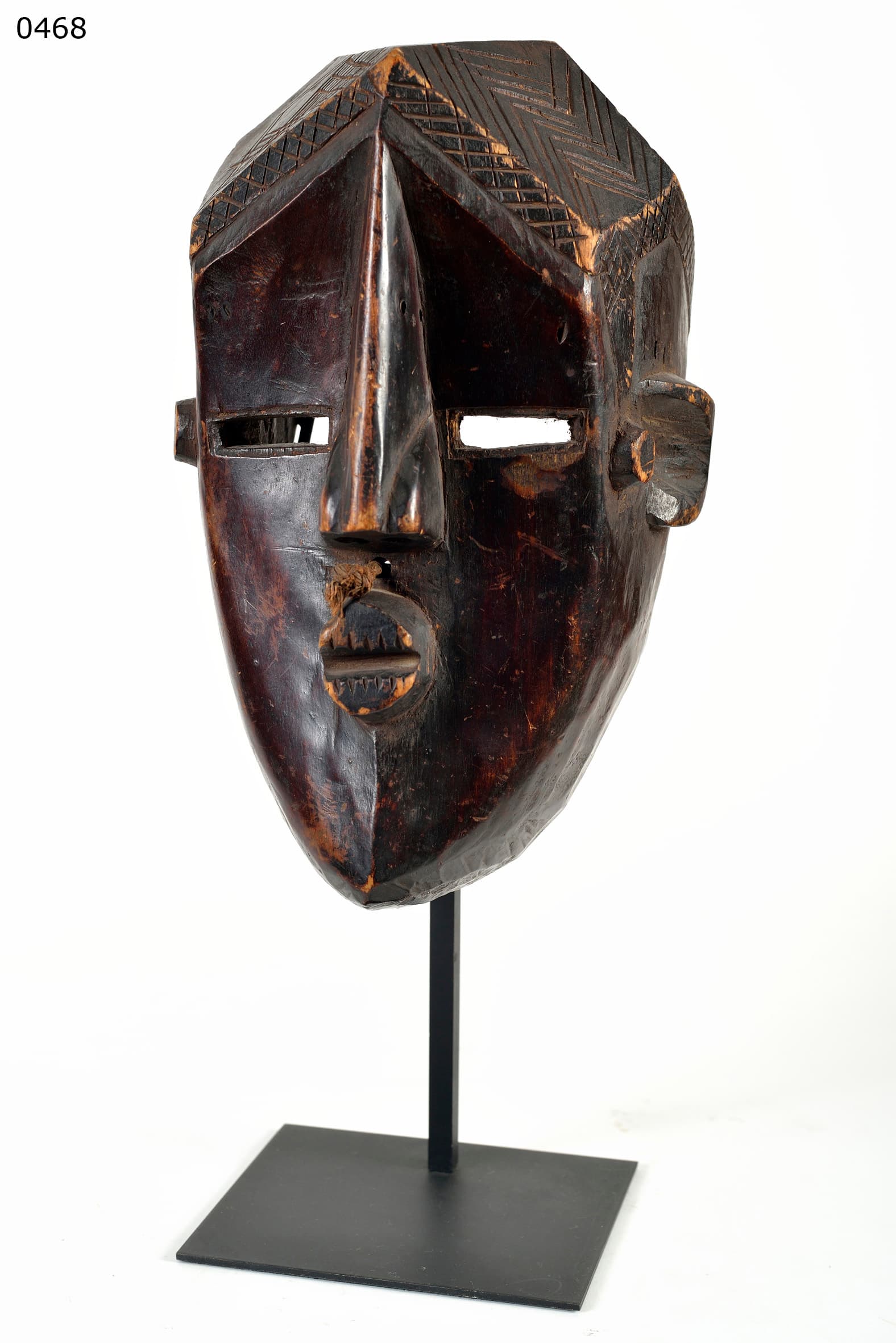
Eine scharf geometrische Lwalwa nkaki / mvondo Maske (1. Hälfte 20. Jh., 34 cm) aus der DR Kongo - eine markante konkave Gesichtsfläche, die von einer extrem scharf vorspringenden dreieckigen Nase definiert wird, die sich von der Stirn bis zum Mund erstreckt, der rechteckig vorspringende Mund und die schmalen rechteckigen geschlitzten Augen, die die kubistische Architektur unterstreichen, tragen eine reiche rotbraune Patina mit Randabnutzung. Ausgestellt in der Französischen Botschaft, Wien
1. Die kubistische Architektur des Lwalwa
Die Lwalwa (oder Lwalu) aus dem Grenzgebiet der Demokratischen Republik Kongo sind weltbekannt für ihre Masken, die zu den radikalsten geometrischen Abstraktionen der afrikanischen Kunst gehören.
- Überschneidende Ebenen: Der Bildhauer reduziert das menschliche Gesicht auf sich überschneidende Ebenen und scharfe Winkel - das bestimmende Merkmal ist die massive keilförmige Nase, die als zentraler architektonischer Grat fungiert und tiefe dramatische Schatten erzeugt.
- Modernistischer Einfluss: Dieser aggressive Kubismus beeinflusste die westlichen Bildhauer des 20. Jahrhunderts zutiefst, die die Fähigkeit der Lwalwa bewunderten, ein Gesicht vollständig aus geometrischen Körpern zu konstruieren.
2. Die Ngongo-Gesellschaft und die männliche Initiation
Diese Masken wurden von der Ngongo-Geheimgesellschaft, die die männliche Initiation und Beschneidung überwachte, streng kontrolliert.
- Phallische Nase/Hornvogelnase: Die hervorstehende spitze Nase wird oft als Phallussymbol oder als Darstellung des Hornvogels interpretiert - beides wird mit männlicher Potenz und Aggression assoziiert.
- Nächtliche Disziplinierung: Von initiierten Männern während nächtlicher Zeremonien getanzt, um die Uneingeweihten zu disziplinieren, den Übergang der Jungen in die Männlichkeit zu feiern und die Jagdfähigkeiten der Elitemänner des Dorfes zu ehren.
3. Dokumentierte Herkunft und rituelles Reiben
Abgesehen von ihrer ausgeprägten Struktur ist diese Maske aufgrund ihrer dokumentierten Herkunft von besonderem Interesse.
- Ausstellung in der Französischen Botschaft in Wien: Sie wurde in der Französischen Botschaft in Wien ausgestellt, was ihre dokumentierte Provenienz stützt.
- Tukula-Öl-Patina: Das Holz wurde traditionell mit Tukula (rotes Rotholzpulver) und Öl gefärbt - im Laufe des frühen 20. Jahrhunderts zu einem satten, dunklen Mahagoniton oxidiert. Die Aufweichung des scharfen Nasenrückens und der dunkle, schweißfleckige Rand auf der Innenseite des Hohlraums sprechen für ein aktives Leben als Tanzobjekt vor der Aufnahme in die historische Sammlung.
Zusammenfassung
Als herausragendes Beispiel des kongolesischen Kubismus veranschaulicht diese Lwalwa-Maske die radikale geometrische Abstraktion, die die globale Kunstgeschichte beeinflusst hat. Mit einer dokumentierten Ausstellungsprovenienz und einer Patina, die auf rituellen Gebrauch hindeutet, stellt sie ein bedeutendes Sammlerobjekt dar.
KI-unterstützt erstellt aus Sammlungsgutachten, Objektfotografie und eigener Recherche, redaktionell geprüft. Fehler sind möglich — Hinweise darauf sind uns willkommen. Zum Verfahren →