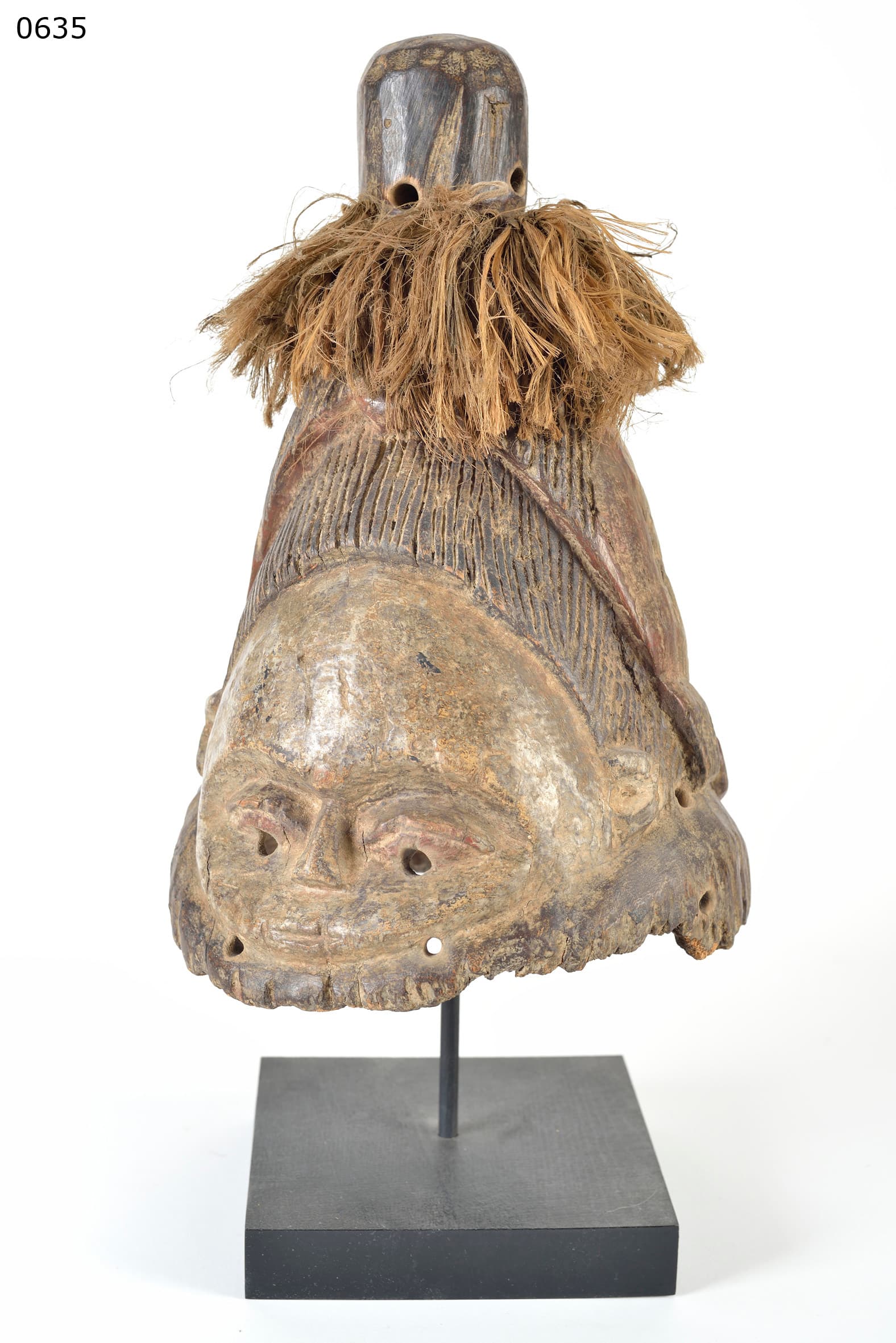
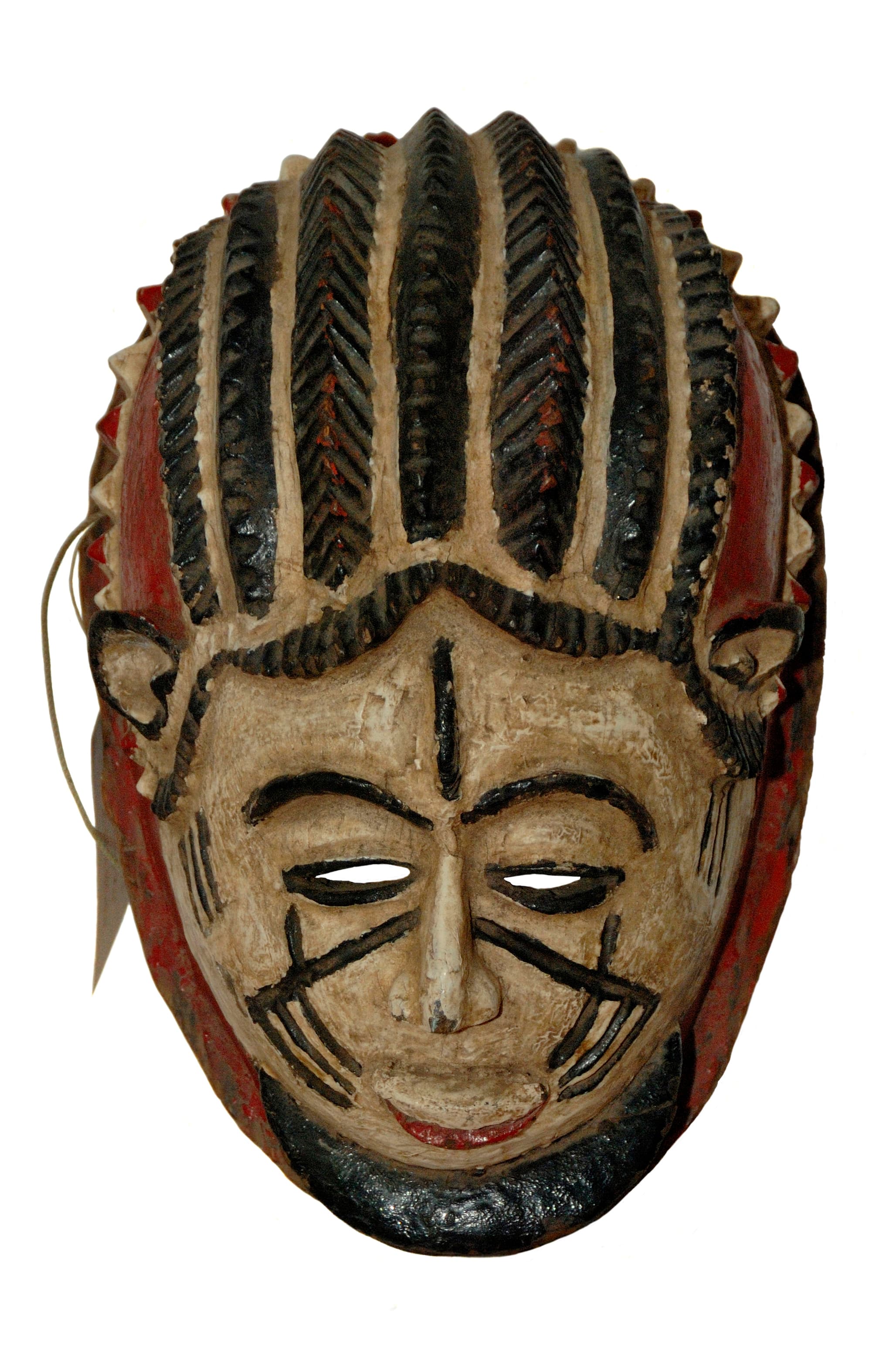
A wooden helmet mask of the Igala in Nigeria. A domed head with closed eyes and a calm, closed mouth, marked by grid-like scarification on the forehead and at the temples.
1. Form and Carving
The mask is carved as a rounded helmet that encloses the whole head and ends in a broad, flat band at the base. The face is smooth and still: a long, narrow nose, finely arched brows that meet above it, slit eyes under heavy lids and a small mouth with a narrow, closed lip line. Below the mouth, a pointed, beard-like field of fine parallel incisions follows the line of the chin.
Three panels of cut squares structure the head. One long panel rises from the brow up the forehead, and two shorter ones sit at the temples, each ending in a small rounded projection at the side. On top of the dome a low, raised segment is set into the surface.
2. Use and Context
According to the collection catalogue, the Igala live in the centre of Nigeria and have been strongly influenced by the Ibo to their south. Masks play a large part in their annual festivals. At the yam festival, helmet masks of this kind appear and stand for the spirit of the ancestors. The catalogue singles out the facial scarifications as stylistically important, and on this mask they are the most striking element.
3. Surface
The wood is dark brown with a dry, matte patina. Pale patches of loss show on the crown, at the temples, on the nose and along the lower band, where the surface has worn back to lighter wood.
Summary
A helmet mask of the Igala whose calm, closed face is set off by grid scarification, a feature the collection catalogue highlights as stylistically important.
Written with AI assistance from the collection appraisal, object photography and our own research; editorially reviewed. Mistakes are possible — corrections are welcome. How we work →