Overview
The traditional settlement area of the Igala, known indigenously as Anẹ Igáláà, represents one of the most culturally, historically and strategically important contact zones on the African continent. Geographically, the territory forms an irregular triangle, the apex of which lies exactly at the confluence of the Niger and Benue rivers in central Nigeria, while the base extends deep into the southern and eastern territories of the Idoma and Igbo (Boston 1968). This hydrological nodal positioning was the fundamental backbone of historical Igala hegemony, as it enabled extensive control over the pre-colonial river trade in copper, slaves and imported textiles (such as the red Ododo cloth) (Boston 1968). Demographic estimates from 2020 put the Igala population at around 2.6 million individuals. The urban and spiritual centre is the historic capital of Idah. Today, the population is primarily concentrated in Kogi State, particularly in the local government areas of Idah, Igalamela/Odolu, Ajaka, Ofu, Olamaboro, Dekina, Bassa, Ankpa and Omala, with significant diasporic minorities documented in the states of Anambra, Delta and Benue (Okwoli 1970).
Linguistically, Igala (proper name: Igáláà) is classified as belonging to the Yoruboid language family within the broad Niger-Congo phylum. This classification implies a deep genetic relationship with the Yoruba in the west, but obscures the immense cultural hybridisation that took place through centuries of interaction with the Edo (Kingdom of Benin), Igbo, Jukun and Nupe (Boston 1968).
| Basic demographic and geographic data | Specification |
|---|
| Ethnic self-designation | Igáláà |
| Territorial designation | Anẹ Igáláà |
| Estimated population (2020) | approx. 2,600,000 |
| Geographical epicentre | Idah (Kogi State, Nigeria) |
| Linguistic classification | Niger-Congo > Benue-Congo > Defoid > Yoruboid |
| Central Neighbouring Ethnicities | Idoma, Igbo, Edo (Bini), Yoruba, Jukun, Nupe, Ebira |
| Primary subsistence strategy | River trade and hoeing (yam cultivation by owe groups) |
The social structure of the Igala is strictly hierarchical and patrilineal. It culminates in the institution of sacral kingship, personified by the Attah of Idah, who acts as the ultimate political, judicial and spiritual authority. The monarch is flanked by the Achadu, a figure who acts as a traditional prime minister and enjoys crucial prerogatives in ritual interaction with the ruler (Boston 1968). This highly centralised, courtly architecture of power contrasts sharply with the traditionally acephalous (lordless or decentralised) kinship systems of the neighbouring Igbo to the south, but shares striking structural parallels with the highly stratified kingdoms of Benin (Oba) and Ife (Ooni). Exhibitions and inventory catalogues of the Fowler Museum at UCLA, in particular the pioneering project Central Nigeria Unmasked, have taken up these interrelationships and increasingly discuss the Igala kingdom in contemporary research as a "third courtly pole" in the hinterland of the Niger Delta, which formed an independent but highly networked axis of power (Berns, Fardon & Kasfir 2011).
The historical classification and genesis of the Igala state is the subject of fierce and partly unresolved research controversies in ethnology and historiography. The sources are extremely ambiguous, which has led to diametrically opposed interpretations. The British anthropologist John Boston (1968) argues in favour of a profound historical interweaving with Yoruba and Edo elements, due to the strategic positioning along the waterways (Boston 1968). In stark contrast to this is the field research of Robert Sargent, the first comprehensive oral historian of the Igala dynasty who was unable to identify any original Yoruba components in the royal rites and postulates a stronger autochthonous development (Sargent 1984). A third faction, led by historians such as Joseph Ukwedeh, relies on the oral traditions of the ruling dynasty itself, which claims direct descent and migration from the Jukun empire of Wukari (Ukwedeh 2003). The identity of the Igala must therefore not be understood as a static ethnic monolithic structure, but rather as a dynamic amalgam that was formed through continuous migration, warlike expansion and ritual exchange in the Benue Valley.
Cultural context
The religious system of the Igala operates within the highly complex parameters of central Nigerian cosmologies, whereby the absolute transcendence of a creator god is intertwined with the immediate, pragmatic immanence of ancestor worship. At the top of the cosmological order is the supreme creator being Ojo (occasionally paralleled in older literature with the Yoruba concept Olodumare), who initiated the cosmos but remains largely passive in everyday ritual performance (Olupona 2014). The vital interface between the physical and metaphysical worlds is formed by the Ibegwu (the deified ancestors) and numerous localised natural and spiritual beings, whose pacification is essential for the ecological and social balance of the lineage.
The ritual authority of the Igala is subject to a dual system. At the macro level of the state, the Attah functions as the divine mediator par excellence. He is the incarnation bearer of the royal founding fathers and bundles the ritual sovereignty over the earth and its fertility. He is supported by the aforementioned Achadu, who serves as a ritual counterweight and orchestrates the central rites of passage of the enthronement. In this context, the designated Attah is first given the interim title Aidokanya with the ceremonial greeting "Todo!" before he attains full sacral capacity (Boston 1968). At the micro level of lineages and villages, spiritual authority is exercised by councils of elders, earth priests and divinators. The practice of the Afa oracle, a mantic system of binary codes that bears striking structural similarities to the Ifa divination of the Yoruba and the divination complex of the Nri-Igbo, is conspicuous in this regard and provides evidence of the intensive intellectual exchange across the Niger (Manfredi 2012).
What significantly distinguishes the Igala religion structurally from that of many neighbouring peoples (such as the decentrally organised Tiv or the western Igbo) is the extreme bundling and instrumentalisation of ritual power to consolidate a central state ideology. An absolutely unique feature in this context is the mythical-historical role of women in the state sacrificial cult. While ancestor cults and masked societies in the Benue Valley are almost exclusively patriarchally dominated, the mythical foundation of Igala sovereignty rests on the ultimate ritual sacrifice of two royal women: Inikpi and Oma Odoko (Okwoli 1970). After consultation with the state diviners, these royal daughters were buried alive during existential military crises - the wars against the Jukun and the Benin kingdom - to guarantee the spiritual victory of the Igala. These drastic narratives not only subvert the classic gender hierarchy in the cult of sacrifice, but also elevate these women to national patron saints and martyrs. Their shrines on the banks of the Niger continue to be epicentres of national identity creation to this day (Idachaba & Inyaregh 2025).
Within African religious studies and museum ethnology, these cosmological structures are the subject of intense and sometimes controversial debate. A central research controversy revolves around the flexibility and historical depth of these systems. In his work African Religions (2014), Harvard religious scholar Jacob Olupona argues vehemently against the methodological approaches of earlier anthropologists (such as the British functionalists), who tended to essentialise "African Traditional Religion" as a static, timeless and monolithic entity (Olupona 2014). Olupona points to the immense adaptive capacity of systems such as that of the Igala, which dynamically domesticated external influences and continuously renegotiated them through divination and masked beings. This dynamic perspective has also significantly influenced modern museum practice. Exhibitions such as Nigeria, Arts de la vallée de la Bénoué at the Musée du quai Branly (Paris), curated in collaboration with scholars such as Sidney Kasfir and Hélène Joubert, have deconstructed the rigid classification of "One Tribe - One Style - One Religion" in favour of a representation of ritual fluidity and intercultural exchange along the river routes (Joubert & Berns 2012).
Aesthetic features
The canonical object catalogue of Igala art is comparatively restrictive, but is characterised by an extraordinary formal power and iconographic complexity. It is dominated by monumental, architectural wooden altars (Okega), the courtly helmet masks (such as the Egwu Agba) and the highly complex coppersmith works from the workshops of Idah (Fagg 1960; Boston 1977).
The most iconic sculptural format of the Igala is the Okega (sometimes also Okinga in local dialects). This is the physical focus of the cult of the right hand, a spiritual concept that materialises physical dexterity, martial assertiveness, economic success and the ability to control one's own destiny (Boston 1977). These altars are carved exclusively from highly resistant hardwoods, primarily from Detarium microcarpum or the mighty iroko tree (Chlorophora excelsa). The choice of these woods is not only pragmatically justified in order to resist the omnipresent termite predation, but also has its own metaphysical dimension: the wood itself is considered a carrier of ase (life force) (Anedo 2019; Manfredi 2021). The size spectrum of these objects is considerable; it ranges from hand-sized, intimate personal amulets to massive monumental sculptures up to 180 cm high, which served as visual anchor points in the reception courtyards of powerful lineage chiefs (Fagg 1970).
The typology and the canon of proportions of the Okega differ fundamentally from the related hand-cult objects of the neighbouring peoples. While the Ikenga of the Igbo usually has a single-step composition focussing on the individual male success (often represented by a seated figure with a knife and severed head in his hands), the carvers of the southwestern Igala and the Idah region developed a completely independent, complex architectural form. A classic Igala-Okega is designed with two to three tiers. The base is often formed by a cylindrical, spool-like corpus, into whose reliefs or as free-standing elements a large number of assistant figures are integrated. These figures represent not only men, but also explicitly women and children (Boston 1977). The Okega of the Igala thus shifts the iconographic focus from pure individualism to the celebration of the cumulative achievements of an entire clan or lineage. A compelling iconographic element that unites all variants are the steeply rising, often geometrically abstracted horns at the top of the sculpture (usually interpreted as rams' horns), which symbolise physical power and aggression.
The interpretation and categorisation of these sculptures was the scene of one of the most prominent iconographic controversies in African art history. In the 1960s, the renowned British art historian William Fagg categorically identified massive, horn-bearing, multi-tiered figures in the collections of the British Museum (such as the prominent object Af1949,46.192) as works by the Igbo, as the Ikenga cult was almost exclusively associated with the Igbo in Western reception (Fagg 1970). Only the detailed ethnographic and morphological analyses by John Boston (Ikenga figures among the north-west Igbo and the Igala, 1977) deconstructed this Western attribution. Boston proved empirically that the elaborate, multi-levelled works with their cylindrical bases are stylistically and ritually exclusive to the south-western Igala (Boston 1977).
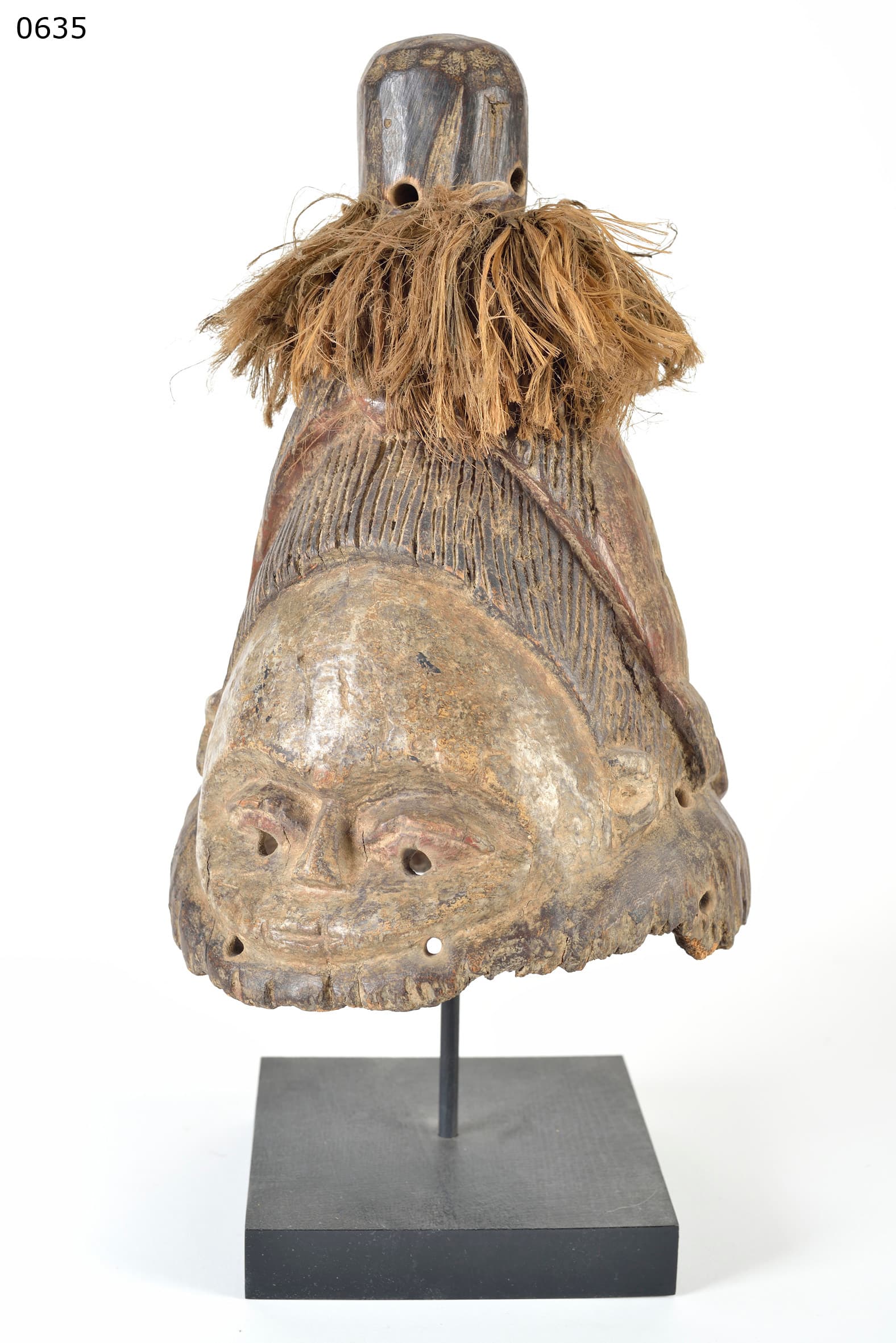
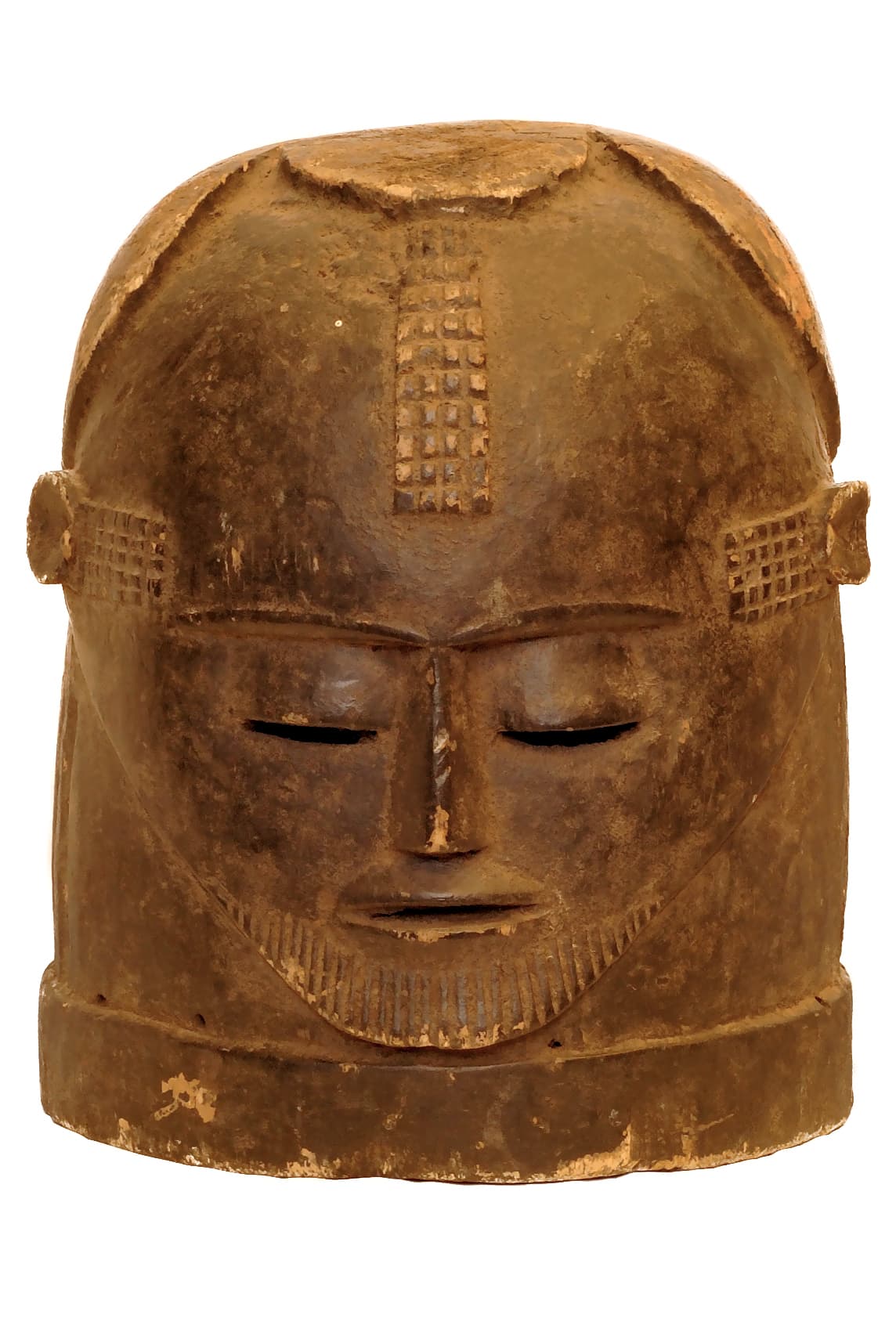
In addition to the monumental woodcarving, whose masters are sometimes remembered by name as pioneers in oral traditions (Manfredi 2012), the courtly aesthetic of the Igala manifests itself in a highly standardised canon of masks. Helmet masks from the Idah region, which have been documented in the Museum Rietberg in Zurich and analysed by curators such as Eberhard Fischer and Bernard de Grunne, are characterised by strict symmetry, smooth surface treatment and architectural hairstyle structures (De Grunne 2001; Fischer & Himmelheber 1976). The copper and brass works form a third, completely distinct field in terms of material. These include bell-shaped objects (bells) with high relief anthropomorphic faces, iron bobbin lace mechanisms and fibre-covered loops, such as those preserved in the British Museum's depots (e.g. Af1954,23.235 and Af1954,23.700) (Fagg 1960).
For the private collector, the differentiation between an ontologically activated ritual object and a purely profane carving is highly relevant. This difference manifests itself physically in the patina. An okega that has been ritually played with accumulates a dense, crusty surface structure over decades. This stratigraphy (layer formation) results from repeated libations of palm wine, chewed kola nuts, millet porridge and animal blood (Boston 1977; Anedo 2019). This accumulation of material is not merely a trace of use, but the physical manifestation of the spiritual charge. In the current art market, forgery criteria rely heavily on forensic patina analyses. Artificially applied crusts (such as glue-sand mixtures) show a chemically homogeneous signature under ultraviolet radiation, while authentic okega show microscopic layers of different organic materials that have grown asymmetrically and gravitationally over long periods of time.
Ritual practice
The ritual practice of the Igala largely eludes spontaneous emotional outbursts; rather, it is a highly formalised, cyclical system of accumulating, channelling and discharging spiritual energy in a controlled manner. At the centre of this system is the interaction of humans with physical objects, whose ontological status is altered through precise performative acts.
The life cycle of an altar begins with the transformation of the carved, still profane block of wood into an active spiritual vessel. After its physical completion by the sculptor, the Okega must be activated by a divinator, priest or the designated owner. The documented ethnographic evidence shows that this process of initiation requires highly specific, choreographed rituals: The initiate ingests ritual snuff exactly three times into the nostrils, ritually strikes the back of the head three times and performs specifically coded dance movements (Umoru 2019). These somatic acts bind the spirit to the wood. This is immediately followed by the primary sealing through an initial blood sacrifice (usually a rooster or a ram). This practice of "feeding the altar" is not a one-off act, but must be repeated cyclically before major economic endeavours, family crises or as part of the annual harvest festivals in order to prevent the entropy of spiritual power.
The most complex and power-politically sensitive ritual network of the Igala is revealed in the masks. The epicentre of this performance is the Egwu Attah complex, the exclusive personal and state mask pantheon of the king in Idah. According to traditional law, the Attah is considered the sole owner of these masks, which function as metaphysical agents of his judicial authority (Boston 1968; Inyanda 2010). This elite ensemble includes characters known and feared by name such as Ekwe (the main mask), Obajadaka, Agbamabo, Ekpe, Odumado and Ochochono (Boston 1968; Anedo 2019). These masks physically reside in the inner palace precinct and only appear in public on occasions of the highest political importance to the state: at royal funerals, enthronement rites and the central annual Ocho festival. In their performance, they act as executive organs of social control that are untouchable and in the past even had executive powers in cases of capital offences.
| Mask Categories of the Igala | Primary Function | Ownership and Control Structure | Examples (Characters) |
|---|
| Egwu Attah (royal masks) | State representation, judiciary, highest social control | Exclusive possession of the Attah (king); residence in the palace district in Idah | Ekwe, Obajadaka, Agbamabo, Ochochono, Ekpe |
| Egwu Icholo (ritual masks) | Ritual purification, ancestral festivals (Ote-abegwu), funerals of adults | Control by lineage elders and clan leaders at village level | Egwu Afia, Ogede, Akwuchi, Inyanwuna |
| Egwu Ugbe/Olopu (ancestor masks) | Direct representation of Ibegwu (deceased) | Clan property | Various lineage-specific variants |
In addition to the court monopoly, there are significant regional and local variants. The Egwu Icholo (Ritual Performing Masquerades) operate at village and lineage level. They are controlled by the clan elders and perform essential ritual purifications during the Ane eche ceremonies and the Ote-abegwu festivals (ancestor worship) (Anedo 2019). Their performance is less about state intimidation and more about affirming village cohesion.
A fundamental aspect of ritual practice that is often ignored in the Western collectors' market is the finite nature of an object's spiritual life cycle. If an altar becomes contaminated through ritual transgressions (breaking taboos), loses its power despite adequate feeding, or if the owner dies and the altar cannot be passed on to a successor, the object must be physically disposed of. This process requires a formal, ritual desacralisation (Hubert & Mauss 1964; Barker 2005). Through final offerings and formulaic invocations, the spiritual entity is asked to leave the physical vessel. Only after the object has been "emptied" in this way is the wood deposited in specially designated sacred groves (shrine bush), where it is left to the natural process of decomposition by weather and termites, or it is ritually burnt (Hubert & Mauss 1964; Barker 2005). In Western museum contexts, ignorance of these mechanisms often leads to ontological misinterpretations: Many objects now in the collections of institutions such as the Metropolitan Museum of Art (Met) that were acquired by missionaries or traders were intentionally ritually deactivated by their creators before being handed over (LaGamma 2021). From an indigenous perspective, such a museum object is materially identical, but ontologically completely decoupled from the once active altar in the Igala household.
Historical context
The historical genesis of the Igala state, its imperial expansion and the resulting art production is inextricably linked to the massive demographic migration and military conflict dynamics of the 16th to early 19th centuries in the Niger-Benue Basin. The exact chronology of the Igala dynasty remains the subject of ongoing academic discourse and dating controversies. While local oral traditions - documented by indigenous historians such as Okwoli - often evoke a formative consolidation phase in the early 16th century through victorious war campaigns against the expanding Kingdom of Benin (Edo), archaeological evidence and deep linguistic drilling point to much older, self-sufficient settlement continuities (Okwoli 1970; Ukwedeh 2003). The aforementioned massive cultural borrowings from the Jukun empire (Wukari) and the mythical sacrifices of the Inikpi in the context of the Jukun wars presumably reflect the historical attempt of the young Igala elite to align themselves power-politically with established, sacredly legitimised empires in heavily contested post-medieval West Africa (Ukwedeh 2003).
The most radical break in the continuous development of Igala art history occurred in the colonial encounter with the expanding British Empire at the turn of the 20th century. In the course of the massive British military campaigns to subjugate the West African hinterland, which culminated in the infamous punitive expedition and the systematic looting of Benin City in 1897, the sovereign Igala empire also came into the crosshairs of British colonial administrators and trading companies (Coombes 1994; Home 1982). The resistance of the local rulers was massive. The tragic culmination of this era was the resistance of Attah Ameh Oboni. Faced with unstoppable British military superiority and the threat of exile, which would have meant the desecration of his sacred person, Ameh Oboni chose suicide (Okwoli 1970). This act marked the final, symbolic break with unchallenged courtly sovereignty. At the same time, the subsequent stationing of British officers, administrators and anthropologists opened up the region to the nascent Western art market. Early, highly influential collectors and researchers such as William Fagg (later Chief Curator at the British Museum) and Margaret Plass began systematically acquiring and cataloguing the material legacies of the Benue region and feeding them into Western academic discourse over the following decades (Fagg 1960; Coulson et al. 2024).
An absolutely central and long-lasting chapter of this early market and collection history is the systematic problem of the so-called "Lower Niger Bronze Industries" (LNB). After the fall of Benin in 1897, when thousands of looted bronze works flooded into Western auction houses and newly founded ethnographic museums, researchers were faced with a glaring taxonomic problem: a significant number of copper alloy works deviated drastically from the strictly regulated courtly canon from Benin in terms of style, iconography and metallurgy (Fagg 1960; Coulson et al. 2024). In the 1950s, William Fagg coined the term "Lower Niger Bronze Industries" as a kind of academic collective term for these disparate, unclassifiable casts, a significant number of which are now closely associated with the royal forges of the Igala in Idah through historical research (Fagg 1960; Peek 2020). Modern materials science has revolutionised this stylistic classification. Forensic analyses of the metallurgical composition now provide precise criteria for determining origin and authentication.
These findings - both in the metallurgical field and through the reclassification of woodwork by Boston - revolutionised the assessment of Igala art on the Western market in the long term. While works from the Benue Valley were long overshadowed financially and curatorially by the highly traded art of the Kingdom of Benin or West African mask cultures (such as the Dan or Baule), they have experienced a drastic revaluation in the last three decades. Breakthrough exhibitions, above all that of Bernard de Grunne in Brussels (2001) or the comprehensive Central Nigeria Unmasked retrospective (2011) under the direction of Marla Berns and Sidney Kasfir, established the identity of workshops and "masters of the Benue region" (De Grunne 2001; Berns, Fardon & Kasfir 2011) that were unknown by name but stylistically tangible. Today, outstanding, deeply patinated Okega altars realise substantial prices on the high-class auction market. Provenances from legendary early collections (such as those owned by the Parisian dealer Pierre Robin) act as the ultimate guarantors of value here; in auctions in the early 2000s (including at Christie's), early estimates for monumental sculptures from the region have already been massively exceeded, establishing the Igala today as a blue chip segment within classical African art (Christie's 2002; De Grunne 2010).
At the same time, this rapid price development inevitably exacerbates the problem of forgery. In addition to the aforementioned X-ray spectroscopy (XRF) for metals, serious collectors and institutions are increasingly relying on the analysis of heartwood cracks (which are the result of decades of natural drying out) and the microscopic examination of patina layers to differentiate accelerated, artificial ageing processes in West African forgery workshops from historically grown sacrificial layers. Today, institutions such as the British Museum and the Metropolitan Museum of Art invest immense curatorial resources in provenance research in order to fully elucidate the often obscure acquisition paths of these complex, once highly sacred Igala artworks, overshadowed by colonial violence, and to cement their rightful historical position in global art history (LaGamma 2021; Coulson et al. 2024).