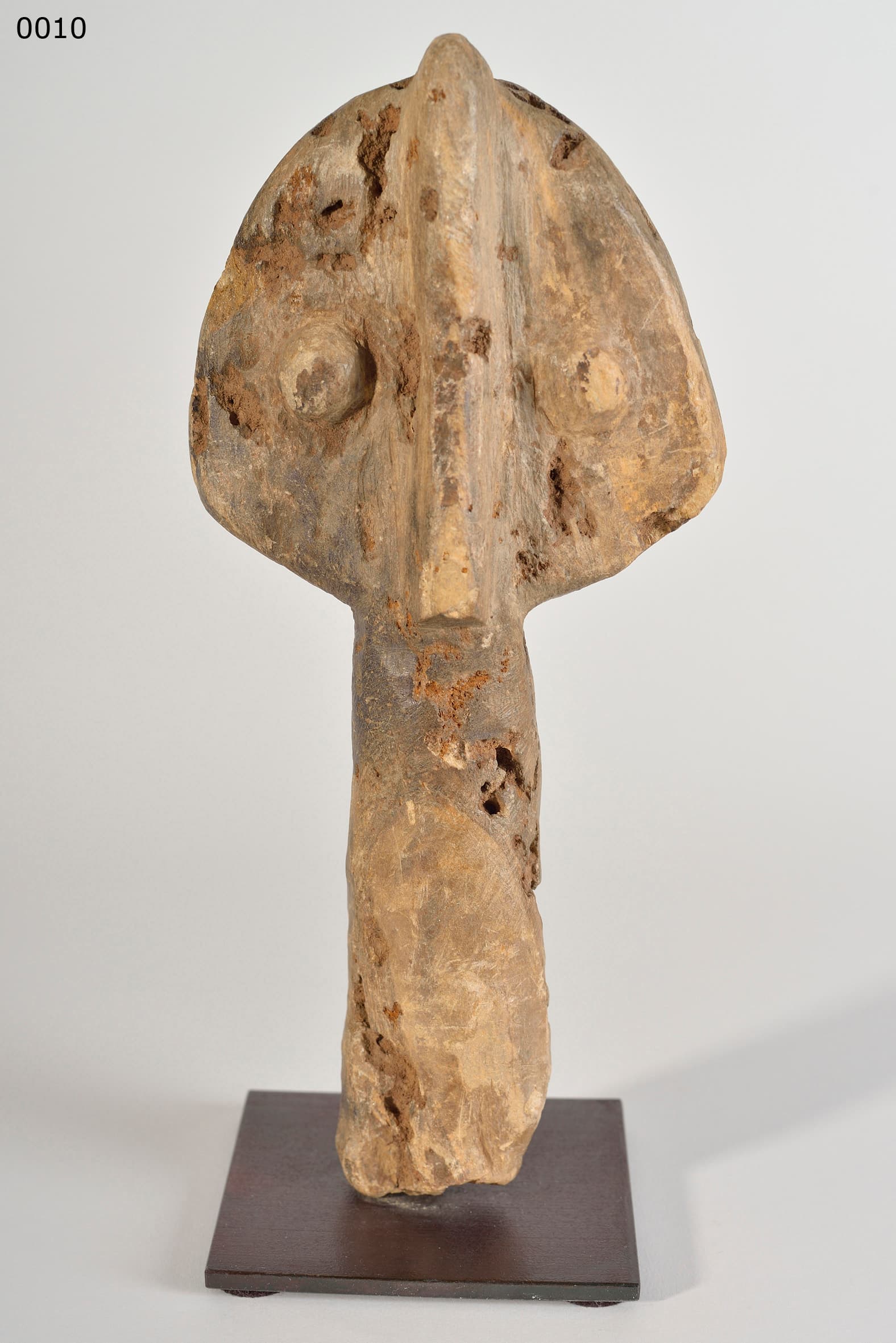
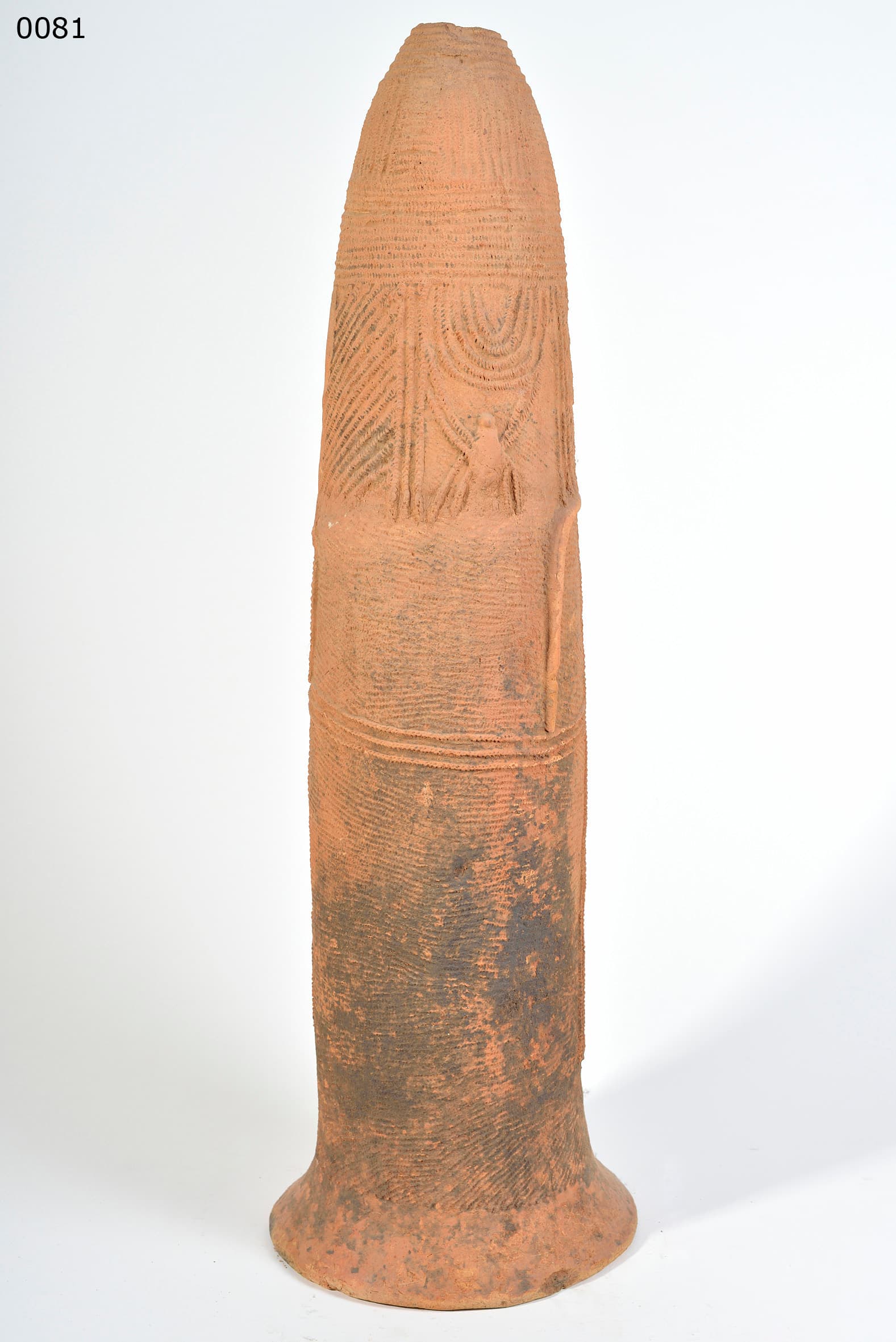
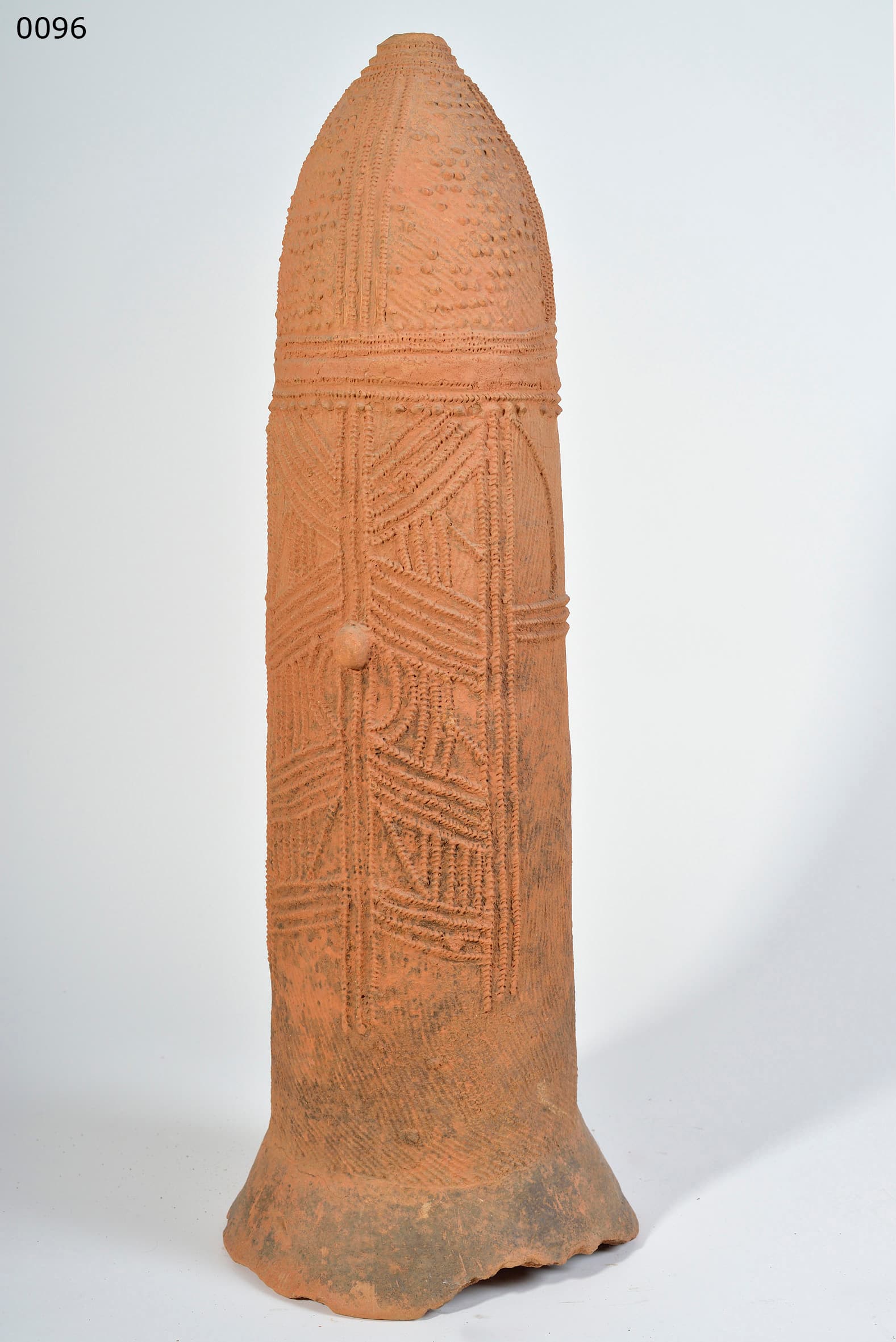
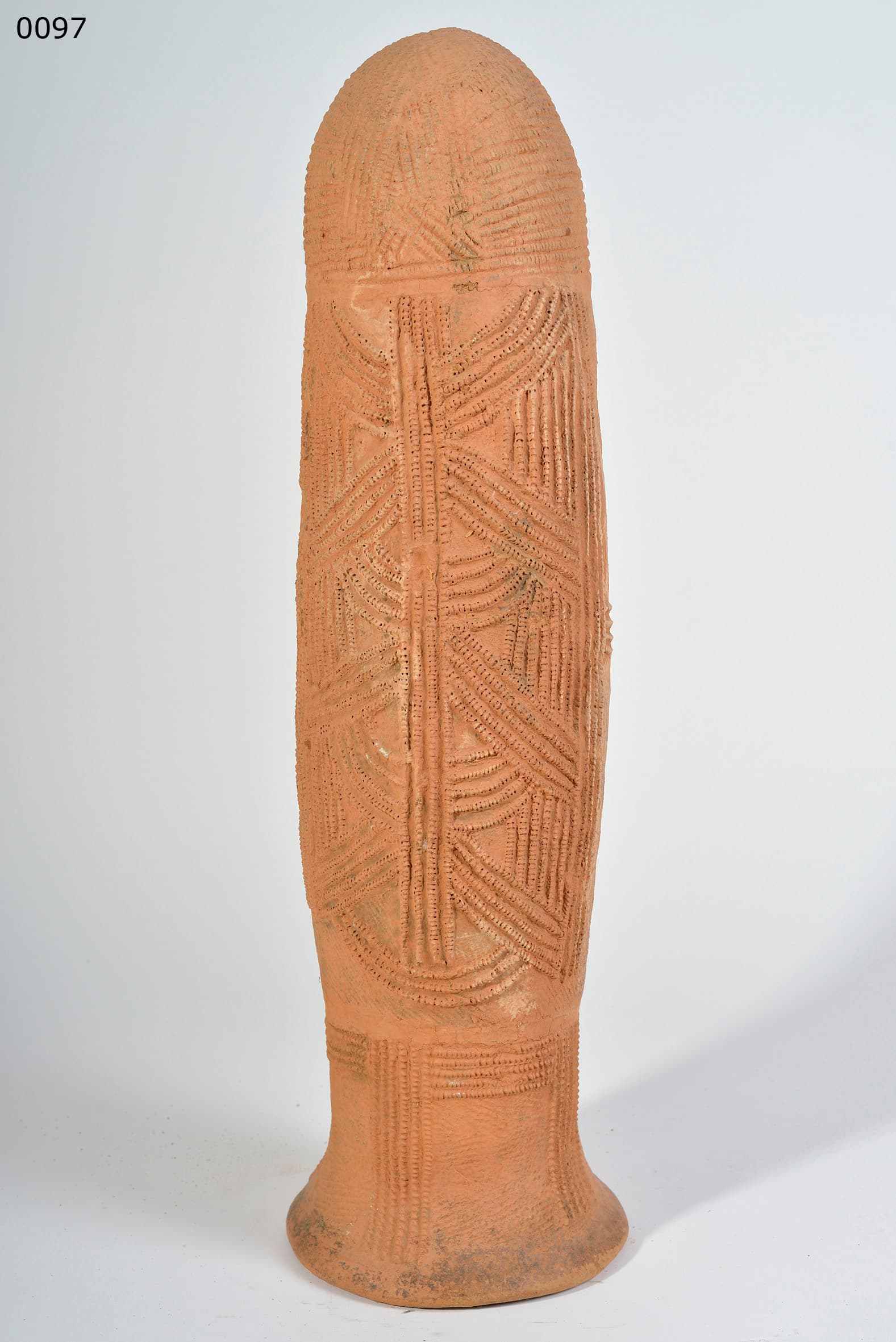
The Bura culture, centred in the middle Niger valley (present-day western Niger and Burkina Faso), produced a distinctive corpus of terracotta funerary sculpture between approximately the 3rd and 11th centuries CE. This small, 9-centimetre head represents a human face rendered with economy and clarity: a domed cranium, defined brow ridge, open mouth, and schematised eyes. Despite its miniature scale, the head carries the essential dignity of Bura funerary portraiture, likely intended to mark a grave or to stand atop a cylindrical funerary vessel.
1. Aesthetic style — compact monumentality
Bura terracotta heads achieve an unusual feat: at miniature scale they project monumental force. This 9-centimetre head reduces the human face to its essential geometry — dome, brow, cavity, mouth — without becoming a caricature. The incised concentric lines that mark the crown may indicate a braided coiffure or a funerary head-wrapping, while the open mouth suggests song, prayer, or the moment of death-breath. The Bura aesthetic favours bold simplicity over Djenne-style elaboration.
2. Ritual function — funerary marker
Bura heads of this type are associated with shaft-grave complexes in which terracotta figures, heads, and vessel-heads were deposited around the interred body. The head served as a stand-in for the deceased — a permanent presence at the grave that ensured the spirit's anchoring and its identification by the living. Some Bura heads were mounted on ceramic cylinders forming composite "trophy" or "post" figures; the break at the neck of this example is consistent with such original attachment.
3. Physical patina — desert-margin weathering
The Bura region's desert-margin environment subjects buried terracottas to alternating moisture and aridity that produces a distinctive pale, matt surface encrustation. This head displays that characteristic pale-grey mineral overlay with occasional orange-rust streaks where iron-rich groundwater migrated along cracks. The interior is hollow, with walls of consistent thickness suggesting controlled firing technique. Surface pitting from soluble-salt crystallisation is present at the crown — a hallmark of genuine long-term burial in the Sahel zone.
Summary
This BURA terracotta head, 9 centimetres and dating to the 3rd-11th century CE, distils the Bura funerary tradition's compact monumentality. Likely a grave marker or vessel-head element, it encodes the deceased's spiritual presence in the landscape of death. Its pale desert-margin patina and hollow construction are consistent with authenticated Bura corpus pieces.
Written with AI assistance from the collection appraisal, object photography and our own research; editorially reviewed. Mistakes are possible — corrections are welcome. How we work →