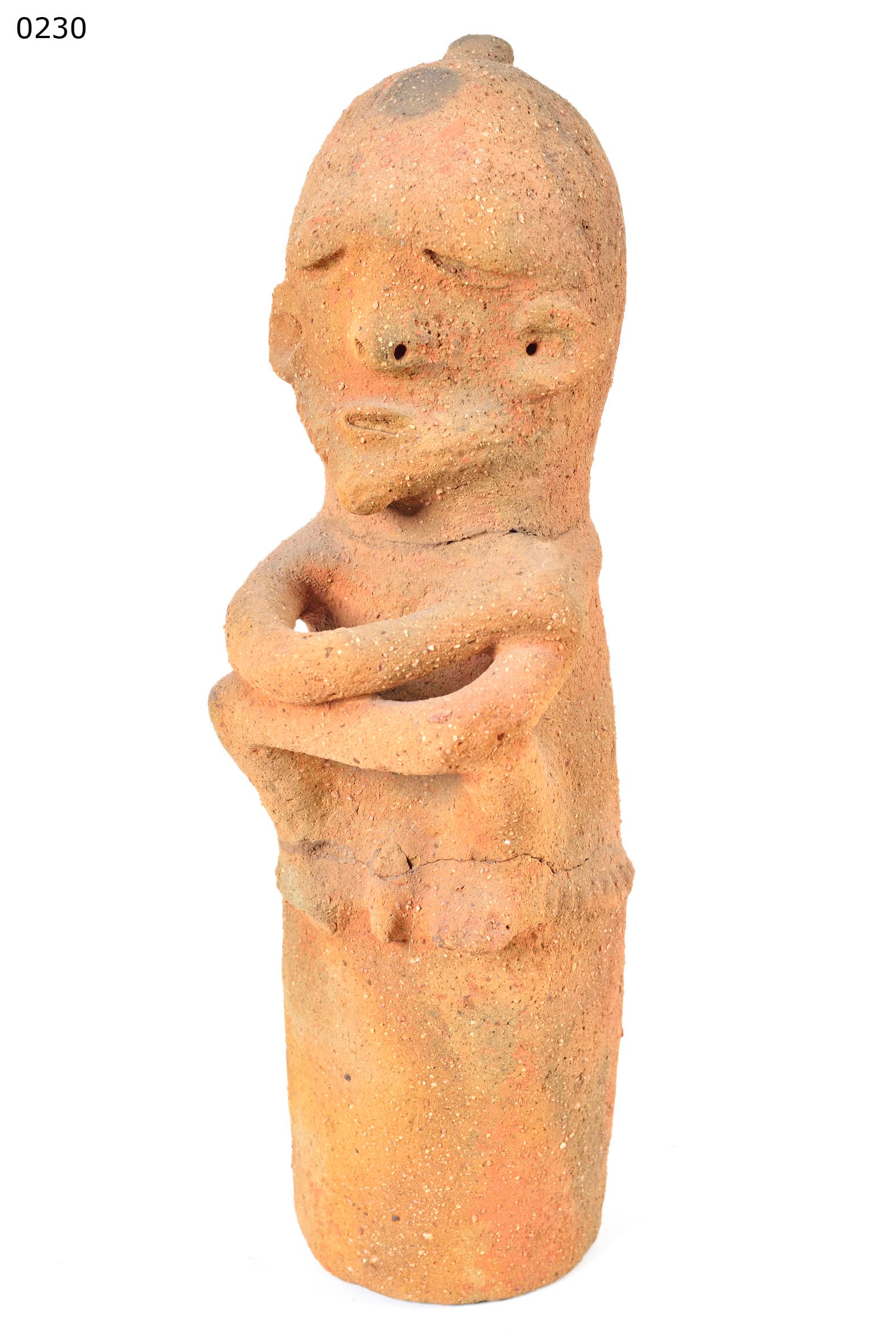
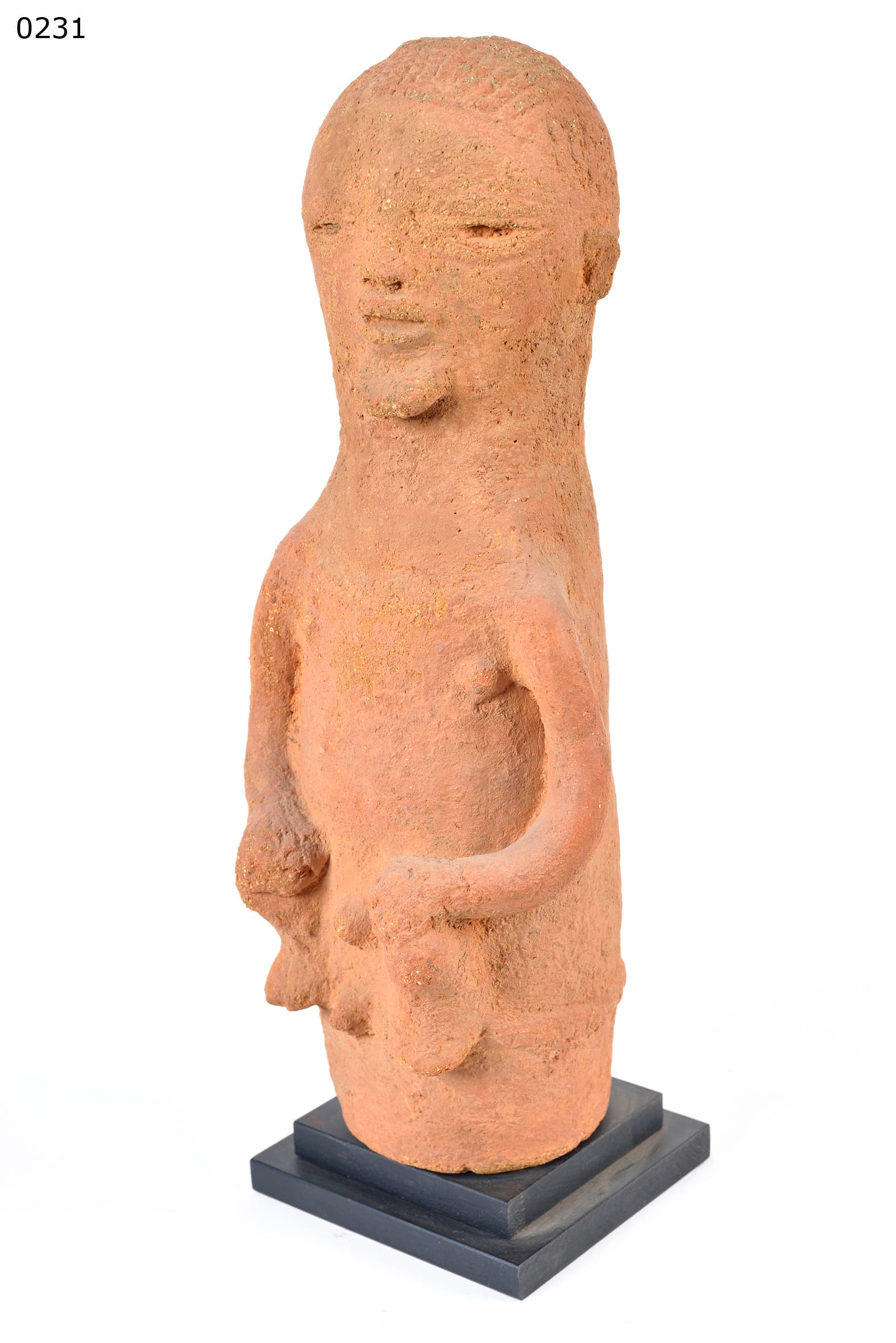
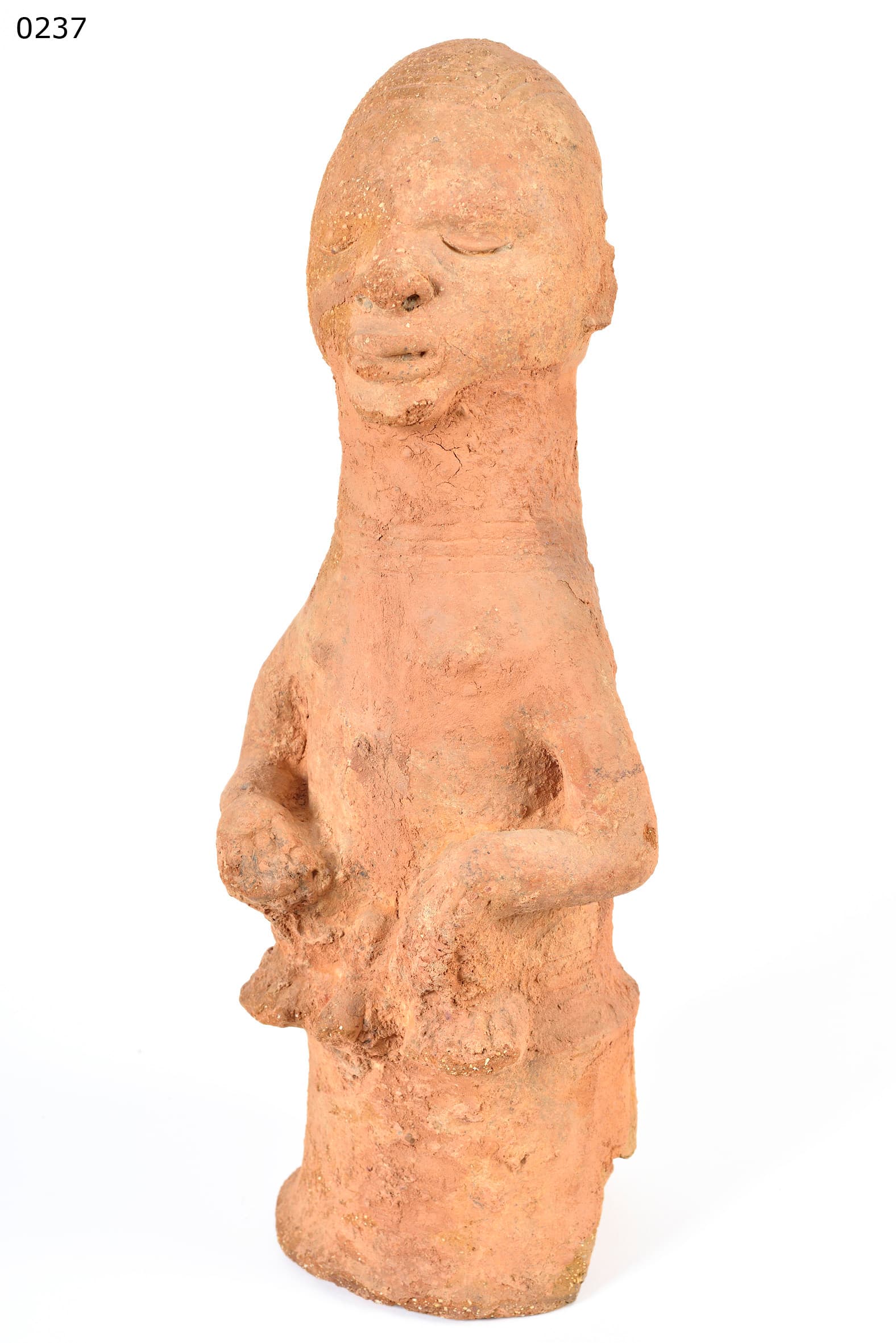
A highly complex two-headed Katsina Janus figure (ca. 2,000 years old, 52 cm) from Nigeria — seated on a flared base, arms projecting laterally from the sides, the dense reddish terracotta heavily abraded, heavily pitted, and heavily encrusted with pale earth.
1. Janus iconography in antiquity
This piece represents a highly unusual form within the ancient Katsina tradition.
- Uncommon Form: The Janus (two-headed) form is a powerful iconographic motif across Africa but is considered uncommon in early Nigerian Iron Age ceramics.
- Dual Vision: Twin heads looking in opposite directions are traditionally interpreted as representing the ability to see the past and the future simultaneously — the physical realm and the spiritual world — symbolizing all-encompassing power.
2. Shamanic authority
The dual-face suggests this was an exceptional object within its cultural context.
- Community Shrine Context: It may have served as a significant object within a community shrine, transcending standard ancestral memorialization.
- Guardian Role: It may have acted as a spiritual guardian to detect malevolence approaching from any direction, with the lateral arms suggesting an embracing or blocking motion.
3. Millennial archaeological integration
The taphonomy is consistent with the 2,000-year age estimation.
- Heavy Weathering: The clay is heavily weathered with a coarse granular surface devoid of any original firing slip.
- Deep Soil Permeation: The pale chalky Nigerian earth has deeply permeated the porous ceramic, filling the incisions of the facial features and the deep recesses beneath the arms — consistent with a long period of undisturbed burial.
Summary
Associated with dual vision and spiritual authority, this rare Katsina Janus figure is a significant archaeological find. Its dual-headed geometry and profound surface weathering are consistent with notable Nigerian Iron Age antiquities.
Written with AI assistance from the collection appraisal, object photography and our own research; editorially reviewed. Mistakes are possible — corrections are welcome. How we work →