Overview
The geographical distribution of the Iron Age tradition known as the Katsina Ala culture extends across the south-eastern edge of the so-called Nok complex in what is now central Nigeria. The overall distribution area of this ancient civilisation covers an estimated 76,800 square kilometres - which corresponds to around eight percent of Nigeria's total land area - and stretches from Kagara in the west to the eponymous site on the Katsina-Ala River south of the Benue Valley. The recent population structure in the Katsina-Ala Local Government Area (LGA) of Benue State has an estimated population of 325,500 for the year 2022, while the extended metropolitan region and surrounding areas are experiencing strong demographic growth. Linguistically, the current indigenous population, primarily the Tiv ethnic group, belongs to the group of tivoid languages. These form a fundamental branch of the South Benoid languages within the macro-family of Benue-Congo languages.
The source situation is ambiguous with regard to the historical continuity between the recent Tiv and the ancient creators of the terracottas. Linguistic analyses of the so-called Bantu expansion, supported by research by scientists such as Greenberg and Blench, suggest that the present-day populations only migrated to this area in the early 15th century. Consequently, there is no known self-designation of the ancient producers; the external designation "Katsina-Ala culture" is a strictly archaeological construct coined by the British archaeologist Bernard Fagg in the mid-20th century in order to taxonomically classify the finds.
The social structure of the Katsina-Ala culture differed radically from the acephalous social models often found in West Africa today. The archaeological evidence shows a highly complex, two-tiered or hierarchical organisation (chiefdoms), which was characterised by pronounced social and occupational specialisation. This stratification was essential to support the sophisticated subsistence economy, which involved a combination of early agriculture and advanced iron smelting technology. The production of elaborate terracotta sculptures was undoubtedly in the hands of specialised artisan castes rather than simple hunters or farmers. The relationship with neighbouring peoples can be traced primarily through stylistic and technological diffusion, which significantly influenced later advanced cultures such as Ife, Igbo-Ukwu and Benin in the form of proportional canons and yellow-casting techniques.
The art-historical and archaeological classification of these finds is the subject of an ongoing scientific discourse. The primary controversy centres on the question of whether Katsina-Ala was an independent culture or merely a regional workshop of a larger empire. Ekpo Eyo dates and interprets Katsina-Ala as an independent, only loosely networked local tradition with its own stylistic parameters, while Bernard de Grunne vehemently argues for a homogenous "Middle Nigerian style" that subsumes Nok, Sokoto and Katsina-Ala under a centralised ideological and cultural hegemony. In recent exhibitions, institutions such as the Fowler Museum at UCLA, which deal intensively with the dynamics and fluidity of artistic identities in the Benue Valley, also emphasise the complex interregional networks of this ancient epoch without committing themselves to a purely monolithic cultural model.
| Demographic & Linguistic Parameters | Specification (Recent vs. Historical) |
|---|
| Geographical epicentre | Katsina-Ala river system, south of the Benue (central Nigeria) |
| Distribution area (historical) | approx. 76,800 km² (entire Nok-Katsina complex) |
| Recent Ethnicity (Benue State) | Tiv (approx. 5.2 million speakers nationwide) |
| Linguistic classification | Benue-Congo / Southern Bantoid / Tivoid |
| Population Katsina-Ala LGA (2022) | 325,500 inhabitants (estimate) |
| Historical social structure | Hierarchical, division of labour (iron smelting, sculpture) |
Cultural context
The religious system of the Katsina Ala culture can only be understood by deductively analysing the material remains due to the lack of written records. The cosmological order apparently did not focus on incorporeal natural or spiritual beings, as is often found in West African animism, but on a strongly institutionalised ancestor cult and the worship of divine authorities. The monumentality and permanent character of the statues made of baked clay indicate a cult that was tied to fixed locations and maintained the physical presence of creators, kings, queens, priests and diviners.
The role of women in this cult complex was remarkably prominent. The archaeological evidence shows a significant proportion of female figures adorned with elite regalia such as polished quartz lip plugs, complex hairstyles and massive beaded jewellery. This implies that women either functioned as high-ranking priestesses or legitimised matrilineal lineages as ancestors. Central initiation and transition rituals were most likely held in so-called "sacred groves" (sacred groves). The Katsina-Ala site itself is explicitly identified in the archaeological literature as such a sacred forest sanctuary, which was used for religious retreats separately from the profane settlement centres (such as Taruga).
Structurally, this ancient religion differs drastically from the practices of recent neighbouring peoples in the Benue Valley. While groups such as the Jukun or Tiv relied on mobile, ephemeral forms of expression such as wooden mask bundles, textile applications and performative dances, the Katsina-Ala cosmology was based on the statics and permanence of barrel-shaped altars. This architecturally anchored cult required continuous institutional maintenance, which would not have been possible without an established, hierarchical priestly caste. Researchers at the Royal Museum for Central Africa (RMCA) in Tervuren often draw parallels with the late sacral kingdoms of the Luba or Kuba, where material prestige objects also served as anchor points of dynastic memory.
A fundamental research controversy exists within the interpretation of this ritual sphere. Ekpo Eyo argues in favour of a sepulchral context and interprets the terracottas primarily as funerary grave goods for high-ranking individuals, similar to later practices in Owo or Benin. Bernard de Grunne firmly rejects this thesis; he points to the lack of skeletal remains in direct association with the primary finds and postulates instead that the figurines were active shrine objects representing living or deified dignitaries in above-ground altar installations and were ritually venerated. These antagonistic interpretations (grave goods vs. active altar focus) still characterise museum reception today.
| Ritual & cosmology | Katsina-Ala tradition (ca. 500 BC) | Recent Benue cultures (e.g. Tiv/Jukun) |
|---|
| Central cult objects | Permanent terracotta sculptures | Ephemeral wooden masks, textile shrines |
| Ritual site | Static sacred groves | Mobile performance spaces, temporary altars |
| Ritual focus | Divinised elites, ancestor worship | Nature spirits, animistic forces, ancestors |
| Materiality | Heavy, fired clay | Light wood, bast, plant fibres |
| Interpretation (De Grunne) | Above-ground shrine objects | N/A |
| Interpretation (Eyo) | Funerary grave goods | N/A |
Aesthetic features
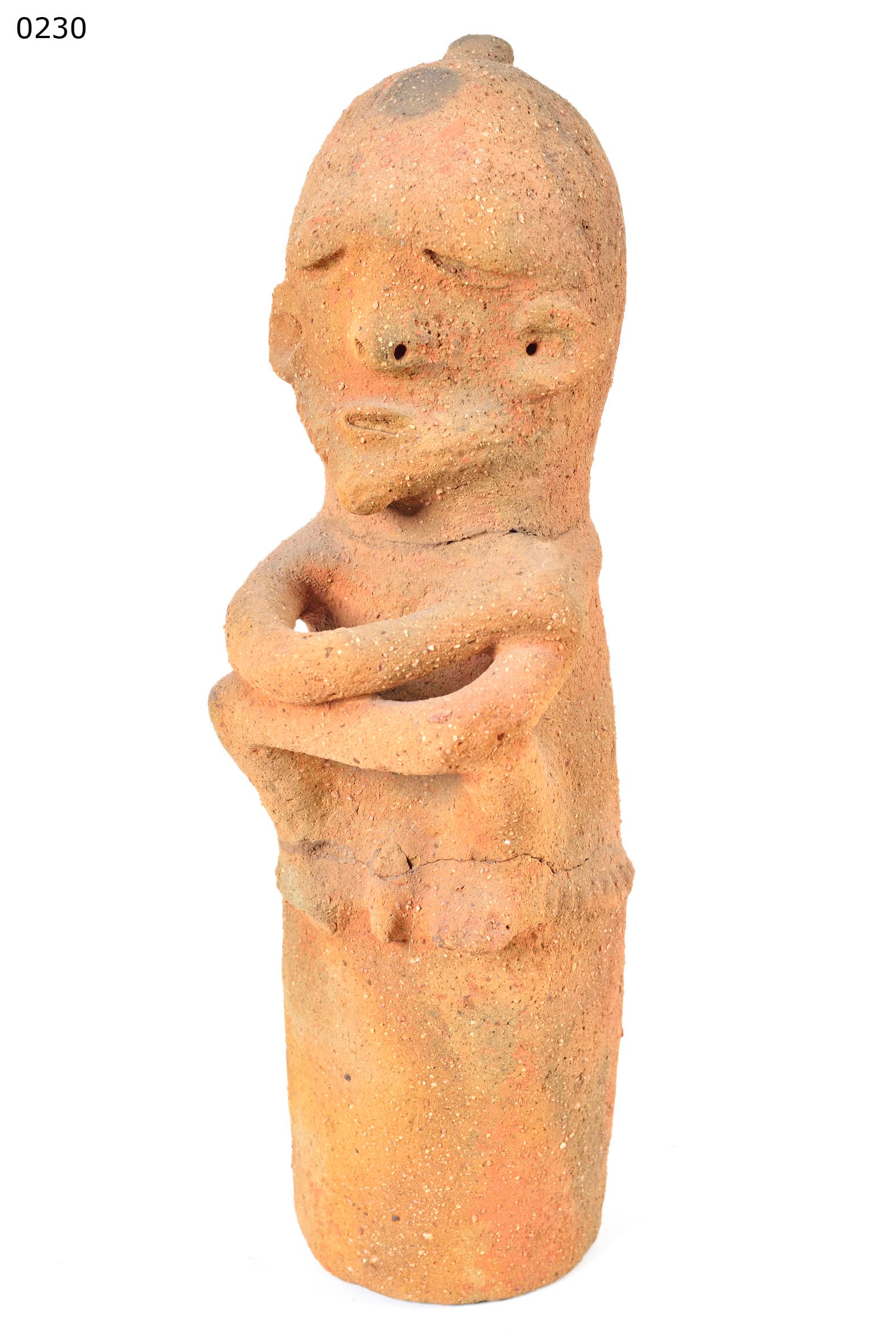
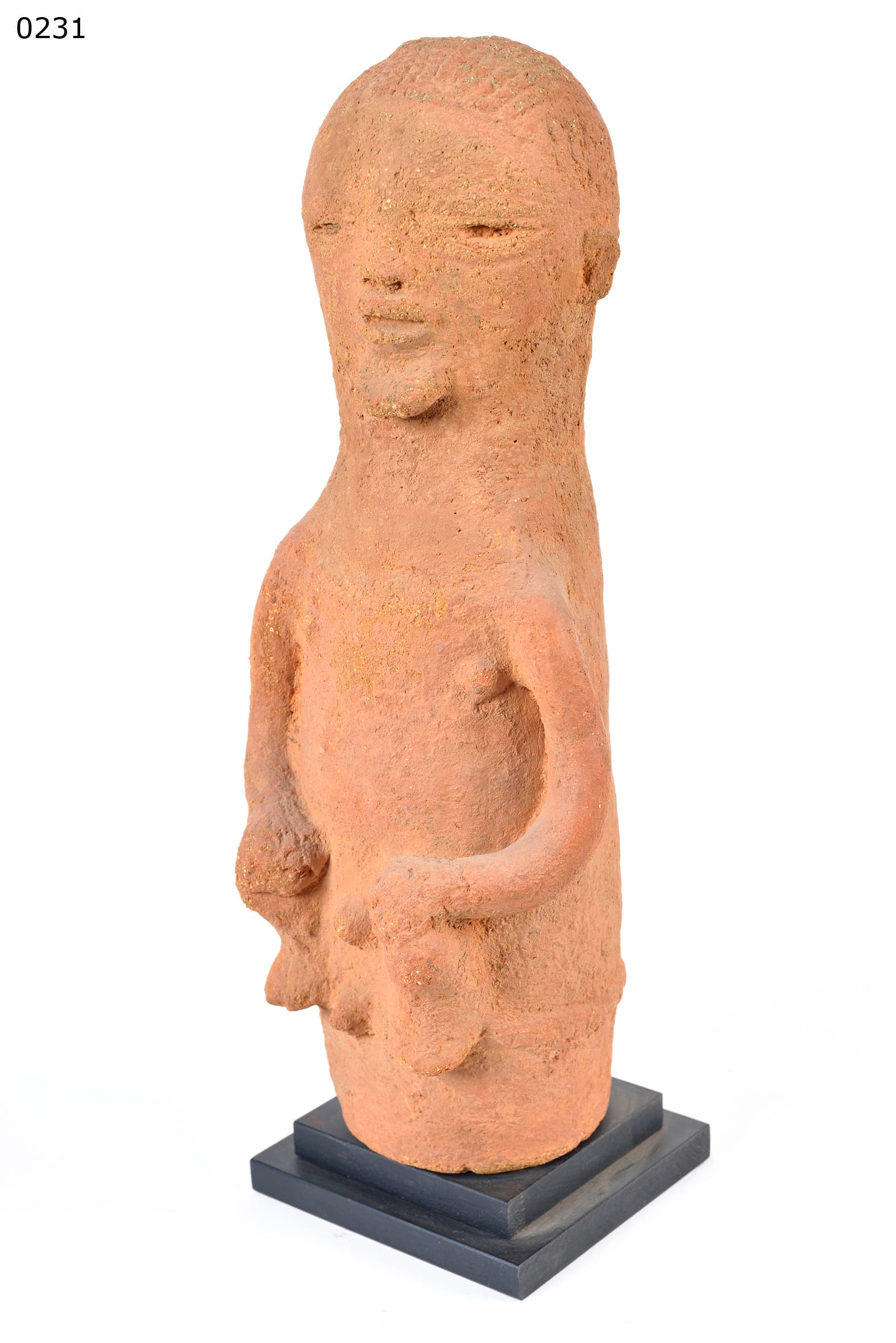
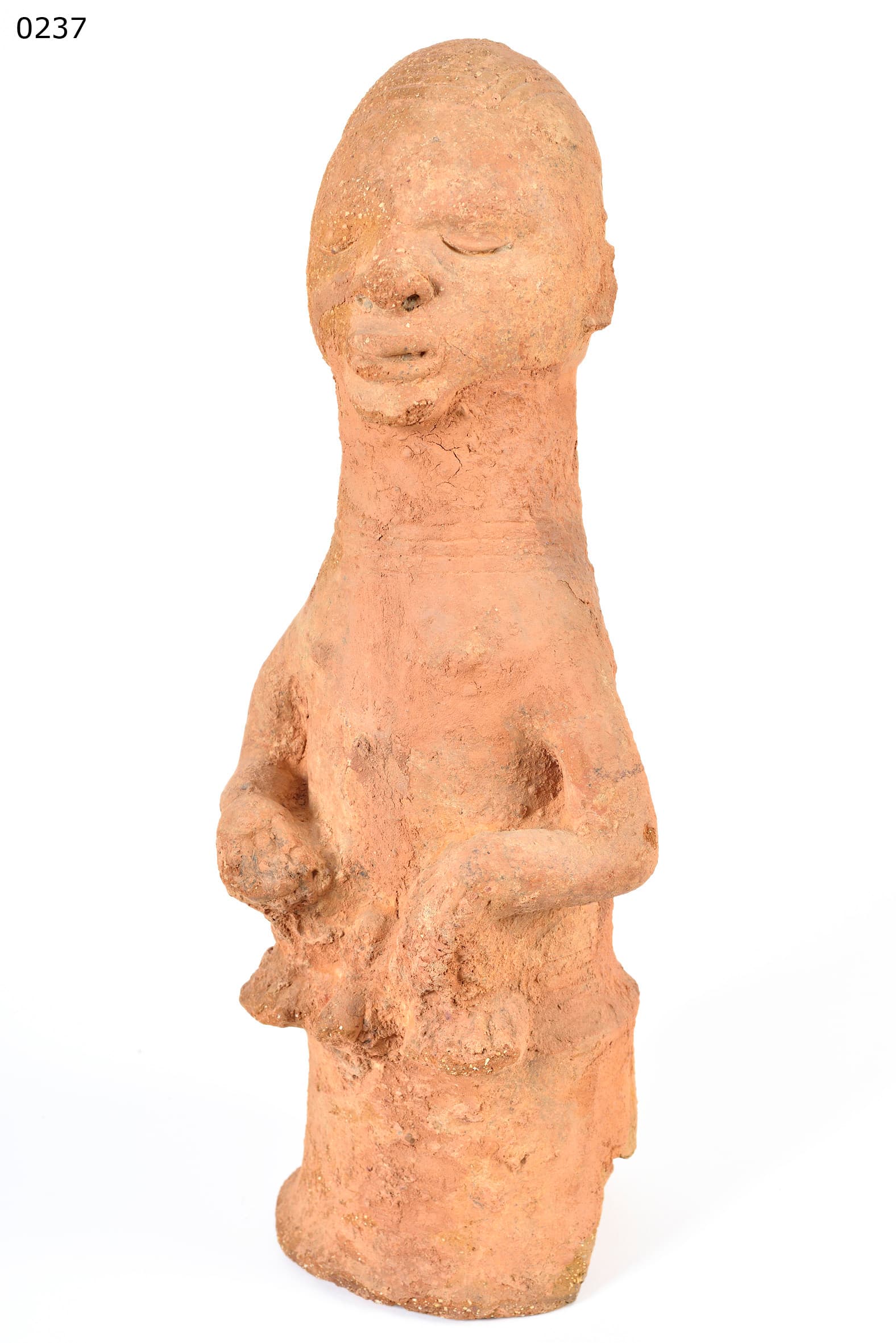
The canonical object typology of the Katsina Ala terracottas forms an independent aesthetic vocabulary that differs in significant details from the classical Nok heartland. Iconographically, the Katsina Ala subtypes are defined by an extremely plastic treatment of the facial features. The most striking difference lies in the moulding of the eyes: while the Nok sculptures are known for their deep, circular pupil perforations, the Katsina Ala style is characterised by distinctive almond-shaped eyes. These are accentuated by the flowing, curved lines of the eyebrows, which merge seamlessly into the bridge of the nose. The cheek and chin areas are often angularly modulated, the lips are slightly open and the faces rest on strongly elongated, cylindrical necks, which are often adorned with multiple neck rings (beadwork).
The canon of proportions rigorously follows the Pan-African convention of the "ontology of the head". The head as the seat of the spiritual essence (Ashe in later Yoruba contexts) is greatly disproportionate and often takes up a third to a quarter of the total body volume. The size spectrum of the sculptures is enormous and testifies to immense firing virtuosity; it ranges from tiny amulets measuring just a few centimetres to almost life-size, multi-part torsos and anthropomorphic full figures. The choice of material fell on local clay deposits, which were heavily mixed with quartz sand and mica to prevent cracking during open field firing (presumably at temperatures of around 600 to 800 degrees Celsius). Today's patina is the result of more than two thousand years of soil storage and is characterised by lateritic sintering, mineral incrustations and a deep penetration of manganese oxides.
A milestone in the exploration of this aesthetic is the identification of master craftsmen's hands and specific workshops. Bernard de Grunne revolutionised the study of the Katsina Ala finds by applying the concept of mains de maîtres (hands of masters) to archaeological terracottas. Through meticulous morphological comparisons - particularly the modelling of the negative space between the arms and the torso and the design of the almond-shaped eyes - he isolated distinct workshop styles and individual sculptors who are now referred to in the literature as the "Master of Katsina-Ala" or similar nomenclatures. This attention to detail distinguishes the activated ritual object massively from the profane object. While everyday ceramics (such as the Puntun Dutse type) were primarily functional and decorated with simple incised patterns, the sculptures functioned as highly complex information carriers, laden with symbolic jewellery and elaborate coiffures.
Due to the price explosion on the Western art market, the problem of forgery in these terracottas has become extremely relevant to the market. As classic African authenticity criteria such as termite damage or cracks in the heartwood of fired clay do not naturally exist, forgers resort to highly sophisticated methods. Modern forgeries often consist of pasticci - newly assembled figures that are fused together from genuine but disjointed archaeological shards using synthetic resin and glue to create seemingly intact sculptures. Such manipulations undermine standard thermoluminescence tests (TL tests), as the shards themselves show ancient age. Leading institutions such as the Museum Rietberg in Zurich, which has one of the most in-depth research departments for West African art, therefore rely on medical computer tomography (CT scans). Only the forensics of radiological density measurement can reveal beyond doubt the hidden adhesive seams and structural inconsistencies of the forger's workshops inside the figure.
Ritual practice
The reconstruction of the ritual practice of the Katsina-Ala culture is based on geoarchaeological findings, spatial distribution patterns and ethnoarchaeological analogies, as there are no direct written or oral traditions. Mask performances, in which objects are set in motion in front of an audience, can be ruled out for this civilisation. The terracottas were static sacred objects that functioned in firmly anchored altar installations. The topographical construction of these shrines usually took place in separate, inaccessible areas - the so-called sacred groves. Archaeological excavations at Katsina-Ala indicate that the statues were arranged on clay or stone pedestals, sometimes flanked by iron tools and ritual stone axes, to create a transcendent centre of power.
The activation of a newly modelled and fired ritual object took place through complex acts of consecration. In contrast to the wooden sculpture of lateral cultures, which often has a thick, crusty patina (matière) of blood, palm oil and millet pulp that has accumulated over decades, the Katsina Ala terracottas show hardly any permanent organic incrustations. This suggests that offerings (libations) were either of a liquid nature and were absorbed or washed away by the clay, or that drink and food offerings were deposited in separate ceramic vessels directly in front of the altar. Occasions for such rituals were most likely agricultural milestones (sowing, harvest), initiation rites of the priestly caste or the spiritual coping with droughts and epidemics.
A particularly fascinating and archaeologically controversial aspect is the deactivation and disposal of the cult objects at the end of their life cycle. Almost all Katsina Ala terracottas ever found - including the reference objects and casts in the British Museum - were recovered in a highly fragmented state. While early scholars attributed this fragmentation to natural erosion or the mechanical destruction caused by later tin mining, the theory of "ritual destruction" (Ritual Destruction) became established in modern archaeology. Researchers such as Peter Garlake and Peter Breunig argue on the basis of excavation situations (e.g. narrowly confined depression pits or refuse mounds) that the statues were deliberately smashed and systematically buried at the end of their ritual use - for example at the death of the king or priest they represented. This ritual desacralisation stripped the object of its metaphysical charge and prevented the misuse of the spiritual power stored in it. Regional variations of this disposal cult can be seen in the specific layering of the fragments, with only torsos being deposited in some groves and isolated heads in others.
Historical context
The historical classification of the Katsina-Ala tradition is still characterised by dating controversies. While early estimates by Bernard Fagg placed the culture roughly between 500 BC and AD 200, modern thermoluminescence (TL) tests and the C14 radiocarbon method (applied to charcoal from the smelting furnaces and the interior of the statues) have corrected and differentiated the chronological spectrum to around 900 BC to AD 400. The so-called Hallstatt plateau of the C14 curve poses a particular challenge for exact calibration, as it makes precise dating in the first millennium BC methodologically difficult. Parallel to this heyday, the early phase of the Bantu expansion took place in this very region - a huge demographic and linguistic migration wave that was to change sub-Saharan Africa forever. Whether the creators of Katsina-Ala were the forerunners of this migration or were displaced by it is an unresolved academic controversy. The sources are ambiguous as to the reasons for the sudden collapse of the culture in the first millennium AD.
There was no classic colonial encounter with the indigenous culture, as it had been extinct for thousands of years. However, the history of discovery and reception is deeply interwoven with British colonial rule in Nigeria. The first systematic finds were made in 1928 by the British mining engineer Bernard Fagg, who discovered the fragments on the spoil heaps of colonial tin mines on the Jos Plateau. As early as 1909, the British colonial official H.M. Brice-Smith collected ethnographic artefacts in the Katsina-Ala region, proving the early presence of Western administrators in the ancient groves. This imperial infrastructure laid the foundation for systematic archaeological exploration, but at the same time deprived the region of sovereignty over its cultural heritage. Naturally, colonial history does not have a direct influence on the production of this art, but it does on its distribution.
The history of the market in the West is a highly problematic chapter. After decolonisation and increasingly in the 1980s and 1990s, the area came under the scrutiny of the international art market. In 1993, a European consortium of dealers reportedly formed to orchestrate the systematic looting (looting) of the Nok and Katsina areas. Between 1994 and 1995, this crisis reached its sad climax: two main local traders employed over 1,000 indigenous tombs, devastating the landscape and exhuming up to ten ancient terracottas a day. As a result, prices on the art market exploded, legitimised by breakthrough exhibitions such as The Birth of Art in Africa (1998, Banque Générale du Luxembourg), curated by Bernard de Grunne. This canonisation led to renowned institutions such as the Musée du quai Branly in Paris and the Metropolitan Museum of Art in New York acquiring pieces from the Benue Valley, often regardless of their questionable provenance.
| Epoch | Event / Development in the history of the market and discovery |
|---|
| 500 BC - 500 AD | Primary production phase of Katsina-Ala terracottas |
| 1909 / 1928 | First colonial contact by H.M. Brice-Smith and B. Fagg in tin mining |
| 1960s - 1970s | First scientific excavations (Taruga, Katsina-Ala) and first waves of counterfeiting |
| 1993 - 1995 | Escalation of systematic looting (up to 1,000 illegal graves active) |
| 1998 | Exhibition The Birth of Art in Africa manifests the international market value |
| From 2000 | Tightening of forensics: use of CT scans against highly complex pastiches |
The flood of plundered originals soon dried up, and the market was flooded with forgeries. As explained in the aesthetics section, the classic authenticity criteria of African wood art - namely patina from body use, termite damage and cracks in the heartwood - do not apply to inorganic terracotta. Today, authentication is based on complex forensics. While simple TL tests by the Bortolot Daybreak Corporation were sufficient in the 1970s, forgers began to forge certificates or build pasticci from ancient shards in the 2000s. Today, a multi-stage forensic analysis consisting of X-ray tomography (CT) to detect density inconsistencies and modern adhesives as well as microscopic examination of the manganese dendrite ramifications on the break edges is the unavoidable standard for the serious collector's market.