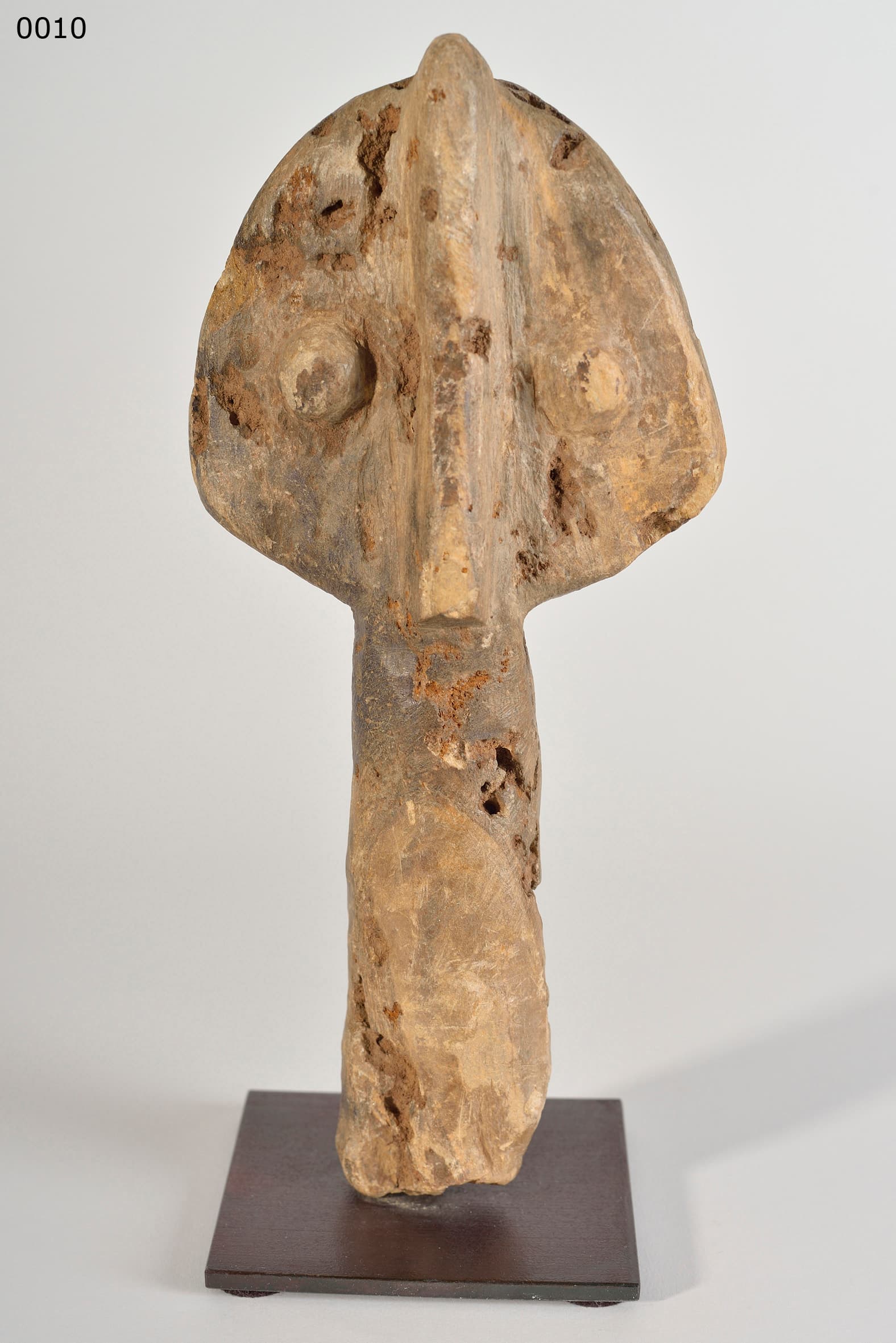
A rare stone monolith (attributed to the 3rd–11th C., 34 cm) from the Bura of Niger/Burkina Faso — a highly abstract heavily stylized female figure with rendered breasts, the extremely dense pale stone heavily pitted, crusted, and geologically degraded.
1. Explicitly gendered rarity
While Bura-Asinda necropolises produced many monoliths, the explicitly female example is remarkably rare.
- Mostly Ungendered Corpus: Most Bura stone monoliths rely on purely phallic ungendered cylindrical forms to convey abstract generative power.
- Breasts as Identity Marker: Carving rendered breasts anchors this stone to a specific gender identity — a founding matriarch or a specific named female ancestor rather than a generic spirit.
2. Matriarchal anchor of the necropolis
Planted vertically in the burial grounds of the lower Niger River valley, this figure played a specific role.
- Gendered Intercession: Where male ancestors might be invoked for political or agricultural matters, a female founding ancestor would be petitioned for fertility, childbirth, and lineage continuity.
- Permanent Avatar: The stone became the focal point for libations and prayers specifically addressing matrilineal concerns of the community.
3. Extreme sahelian taphonomy
The surface shows wear consistent with significant antiquity.
- Wind-Sandblasted: Abrasive Sahelian winds have over time removed softer mineral inclusions.
- Spongy Texture: What remains is a cratered sponge-like surface completely devoid of original tool marks, consistent with an ancient origin.
Summary
Translating the iconic Bura aesthetic into explicitly female stone, this rare monolith is a powerful sentinel of West African antiquity. Its gendered abstraction and extreme geological erosion highlight its archaeological significance.
Written with AI assistance from the collection appraisal, object photography and our own research; editorially reviewed. Mistakes are possible — corrections are welcome. How we work →