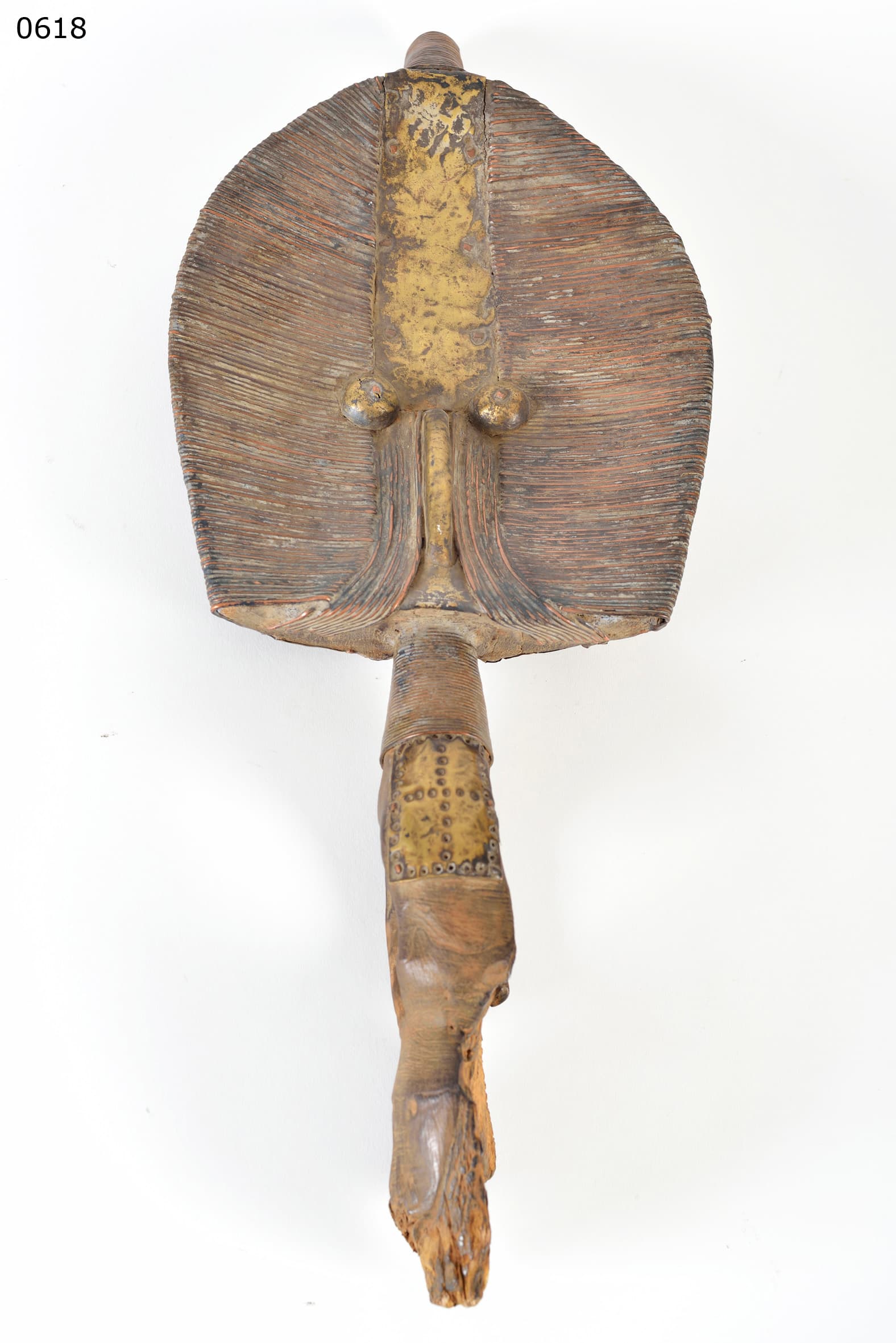
A Mahongwe bwete reliquary (1st half 20th C., 46 cm) from Gabon — a highly abstracted flat leaf-shaped wooden armature entirely enveloped in hundreds of tightly wound horizontal strips of thin copper and brass wire, with a central vertical ridge of metal dividing the "face," punctuated by two small protruding conical eyes and a sweeping metal band representing a nose/mouth. Published in Kopfskulpturen p. 150.
1. Wire-wrap abstraction
The Mahongwe (a subgroup of the Kota complex in Gabon) developed a highly abstracted variation of the mbulu ngulu reliquary form.
- Fine Wire: Rather than large hammered sheets of metal used by their Kota neighbors, Mahongwe artists used extensive lengths of fine drawn brass and copper wire — meticulously wound side-by-side over the wooden core.
- Teardrop Radiance: The result is a highly textured ribbed surface that catches and scatters light in a different, almost vibrating manner — the face reduced to a radiant teardrop or leaf shape with minimal anatomical markers.
2. Bwete guardians and supernatural reflection
Like the Kota, the Mahongwe tied these bwete figures to woven baskets holding the skulls of high-ranking lineage founders.
- Prestige Copper: The intense use of copper — a highly prestigious expensive and spiritually charged material in Central Africa — was intended to "blind" and terrify witches or uninitiated individuals.
- Vibrating Magical Barrier: The reflective vibrating surface of the tight wire wrapping was believed to mirror the intense unfathomable power of the ancestral realm — establishing a visual and magical barrier around the bones.
3. Publication history and oxidative aging
An object of notable quality, documented in publication.
- Kopfskulpturen p. 150: Published in the text Kopfskulpturen (p. 150).
- Verdigris Crevices: The copper wire has developed a rich dark verdigris and deep brown oxidation in the crevices — a chemical process requiring decades of exposure to humid tropical air. The wooden handle shows severe structural desiccation and age wear, consistent with a utilized Gabonese antiquity.
Summary
A significant example of Gabonese reliquary art, this Mahongwe figure represents a highly developed form of African wire-wrap abstraction. Its publication history and deep oxidative aging make it a notable example of spiritual geometry.
Written with AI assistance from the collection appraisal, object photography and our own research; editorially reviewed. Mistakes are possible — corrections are welcome. How we work →