Overview
The ethnographic and linguistic classification of the population groups in north-eastern Gabon and the neighbouring Republic of Congo is characterised by considerable historical and taxonomic complexities. The population, which is subsumed under the collective term "Kota" (or Bakota, Akota) in Western art history and ethnography, comprises around 43,500 to 70,000 individuals according to current demographic estimates. Geographically, around 79 per cent of this population group is concentrated in the province of Ogooué-Ivindo in Gabon, while the remaining 21 per cent live primarily in the north-west of the Republic of the Congo, specifically in the districts of Kellé and Mbomo (Département Cuvette-Ouest).
Linguistically, the Kota dialects belong to the extensive Bantu language family, specifically the north-west Bantu group B20 according to the Guthrie nomenclature. The documented primary dialects include Ikota (or iKota), Ndambomo, Mahongwe, Sake, Bougom and Menzambi. Recent computational linguistic analyses using Levenshtein distances to measure lexical differences suggest that speakers of the Kota-Kele languages (B20) were among the earliest Bantu populations to populate present-day Gabon during the great Bantu expansion some 4,000 to 5,000 years ago. These migrations penetrated the Central African rainforest and established a first wave of sedentarisation in the region.
The nomenclature of the ethnic group reveals profound epistemological problems. The self-designation of the various subgroups differs fundamentally from the exogenous collective term "Kota". Etymologically, the term "Kota" is often traced back to a local verb for "to bind", "to link" or "to join together", which could indicate a postulated common fate of the alliances. However, contemporary researchers such as the Belgian analyst Frédéric Cloth explicitly characterise the term as a problematic signifier ("fraught signifier"). Cloth postulates that the Kota themselves did not carve relic guardian figures in the narrower sense. Rather, the attribution results from a massive historical oversimplification by European explorers in the 19th century, who primarily encountered the Kota during their exploration of the Ogooué River and subsequently applied this name imprecisely to all neighbouring, art-producing groups (such as the Shamaye, Sango, Obamba, Wumbu and Ndassa). Neighbouring ethnic groups use different terms; for example, the Kota are traditionally referred to as "Mekora" by the Fang. There were also serious misclassifications in the early ethnographic literature of the 19th century: For a long time, the Mahongwe were referred to as "Ossyeba" (or Bocheba), an ethnic error that was only corrected decades later by specialists such as Leon Siroto.
The social structure of the Kota groups is traditionally organised acephalously. There is no centralised state authority; political and social power is completely decentralised to the level of local clans and lineage elders. In these primarily egalitarian, albeit age- and gender-stratified societies, consensus-building is seen as the highest political good. Social values are centred around tradition, respect for elders and the concept of Ewele, which can be roughly translated as "pride" or "dignity".
One aspect that is the subject of intense debate in research is the region's fluid kinship and descent system. The sources are ambiguous or indicate a historically evolved heterogeneity: While the northern Kota groups are primarily patrilineal in organisation, more southern subgroups - especially the Mahongwe and the Obamba - have clearly matrilineal descent systems (ironically, "Mahongwe" etymologically means "from your father"). Recent macro-economic and anthropological studies suggest that the establishment of matrilineal systems in these equatorial regions was an adaptive socio-cultural survival strategy. This structure facilitated the integration of new members and the maintenance of lineage continuity in times of extreme external shocks, such as those caused by the transatlantic slave trade and specific agroclimatic conditions (extensive agriculture without livestock).
The traditional subsistence of the Kota was based on semi-nomadic shifting cultivation (slash-and-burn agriculture), supplemented by hunting, fishing and gathering. As the extremely nutrient-poor soils of the tropical rainforest were exhausted after five to seven years, the village communities were forced to move their settlements in this rhythm. This ecological determinant not only characterised the mobile architecture, but also fundamental aspects of ritual art production. The relationship with the neighbouring peoples - especially the Tsogho, Kwele and the dominant Fang - was characterised by cultural exchange, but also by pressure to assimilate. Today, institutions such as the Musée du quai Branly - Jacques Chirac in Paris document the fluid boundaries of material culture in this contact zone in their collections.
Cultural context
The ontological and religious foundation of Kota societies manifests itself in the bwete or bwiti cult, a complex ancestor worship system that structures the entire social and cosmological order. In the cosmology of the Kota, there is no strict separation between the profane world of the living and the sacred sphere of the dead. The spirits of high-ranking ancestors - especially former judges, clan leaders, exceptional healers or outstanding craftsmen - are seen as active, omnipresent actors who directly control the fate of the community. The ancestors act as intermediaries to the unapproachable nature and creator deities; they are invoked to intervene in social crises, avert epidemics, guarantee hunting and trading success and ensure fertility and general well-being.
Ritual authority within this system rests exclusively with the initiated men, specifically the clan elders and the N'ganga (spiritual specialists, priests and diviners), who control the complex ritual liturgy. The role of women in formal worship is extremely restrictive; women and uninitiated male youths were strictly excluded from direct contemplation of sacred relics and the innermost mysteries of the bwete. This gender-specific segregation of the ritual space served to maintain social hierarchies within the otherwise acephalous structure. Among the central initiation and transition rituals were the satsi ceremonies, during which circumcision and the formal acceptance of young men into the circle of adults and potential bearers of knowledge took place.
The material axis of this belief system is the reliquary. In contrast to the Christian or Islamic conceptualisation of cemeteries, which requires a permanent geographical location for the dead, the semi-nomadic society of the Kota developed a mobile necropolis. As the villages were moved every five to seven years, access to stationary graves was impossible. Consequently, the Kota excarnated the physical remains (especially skullcaps and small bone fragments) of their most important ancestors and transferred them into cylindrical bark boxes or woven baskets called musuku, nsuwu or mbulu. These mobile altars became the centre of family and collective religious practice.
What structurally distinguishes the religion and its material manifestation of the Kota from their immediate neighbours, especially the Fang, is the core of a far-reaching research controversy. Both peoples practise ancestor cults (called bieri or byeri among the Fang), but the material realisation is diametrically opposed. While the Fang carved fully sculpted, organic, three-dimensional wooden figures to guard their relics, the Kota abstracted the human form into a radically stylised, extremely two-dimensional plane that was completely plated with metal.
The scientific categorisation of these art and cult forms led to a striking epistemological conflict in ethnology. Author A, the French ethnologist Louis Perrois, established a primarily form-analytical approach from the 1970s onwards. Perrois classified the Kota and Fang material into rigid geographical and subtribal style categories (e.g. northern, equatorial and southern styles), which he regarded as more or less hermetically closed. Author B, the American anthropologist James W. Fernandez (1982), sharply criticised this formal typology. Based on his field research, Fernandez argued that Perrois ignored the extremely high intercultural mobility of individuals and carvers, which made the exact assignment of sub-styles to isolated sub-tribes obsolete. Fernandez regarded the Bwiti complex not only as a static ancestor cult, but also as a dynamic, syncretic "religious imagination" that served as a reformative survival strategy during the colonial period to psychologically compensate for the social deprivation caused by colonial intervention and the loss of traditional space. This discourse makes it clear that artefacts in collections such as the Museum Rietberg in Zurich must not be understood in isolation as aesthetic objects, but as fluid documents of social renegotiation.
Aesthetic features
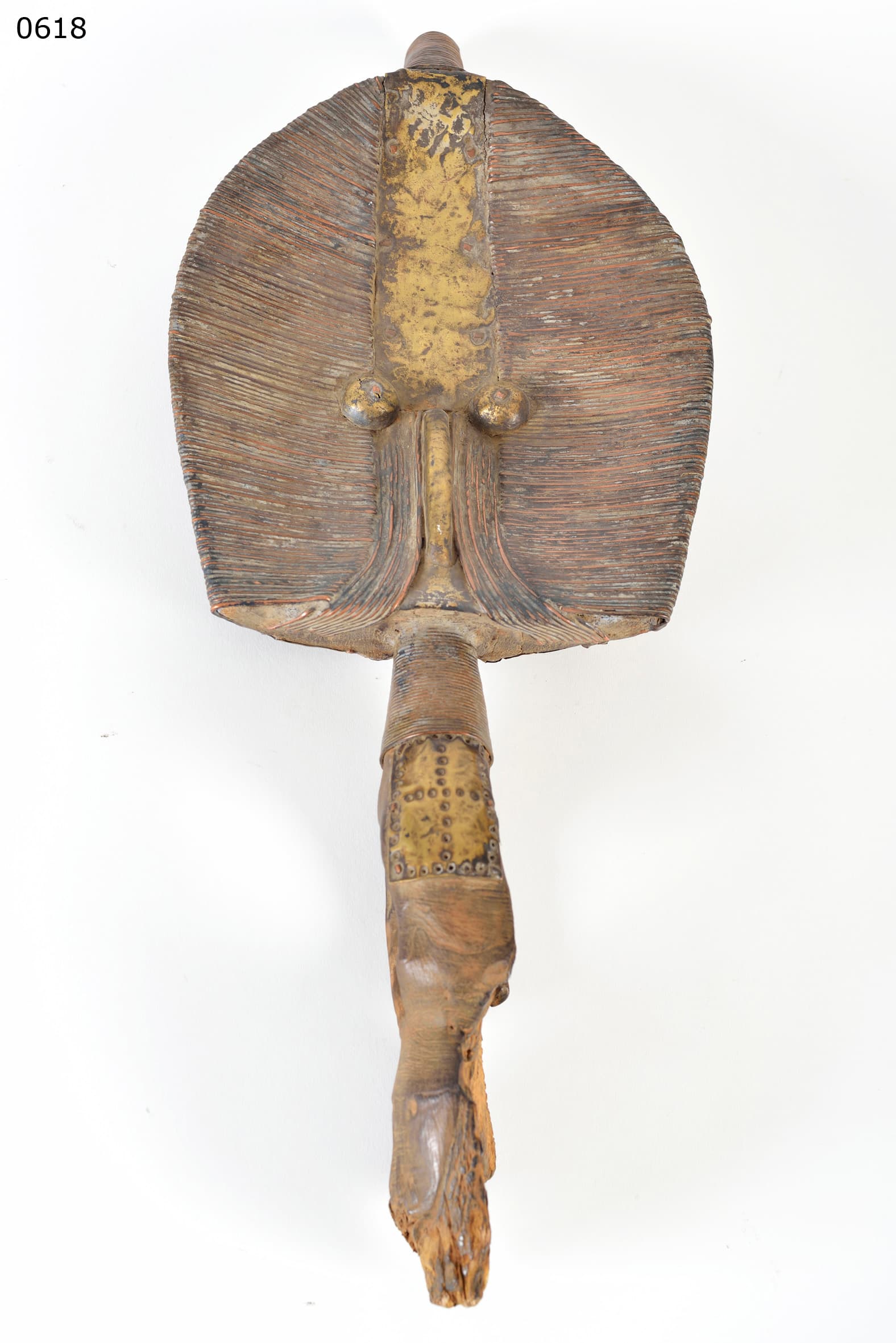
The canonical object typology of the Kota manifests itself almost exclusively in the relic guardian figures, which are primarily referred to in the research literature as mbulu ngulu (literally: effigy or basket of the dead). These sculptures represent one of the most radical stylisations of the human anatomy in the entire history of African art and are characterised by the singular synthesis of wood and chased metal.
The standard classification of this complex formal language is largely based on the comprehensive typology of Alain and Françoise Chaffin (L'art Kota: les figures de reliquaire, 1979). The Chaffin typology divides the corpus into distinct sub-styles, although the transitions, as Louis Perrois notes, are often fluid in practice and characterised by mutual influence.
| Sub-style (according to Chaffin) | Geographical / ethnic categorisation | Characteristic iconographic features |
|---|
| Mahongwe | Northern Ogooué Basin, Ivindo region | Leaf-shaped, ogival face (boho na bwete); horizontally running, tightly wound brass wires; strongly reduced comb; often depicted without mouth. |
| Obamba / Ndassa | Southern area, Haut-Ogooué | Classic mbulu ngulu shape; concave or convex oval faces; broad, cross-shaped metal plates; protruding lateral "ears" and large crescent-shaped comb (Coiffure). |
| Middle Ogooué | Spherical, highly stylised heads with high foreheads; eyes often made of bone; horizontal relief patterns; cylindrical ears. | |
| Shamaye | Region north of Okoudja | Morphological transitional style between Mahongwe and Obamba; narrow face, dominant vertical metal band; elaborate Repoussé motifs on the chin. |
A special and extremely rare subtype is the mbulu viti (Janus head), which has a face (often male and female) on the front and back. The anthropological interpretation varies from the representation of the duality of the ancestral lineage to the function as an omniscient, all-seeing guardian, which is supposed to ward off harmful influences from all directions. The size spectrum of the figures varies considerably and ranges from miniaturised formats (approx. 15 cm), which were probably developed during the colonial period for clandestine transport, to monumental representations over 70 cm high.
The canon of proportions follows a strict, deconstructivist logic. The base is formed by an open, diamond-shaped wooden structure that iconographically represents the figure's strongly abstracted shoulders and angled arms. The oversized, two-dimensional head is framed by an elaborate crest consisting of an upper crescent and downward-pointing lateral flanks (often with cylindrical counterparts).
The choice of materials is deeply rooted in the cosmology and economy of the region. The wooden centrepiece was almost entirely clad with sheets and wires of copper and brass. These metals, which were mainly imported into the interior of the country via European trade routes ("red gold"), were extremely valuable and thus served as material proof of the wealth and prestige of the lineage that donated the relic. The patina of these objects was very different from other African wooden sculptures. Instead of using palm oil or ritual blood to create a dark encrustation, the metal of the Kota figures was systematically rubbed off with fine sand by their guardians. The resulting brilliant, reflective lustre had an apotropaic (ominous) function and was associated with the reflection of water - a symbolic barrier between the world of the living and the undersea imaginary realm of the dead.
Despite the strong formal limitation of this canon, there were outstanding, individually identifiable artistic hands whose workshops defined the style. A striking example is the "Master of Sébé" identified by researchers, whose works are characterised by an extremely skeletal, highly reduced style. For the Western art market, for example during appraisals at the Metropolitan Museum of Art (Met), the separation between the profane, freshly carved object and the ritually activated ensemble is of the utmost importance. From an indigenous perspective, a figure without the reliquary basket was merely a piece of wood and metal; only the physical connection to the bones charged it with sacred essence. Today, forgery criteria are based on this knowledge: While artificially produced green or white traces of corrosion often expose modern recastings, natural signs of wear and tear on the wooden track that was in the basket testify to authentic ritual use.
Ritual practice
The ritual practice of the bwete complex is characterised by a complex performative choreography that encompasses the entire lifecycle of the relic ensemble, from its production and regular activation to its ritual deactivation or disposal. The sculpture itself, isolated from its context, was profane. Its spiritual transformation only took place at the moment of assembly: the diamond-shaped base of the mbulu ngulu was thrust deep into the musuku basket or bark box and firmly lashed down with plant fibres. This specific construction meant that only the metal-clad upper body remained visible from the "shoulders" upwards, giving the guardian figure the menacing, supernatural illusion of floating freely above the relics. For the initiated men of Kota, the true power of the ensemble lay not in the sculpture, but in the invisible presence of the bones inside.
The physical and spiritual activation of the altar required continuous action. Regular offerings were made to keep the connection to the ancestral world vital. The ritual application of red pigment or direct animal (and in early times occasionally human) blood served to metaphorically feed the ancestors, with the colour red acting as a synonym for life force and the transitional space between life and death. Regionally, especially among the Mahongwe, primate skulls (of chimpanzees or gorillas) were occasionally added to the basket alongside human bones and magical forest fruits. This practice was based on the belief that gorillas possessed occult, supernatural natural powers, which the priests were able to acquire through this physical aggregation.
The performative use of the altars primarily took place out of everyday sight. The reliquaries were kept in separate, darkened huts on the outskirts of the village, to which women and children were strictly forbidden access. However, the static guardian function was transformed into a dynamic mask-like performance during collective crises. The reliquaries were taken out of their shrines during serious outbreaks of illness, prolonged drought, to ward off witchcraft or to mark the end of the mourning period. During the satsi initiation rites, the heads of several clans would gather and dance for nights on end with the heavy reliquaries in their hands, accompanied by ritual chants to mobilise the accumulated energy of the ancestors for the community.
The life cycle of these objects often ended abruptly due to ecologically determined constraints. When the nutrients in the soil were exhausted by shifting cultivation and the village had to be relocated, the transport of dozens of heavy wooden baskets and sculptures posed a massive logistical problem. At this moment of deactivation, the Kota separated the sacred elements from the profane carrier: they removed only the sacred bones and magical substances, bundled them into small, easily transportable packages and often left the large mbulu ngulu sculptures behind in the forest or in the abandoned huts. This ritual disposal explains why collections in Western institutions - such as the Fowler Museum at UCLA or the Dallas Museum of Art - now have thousands of guardian figures, but the corresponding reliquary baskets are almost completely missing. From the Kota's point of view, the loss of the wooden sculpture was bearable as long as the essence of the ancestors was preserved.
Historical context
The historical contextualisation of Kota art reveals a complex web of pre-colonial migrations, brutal colonial ruptures and an unprecedented dynamic of value creation on the Western art market. The ethnogenesis of the region goes back to the massive Bantu expansion, the dating of which is the subject of ongoing scholarly controversy. While linguistic models based on lexical-statistical analyses (Levenshtein distances) date the penetration of Gabon by the B20 language group to around 4,000 to 5,000 years before the present, archaeological findings point to a much more recent, phased process that was largely dependent on climatic fluctuations in the rainforest.
The decisive turning point in the production of mbulu ngulu figurines came in the late 19th and early 20th centuries with the advance of French colonial administrations and Christian missionaries. The European actors categorised the bwete cult as pathological "fetishism" and "witchcraft" and initiated systematic campaigns of destruction. In the 1920s and 1930s, thousands of reliquaries were confiscated, burnt or sold to dealers. This wave of repression forced the cult underground and led to an almost complete cessation of classical Kota carving by the middle of the 20th century. At the same time, local artists adapted by creating smaller sculptures (bwiti) that could be more easily concealed from the authorities.
While the cult was physically destroyed in Gabon, the out-of-context sculptures underwent a dramatic semiotic reinterpretation in Europe. By 1900 at the latest, the first examples were circulating in the Musée d'Ethnographie du Trocadéro in Paris, where they were discovered by the artistic avant-garde. Gallery owners such as Paul Guillaume and experts such as Charles Ratton deliberately cultivated a market for these extremely abstract, geometrically austere works, which in retrospect was referred to as the "Guillaume-Ratton taste". The absolute market breakthrough came in 1966 at the auction of the Helena Rubinstein collection by Parke-Bernet in New York. This auction established African art as a high-priced investment object; works that Rubinstein had acquired for a few thousand dollars before the war suddenly realised record sums. Today, Kota masterpieces change hands at Christie's and Sotheby's for sums in excess of 500,000 euros.
This market history culminates in the so-called "Picasso modernism myth", which represents one of the most intense controversies in modern art history. It is undisputed that Pablo Picasso owned his own Kota sculptures from 1908 at the latest and that these helped to shape Cubism. However, the debate centres on the direct inspiration for his epochal work Les Demoiselles d'Avignon (1907). Author A, William Rubin (former director at MoMA), argued in the 1980s that Picasso painted over the faces of the figures on the right after a late visit to the Trocadéro Museum under the shock of "African magic" (and here explicitly the Kota/Mahongwe forms) in order to exorcise his own psychological crisis and fear of venereal disease. Author B, the art historian Suzanne Preston Blier (2019), vehemently disagrees with this interpretation. Using studio photographs and archival evidence, she dates Picasso's encounter with the African forms before the painting process and argues that the masks were not a sudden, trauma-driven overpainting. Rather, Picasso used illustrated ethnographies (such as those by Leo Frobenius) to consciously construct the figures as global representatives of different ethnicities from the outset.
The price explosion on the art market caused a massive wave of forgeries, mainly produced in West African foundries from the 1950s onwards. The authentication of high-class Kota objects, as they are analysed today at the Art Institute of Chicago, therefore requires rigorous forensic methods. Visual inspections look for specific, non-simulable heartwood cracks and real termite damage. Metallurgical analyses test the historical purity of copper-zinc alloys for trace elements such as sulphur and selenium, as post-1950 cast brass is usually of industrial purity. Artificial ageing by toxic acids, which produce white or greenish corrosion patterns, serves as a strong indication of modern recastings. To overcome this complexity, computer scientist Frederic Cloth developed a digital algorithm for an exhibition at the Pulitzer Arts Foundation (2015) that catalogues over 2,000 Kota figures and uses machine vision to detect deviations in the canon of proportions in order to reconstruct the lines of origin of the master hands.