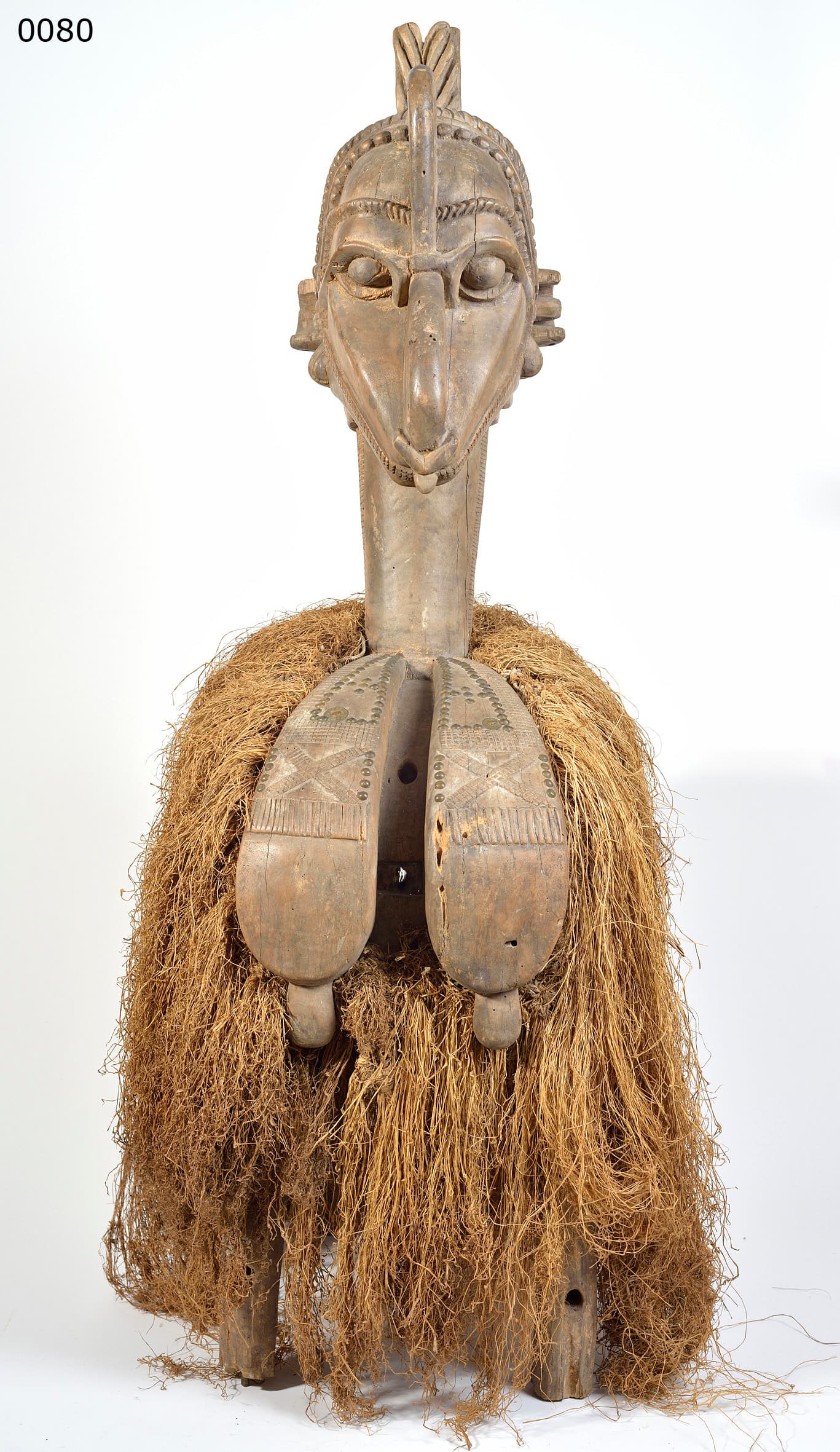
A massive heavy Baga D'mba / Nimba shoulder mask (1st half 20th C., 118 cm) from Guinea — the iconic cantilevered head with a massive aquiline nose, U-shaped eyes, an intricately braided coiffure, and a large chest plate bearing two flat pendulous breasts, the wood severely oxidized with a dry deeply aged core and significant wear on the lower carrying struts.
1. The d'mba mother of fertility
The D'mba (commonly known as Nimba) is among the most widely recognized sculptural traditions of the Baga of Guinea.
- Idealized Mother: Represents the idealized "Mother of Fertility" — a woman who has borne many children and nurtured them to adulthood, represented by the grand flattened pendulous breasts.
- Grace and Maternal Dignity: The massive cantilevered head with its sweeping exaggerated aquiline nose and intricate linear coiffure projects immense grace, power, and maternal dignity — a towering volumetric structure that is a classic example of West African carving.
2. The simo society and the agricultural cycle
The Nimba is the focal point of the Simo secret society's public performances.
- Single-Dancer Carrying: Despite its massive 118 cm size, the mask was worn on the shoulders of a single incredibly strong male dancer — looking out through holes carved between the breasts while his body was entirely hidden beneath a massive raffia skirt.
- Benevolent Harvest Spirit: Danced during rice harvests, planting season, and at funerals of prominent women — the Nimba was a joyful benevolent spirit whose rhythmic stamping dance guaranteed the ongoing fertility of the community's crops and women.
3. Structural desiccation and shoulder wear
The physical surface shows wear consistent with active ceremonial use.
- Matte Charcoal-Brown Core: No commercial shiny varnish — the wood is deeply oxidized to a dry matte charcoal-brown hue, with deep natural desiccation cracks along the grain of the head and breasts.
- Shoulder-Strut Friction: The lower wooden struts — where the dancer's shoulders supported the mask's immense weight — exhibit heavy smooth frictional wear, consistent with its history as a danced ceremonial object.
Summary
Towering at nearly 1.2 meters, this Baga Nimba mask is a striking representation of West African ideals of fertility and maternal grace. Its profound volumetric carving and structural wear consistent with ceremonial use make it a significant example of this classic tradition.
Written with AI assistance from the collection appraisal, object photography and our own research; editorially reviewed. Mistakes are possible — corrections are welcome. How we work →

cresthead serpent mask

zoomorphic shrine figure (used in ritual ceremonies)
serpent head crest