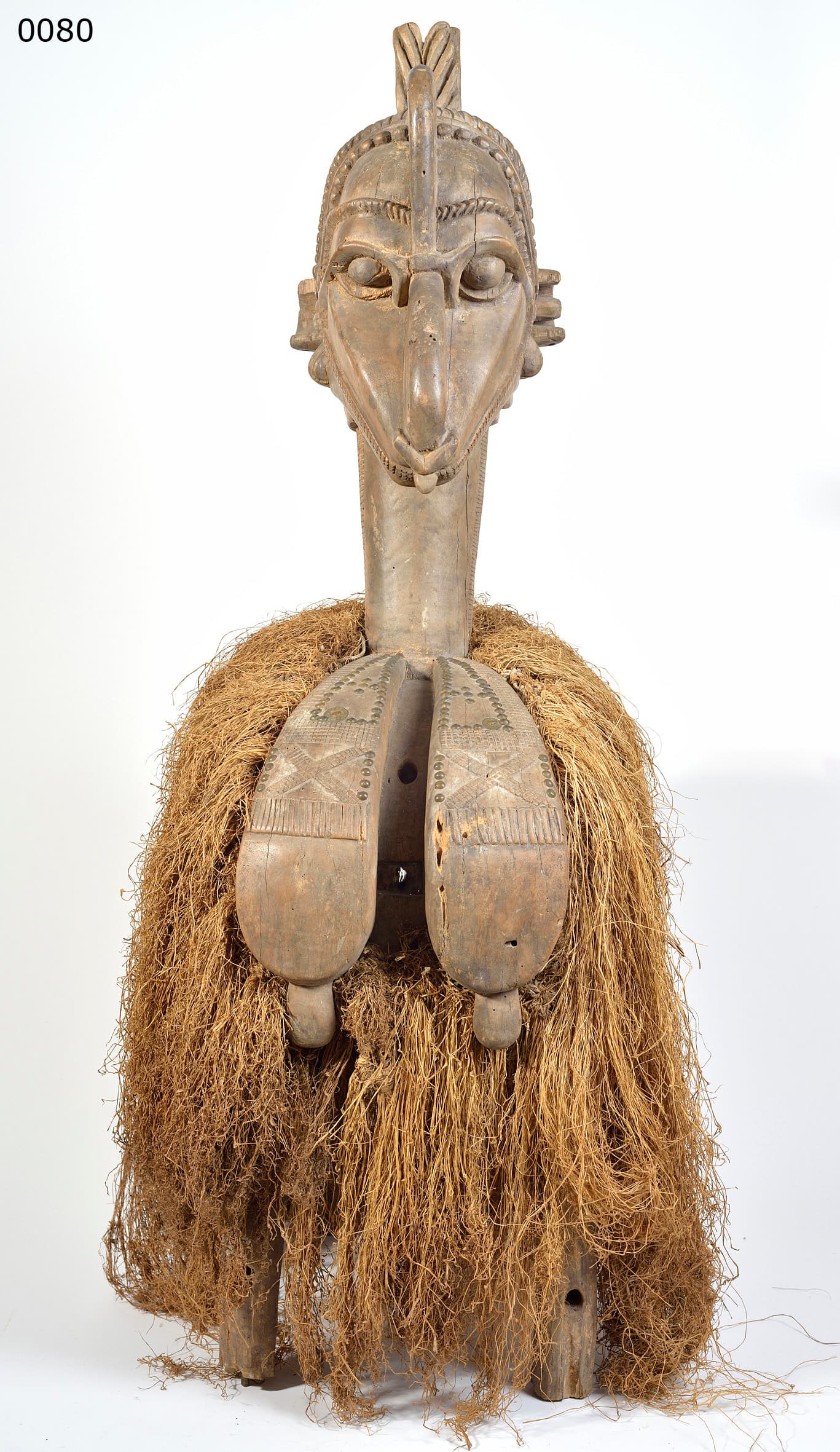
The Baga are a Guinean people of the Atlantic coast, known for monumental D'mba (Nimba) shoulder masks with long beak-like noses, carried on the dancer's shoulders.
Overview
The Baga form a highly specialised ethnolinguistic group whose historical and current settlement area extends primarily along the highly indented Atlantic coast of the present-day Republic of Guinea (Guinea-Conakry), which is characterised by extensive mangrove forests, marshlands and lagoons, as well as in the southern coastal strip of Guinea-Bissau. The demographic estimates of the current population size of this ethnic group vary considerably in the scientific literature and in the data sets of international organisations. While older ethnographic surveys assume a rather static population of around 50,000 to 60,000 individuals, more recent projections put the population at up to 80,000 members. This quantitative uncertainty results not least from a massive, ongoing rural exodus and urbanisation trend towards the Conakry metropolitan region. In 2024, the capital region had an estimated population of over 2.17 million inhabitants, leading to complex assimilation processes of the rural Baga population into urban, multi-ethnic milieus. Such demographic shifts must be analysed in the context of general West African population growth, which, according to UN projections, entails significant socio-economic transformations.
Linguistically, Baga (often together with the languages of the neighbouring Nalu and Landuma) is assigned to the Atlantic language family within the gigantic Niger-Congo macrophyllum. The source situation regarding the etymology and the exact separation of self-designation (endonym) and foreign designation (exonym) is ambiguous. As Frederick Lamp explains in his detailed linguistic analyses, there is a far-reaching semantic controversy in this regard: Historically, the term "baga" functions primarily as an exonym. In the languages of the neighbouring Susu and Temne, the term roughly means "people of the sea" or "people who fell by the water". This makes it clear that the neighbouring peoples classified the various Baga subgroups - including the Baga Sitem, Baga Koba or Baga Mandori - primarily as a geographical-ecological unit linked to the maritime region and less as a strictly genetically or politically homogeneous nation.
The traditional subsistence strategy of the Baga is based on highly specialised, extremely labour-intensive wet rice cultivation, which is practised in the tidal polders and mudflats (the so-called dabaka). This agri-cultural system, often referred to in specialist literature as the Mangrove Swamp Rice Production System (MSRPS), is supplemented by the cultivation of so-called N'pam-pam (upland rice) in the higher savannah regions. The division of labour here is strictly gender-specific: While the cultivation of rice was historically the domain of women, men focussed on maritime fishing and the cultivation of kola nuts. This specific ecological niche in the mangrove swamps, which are difficult to access, historically functioned as a strategic refuge. The Baga used the topography to escape hegemonic expansion efforts, slave hunting and aggressive Islamisation by the theocratic states of the Fulbe (Futa Jallon) and Malinké in the continental hinterland. As a result of this geographical isolation, the relationship with the neighbouring peoples developed over centuries in a defensive, segregated and deeply mistrustful manner. Recently, however, this ancestral territory has been transformed into an "extractive frontier", as massive bauxite mining projects threaten the ecological foundations of the Baga and lead to land expropriations.
With regard to the socio-political structure, there are profound controversies in research about the classification of the pre-colonial order. Most serious ethnography describes the social organisation of the Baga as genuinely acephalous (free of domination) and strictly gerontocratic. Authoritarian chieftaincy structures or centralised kingdoms simply did not exist in the indigenous taxonomy. Political and spiritual authority lay exclusively with the councils of elders of the patrilineal kinship groups (clans), whose power was supported by strict initiation covenants. A traditional village was divided into two to four neighbourhoods, which in turn consisted of five to six clans, each led by the oldest male member. It was not until the French colonial administration implemented the artificial structure of the "Canton Baga" as part of a system known as "decentralised despotism". The French installed authoritarian chieftains who radically contradicted indigenous political ideas and primarily acted as henchmen of the colonial power. This external interference in the socio-political integrity of the Baga later led to massive social upheaval. Exemplary objects that were acquired during this early phase of contact and transformation and reflect the complex social stratification can be found today in the earliest holdings of the Africa collection of the Musée du quai Branly - Jacques Chirac in Paris, which impressively maps and contextualises the geographical distribution of early Baga artworks.
| Demographic & Ecological Parameters | Specification/Source Reference |
|---|
| Estimated population | 50,000 - 80,000 individuals (strong urbanisation tendency) |
| Geographic habitat | Atlantic coast (Guinea, Guinea-Bissau), mangroves, Dabaka |
| Subsistence basis | wet rice cultivation in polders (MSRPS), N'pam-pam (upland rice), fishing |
| Language family | Atlantic branch (Niger-Congo macrophylum) |
| Socio-political primitive structure | Acephalous, gerontocratic, patrilineal, clan-based |
| Colonial construct | "Canton Baga" (decentralised despotism) |
Cultural context
Until the middle of the 20th century, the indigenous religious system of the Baga was characterised by a highly complex cosmology that was unique in West Africa. At the head of the pre-Islamic cosmological order was a distant, unapproachable creator god called "Kanu", who was flanked by a far-reaching duality of male and female natural and spiritual beings. A central conceptual feature that fundamentally distinguishes this religion structurally from the theocratic systems of the neighbouring Fulbe or Susu is the explicit view of the Baga that they create and actively construct a large part of their spiritual world themselves. As Lamp demonstrates through fieldwork, Baga informants decidedly emphasise that certain sacred entities function primarily as manifestations of social and ethical 'ideas' invented by ancestors to maintain social order and entertainment, rather than as pre-existent, transcendental gods. This anthropocentric cosmology lends immense sociological significance to Baga art production.
Ritual authority lay exclusively in the hands of the initiated elders, who were organised in elite secret societies, above all the powerful and feared Simo League. This society controlled the central initiation and transition rituals, which traditionally took place in extremely long cycles of 24 years. These rituals drew a sharp social dividing line between initiated adults, who were considered fully-fledged Baga, and uninitiated youths and outsiders. The sources make it clear that formal initiation went hand in hand with the acquisition of esoteric knowledge and the obligation to maintain absolute secrecy. The last major traditional initiation took place in 1948. This abrupt stop created a deep generational divide: the initiated elders increasingly regarded the generation born after 1948 as uneducated and in some cases denied them their true Baga identity by labelling them "Susu". The uninitiated youth, on the other hand, lived in what Ramon Sarró aptly described as a "landscape of fear" - a permanent fear of the supposedly destructive, secret powers (such as the amanco) of the elders, the true meaning of which they no longer understood.
But the role of women in the cult was also far more central and institutionalised than the early, often strongly androcentric colonial ethnography suggested. In addition to the male-dominated societies, women's associations (such as the keke society) had their own authority, specific secret knowledge and exclusive cult objects. These objects included, in particular, elaborately carved caryatid drums (known as endef in the Bulongic dialect) and slit drums (kipem), with which the women acted as guardians of specific agri-cultural rituals and village morality. Even after the decline of male initiation rites due to Islamisation, these women's associations continued to use and commission sculptures as an act of cultural resistance.
In art historical and anthropological research, there is an extremely prominent theological and iconographical controversy regarding the nature of the central masked beings. Older literature and early museum catalogues interpreted the iconic large mask of the Baga in general terms as a "goddess of fertility" or as an autonomous spirit being (locally referred to as kàrfi). Frederick Lamp (1996) vehemently deconstructs this view and proves through extensive field research that this interpretation is a reductive Eurocentric projection. According to Lamp and the Baga informants interviewed, the mask is by no means a spirit being or a deity, but the absolute abstraction of an ideal, an "idea" of immaculate female virtue, goodness and universal motherhood created by the Baga ancestors and explicitly constructed for social edification. This theological nuance marks a paradigm shift in the understanding of West African aesthetics. Artefacts of this highly complex worldview, which render the Western separation of profane entertainment and sacred depth obsolete, are an integral part of the collections of renowned institutions such as the Israel Museum in Jerusalem, which documents the cosmological and social significance of the "Great Mother" in detail in dedicated exhibitions.
| Religious & Social Actors | Function in the Baga Cosmos | Physical/Ritual Manifestation |
|---|
| Kanu | Distant creator god | No physical representation |
| Ancestors | Inventor of ritual "ideas" and dances | Cosmological reference in prayers |
| Simo covenant | Male elders, control of initiation | Bansonyi, A-Tshol, D'mba performance |
| Keke Covenant | Female Elders, Protection of Agriculture | Endef Drums (Caryatids) |
| Uninitiated youth | Subsistence labourers, recipients of the rituals | Dancers under the direct guidance of the elders |
Aesthetic features
The sculptural canon of Baga sculpture is characterised by a striking monumentality, formal boldness and an almost baroque compositional density in an intercultural comparison. The spectrum of artefacts ranges from extremely massive shoulder masks to intricate altarpieces. The stylistic coherence of these objects is defined by a distinct Sudanese geometry, which manifests itself in sharp edges, pierced piercings, linear grooves and often brilliant polychrome frames. The material canon is predominantly based on light but extremely durable tropical woods, such as the documented Ricinodendron rautanenii. The surfaces are traditionally decorated with interwoven palm fibres, imported European brass nails (upholstery nails) and ritual colour pigments such as white kaolin and indigo.
By far the most prominent and internationally best-known type of object is the shoulder tragedy D'mba (on the Western art market and in historical catalogues almost exclusively listed as Nimba). This massive sculpture reaches a height of 1.25 to over 1.5 metres and weighs an enormous 40 kilograms (approx. 80 lbs). Iconographically, it represents the imposing bust of a mature woman. The canon of proportions is strictly determined: An extremely protruding, strongly prognathous head with an eagle-like hooked nose rests on a relatively slender, cylindrical neck. The hairstyle is strikingly piled high and engraved with fine braid and scarification patterns, which is an aesthetic borrowing from the women of the neighbouring Fulbe, who were praised regionally for their physical beauty. The most striking iconographic feature, however, are the flat, long-hanging breasts. They visually and unmistakably signalise that this woman has reached the zenith of her life and has successfully breastfed numerous children and raised them to become productive members of society. The wooden bust rests on a yoke with four massive legs that serve as a support for the dancer.
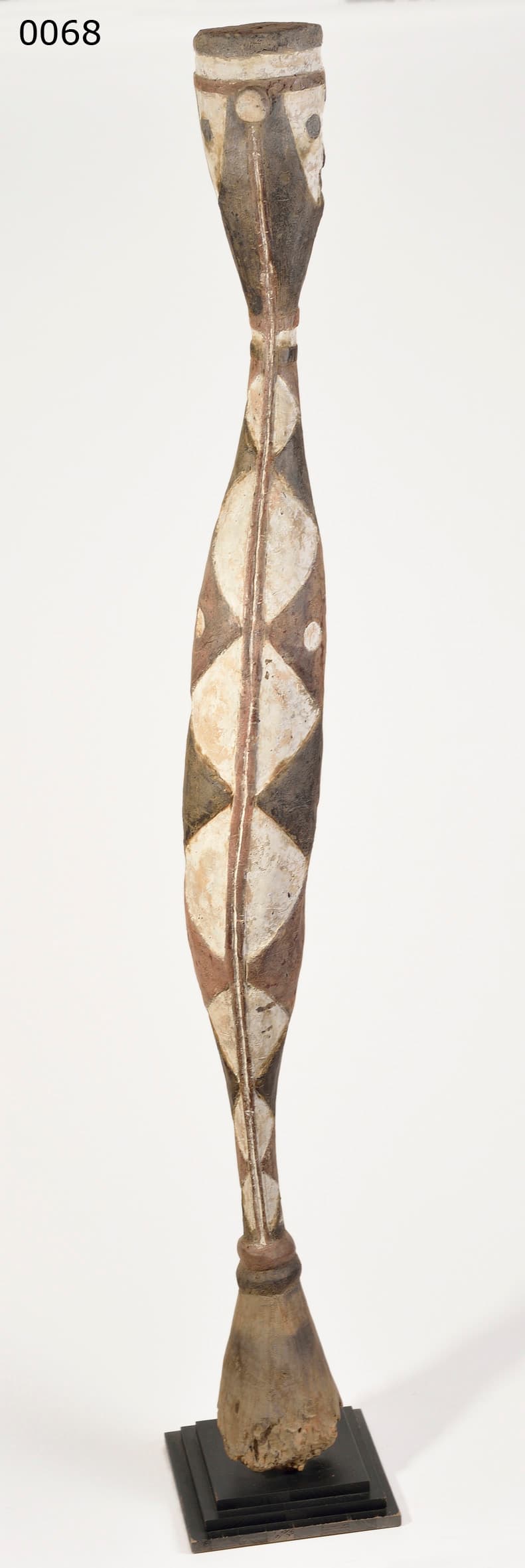
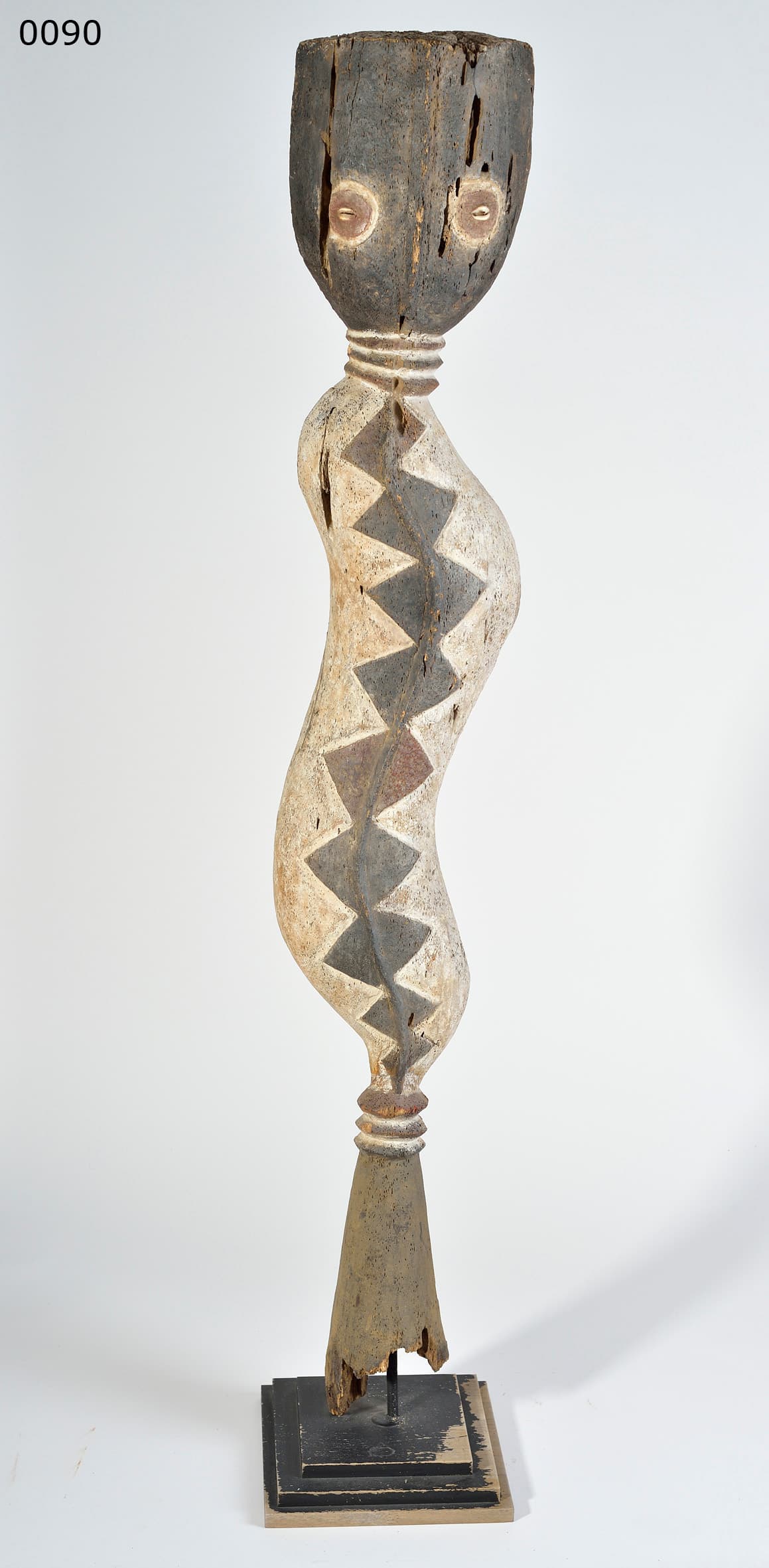
Another canonical type of breathtaking dimensions is the Bansonyi (or Mantsho-na-Tshol). This is a vertical post mask, up to six metres high, which symbolises the spirit of the snake or a rainbow. It consists of a heavily corrugated, polychrome-painted wooden pillar. The openwork diamond patterns, often painted in bright red, white and black, demand the utmost craftsmanship from the carver. The A-Tshol (also known regionally as Elek or Ma-Tshol) functions as a mobile shrine attachment and represents a hybrid creature of human and bird. This repertoire is flanked by the Timba and Endef drums, which are carried by female caryatids or horses, as well as horizontally worn masks of the Banda (or Kumbaduba) type.
There are two major controversies in art-historical analysis. The first concerns the naming of the large mask: Lamp postulates a linguistic-revisionist thesis according to which the term "Nimba", which has been established in Western collections for decades, is a loanword originating from the Labadi-Susu, which was falsely popularised by early French colonial literature as a proper name for the Baga. The correct, internal Baga nomenclature is exclusively D'mba. The second debate revolves around the A-Tshol iconography: while the renowned French ethnologist Denise Paulme (1958) specifically identified the long beak of the bird's head as a pelican, American and contemporary researchers such as Frederick Lamp and Marie-Yvonne Curtis have revised this zoological classification. They argue that it is either an osprey - an animal associated as a messenger of doom - or rather an abstract, mutable form that has no real ornithological model, but represents a purely conceptual "medicine" symbol.
Although classical African art is often perceived as an anonymous collective work, in rare cases individual workshops or master craftsmen can be stylistically identified in the Baga. For example, the art expert Pierre Amrouche speaks of a "master of the Chazal collection" in a particularly elaborate Elek essay. This unknown carver can be recognised by the unprecedented balance of the curved bird's neck, the integration of small fish in the beak and the carving of colonial house motifs into the composition. The fundamental difference between a sacredly activated and a profane object is always manifested in the application of "medicine" (Tshol) in the Baga. A purely perfect carving does not yet possess any power; only the filling of the relic cavities activates it. Deconsecrated pieces that regularly found their way into the art trade often have explicitly emptied relic chambers.
For private collectors, forgery criteria are extremely relevant to the market. A significant identification feature when checking the authenticity of the D'mba are deep, organically formed traces of wear on the inner supporting timbers, caused by sweat and friction on the dancer's shoulders. Proofs of authenticity require a deep, dark patina that has grown organically through palm oil and ritual use, historical heartwood cracks and authentic termite damage from the pre-collector phase that has not been artificially simulated with drills. Outstanding, undoubted reference objects for this complex formal language and patina development can be found in the Department of Africa, Oceania and the Americas at the British Museum in London, exemplified by the D'mba mask Af1957,07.1.
| Canonical object type | Iconography / symbolism | Dimensions | Specific ritual context |
|---|
| D'mba (Nimba) | Shoulder bust of a mature woman with drooping breasts (ideal motherhood) | Up to 150 cm high, approx. 40 kg | Agricultural festivals (harvest), weddings, funerals of elders |
| Bansonyi (Mantsho-na-Tshol) | Vertical post mask, snake/rainbow (power, transformation) | Up to 600 cm (6 metres) high | Completion of Simo boy initiation (occurs in pairs) |
| A-Tshol (Elek) | Hybrid altar piece, bird-human combination (family medicine) | Length mostly 50-80 cm | Divination, healing, witchcraft defence, ancestral shrine |
| Monumental drum, carried by caryatids (female) or horses | Varies greatly | Rites of female (keke) and male authority | |
Ritual practice
The performance of the Baga objects completely eludes static Western art categories; it manifests itself not as an isolated contemplation of a sculpture, but as a multi-sensory, dynamic choreography of heavy wood, kinetic energy, voluminous textiles, drum rhythms and active social participation. The life cycle of a ritual object begins when the elders commission a professional carver. After the physical completion, the formal empowerment of the wood takes place. In the case of the D'mba, the raw carving is rubbed intensively with palm oil before each use in order to create that vital, deep lustre which, in Baga aesthetics, stands for youth, health and exuberant vitality.
The ritual practice of D'mba is unique in West African masking, as it radically breaks down the otherwise strict dichotomy between esoteric secrecy and public space. In contrast to strictly sanctioned masks (which are considered to-lom or sacred in Baga terminology and whose wearers must remain unrecognised on pain of death), the D'mba is explicitly designed for the entertainment of the entire community - including women and children. The mask is activated on the central village plaza on the occasion of agri-cultural highlights such as rice sowing or the harvest, as well as at weddings, births and funerals of high-ranking elders. A physically extremely powerful, muscular young man balances the 40-kilogram structure on his shoulders. He is completely wrapped in a thick cloak made of imported dark European cotton cloth and a voluminous raffia skirt that reaches down to the ground and covers the wooden base of the mask. The wearer navigates blindly, only through a discreet peephole carved between the breasts of the wooden sculpture. The performance alternates abruptly between dignified, majestic composition and rapid, whirling movements, driven by a procession of drummers. A key aspect of the ritual practice is the proactive interaction: the identity of the dancer does not necessarily have to remain hidden; you can see their feet and often know who is dancing under the mask. Women from the audience approach the mask, throw rice as an offering and touch the wooden breasts of the D'mba in ecstatic worship to ask for fertility for themselves, the blessing of universal motherhood and protection for their unborn children.
In radical contrast to the public accessibility and festivity of the D'mba, the use of the A-Tshol altar shrines is subject to the strictest secrecy. The A-Tshol acts as the protector of the patrilineal lineage, is hidden on the clan shrine and controlled by the eldest male member of the family. This object of power is activated by regular, often bloody libations and libations poured directly onto the sculpture to make it hot as "medicine". Its practice includes the defence against damage spells, the performance of healing rituals and the legal determination of truth in village disputes. Only on exceptional, highly sacred occasions (such as the completion of initiations or the death of a venerated elder) does the A-Tshol leave the shrine: It is then balanced, without being physically fixed, on the head of a dancer. It is believed that at this moment it is not the human bearer who guides the sculpture, but the activated spirit of the A-Tshol takes full control and dictates the dancer's movements. The gigantic Bansonyi masks in turn always act in choreographed pairs, representing the male and female forces of nature. They evoke the spirit of the serpent and mark the ceremonial climax of the Simo boy initiation, when the young men return from the sacred forest to the village as fully-fledged adults.
The deactivation and disposal of such highly charged objects follows both pragmatic and ritual laws. If a wooden object was irreparably damaged by intensive termite damage or cracks in the heartwood, or if it became obsolete due to a social rupture (such as the aggressive Islamisation of the coastal regions), it could not be disposed of profanely. It had to be ritually deactivated. This was traditionally done by removing the magical substances from the sculpture's cavities. Only through this desecration did the object return to its profane state. The wooden shell was then either burnt, sold to Western traders or ritually left to rot naturally in inaccessible places such as deep caves and isolated mangrove forests. Numerous excellently documented, desecrated masks that went through this complex life cycle and were flushed into European depots through colonial history now form the core of the historically significant mask collection of the Royal Museum for Central Africa (RMCA) in Tervuren. As part of the groundbreaking "Persona" exhibition, the problem of how such masked beings are inevitably reduced to purely static wooden faces in Western museology due to the loss of their wearer, their offerings and their social space was explicitly highlighted.
Historical context
The art and ritual history of the Baga in the course of the 20th century is a drama of drastic cultural ruptures, forced migrations and unprecedented iconoclastic traumas. The sources regarding the exact dating of the early migration routes are historically ambiguous and are the subject of controversial debate among researchers. However, it is considered certain that the ancestors of the Baga were originally at home in the mountainous Futa Jallon. The consolidation of the Baga in the inhospitable mangrove swamps of the coast is understood as a direct, existential flight reaction to the massive military expansion pressure and the theocratic state foundations of the Islamic Fulbe in the 17th and 18th centuries. This forced isolation preserved their animist art traditions for a long time.
The subsequent colonial encounter with the French administration in the late 19th and early 20th centuries led to paradoxical socio-cultural effects: On the one hand, the French system of the "Canton Baga" solidified an artificial chiefdom hierarchy that was deeply hated by the autochthones. This regime, described as "decentralised despotism", was based on collaborators who collected taxes and organised forced labour, which fundamentally contradicted the egalitarian ethos of the Baga. On the other hand, paradoxically, it was precisely during this phase that traditional art production prospered, as colonial officials, military officers and missionaries became the first systematic collectors of these exotic artefacts, stimulating a lucrative local market for carvings.
However, the radical, final collapse of traditional Baga art production took place in two devastating waves of iconoclasm. The first wave was initiated in the mid-1950s by radical Islamic missionaries, notably the influential scholar Asékou Bokaré in 1955. His campaigns led to the forced end of initiation in many coastal villages and to massive autodafés (public burnings) of countless masks and caryatid drums (timba), symbolically silencing the voice of the elders. The second, far more systematic wave of destruction took place shortly before and immediately after Guinea's independence (1958) and was ordered by the state. Influenced by anti-colonial movements such as the Rassemblement Démocratique Africain (RDA), youth organisations (the J.R.D.A.) violently rebelled against the corrupt colonial chiefs. This political upheaval merged with a cultural iconoclasm that was institutionalised by Guinea's first autocratic president, Sékou Touré. Touré's Marxist-inspired "demystification campaign" (1956-1984) aimed to radically eradicate traditional "fetishism" and the power of secret societies in order to mould the socialist "New Man". Militant youths invaded the sacred groves, burnt the altars, persecuted and killed ritual leaders and forced initiated men to remove their masks in public in front of women and uninitiated children in order to finally break the foundation of gerontocratic secrecy.
Due to this widespread, state-orchestrated destruction, authentic Baga artworks created before 1950 are extremely rare on the Western art market. Almost all of the high-calibre museum objects - dubbed "survivor pieces" in collectors' parlance - were either evacuated to Paris by early dealers such as the legendary Charles Ratton as early as the 1930s, or they survived the dictatorship hidden deep in caves and mangrove thickets before seeping onto the international market after Touré's death in 1984. The historical market reception in the West was explosive, not least because the formal abstraction of the D'mba large masks had already profoundly inspired the pioneers of European classical modernism in the 1920s, above all Pablo Picasso, Henri Matisse and Alberto Giacometti. This historical scarcity and art-historical ennoblement led to an extreme price trend, with even smaller masterpieces such as an Elek essay achieving estimates of between 80,000 and 120,000 euros at Paris or London auctions, while monumental D'mba masks with excellent provenance often reach the millions.
The immense market relevance and monetary valuation of Baga art inevitably implies a massive forgery problem. Collectors and auction houses have to apply rigorous authenticity criteria. As Baga society has experienced a remarkable cultural renaissance since the 1990s and contemporary masters in the suburbs of Conakry are carving legitimate, perfectly crafted replicas for revived rice festivals and tourism, the forensic difference must be precisely analysed. A genuine historical "survivor piece" requires in-depth provenance research and forensic expertise. The Museum Rietberg in Zurich is an example of the rigorous examination of such post-colonial acquisition histories. Based on collections such as those of Eduard von der Heydt or Charles A. Drenowatz, the institute conducts proactive provenance research, whose curatorial reappraisal makes the often violent routes, ethical grey areas and commercial transit of African objects from the mangrove forests of Guinea to the vaults of European museums relentlessly transparent. Similar restitution debates about masks looted during the colonial era also dominate the discourse at the Tervuren RMCA in Belgium.
| Historical caesuras of the Baga | Core events & effects on ritual art |
|---|
| Pre-1900 | Migration to the coast; establishment of the animist art canon (D'mba, Bansonyi). |
| 1900-1940s | French colonialism ("Canton Baga"); first exports to Western traders (Ratton). |
| 1948 | Last formal Simo initiation by men; beginning of the generational break. |
| 1955-1958 | Islamic iconoclasm (Bokaré) & revolt of the J.R.D.A. youth; destruction of the altars. |
| 1958-1984 | Sékou Touré's "demystification"; ban on "fetishism"; masks hidden or burnt. |
| Post-1990s | Cultural renaissance; revival of the D'mba for secular harvest festivals & weddings. |