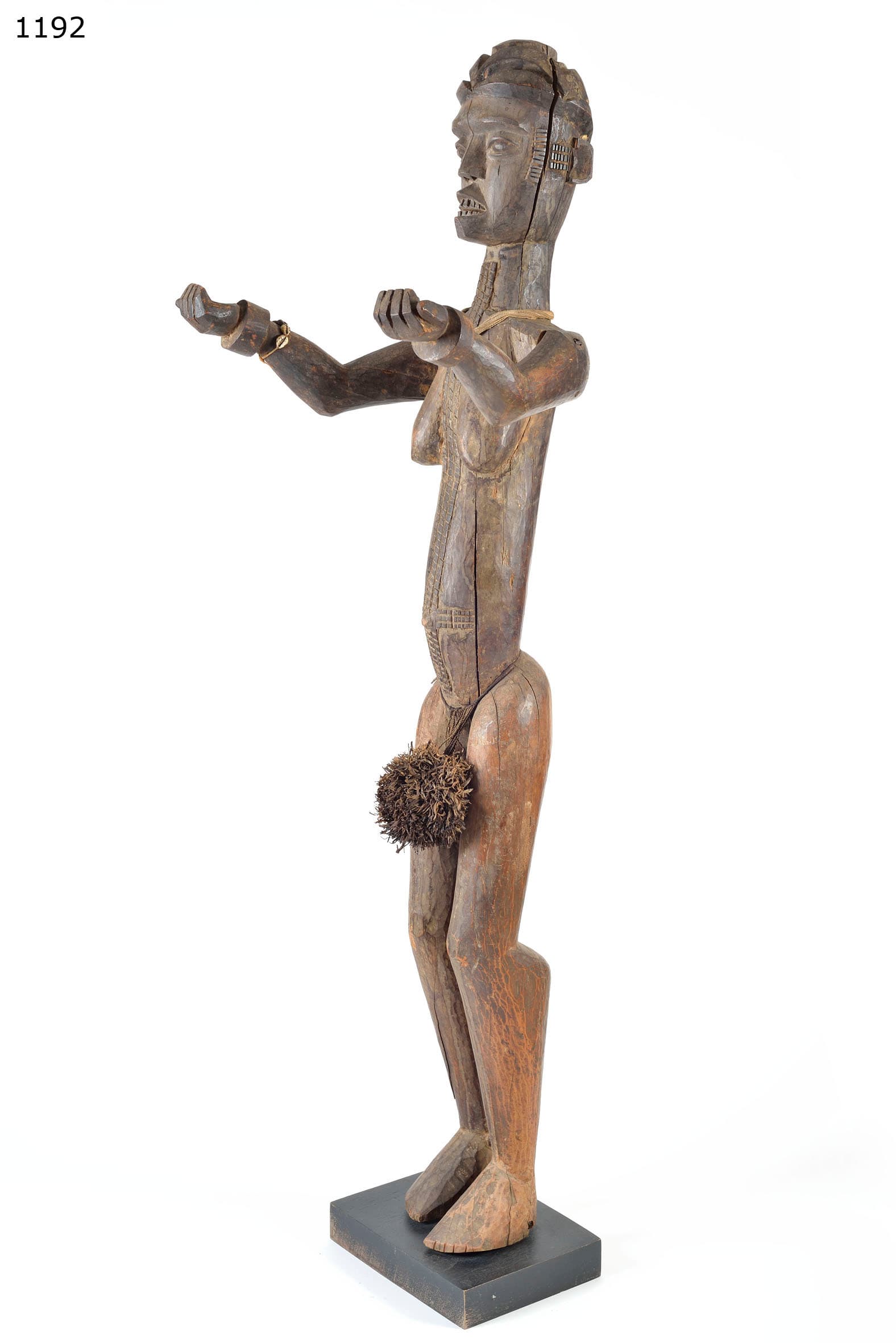
A dramatic sharply carved Igbo / Izi Ogbodo Enyi elephant mask (1st half 20th C., 60 cm) from Nigeria — a highly stylized elephant head with prominent projecting tusks, a sweeping trunk, and flat geometric ears, covered in high-contrast alternating blocks of black, white, and red pigment, the massive piece showing edge wear consistent with ceremonial use and a dry faded polychrome patina. Published in Kopfskulpturen p. 110; mounted on Metra socle.
1. Ogbodo enyi and zoomorphic cubism
The Izi (Izzi) subgroup of the Igbo in northeastern Nigeria are well known for the Ogbodo Enyi elephant mask — a departure from standard Nigerian portraiture.
- Sweeping Geometric Planes: The artist deliberately abstracts the immense bulk of the elephant into sharp sweeping geometric planes and stark triangular volumes.
- Kinetic Polychrome Disruption: High-contrast blocky pigmentation (red, white, black) disrupts the visual outline — creating a kinetic mesmerizing almost purely cubist architectural form designed to be viewed in rapid spinning motion.
2. Cleansing the village and ancestral weight
Despite its fierce aggressive appearance, the Ogbodo Enyi masquerade is a force of communal purification.
- Sweeping Away Discord: Danced by men of the Oglinye or related secret societies, the elephant spirit is invoked to forcefully sweep away witchcraft, disease, and social discord from the village.
- Charging Authority: Worn flat on top of the dancer's head, allowing him to charge through the community with the heavy unyielding power of the elephant — asserting male solidarity and the overwhelming authority of the ancestors to reestablish cosmic order.
3. Documented provenance and pigment oxidation
An example of documented provenance, published in Kopfskulpturen (p. 110).
- Pigment Aging: The natural pigments — white kaolin, red camwood, black charcoal — have deeply oxidized and faded directly into the wood grain, showing characteristics consistent with natural aging.
- Athletic Wear: Sharp protruding edges of tusks and trunk exhibit significant blunting, friction wear, and age-related chipping — suggesting its history as an actively danced crest mask.
Summary
Documented in the literature, this Igbo / Izi elephant crest is a striking example of West African zoomorphic cubism. Its aggressive architectural planes and aged polychrome surface make it a compelling ethnographic work.
Written with AI assistance from the collection appraisal, object photography and our own research; editorially reviewed. Mistakes are possible — corrections are welcome. How we work →

head crest (called elephant mask)
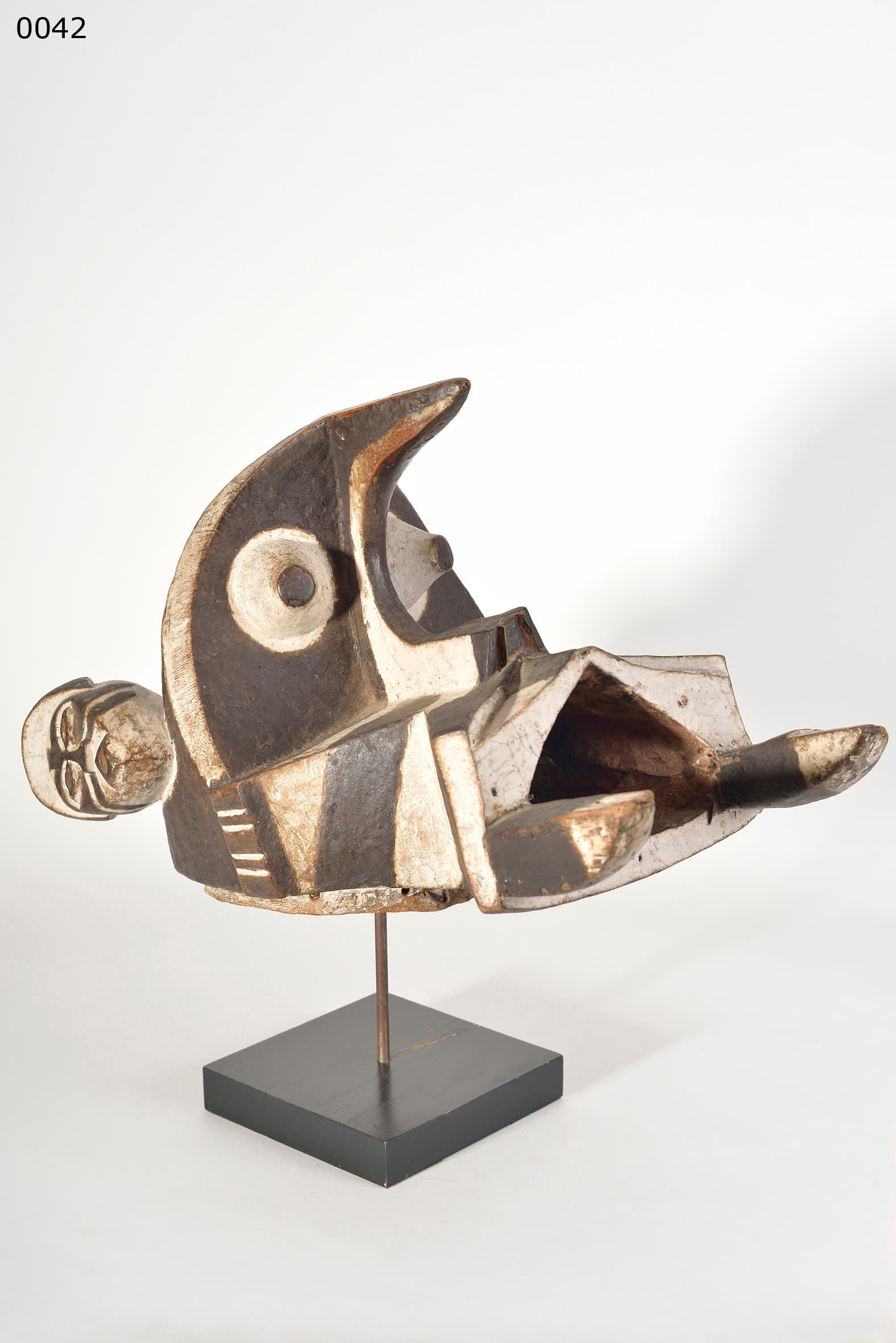
headcrest mask with multiple faces (called elephant mask)
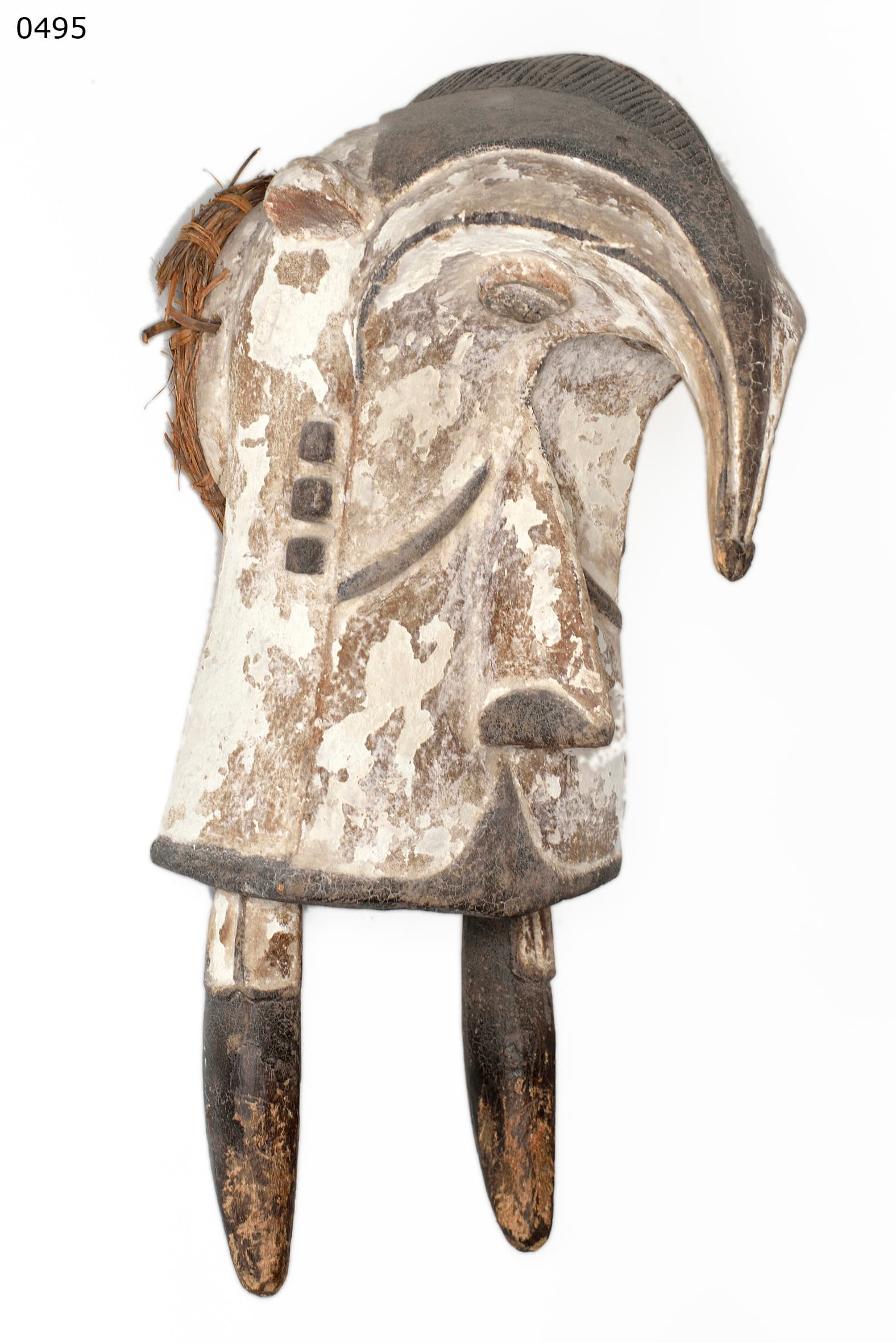
headcrest mask