Overview
The Izi (also variably transcribed as Izhi or Izzi in the ethnographic and linguistic literature) represent a demographically significant and culturally highly distinct entity within the highly heterogeneous and extensive Igbo linguistic and cultural group in south-eastern Nigeria. The geographical localisation of this ethnic group is primarily concentrated on the territory of present-day Ebonyi State, whose administrative, economic and historical axis is formed by the metropolis of Abakaliki. The ecological topography and the specific microclimate of this settlement area are of fundamental importance for the material culture of the Izi. The region is characterised by a distinctive transitory zone that forms an ecological bridge between the dense, humid humid tropical cross-Niger forests in the deep south and the significantly drier Guinean forest-savannah mosaic in the north of the state. This habitat is flanked by major hydrological systems, particularly the Cross River and its tributary, the River Aloma, which define the southeastern and eastern natural boundaries of the region and have historically acted as key vectors for cultural diffusion and economic exchange.
Demographic estimates from more recent statistical surveys put the specific population of the Izi at around 771,000 individuals, although this figure must be placed in the context of the total population of Ebonyi State, which is projected to be around 3,242,500 by 2022. Within this cohort, an estimated 540,000 individuals (based on linguistic census data from 2012) actively practise Izi as their primary mother tongue. From a linguistic perspective, Izi is categorised as part of the nuclear Igboid language family, which is an integral branch of the Volta-Niger languages within the superordinate Niger-Congo phylum (more precisely: Atlantic-Congo). What is remarkable here is that Izi does not form an isolated linguistic monolithic structure, but together with the idiomatic varieties Ezaa (Ezza), Ikwo and Mgbo forms a close-meshed and fluid dialect cluster that dominates the north-eastern periphery of the Igbo language area.
The pre-colonial social structure of the Izi, which has been handed down in part to the present day, is characterised by a strictly acephalous (free of domination) and radically egalitarian organisation. This socio-political model stands in sharp structural contrast to the highly centralised, hierarchical kingdoms and imperial systems of neighbouring peoples, such as the Edo Kingdom of Benin in the west or the Igala Empire in the north. The Izi historically refused to establish an autocratic monarchy or a superior chieftaincy. Instead, political, legal and ritual executive power is decentralised to a complex network of institutions. The basis of this system is the Umunna, the patrilineal kinship system, which generates the fundamental unity of social belonging, land tenure and ritual identity. Humphrey Nwosu and Francis Arinze agree that the Igbo family is not merely a reproductive unit, but an essential micro-political structure that is the absolute centre of social order, discipline and legal balance.
Beyond this kinship network, society is regulated by the highly complex Ogbo system (age classes). The age class system stratifies the male - and in specific functional contexts also the female - population strictly according to seniority. Individuals born in an identical chronological window (often at intervals of three to five years) are formed into a cohesive Ogbo unit. These cohorts grow up collectively, undergo synchronous initiation rites and take on sequentially ascending responsibilities for the community as they age - from physical defence and communal agricultural work in youth to legal dispute resolution and spiritual leadership in old age. The transition between these classes is obligatory, automatic and forms the most important index of an individual's social status. Anyone who does not rise in this system through economic failure or social deviance or does not acquire prestigious titles is socially marginalised, given the status of a "boy" and loses the right to a ritually appropriate burial.
Historically, the subsistence economy of the Izi was primarily based on extensive agricultural production, with the cultivation of yams (Dioscorea) holding absolute economic and ritual dominance. The topography of the region, characterised by fertile soils in the transition area to the Cross River Basin, predestined the Izi for agricultural surplus production, which involved them in dense trade networks with neighbouring peoples. The rhythm of these agricultural cycles not only determined the economy, but also synchronised the entire ritual calendar, in particular the timing of the great mask festivals in the dry season after the yam harvest.
In ethnographic taxonomy and historical mapping, the precise classification of the Izi represents a prominent and ongoing research controversy. The sources are ambiguous in this respect and characterised by conflicting scientific paradigms. The early, highly systematising classification by the British anthropologists Daryll Forde and G. I. Jones in their standard work from 1950 assigns the Izi, Ezza and Ikwo to the group of the "North-Eastern Igbo". This categorisation was primarily based on geographical parameters and the specific nature of their decentralised, dispersed settlement structure, which differs significantly from the highly localised, compact village units of the central Igbo.
However, later authors and especially art historians such as Sidney Kasfir call for a radical re-evaluation of these rigid linguistic-ethnic boundaries. Kasfir (1984) argues decisively that the Izi, through massive interethnic interactions, migrations and ritual borrowings in the Cross River Basin, have much stronger socio-cultural, performative and aesthetic affinities with the so-called "Cross River Igbo" as well as with non-Igbo groups of the Cross River region (such as the Mbembe, Yakurr or Ejagham) than with the nuclear Igbo groups in the West. Kasfir deconstructs the colonial paradigm of "One Tribe, One Style" and argues for abandoning the notion of "Igbo style" in this region in favour of a trans-ethnic "Lower Niger" or "Cross River" style, as secret societies and masked genres diffused freely across linguistic boundaries. Onwuejeogwu (1981) also supports this peripheral special position by pointing to the structural deviations in the kinship and settlement system of the north-eastern groups. Today, institutional access to the elementary ethnographic basic data, vocabularies and structural analyses of this region is largely secured by the historical collections and archive records in the British Museum in London and the Pitt Rivers Museum in Oxford.
| Linguistic classification | Population data (estimates) | Geographical localisation | Socio-political structure |
|---|
| Niger-Congo > Volta-Niger > Igboid > Izi-Ezaa-Ikwo-Mgbo Cluster | Total Ebonyi State: ~3,242,500 | Southeastern Nigeria, Ebonyi State | Akephalian (non-dominated), decentralised |
| Native speakers (active): ~540,000 (as of 2012) | Izi population: ~771,000 | Forest-savannah mosaic, Cross River Basin | Regulated by Umunna (lineage) and Ogbo (age classes) |
Cultural context
The religious and cosmological grid of the Izi is deeply rooted in the phenomenological reality of the agrarian cycle economy. It shares structural paradigms and basic ontological assumptions with the pan-Igbo system, but its local exegesis and ritual emphasis show specific north-eastern and Cross River-influenced deviations. The spiritual ontology of the Igbo is fundamentally based on a dual cosmological model. At the absolute top of this hierarchy is the supreme entity, the creator god Chukwu (in some dialects also Chineke), who is postulated in the indigenous creation myths as the direct creator of the Igbo (nwa ala - children of the earth) and initiator of yam cultivation.
Despite his absolute metaphysical supremacy, Chukwu functions in everyday ritual life as a classical Deus otiosus - a distant, remote creator who, after the initial cosmogony, has withdrawn into a spherical inactivity and no longer intervenes directly in the immediate worldly, legal or ecological concerns of the people. Instead, Ala (also articulated regionally as Ani or Ali), the omnipotent earth goddess, is responsible for daily cultic, legislative and normative power. Ala is the undisputed moral guardian of society, the invisible ruler of the local community and the definitive guarantor of fertility and agrarian reproduction. Every breach of taboo, no matter how marginal, every act of bloodshed and every disturbance of social harmony is primarily sanctioned not as an offence against abstract laws, but as direct ritual pollution of the earth (Ala). The metaphysical anchoring of patrilineal authority is legitimised via the Ofo - a ceremonial staff made from a specific branch, which is carried by the lineage elders and symbolises the uninterrupted, sacred connection to Ala as well as to the deified ancestors.
Among the Izi, ritual authority does not manifest itself through an institutionalised, hierarchical clergy in the Western sense. Rather, the religious system operates through a highly dynamic, polycentric network of councils of elders, specialised divinators (Dibia), secret societies and the aforementioned institution of age groups (Ogbo). The Dibia fraternities act as essential mediators between the profane and spiritual worlds; they diagnose metaphysical causes of illness or crop failures and prescribe the necessary sacrificial rituals to restore the cosmic balance. Secret societies and especially masked societies (generically called Mmanwu) appear incognito as physical embodiments of the ancestral spirits, especially in times of crisis or during festivities. Their liminal position allows them to humorously mock social deviance or repressively punish unsolved crimes without provoking intra-village blood feuds or individual acts of revenge, as the punishment is carried out through the medium of the spirits.
The role of women in the sacred and socio-political structure of the Izi is highly complex and defies a simplistic patriarchal interpretation. While women are strictly excluded from active physical performance within the masked societies (a transgression of this taboo was historically punished draconically, as myths about women buried alive testify), they organise themselves in parallel, extremely influential collectives. Groups such as the Umuada (the patrilineal daughters of a lineage) and the Inyemedi (the co-wives by marriage) form ritual-social power structures that regulate the behaviour of the men through collective actions, enforce peace agreements and create the indispensable spiritual resonance without which a ritual is considered ineffective through specific accompanying songs during mask performances.
A central, life-changing rite of passage for young men in the region is the Isiji ritual. This complex initiation ceremony marks the entry into the secrets of the men's societies and the acquisition of full social maturity. The eldest son of a family is required to undergo days of ritual isolation and preparation. The culmination of the initiation consists of an extreme endurance dance in front of the assembled village community. The initiate wears a specific Isiji mask - a hybrid construction of a wooden frame and a calabash face, which is ritually activated immediately before the dance by the application of dark Thaumatococcus leaves and a massive raffia robe. The dance not only tests physical resilience, but also proves the initiate's spiritual connectivity with the ancestors.
In the scientific interpretation of cosmological authorities, there is a prominent and ongoing research controversy between the Nigerian historians A. E. Afigbo and M. A. Onwuejeogwu. Afigbo dates the absolute spiritual hegemony of the central Nri culture (the historical spiritual centre of the Igbo) and its priesthood far beyond the entire Igbo territory as a uniform, almost undisputed paradigm of the pre-colonial era. He postulates a universal Igbo mythology in which Chukwu withdrew after a "fall of man" and the Nri priests acted as the sole mediators of earth purification. Onwuejeogwu (1981) vehemently contradicts this in his structural analyses: he states that the elaborated Chukwu mythology remained primarily limited to the immediate Nri sphere. Peripheral and geographically more isolated groups such as the north-eastern Izi and the Cross River Igbo maintained an almost self-sufficient cosmology, radically centred on Ala and local ancestors, in which the Nri priesthood played no institutional role. The sources on the pre-colonial networking of these extreme outlying districts are still ambiguous today, as oral traditions often retrospectively emphasise regional autonomy. Detailed information on these structural differences and their manifestation in material culture can be found in the scientific holdings of the Fowler Museum at UCLA. The groundbreaking exhibition Igbo Arts: Community and Cosmos (1984), curated by Herbert M. Cole and Chike C. Aniakor, was the first to systematically contextualise these regional cosmological variations for a Western audience.
Aesthetic features
The visual culture and the sculptural work of the Izi manifest themselves most impressively in a strictly canonised corpus of sculptures and masks, which in terms of formal language is significantly different from the classical, rounded aesthetics of the northern and central Igbo groups. At the centre of the performative and visual aesthetics are two divergent, complementary mask types that embody the ethical and energetic poles of the Izi cosmology: the delicate Agbogho Mmuo (spirit of the beautiful maiden) and the brutalist Ogbodo Enyi (elephant spirit mask), which is iconic for the region.
The Agbogho Mmuo masks epitomise the Igbo's absolute moral and physical ideal of beauty. Iconographic constants of this type are a delicate, symmetrical physiognomy, an extremely small, often slightly open mouth, a narrow, pronounced bridge of the nose and the detailed sculptural reproduction of local scarification marks (Uli tattoos), which signalise the ethical status of purity. The striking, pure white setting of the face, which is achieved through the repeated application of kaolin (white chalk), directly references the liminality of the afterlife, as white is the colour of spiritual purity, ancestors and the spirit world in the semiotic order of Igbo cosmology. While the standard Mmuo masks of the Isuama Igbo region have more compact helmet shapes, the Izi-specific sub-style is characterised by extremely verticalised hairstyles comprising up to three crests. These fragile structures are supported and aesthetically balanced by delicate and spirally carved appliqués (simulating elaborate braids) and multiple staggered, prominent neck rings. During the ritual activation, the white wooden head contrasts sharply with the colourful, geometrically appliquéd full-body suit made of imported or locally woven fabrics worn by the male dancer.
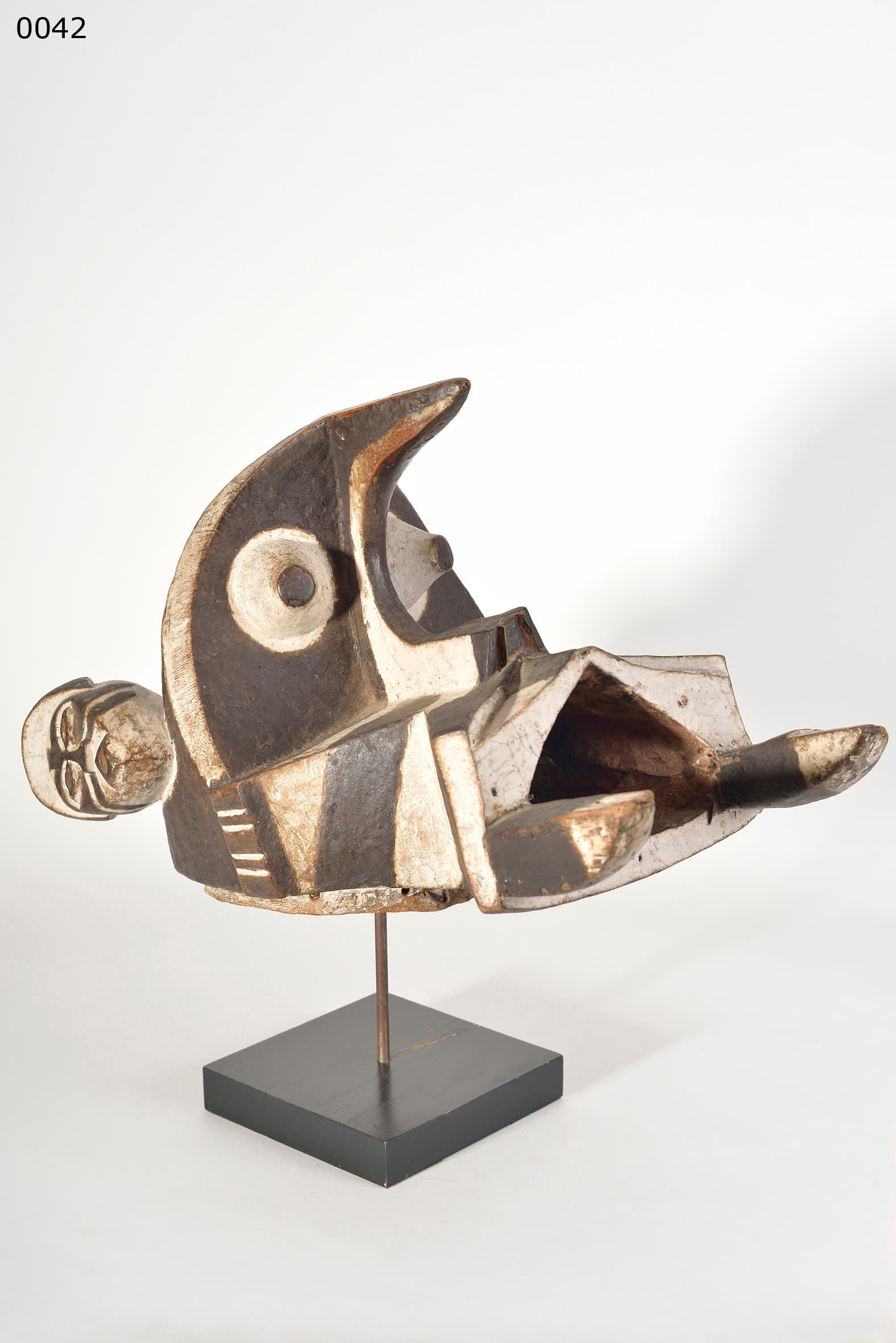
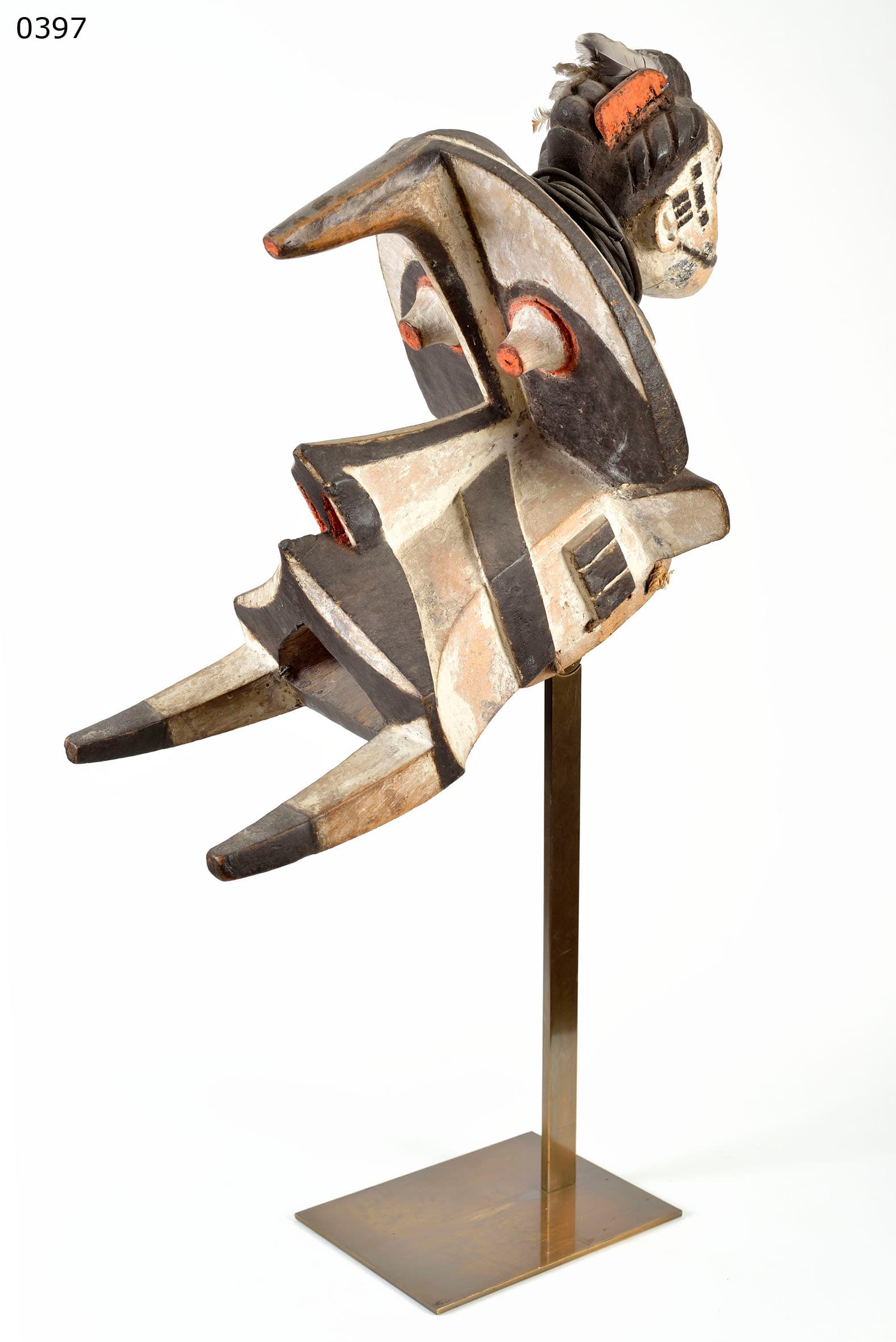
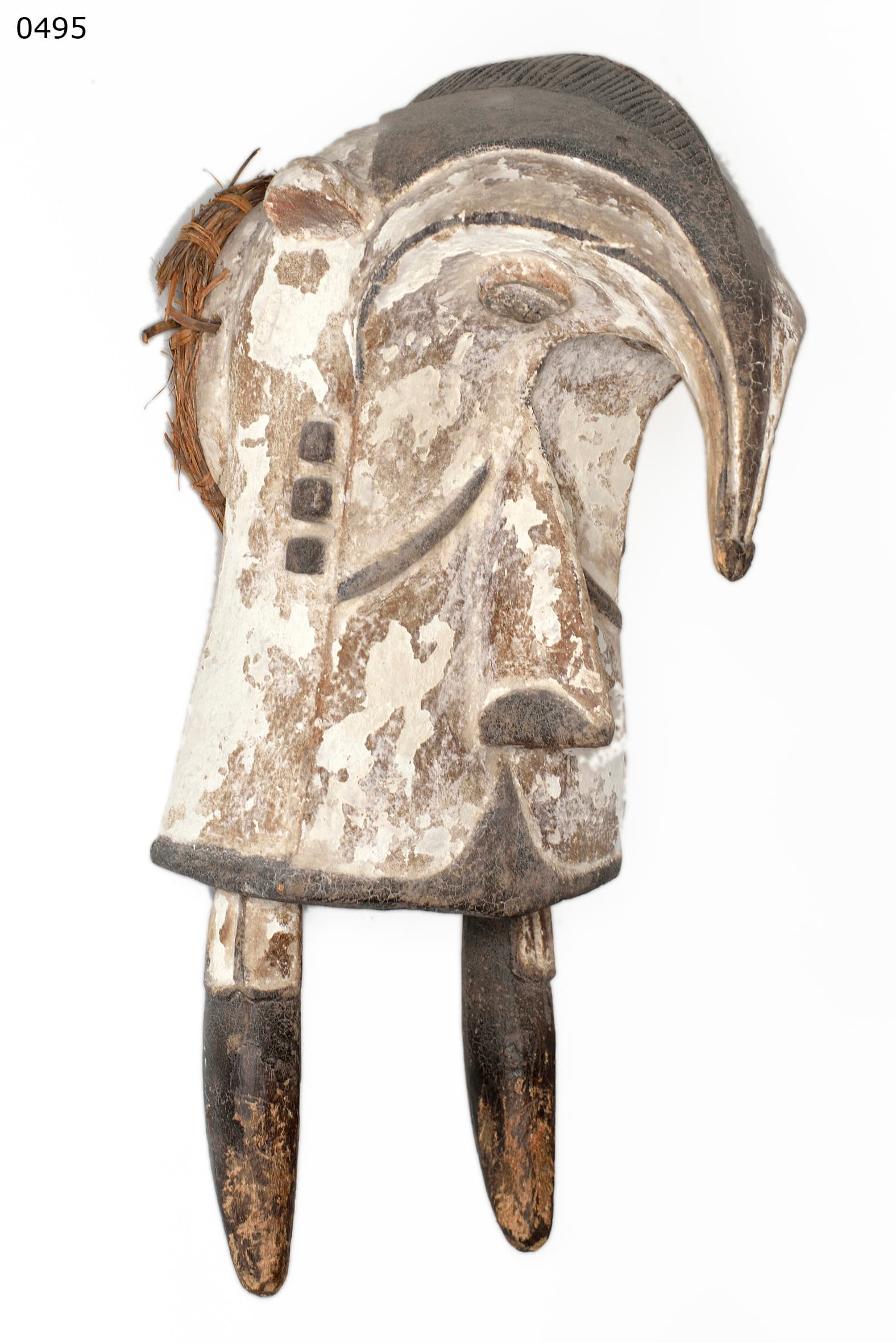
The radical aesthetic and performative antithesis to the girl's mask is the Ogbodo Enyi, a massive helmet to horizontal mask used exclusively in the Abakaliki region by the Izi and neighbouring Cross River clans. This type operates in an immense canon of proportions, with the objects often reaching a length of over 50 centimetres, which demands considerable physical strength from the dancer. The Ogbodo Enyi combines zoomorphic and anthropomorphic elements in a highly abstract, cubist form. The front of the mask is formed by a dominant, aggressively protruding elephant trunk and stylised tusks, while a flat, often highly abstracted human face is carved into the back of the head. The wood used is usually encrusted with an extremely rough, thick patina of use and sacrifice. This patina is created through the repeated ritual application of palm oil, copal, animal blood and chewed plant extracts, which form an organic layer over decades. The polychrome colouring is limited to aggressive accents of red, black and white, which visually reinforce the expressive facial features, protruding eyes and archaic force of the mask.
A substantial iconographic and material controversy that characterised research for decades was ignited by the specific surface treatments of this regional style and related Cross River objects. Early colonial officials and ethnographers such as P. A. Talbot (1912) summarily categorised the skin-covered sculptures found in the wider Cross River/Izi region as morbid 'war trophies'. Based on racist premises, they stylised these objects in an exoticising way as definitive forensic evidence of cannibalistic practices in which the skin of killed enemies was allegedly used to cover the wooden cores. This romanticising and pejorative colonial trope persisted, even in academic circles, until it was scientifically dismantled by the precise empirical and forensic fieldwork of Sidney Kasfir (1988) and Keith Nicklin (1974). Kasfir and Nicklin proved beyond doubt that the covering material in all documented cases was ritually tanned antelope skin. This was stretched over the wooden core to visualise the raw aggression and animalistic potency of specific masculine spirits, and bore no macabre anthropodermic origin.
Regardless of such historical clarifications, forgery issues remain highly evident on the recent art market, as the Ogbodo Enyi in particular has become a coveted collector's item. The dating of completely unpatinated works or isolated mask fragments is often highly speculative. Forgery criteria are strongly based on material science forensics: the absence of natural, asymmetrical insect feeding traces (especially by termites), the absence of deep heartwood cracks (which are inevitably caused by the permanent alternation of extreme humidity and dryness in the West African climate) and a homogeneous, sprayed-on patina instead of an organically stratified patina are considered almost certain indications of modern replicas aimed at the Western market. First-class, forensically verified reference pieces of the Izi aesthetic can be found in the curated collections of the Musée du quai Branly in Paris, the Metropolitan Museum of Art in New York (in particular from the former Tishman collection) and occasionally in the Museum Rietberg in Zurich. Documented master craftsmen or workshops that have been handed down by name are largely unknown in the historical literature on the Izi due to the strict anonymity of the ritual carver, whose identity had to take a back seat to the spiritual object.
Ritual practice
The functional biography of a ritual object among the Izi - its sociological lifecycle - runs through strictly orchestrated phases from profane wood harvesting to sacred charging, performative culminating use and final, often abrupt disposal. In this context, the performance of masks does not operate as an isolated artistic display, but primarily as an integrative theatrum of community regulation, ancestral remembrance and agrarian evocation, which builds on the anthropological premises of sacred time (in the sense of Mircea Eliade) and ritual drama (cf. E. R. Leach).
The performance of the Agbogho Mmuo (girl spirit masks) is a paradigmatic example of the channelling of metaphysical concepts through aesthetic exaggeration. These masks are danced exclusively by physically extremely agile young men of the Mmuo secret societies. Although the wooden mask represents female purity, moral integrity and gentleness, the masquerade requires immense physical dynamism and persistent rhythm. The dancer completely disguises her human identity with a tight-fitting, colourful and geometrically applied full-body suit made of fabric. These masks predominantly appear at the cyclical agricultural festivals in the dry season (such as the documented Fame of Maidens festival) to evoke bountiful harvests, as well as at the funeral rites of high-ranking elders. At funerals, they act as liminal escorts, accompanying the soul of the deceased safely to the afterlife of the ancestors. The choreography of these spirits is highly theatrical, graceful and light-footed; it explicitly serves to entertain humans and attending spirits alike - a sharp performative contrast to the threatening heaviness of the masculine mask genres.
An explicit example of such masculine performativity and raw energy is the use of Isiji masks in youthful initiations. This ritual act is usually performed by the eldest son of a family as he enters maturity and the Ogbo structure. The wooden core of the mask, made as a tall framework, is extended by the addition of a calabash face section. Immediately before activation - the moment in which the profane wooden object temporarily mutates into an altar of the spirit - the mask undergoes its ritual consecration. This takes place through the application of dark green Thaumatococcus leaves, which are inserted into the raffia weave at the top, whereupon the dancer, completely covered in a floor-length robe made of fresh raffia, begins his strenuous endurance dance. This dance is accompanied by the hypnotic, percussive rhythms of drums and drums. In parallel rituals, Ogbodo Enyi masks storm across the village square with extreme, seemingly uncontrollable speed and aggression in order to channel the destructive potential of unchecked natural forces (symbolised by the elephant) and make the authority of the secret societies physically tangible.
Central components of the ritual practice apart from the masquerades are prescriptive sacrificial acts and libations at static shrines. Ancestors and lower spirits who reside in the domestic or village altars require a continuous supply of energy. This is done through the ritual throwing of food (itu aka or itu aka ezi - the ritual throwing of food outside for wandering spirits) and the offering of palm wine. These acts appease the entities and reintegrate them into the social fabric of the family. Each Izi also has a chi (a personal guardian spirit) whose disposition determines the individual's fate. If illnesses or failures are attributed by divinators to a malevolent chi, the ritual authorities demand more drastic blood sacrifices, primarily goats, cows or chickens. In historical, pre-European crises, there are reports in the ethnographic periphery (as handed down by informants in Ohafia or among the Mmanwu covenants) of extreme ritual punishments, including human sacrifices, in order to appease the supreme chi-chuku and generate powerful medicine, even if the truthfulness of such practices is often regarded from today's perspective as the result of inner-African intimidation rhetoric.
The lifecycle of an object ends drastically and lacks any romanticised intention of preservation. As soon as a mask becomes unusable due to physical decay (such as massive termite infestation or structural cracks) or the divinator declares the irreversible loss of its spiritual effectiveness (agency) (deactivation), it abruptly mutates from a sacred tool to profane, even dangerous waste. In the Izi culture, objects that have been emptied in this way, but are ritually heavily preloaded, are never kept as works of art in the living space. Instead, they are thrown into the so-called ajo ofia ("fearful wilderness" / the evil bush). This strictly taboo section of forest on the edge of the settlement functions as a liminal dumping ground for anything spiritually dangerous, used or cursed that no longer has a place in the orderly village topography sanctioned by ajo ofia. The glaring discrepancy between a formerly living altar in the village and an inert museum piece alienated by the Western market can be studied in the historical diorama collections in the Pitt Rivers Museum (Oxford), which critically question the decontextualisation and "imprisonment" of these objects behind glass through postcolonial research.
| Ritual phase | Place of action | Actors | Objects / materials used | Function |
|---|
| Activation | Secret society area / shrine | initiates, priests | Thaumatococcus leaves, bast, palm oil, blood | Spiritual consecration of the wooden object |
| Performance | Village square (Obodo) | Mmuo dancers, accompanying musicians | Agbogho Mmuo, Ogbodo Enyi, cloth suits | Community regulation, ancestral commemoration |
| Libation | domestic altar | lineage elders, divinators | palm wine, yams, chickens (itu aka ezi) | appeasing the chi, maintaining cosmic balance |
| Deactivation | Ajo ofia (evil bush) | Secret society members | Decayed/termite-eaten masks | Disposal of spent ritual agency |
Historical context
The historical stratigraphy of the Izi-Igbo and their material culture is characterised by complex waves of migration, deep ecological adaptation processes and ultimately by harsh colonial ruptures. Prehistorically, the wider region is located in the extended cultural sphere of influence of the Igbo-Ukwu complex (dated to the 9th to 11th centuries AD), which provides archaeological evidence of early trans-Saharan trade networks and the existence of stratified, elite societies on the lower reaches of the Niger through spectacular, highly complex bronze works using the lost wax technique. However, oral traditions and historical research date the specific ethnogenesis of the Izi and the related Abakaliki cultural groups (Ezaa, Ikwo) to a later wave of migration in the 17th century. At this time, the legendary patriarch Ekuma Enyi and his followers separated from other, central Igbo groups (presumably originating from the Owerri/Orlu/Okigwi area) and settled in the fertile north-eastern periphery. In the course of the late 18th and especially the 19th century, there was a massive, demographically induced territorial expansion: the Izi, Ezza and Ikwo consistently advanced towards the Cross River in order to conquer undeveloped arable land. This aggressive land grab provoked regular armed conflicts with local indigenous, non-Igbo-speaking groups such as the Akunakuna.
The British colonial settlement at the turn of the 20th century met with fierce, decentralised resistance in this region. As the British doctrine of "Indirect Rule" was dependent on localisable rulers, it failed due to the acephalous structure of the Izi. Around 1898, British officers such as Moor and later (1904) Syer were forced to send brutal punitive military expeditions (so-called patrols) into the Abakaliki and Ahoada region to stop the ongoing warfare on the Cross River, monopolise the lucrative trade and enforce the Pax Britannica by force of arms. These colonial frictions culminated in systematic refusals to pay taxes, in which Igbo women in particular (in the wider context of the famous Aba Women's War / Women's Wars) participated extensively through organised protests against the colonial administration, which were violently suppressed by the British police.
A fundamental economic and socio-structural turning point, which indirectly fuelled art production, was marked in 1942 with the colonial introduction of wet rice cultivation in the Abakaliki district. Until this time, Izi women were primarily responsible for the tedious weeding of the yam fields in subsistence farming. With the advent of rice, however, women rapidly took over the parboiling (pre-cooking) and de-husking of the rice in huge wooden mortars. This new cash crop economy suddenly catapulted formerly economically marginalised Izi women into immense positions of power, as rice was not easily perishable and fetched high prices on trans-regional markets. This newly accumulated wealth indirectly flowed massively into the male title system and the patronage of ritual art, as considerable financial resources were now available in the families to pay renowned master carvers and sponsor prestigious mask dances to manifest status. Paradoxically, the colonial economy thus led to a late flowering of specific traditional art forms.
The Western art market discovered the radically abstract formal language of the Izi and the north-eastern Igbo comparatively late, as the focus had long been on the courtly arts of the Edo (Benin) or Yoruba. One of the first systematic collectors in the region was the anthropologist Jack Harris, who acquired important masks and sculptures in the Umuahia and Abakaliki region in 1939 (many of these pieces are now reference works in the Yale University Art Gallery). G. I. Jones (1950/1963), whose photographs and classifications are still standard works today, later carried out the in-depth scientific cataloguing. However, the global commercial breakthrough for the aesthetics of south-eastern Nigeria did not come until 1981 with the exhibition of the epoch-making Tishman Collection at the Metropolitan Museum of Art, New York. This exhibition finally elevated the radical abstraction of Igbo works into the Western canon of "World Art" and triggered a price surge. Auction houses such as Sotheby's subsequently recorded significant increases in value for authentic Ogbodo Enyi masks.
Today, the commercial trade in Izi art on the Western market is heavily dominated by counterfeiting issues, as the high demand has stimulated a local replica industry. Collectors and forensic experts evaluate the authenticity of ritual pieces on the basis of biometric, climatic and ritual markers. A genuine mask from the humid climate of the African rainforest usually reveals deep drying cracks in the heartwood (heartwood cracks) caused by the rapid change in humidity. Another criterion is asymmetrical insect damage (especially by termites) that has eaten deep into the wood, as historical storage in open village shrines offered no climatic preservation. In addition, the natural stratification of the patina is examined visually and chemically: an authentic patina shows smoothed edges that have become greasy through years of handling, while ritually applied layers of palm oil, blood or kaolin have migrated deep into the pores of the wood. This must be sharply distinguished from modern, chemical rapid ageing (such as artificial staining, smoking in ovens or superficial rubbing with earth). Ultimately, the only absolutely reliable sign of authenticity on the current market is a complete, documented provenance, as recorded in the early collections of the 1930s and 1950s.