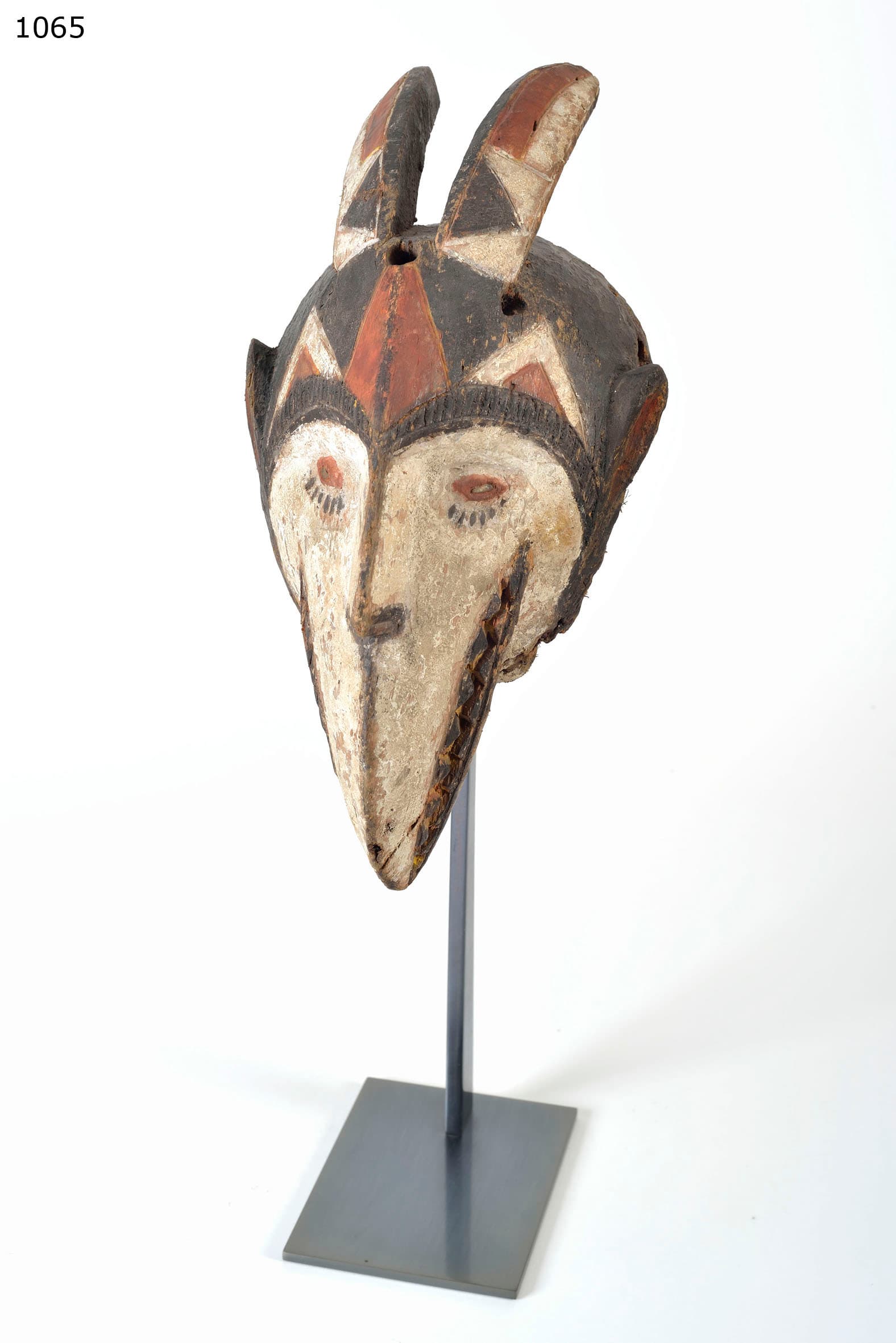
A naturalistic Boki headcrest mask (attributed to the first half of the 20th century, 36 cm) from Nigeria — a broad face with arched brows, an open mouth, and prominent lateral ear projections, framed by a thick border of woven fiber and hair. The surface is heavily darkened, exhibiting a deep encrusted patina suggestive of organic anointing and oxidation.
1. Cross river naturalism and volumetric power
The Boki, situated in the Cross River region bordering Cameroon, share stylistic affinities with their Ekoi/Ejagham neighbors, who are known for producing highly naturalistic portraiture.
- Fleshy Swelling Volumes: The carving features fleshy cheeks, a defined nose, and an open mouth, conveying a sense of vitality.
- Fiber + Wood Hybridity: The integration of thick organic fibers around the crown is characteristic of Cross River hybrid materiality, combining wood and organic elements.
2. Nkanda and secret society prestige
Worn horizontally atop the head like a cap during masquerades, these crests are traditionally regarded as insignia of elite male (and sometimes female) secret societies — such as the Nkanda.
- Ancestral Portraiture: They are traditionally understood to represent idealized ancestors, warriors, or tutelary forest spirits.
- Performance Contexts: Traditionally danced during funerals of chiefs, initiations, and major harvest festivals, the mask is associated with reinforcing social cohesion and the authority of the secret society.
3. Dark oxidation and fiber preservation
The dark, almost blackened surface suggests a history of ritual use.
- Glossy Anointed Crust: The surface is consistent with anointing with palm oil, soot, and camwood powder, which has oxidized into a dark crust.
- Rafter-Preserved Fibers: The organic fiber trimming at the crown is preserved, suggesting it may have been kept in domestic or shrine environments between performances.
Summary
Embodying the naturalism of the Cross River region, this Boki headcrest presents a naturalistic ancestral depiction. Its organically encrusted patina and preserved fiber elements are consistent with its traditional role as a secret society insignia.
Written with AI assistance from the collection appraisal, object photography and our own research; editorially reviewed. Mistakes are possible — corrections are welcome. How we work →