Overview
The Boki ethnic group, usually referred to in the specialist literature under the indigenous self-designation Bokyi, forms a highly complex and culturally and linguistically significant population group in the deep south-east of the Federal Republic of Nigeria and in the neighbouring south-west of the Republic of Cameroon. The geographical distribution of this community is primarily centred on the densely forested and topographically challenging corridor of the Cross River Basin. On Nigerian territory, the settlement area is administratively located in the Boki Local Government Area (LGA) of Cross River State with the administrative capital of Boje. This area is characterised by the massive and inaccessible foothills of the Afi Mountain range (Afi Mountain Wildlife Sanctuary) and the last remaining contiguous tropical rainforest areas in Nigeria. On the Cameroonian side, the settlement area of the Boki diaspora extends into the Akwaya Subdivision of the Manyu Division in the Sud-Ouest region, deep into the border area north-west of the town of Mamfe (Mansfeld 1908: 7). Current demographic surveys and estimates based on models of geostatistical population updates put the global population of the Boki at around 322,000 individuals. The distribution is extremely asymmetrical: while around 314,000 people of this ethnic group live in Nigeria, the Cameroonian population comprises only around 8,300 people (Blench 2015: 12; Bonchuk 2009: 76). This sharp demographic division is not the result of indigenous migration patterns, but the direct legacy of the colonial demarcations between the then British and German protectorates, which artificially cut up the unified cultural area from 1884 and finally in the border treaties of 1913.
Linguistically, Bokyi (also known in older ethnographic literature under the exonyms Nki, Nfua, Osikom or Vaaneroki) represents a highly differentiated language that is divided into a dozen regional dialects. The documented linguistic varieties include Basua, Irruan, Boje, Kwakwagom, Nsadop, Osokom and Wula (Tawo 1977: 54). The phylogenetic categorisation of this language marks one of the most prominent controversies in Africanist linguistics. Traditionally, Bokyi was categorised as belonging to the Bendi language family, which in turn was classified by researchers such as Greenberg as a sub-branch of the Cross River languages within the massive Benue-Congo language family. However, more recent lexicostatistical analyses and historical reconstructions, particularly by Blench, radically challenge this paradigm. Blench argues that the Bendi languages, and thus also Bokyi, are not cross-river languages in the strict sense, but rather must be understood as an isolated, early split-off group of southern Benoid languages, which only developed lexical convergences with the neighbouring cross-river peoples through extreme cultural diffusion pressure (Blench 2015: 10; Bruns 1975: 12).
The social structure of the Boki is historically characterised by an acephalous, i.e. rulerless, organisation. Instead of a centralised kingship, as exists in other large African kingdoms (such as the neighbouring Bamum in the Cameroon grasslands), the political, judicial and social executive rests on the shoulders of local councils of elders and a complex architecture of secret societies. The kinship system that forms the core of this social structure is another point of massive ethnographic research controversy. While early administrative reports simply defined the Boki as patrilineal, more recent socio-historical and ethnological studies point to the profound influences of so-called double-unilineal (bilineal) kinship systems, as documented among the Cross River Igbo and the Yakurr (Yakö) in the west. Vubo points out that in this region patrilineal and matrilineal institutions often coexist as complementary "inverted mirror images". In such a system, the patrilineal line is responsible for the inheritance of immovable property and political status, while movable property, spiritual knowledge and cultic privileges are often passed down through the matrilateral kin (the mother's line) (Vubo 2005: 146; Ndukwe 1996: 22). This systemic duality acts as a mechanism of conflict reduction and wealth dispersion, as wealth flows horizontally through society and is not accumulated purely vertically in a single line of descent (Okoko 1983: 45).
Economically, Boki society is based on a subsistence system that is categorised in the literature as forest-dependent peasant farming. The central basis of nutrition and social prestige is the cultivation of yams, flanked by cassava, maize and plantains. This subsistence economy is complemented by the commercial extraction of forest products, including cocoa, coffee, palm oil and tropical timber. However, the dense forests are not only an economic resource, but also a spiritual retreat and supplier of raw materials for the ritual art production of the mask carvers.
The relationship between the Boki and their neighbouring peoples is characterised by a historical symbiosis that goes far beyond the concept of strict ethnic boundaries. The Boki are flanked to the north by the Ogoja, Obudu and Tiv, and to the south and west by the Ejagham (Ekoi), Etung and Efik. Bonchuk coined the term "osmotic point" for this region. Despite the harsh colonial demarcations, the Cross River borderland always functioned as a permeable zone of massive cultural, economic and ritual exchange. Religious cults, mask forms and the secret writing system Nsibidi diffused freely between the Boki, the Ejagham and the Efik (Bonchuk 2009: 77). Museum documentation in the Fowler Museum (UCLA) repeatedly emphasises these fluid transitions in its inventory catalogues, which often make it impossible for ethnographers to assign an object removed from its historical context to a single ethnic group in isolation without considering the transcultural corridor.
| Demographic parameters | Nigerian population | Cameroonian population |
|---|
| Primary settlement area | Cross River State (Boki LGA) | Sud-Ouest Region (Akwaya Subdivision) |
| Estimated population | approx. 314,000 | approx. 8,300 |
| Ecological Zone | Afi Mountains, Tropical Rainforest | Cross River Foothills, Dense Forest |
| Political Administration | Local Government Council | Subdivision Administration |
| Linguistic status | Vigorous (High vitality, ISO 639-3 bky) | Minority dialects, Pidgin dominance |
Cultural context
The religious system of the Boki is a highly complex, multi-layered structure that differs significantly from the monotheistic or strongly anthropomorphised pantheons of other West African societies. The cosmological order rests on the fundamental premise of a supreme creator god who is invoked as Osowo-Obrokpabe (in dialectal variations also Osiwe-Oborokpabe or Osowo osusó). This creator is the singular, absolute supreme authority of all matter and spirituality. He is characterised as peaceful, merciful and immeasurably wise, but rarely intervenes directly in the profane, everyday concerns of people. Instead of a punitive, tyrannical God, Osowo-Obrokpabe is a silent presence (Owan 2004: 219). The ontological connection between this creator god, the human community and the physical environment is regulated by two deeply philosophical core motifs of Boki religion: Beri-be and Keredede. Beri-be can best be translated as a basic ethical attitude of ritual and physical harmlessness - a state in which humanity does no harm to creation. Keredede refers to the final state of ultimate cosmic harmony in which all relational tensions between individuals, animals, plants and ancestral spirits are cancelled out. Every agrarian failure, every illness and every social misfortune is interpreted as a breach of the Keredede that must be ritually healed (Oweh 2004: 68).
Since the creator god remains abstract, everyday ritual interaction is conducted through a hierarchical system of intermediaries. These include ancestors (Ndi ikwu) as well as personified natural and spiritual beings who act as local deities. Among the most prominent are Ezza, the god of war and defence, and Mfam, a guardian spirit who acts as the guardian of truth and avenger of perjury and is ritually invoked when oaths are sworn (Owan 2004: 220). The ritual authority to contact these entities is vested in specialised divinators and the priests of the Nchebeh covenant, who oversee the symbolic bond between creator and community.
Structurally, the religion of the Boki differs drastically from the cults of their northern neighbours (such as the Tiv) through the absolute dominance and penetration of society by formalised secret societies. Political, judicial and religious life is dictated by these exclusive associations. The most powerful of these societies, which spans the entire Cross River corridor, is the Ekpe or Mgbe society (the Leopard society). Originally from the dense rainforests, this men's organisation acts as a supreme judicial authority, debt collector and guardian of public morality. The members of the Ekpe confederation communicate via the esoteric, ideographic sign system Nsibidi, which is embroidered on fabrics, carved into wood or drawn on the ground to encode grade-specific knowledge (Kah 2017: 501). In addition to the pan-regional Ekpe, the Boki maintain specific functional covenants: The Nkang covenant forms the warrior society, the Bekarum covenant organises the elite hunters and controls the metaphysical dangers posed by animals killed in the forest (Nicklin 1974: 15).
A strikingly unique feature of the Cross River cultures and the Boki in particular is the institutionalised role of women in the cult, which culminates in the Egbege covenant. Unlike in many patriarchally dominated African societies, where women are excluded from ritual authority, the Egbege covenant autonomously controls the affairs of the female sphere. The central rite of passage orchestrated by the Egbege covenant is the initiation ritual of young women, known as the "fattening house". The initiates are physically separated from the village community for months, sometimes years. During this time, they are given an extremely high-calorie diet to achieve a beauty ideal of fullness and fertility, are given elaborate kedako scarification marks and taught the esoteric songs, dances and duties of motherhood.
The exact power-political interpretation of this female covenant is the subject of fierce research controversy. Authors such as Ute Röschenthaler (1998: 38) postulate that women's alliances such as the Egbege possessed a complementary, independent authority in pre-colonial society that was completely equal to that of the men's alliances, and are thus evidence of a balanced, dual-gender power structure. Diametrically opposed to this are the interpretations of early colonial ethnographers such as Percy Amaury Talbot (1912: 260), who saw these female institutions merely as instruments of patriarchal moulding, through which women were prepared for the male marriage market, while ultimate political control always remained with the male leopard leagues. Museum collections, such as the British Museum's holdings (which include many objects acquired by Talbot), often still reflect this outdated, asymmetrical reading in their archives, while modern fieldwork reinterprets the ritual masks of the Egbege League as symbols of female sovereignty.
| Secret society / association | Primary clientele | Cosmological-ritual function | Typical ritual objects |
|---|
| Ekpe / Mgbe (Leopard League) | Men (hierarchical degrees) | Supreme judiciary, debt collection, preservation of the Keredede, death cult | Nsibidi cloths, leopard skins, gongs, esoteric drums |
| Nkang | men (warrior caste) | defence of the community, defence against physical/spiritual aggressors | large leather-covered helmet masks (Janus form), weapons |
| Women | Female initiation (Fattening House), fertility rituals, protection of mothers | Small, fine bonnet attachments with light-coloured pigments (kaolin), hairpins | |
| Men (hunters) | Propitiation of the forest spirits, rituals after killing dangerous animals | Horizontally worn animal masks, amulets, hunting trophies | |
Aesthetic features
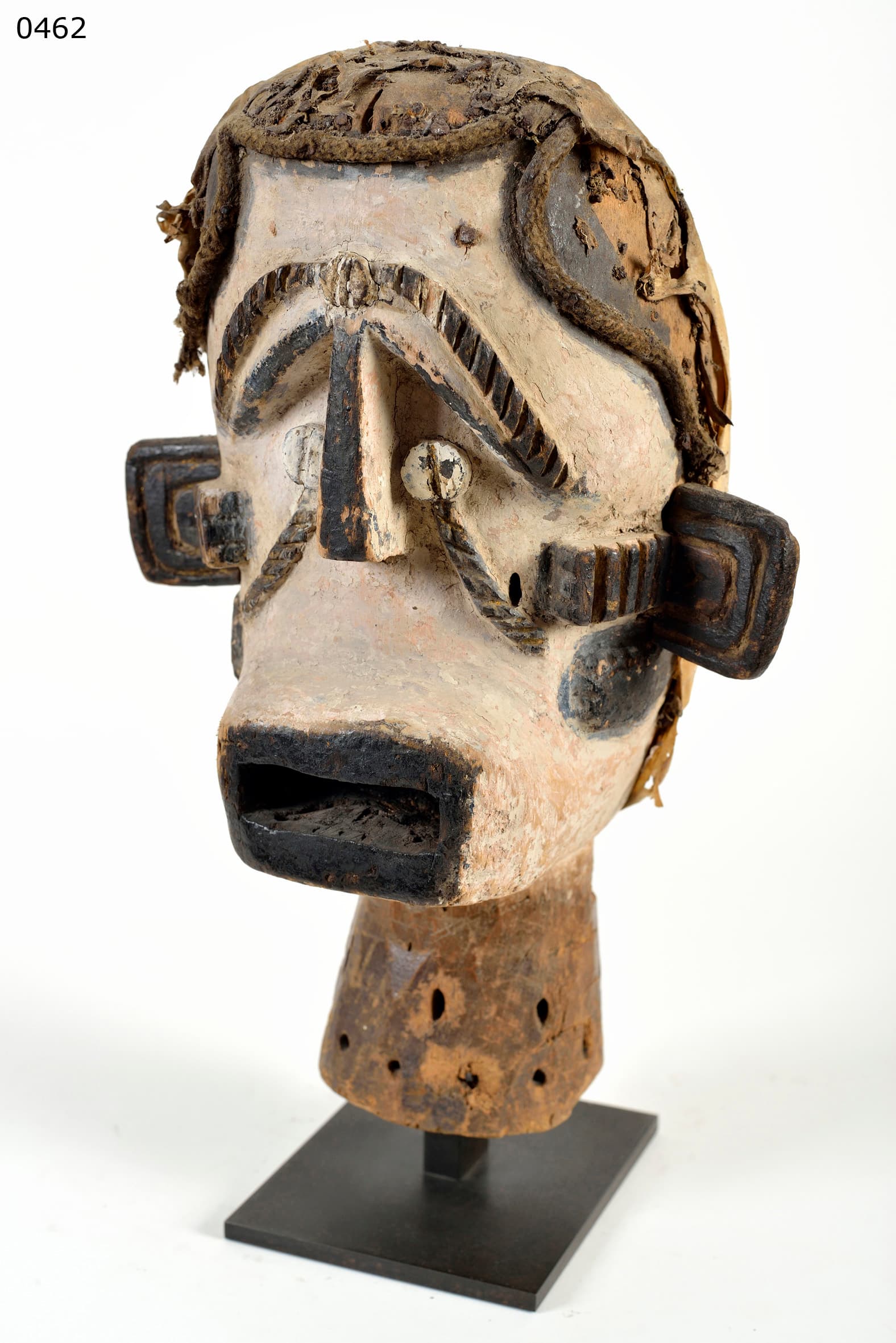
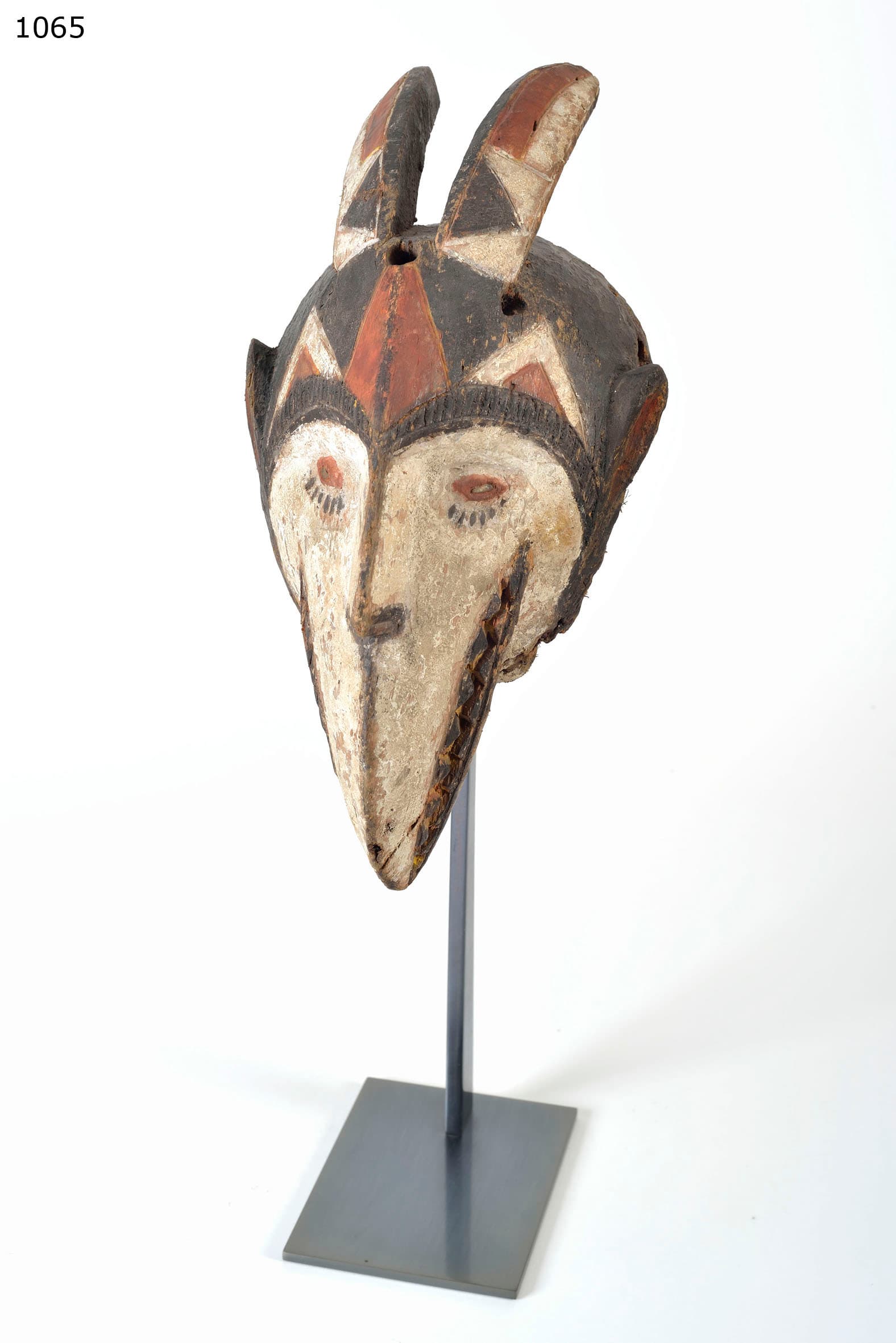
Among international collectors, Boki visual art is represented almost exclusively by an extremely specialised and technically outstanding canonical object type: the leather-covered wooden mask. These masks represent the aesthetic pinnacle of material culture in the entire Cross River Corridor and are a unique feature that cannot be found anywhere else on the African continent. The object typology of the Boki is essentially divided into two primary subtypes. The first type is the smaller cap mask, which is mounted on a woven basket ring and balanced on the top of the dancer's head so that the wearer's face remains underneath (often covered by cloth). The second, far more massive type is the helmet mask (Helmet Mask), which is placed over the dancer's entire head and neck like an upturned cylinder and rests on the dancer's shoulders (Nicklin 1974: 8).
Both subtypes appear most strikingly as a Janus figure (Janiform). Iconographically, this proportional canon of two-facedness has a profound significance. The Janus-headedness of the Boki masks epitomises the omniscience and metaphysical superiority of the ancestral spirits, who can simultaneously see into the world of the living (past) and the spirits (future) (Vogel 1986: 102). The two faces are often differentiated according to gender: One face (male) is coloured dark, while the opposite face (female) is lightened with white kaolin pigment.
The choice of material and the process of creating the patina are technologically unique. A core of soft, easy-to-work tropical wood serves as the basis. When wet, this wooden core is covered with the freshly stripped, untanned skin of antelopes. During the slow drying process, the subcutaneous fat particles on the inside of the animal skin act as a natural, high-strength adhesive that moulds the skin precisely to the contours of the recesses in the wood. The mask is then finished with applications that evoke an uncanny realism: Eyes are cut out of shiny sheet zinc or iron, pupils are fixed with wooden pins and the mouths are fitted with real animal bones, carved wooden pegs or palm leaf ribs that imitate the typical local teeth filing. The final colour patina is achieved using organic pigments. The deep black (kedako), obtained from the leaves of a local legume, is used to mark scarification and nsibidi patterns on the temples and cheeks. A further layer of patina (smoke patina) is deposited on the masks over decades in the smoky attics of the meeting houses. The Metropolitan Museum of Art preserves a striking example of this outstanding technique (Accession 315079): A boki bonnet attachment that features elaborate indigo-dyed textile wraps on six horn-like coiffure cylinders in addition to the leather covering. In terms of size, the spectrum ranges from intimate 20 cm tops to over 60 cm tall, massive helmet masks of the Nkang waistband, which demand enormous neck muscles from the dancers.
Research into these aesthetic objects has been characterised by a long-running iconographic controversy between leading experts in the region. The husband and wife team of Keith Nicklin and Jill Salmons, who dominated the fieldwork in the Cross River area, argued academically about the exact stylistic origins of the masks. While Jill Salmons argued in parts of her work (e.g. 1986: 72) for a narrower stylistic core zone and attributed certain formal characteristics to the eastern Keaka, Nicklin argued vehemently in favour of a comprehensive continuum model. Nicklin (1979: 54) did not see the Boki masks as an imported style, but rather as the centre of a flowing stylistic evolution that extended from an archaic Idoma style in the northwest to the Ejagham communities in Cameroon. Another historical 'controversy', which was more of a colonial misunderstanding, was the claim by early British officers (such as Talbot in 1912) that the masks were covered with human skin from slain enemies. This macabre, romanticising and pejorative trope of the 'cannibal headhunter' was finally debunked as a myth by Nicklin's (1974: 8) rigorous scientific analyses; the use of antelope skin has been factually proven.
Master hands known by name (such as the famous Ateu Atsa among the nearby Bangwa) are completely absent among the Boki; art production was institutionally anchored in the secret societies and demanded anonymity. There is an absolute ontological dividing line between the profane, freshly carved wooden blank and the ritually activated object. It is only through the rite of consecration that the handcrafted piece is transformed into a sacred object. This separation is of great relevance on the art market today, as forgery workshops (especially in Foumban, Cameroon) flood the market with replicas (Tchandeu 2022). Genuine, ritually used pieces are distinguished by clear forgery criteria: Deeply penetrating termite damage that does not appear artificially milled, natural heartwood cracks caused by decades of drying, and a patina that shows layers of blood, plant soot particles and organic fats under UV or spectroscopy analysis, in contrast to the shoe polish or bitumen used by counterfeiters.
Ritual practice
The ritual practice around the masks and altars of the Boki represents a multimedia, sensorially overwhelming transformation. For the Boki, a mask attachment in itself is merely a mute wooden and leather body. It must first be activated by priests of the Nchebeh covenant in order to function as a vessel for metaphysical powers. This activation is a strictly esoteric process, subject to the consecration rites of the creator god Osowo-Obrokpabe and the ancestral spirits. The rite involves the offering of blood sacrifices - usually roosters or, more rarely, goats - whose blood is spread on specific altar stones and in the inner basketwork of the mask (Mansfeld 1908: 221; Oweh 2004: 70). The blood acts as an energetic catalyser, summoning the spirits of the ancestors from the dense jungle and binding them in the physical form of the mask to ensure cosmic harmony (Keredede).
Once the mask is activated, it is prepared for the performance. Fitting it to the dancer's body is a physically demanding feat of engineering. Bonnet masks are lashed tightly to the wearer's head using strings. To create the illusion of a purely spiritual being and erase any human anatomy, the performer's entire body, from neck to ankles, is wrapped in an opulent garment of knitted nets, hand-woven textiles and solid layers of black-dyed raffia fibres (Nicklin 1974: 15). This habitual structure guarantees complete depersonalisation. The dances themselves vary drastically depending on the commissioning organisation. In performances of the warrior covenant Nkang, the dancer performs wild, unpredictable and aggressive hooks. This kinetic violence demonstrates the warlike power of the ancestors, who shield the village from enemies and malevolent magic. The energy of the mask is considered so explosive in Nkang performances that in some regional variants of the southern Cross River areas, attendants must guide the mask dancer on thick ropes to prevent the spiritual ecstasy from propelling him into the crowd (Nicklin & Salmons 1984: 41). In contrast, the dances of the women's Egbege, which often mark the conclusion of the "Fattening House" initiation of young girls, are dynamic but rhythmically softer and accompanied by the pounding sounds of small metal bells and leg bells, celebrating fertility and the continuity of the lineage.
The life cycle of such a ritual object is a reflection of transience. From a newly carved, light-coloured block of wood, it is transformed into a highly charged sacred object through covering with animal skin, pigmentation and blood sacrifice activation. However, after festive occasions (such as yam harvest festivals or funerals of dignitaries), the object is rarely ritually burnt or ceremonially buried. Instead, it is virtually put into a state of deactivation ("sleep"). The masks are stowed away in the dimly lit, poorly ventilated attics of the central Ekpe meeting houses. They are often stored there unused over open fires for years. The rising smoke penetrates the animal leather and the soft tropical wood, partially preserves it against insect damage and covers the objects with the dense, sticky, deep black smoke patina (smoke patina) that is a primary criterion of authenticity for Western collectors today. When the leather finally cracks or the wood is eaten away by insects, the spiritual power is considered to have escaped and the remains are disposed of without further ceremony in the bush ("bad bush"). Field photographs that have found their way deep into the archives of the Pitt Rivers Museum in Oxford (such as PRM 1998.480.11) impressively document this sharp contrast between a mask lying statically in a display case and the multimedia inferno of dust, bast, drum rhythms and transcendental energy at the moment of performance (Jones & Salmons 2011).
| Phase of the Lifecycle | Ritual Status | Physical & Material Transformation |
|---|
| 1st carving & covering | Profane (wooden block) | Carving of the soft wood, stretching of the fresh antelope skin, fixation with fat and wooden pegs. Pigmentation with Kedako. |
| 2nd consecration | activation (sacred) | discussion by Nchebeh priest, offering of chicken's blood on the basketwork. |
| 3rd performance | Active presence of the ancestors | Binding to raffia costumes. Exposure to sweat, kinetic movement and climatic humidity during the dance. |
| 4. dormancy (storage) | passive (sleeping) | storage in the roof truss of the Ekpe house. Accumulation of a thick, protective soot and smoke patina (Smoke Patina). |
| Decay & disposal | Deactivated (desecrated) | Cracks in the leather, termite damage to the heartwood. Loss of connection to the ancestors. Formless disposal in the undergrowth. |
Historical context
The historiography of the Boki is deeply interwoven with the major demographic tectonic shifts of the African continent. The migration history of this people is a field of intense debate in historical linguistics and archaeology. Oral traditions of the Boki, flanked by lexicostatistical data, indicate that the Bendi-speaking groups were part of the prehistoric Bantoid expansion. Some theories postulate that the Cross River region, on the border between present-day Nigeria and Cameroon, was the actual nucleus of this gigantic migration, from where proto-Bantu-speaking groups successively colonised the Congo Basin (Zaire) and southern Africa from around 1500 BC (Blench 2015: 11). Dating controversies pervade this field: while linguists date the differentiation of the Cross River groups to the late Neolithic, other historians argue that the Boki in their recent form only emerged through much later, pre-colonial return migrations or consolidations in the 16th century during the transatlantic slave trade. Before the arrival of the Europeans, the Boki acted as crucial middlemen in the highly profitable trade routes along the Cross River, through which copper alloys (manillas), slaves and later palm oil were transported to the coast to the Efik.
The colonial encounter in the late 19th and early 20th centuries represented a traumatic geopolitical rupture. During the so-called "Scramble for Africa", Great Britain and the German Empire used the Cross River and the Rio del Rey as a bargaining chip. Between 1884 and 1913, numerous British-German border commissions were set up, which cut up the homogeneous cultural territory of the Ejagham and Boki with a ruler without any regard for ethnic, kinship or economic ties ("osmotic points"). Families were separated overnight into subjects of British Nigeria and German Cameroon (Rudin 1968, cited in Bonchuk 2009: 80).
Ironically, the era of the German colonial administration in Cameroon is a stroke of luck for the documentation of the art history of the Boki. The German doctor and district officer Alfred Mansfeld was in charge of the Odissinge station from 1904. Unlike many destructive colonial officials, Mansfeld developed a deep, if paternalistic, ethnographic interest in the peoples of the region (Boki, Ejagham, Keaka). With the help of his local informants, King Ogba and the interpreter Odjong-ofo, he not only compiled comprehensive data on law, music and agriculture, but also acquired enormous quantities of cult objects. Mansfeld's monograph Urwald-Dokumente, published in 1908, is still one of the most invaluable primary sources today. His immense collection of hundreds of objects was shipped to Europe and today fills substantial parts of the holdings of the Ethnological Museum in Berlin and the Museum am Rothenbaum (MARKK) in Hamburg. The archives and correspondence surrounding these collection acquisitions document the earliest Western market value of these artworks (Fossi 2020: 3).
At the same time, colonial history had a devastating impact on local art production. The enforcement of colonial administrations and the aggressive expansion of Christian missions (such as the Qua Iboe Mission) led to the targeted suppression of secret societies. As the masks were an integral part of the Ekpe and Nkang cults, their ritual production collapsed dramatically in the 20th century. When the British ethnographers Keith Nicklin and Jill Salmons travelled to the region in the 1970s, the leather-covered masks were on the verge of extinction. They then initiated the "Ethnographic Retrieval Method" - a controversial but salvageable programme in which they located surviving ancient carvers and paid them to recreate traditional mask types for museum collections (such as the National Museum in Oron or Western institutes) (Nicklin 2000). These efforts conserved knowledge, but led to a wave of "new" pieces emerging in the 1970s, which later posed problems for the art market in terms of their ritual authenticity.
The global market for Boki and Ejagham art experienced its absolute breakthrough in the West from the late 1970s and 1980s. Driven largely by publications in the peer-reviewed journal African Arts (in particular the seminal articles by Nicklin in 1974 and 1979), the perception of ethnographic curiosities changed to high-priced masterpieces. Collections such as that of the American Carlo Monzino (Vogel 1986) or the holdings of the Musée du quai Branly and the Museum Rietberg elevated the leather-covered masks to the canon of world art, which led to considerable price increases at auctions at Sotheby's and Christie's. This commercial boom gave rise to a blatant counterfeiting problem. Workshops throughout West Africa, particularly notorious in Foumban in the Cameroon grasslands (Tchandeu 2022), specialised in the reproduction of these masks. As antelope skin and wood are easy to obtain, collectors today have to apply rigid authenticity criteria. Forensics is based on several pillars: deep heartwood cracks must prove organic drying over decades; termite damage must not be superficially imitated with drills, but must naturally infiltrate the wood core; and the patina must show, under spectroscopic analysis, the complex chemical mixture of animal fat, Kedako plant colours, historical blood splashes and organic wood fire soot that forgers can never coherently simulate with bitumen solutions, shoe polish and artificial acid ageing.