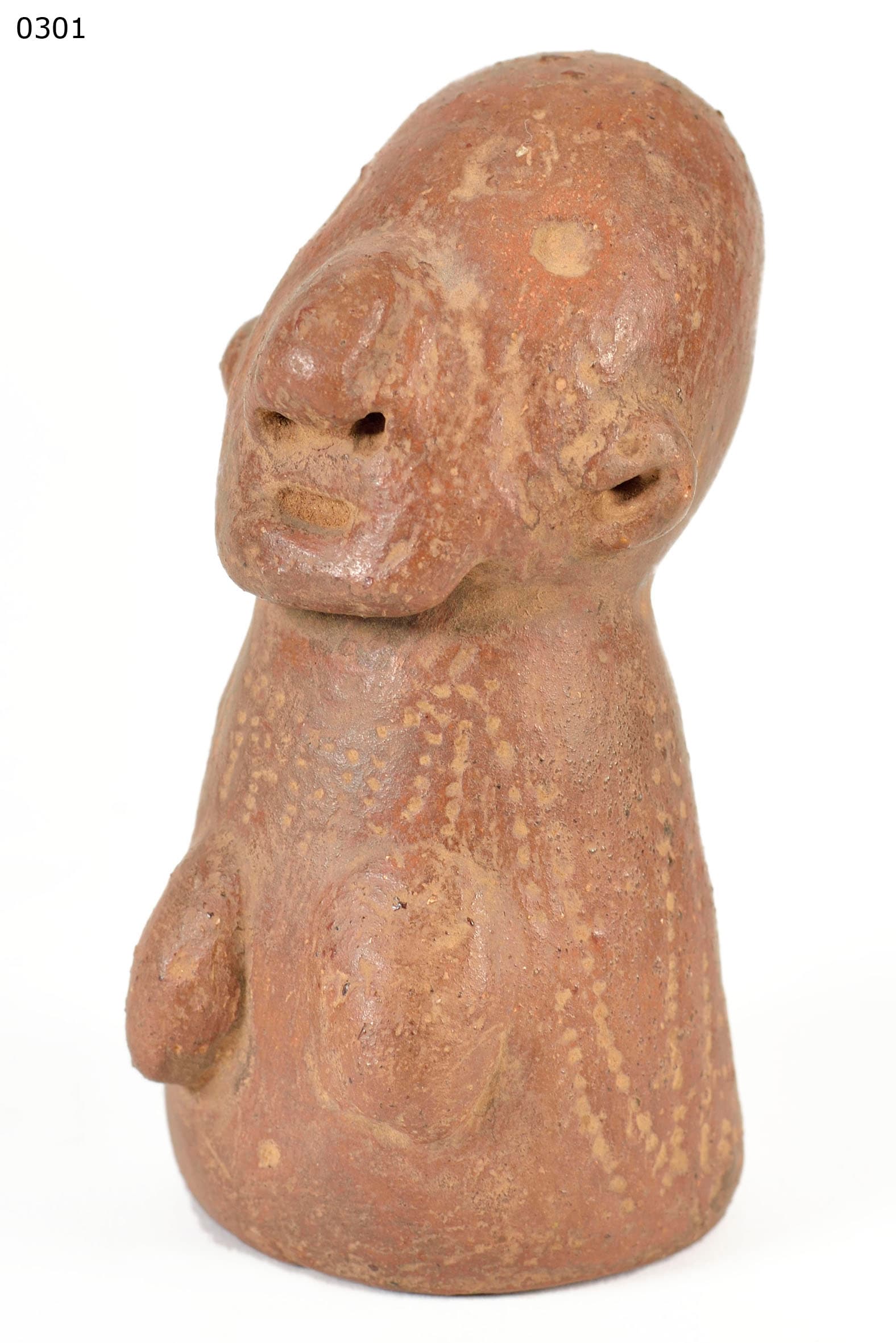
A tiny, incredibly complex ancient bronze figure depicted with its hands held to its face/ears. Its entire body is consumed by dense, twisting, snake-like coils and raised pustules, exhibiting a deep, crusty archaeological patina.
1. Aesthetic style and regional traits
In the artistic vocabulary of the ancient Inland Niger Delta (Djenné), physical disease was a profound spiritual marker. This tiny figure is a striking example of horrific realism mixed with mythology. The twisting forms enveloping the body may represent serpents (often associated with water spirits and disease) or the literal physical distortions of illnesses like leprosy or dracunculiasis. The hands raised to the head convey deep physical agony or overwhelming spiritual possession. The Djenné disease-figure subgenre is unique among African bronze traditions in its explicit depiction of bodily affliction.
2. Ritual function and apotropaic magic
Because disease was understood as a supernatural attack, traditional healers and blacksmith-priests forged these miniature bronzes to act as apotropaic (evil-averting) talismans. Kept by a healer or worn by a patient, the figure operates on the principle of sympathetic magic: by capturing the terror and symptoms of the disease in the incorruptible medium of bronze, the sickness is trapped, thereby protecting the living human from its ravages. The amulet's role is traditionally understood as active rather than commemorative, believed to engage in continuous magical work on the wearer's behalf.
3. Physical patina and age indicators
At only 5 cm, the survival of this intricate casting is notable. The heavy accumulation of malachite oxidation (the powdery green crust) and deep chemical pitting across the coils is consistent with an object that spent roughly half a millennium buried in the Malian soil. The patina appears natural and un-restored, supporting an attribution to the 12th–16th century.
Summary
A terrifying, medically and spiritually significant piece of ancient Malian metallurgy. The intricate depiction of disease, agony, and writhing serpents, combined with a profound burial patina, makes it a highly significant apotropaic antiquity.
Written with AI assistance from the collection appraisal, object photography and our own research; editorially reviewed. Mistakes are possible — corrections are welcome. How we work →