Overview
The Bwa, historically often referred to as "Bobo-Oulé" (Red Bobo) in older Francophone ethnographic literature and early colonial records, represent a linguistically, demographically and culturally distinct population group in the West African savannah belt. Their primary settlement area extends across the central and southern part of Burkina Faso - particularly in the provinces of Mouhoun and Tuy and along the river systems of the Black Volta - and stretches across the border into the south-east of the Republic of Mali. Current demographic estimates put the core population of the Bwa at over 300,000 individuals, of which around 175,000 live in Burkina Faso and 125,000 in Mali. Broad linguistic clusters of the Gur language family, to which the Bwa languages belong, are estimated to comprise up to half a million speakers.
Linguistically and ethnologically, the classification of the Bwa is characterised by a protracted research controversy. The term "Bobo-Oulé" originates from the administrative simplification by the French colonial administration and the nomenclature of the Jula traders, who dominated the region as a lingua franca. This foreign designation falsely amalgamated completely different ethnic groups. As the art historian Christopher D. Roy (1987) succinctly points out, the Bwa and the Bobo (historically "Bobo-Fing" or Black Bobo) are not related linguistically or in their social structure. The Bobo belong to the Mande language family, while the Bwa speak Bwamu (or Bomu), which places them in the Voltaic (Gur) language family. They share this affiliation with other regional actors such as the Mossi or the Gurunsi groups (Nuna, Winiama, Ko). The self-designation Bwa (singular) or Bwaba (plural) is therefore established as binding in modern ethnographic and art historical research. Museum institutions such as the Royal Museum for Central Africa (RMCA) in Tervuren or the Musée du quai Branly in Paris are increasingly reflecting this revised taxonomy in their digital databases, even though historical inventories sometimes still show the colonial nomenclature.
Socio-politically, the Bwa are strictly acephalous and organised in segments. There is neither a central political authority nor a superordinate kingship, as is the case with the neighbouring Bamana or Mossi, for example. Political, judicial and territorial power lies exclusively with local councils of elders at the level of the respective village communities. The French ethnologist Jean Capron (1973) analysed this specific economic and social structure in detail in his fundamental monograph Communautés villageoises bwa. Capron describes a system of independent, patrilineally organised "maisons" (houses) in which subsistence farming is carried out cooperatively.
The subsistence strategy of the Bwa is primarily based on rain-fed agriculture. Traditional crops include millet, sorghum, yams and peanuts, while cotton is increasingly cultivated as a market economy cash crop. As documented by long-term ethnographic studies, the transformation of the agricultural economy through the commercialisation of cotton has led to an erosion of traditional, collective field work and fuelled individualisation within the village communities.
In terms of kinship, patrilineal rules of descent dominate, although the residence patterns and land use rights analysed by Capron show highly complex inter-family networks that guarantee flexibility in times of agrarian crisis. The source situation is ambiguous with regard to the historical depth of their territorial consolidation, as the Bwa, in contrast to many neighbouring peoples, do not pass on elaborate myths about far-reaching migration from other regions, but regard themselves as autochthonous inhabitants of their territory.
The relationship with neighbouring peoples is historically complex and was often characterised by asymmetrical power structures. In the 18th century, the Bwa territories were made subject to tribute by the expansionist Bamana empire of Ségou. After the decline of the Bamana in the 19th century, the region was dominated by the Fulani (Peul), whose cavalry carried out systematic slave raids and decimated the Bwa's livestock. These intercultural contact zones and historical traumas manifest themselves to a high degree in the material and ritual corpus of the Bwa.
| Demographic & Linguistic Parameters | Specification |
|---|
| Geographical core area | Burkina Faso (centre/south), Mali (south-east) |
| Population estimate | approx. 300,000 (175k BF, 125k Mali) |
| Linguistic classification: Niger-Congo > Atlantic-Congo > Volta-Congo > North Volta-Congo > Gur > Bwamu/Bomu | |
| Historical foreign designation | Bobo-Oulé (Red Bobo) - obsolete |
| Social structure | Acephalous, segmentary, patrilineal, councils of elders |
| Economic form | Agricultural subsistence (millet, yams) & cash crop (cotton) |
Cultural context
The ontological and religious system of the Bwa is structurally centred around the entity of a distant creator god, who is referred to in the Bwamu language as Wuro, regionally also as Difini or Dobweni. In accordance with the widespread paradigm of Deus otiosus in West Africa, this creator is considered unapproachable, passive and removed from everyday human life after the initial formation of the world and the establishment of the cosmological order. In order to maintain the balance between the sacred and profane spheres, Wuro delegated the interaction with humanity to spiritual emissaries. The absolute central figure in this mediation process is Dwo (or Do), the eldest son of the Creator. Dwo acts as a representative of unconquered nature, the wilderness and the life-giving forces of the forest.
A fundamental socio-religious characteristic of the Bwa, which radically separates them structurally from neighbouring peoples in Côte d'Ivoire (such as the Dan or Senufo) and from various Mande groups, is the complete absence of secret societies. While institutions such as the Poro or Sande societies of neighbouring ethnic groups have an exclusive monopoly on ritual authority and the control of sacred objects, the masks of the Bwa are the collective property of the extended families or clans. Ritual authority is not vested in an esoteric brotherhood, but in the family elders. The spiritual leader of a village, the Labie, is usually the oldest man in the community and acts as Primus inter Pares without absolute coercive power.
This familial, non-exclusive character of the mask-wearing community means that the role of women in the cult is specific and often emphasised in the literature. As the masks are not tabooed by secret societies, they are physically accessible to all members of the family - explicitly including women and uninitiated children. Although the physical execution of the mask performance (the actual dance) is strictly reserved for the initiated young men, women are integral actors in the ritual choreography. They accompany the performances musically, interact with the dancers and are the bearers of their own spiritual objects of protection. According to field notes, Bwa women whose families worship Dwo leaf masks wear specific iron ankle rings that serve as a physical manifestation of divine protection. The Metropolitan Museum of Art (Met) in New York, which maintains substantial holdings of the Thomas G. B. Wheelock collection in the Michael C. Rockefeller Wing, documents this inclusive familial context in its curatorial analyses as a key differentiating feature of the Volta region.
In art historical and ethnographic research, there is a decided controversy regarding the stratification of the Bwa pantheon and the historical adoption of foreign cults. In his works (1987, 2007), Christopher D. Roy postulates a sharp dichotomy between the northern and southern Bwa. According to Roy, the northern Bwa remained faithful to the original cult of Dwo and to this day use almost exclusively ephemeral leaf masks, which are destroyed at the end of the ritual season. The southern Bwa, on the other hand, adapted wooden plank and animal masks from their eastern neighbours, the Gurunsi (especially the Nuna and Winiama), as a result of severe historical crises. With these masks, they also adopted the cult of the spirit Lanle, which was integrated into the pantheon alongside Dwo. Roy dates this paradigmatic change to the beginning of the 20th century and documents sometimes violent ritual conflicts between the traditionalists of the north and the users of the Lanle wooden masks in the south.
In contrast, analyses in the wake of Jean Capron's structural studies place greater emphasis on internal functional cohesion through agrarian rites. From this perspective, the wooden masks are interpreted less as evidence of a historical rupture than as a pragmatic extension of the ritual arsenal to ensure social integration and the agrarian cycle.
Central Bwa rites of passage include the initiation of young people into the moral codes of the community, burial and memorial ceremonies to escort the ancestors into the afterlife and annual renewal rites linked to the plant and agricultural cycle. In these contexts, the masks do not function as images, but as physical incarnations of nature spirits that temporarily enter the wooden body in order to communicate with the village community.
| Cosmological order of the Bwa | Function & attributes | Mask type |
|---|
| Wuro (Difini/Dobweni) | Creator God, Deus otiosus, formed the world, remote and passive | No physical representation |
| Dwo (Do) | son of Wuro, mediator, lord of the wilderness and life-giving nature | leaf masks (north), conditionally wooden masks (south) |
| Lanle | later adapted spirit (presumably from Gurunsi), grants protection | wooden masks (planks & zoomorphs) |
Aesthetic features
The formal canon of the Bwa wooden masks is characterised by a radical, almost architectural geometrisation and a strict polychromy in the colours black, white and red. This colour scheme has profound symbolic connotations: According to documented field reports, the colours evoke, among other things, the three major river courses of Burkina Faso (Black, Red and White Volta). The canonical object typology of the southern Bwa is primarily differentiated into two categories: zoomorphic masks and the monumental, anthropo-abstract plank masks known as nwantantay.
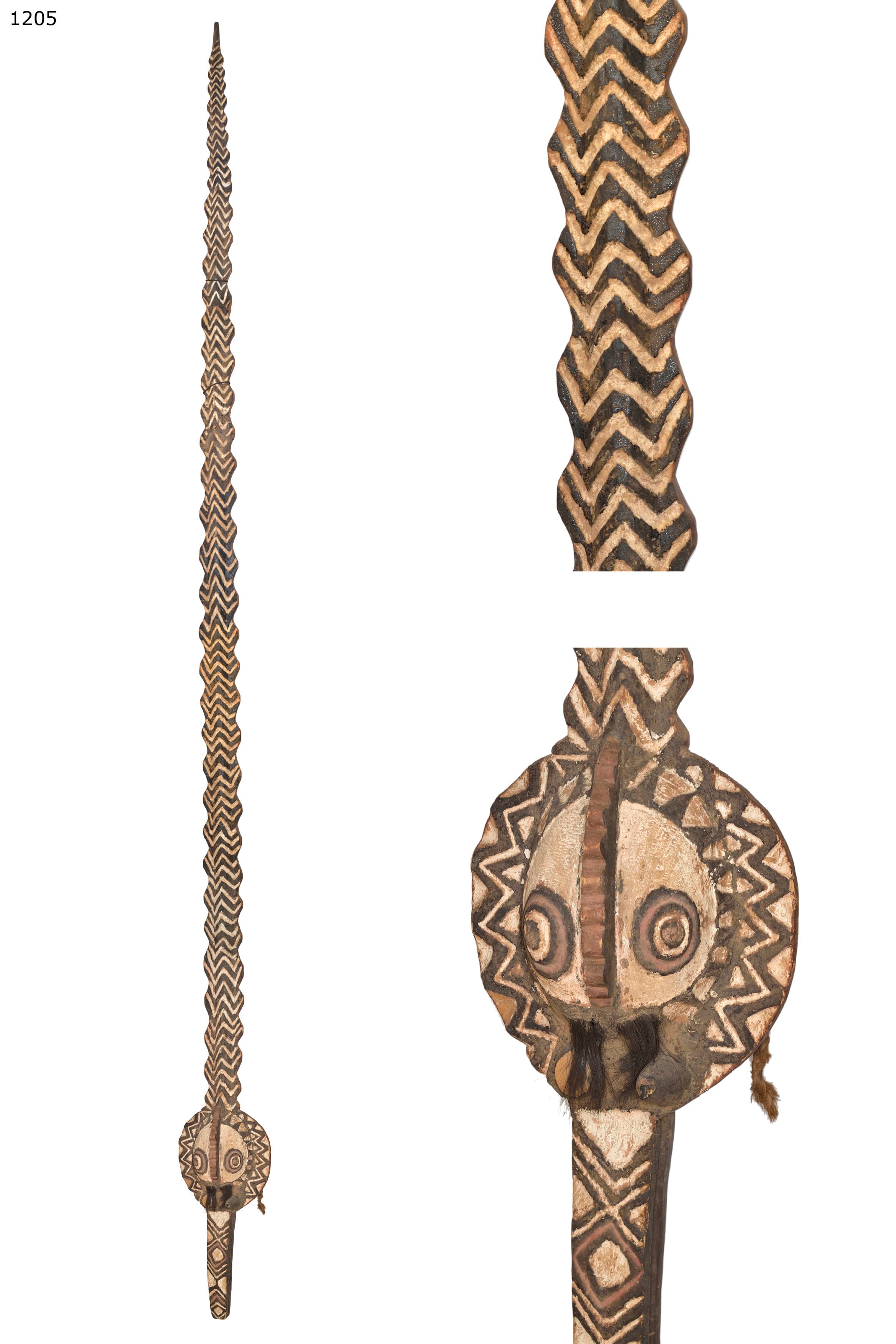
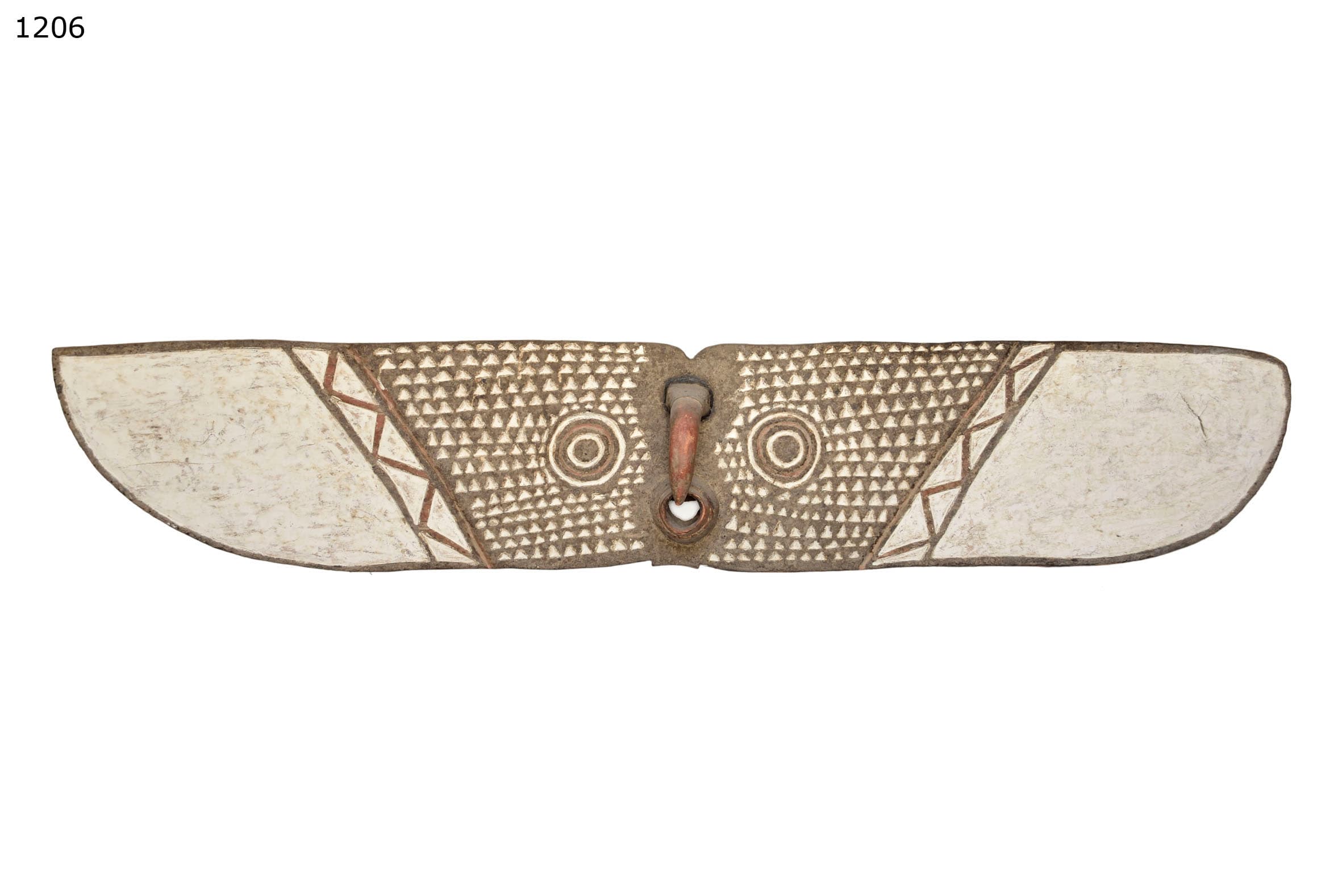
The zoomorphic masks represent a variety of animals that appear in mythology as manifestations of nature spirits. These include butterflies, hawks/rhinoceros birds, crocodiles, antelopes, snakes, bush pigs and monkeys. Each animal encodes a specific moral quality: the monkey (imina omono) often functions as a trickster figure, the bush pig is considered impure, and birds act as transcendental messengers between the earthly sphere and the spirit world. A rarer but well-documented type is the "leper mask" (Leper mask), which embodies historical misconceptions about the causes of disease and conveys ethical lessons about tolerance.
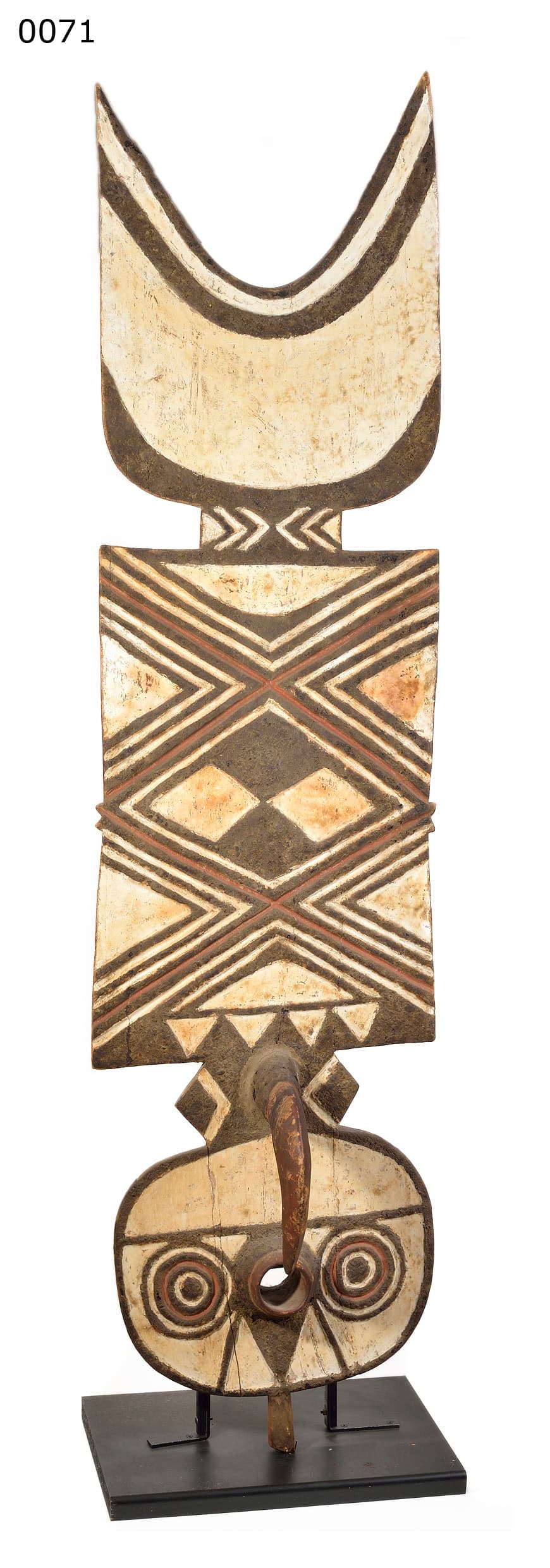
The morphological architecture of a nwantantay plank mask is highly standardised. It is based on an oval or circular, flat visual field. At its centre is a strongly protuberant, diamond-shaped mouth, which is often provided with serrated teeth and serves as a viewing slit for the dancer. Three leaf-shaped black triangles are typically arranged below the mouth, while two enormous, concentric disc eyes dominate above the mouth. The connection between the face and the vertical plank, which rises up to 250 centimetres, is formed by a diamond-shaped element from which a massive, downward-pointing hook (often interpreted as a beak) protrudes at the front and sometimes also at the back. The plank itself is crowned by a large, upward-opening crescent.
The iconography of the geometric patterns applied to the plank is not a purely decorative element, but a complex semantic system that encodes moral concepts and social rules of behaviour that are taught as part of the initiation. On a literal level, the omnipresent chequerboard pattern of black and white rectangles refers to the skins on which the people sit: white skins for the young initiates, dark skins for the elders. On a more abstract level, this dichotomy visualises the tension between ignorance and knowledge, light and darkness and good and evil. Zigzag lines symbolise the path of the ancestors, while the dominant X motif on the forehead is a direct transcription of traditional, real Bwa scarification marks.
In terms of materials, the masks are predominantly made from the soft, light wood of the Ceiba tree (Ceiba pentandra), which makes it possible to balance these enormous dimensions in a danceable way. The pigmentation comes from local, natural resources whose forensic composition has recently been intensively researched using complex methods (FTIR, GC-MS). White is obtained from chalk rock or the excrement of reptiles (e.g. the panther chameleon, Calumma parsonii). Red is produced by pulverising rock containing iron oxide, which is traditionally mixed with plant gum or egg white as a binding agent. The significant Bwa black is produced through a laboratory-intensive process: Seed capsules of the acacia tree (Acacia nilotica) are boiled for hours until a viscous, tar-like brew is produced, which is applied thickly to the raised relief areas.
A long-standing iconographic controversy in research concerns the stylistic classification of plank masks between the Bwa and their neighbours, the Gurunsi (Nuna, Winiama), as both use an almost identical vocabulary. Christopher D. Roy established decisive sub-stylistic markers for this: while Nuna masks are often dominated by extremely dense, extensive chequerboard patterns, Bwa pieces are typically characterised by a more reduced geometry, vertical stripes, the prominent concentric target eyes and the specifically shaped hook between face and plank. Prominent exhibits in the Museum Rietberg in Zurich, such as a bird mask donated by Dr Oliver Cobb, impressively document this formal precision.
Master hands are rarely documented by name in classical Bwa art, as the focus was on the spiritual object and not on the individual. One notable, more recent exception, however, is the master carver and village elder Yacouba Bonde (*1963) from the village of Boni. His works - including documented Nwantantay, butterfly and leopard masks - are both performed in the local ritual context and acquired by Western collections such as the High Museum of Art in Atlanta or the Birmingham Museum of Art as examples of vital, living tradition.
For the Bwa, the difference between a pure wooden object and an activated ritual object is defined by its consecration. Profane objects, such as those produced directly after carving or at markets for tourists, have no spiritual power whatsoever. Only through ritual discussion and sacrifice at the family altar does the wood transmute into a carrier of spirits. This is also the primary forgery criterion on the art market: authentic pieces have a complex patina of sweat, saliva, ground pigments and ritual offerings, while workshop forgeries for the decoration market remain flawless or are artificially trimmed to look old with sandpaper.
| Pigment | Traditional material source (forensically proven) | Semantics & processing |
|---|
| Black | Acacia nilotica (seed capsules) | Age, health, wisdom. Lengthy cooking process to viscous broth. |
| White | chalk, reptile faeces (Calumma parsonii) | youth, initiation, purification. Applied powdered. |
| Red | Rock containing iron oxide (ochre/haematite) | Blood, life force, transition. Mixed with plant gum. |
Ritual practice
The ritual activation and performance of the Bwa masks is a highly physical, kinetic and synaesthetic process. The mask performances are primarily centred on the dry season between the months of March and May. The social and spiritual life of the village communities culminates during this period, when agricultural work is suspended. The occasions for mask performances are manifold: they include large-scale funeral and memorial ceremonies, where the masks honour the souls of deceased elders and escort them safely to the afterlife. They also perform at annual renewal rites, harvest festivals, the inauguration of new masks and even as entertainment on regular market days. Initiation rituals, in which young men and women are introduced to the secrets of the adult world, occupy a central social space.
The choreography of the dances varies significantly depending on the iconography and architecture of the respective mask type. While zoomorphic butterfly masks - often with a wingspan of over a metre - describe rapid, spiralling circular paths with sweeping horizontal movements, the monumental nwantantay plank masks demand extreme vertical balance from the dancer. The dancers, exclusively young, fit initiates of the respective owner family, perform athletic torso rotations, jumps and deep bows that bring the plank dangerously close to the ground without touching it.
A biomechanically distinctive feature of mask use among the Bwa and their direct neighbours in the Volta region is the system of attachment to the body. In contrast to helmet masks (such as those worn by the Sande communities of the Mende), which enclose the entire head, the Bwa plank mask is worn exclusively in front of the face. The actor fixes the sometimes massively heavy wooden construction by biting on an extremely thick fibre rope pulled through perforations in the back of the mask. This archaic-looking biting technique leaves behind deep traces of wear and tear, wood erosion and a specific saliva and sweat patina on the inside of authentically used objects - a forensic feature that collection curators, such as those at the British Museum (e.g. for objects in the Cranmore Ethnographic Museum collection), use to determine authenticity and age.
The wooden face is always accompanied by a voluminous, shaggy suit made from locally sourced, often red or black coloured hibiscus fibres (kempf). This suit covers the back of the dancer's head and the entire body, completely anonymising the human physiognomy. At the moment of the dance, the young man ceases to be a member of the community; he becomes physically and spiritually an entity of the spirit Dwo or Lanle.
The ritual life cycle of a Bwa object is organic and circular, which fundamentally contradicts the Western museum paradigm of eternal physical preservation. The creation of a new mask usually takes place during the dry season. The blacksmith or a specialised wood carver in the village makes the mask on behalf of a family elder. After completion, the ritual activation takes place: in a festive ceremony, the wooden object is presented to the community and consecrated at the altar of the family clan through specific offerings - traditionally by pouring millet beer and the blood of sacrificed chickens. It is only through this consecration that the mask is transformed from profane wood into a spiritually charged artefact.
The sources in ethnography are ambiguous as to exactly how the masks are maintained after the end of the ritual season (before the start of the rainy season). Some reports and forensic analyses indicate that the Bwa soak their masks in water for several days each year. This process functionally serves to rehydrate the dried out wood and protect it from cracking, but also has the effect of washing away the powdery, largely binder-free pigments (especially the white and red). The mask is then freshly painted by the men of the family for the following year, which explains the strong luminosity of the patterns during performances.
When a mask becomes unusable after years of intensive ritual use due to unavoidable termite infestation, insect infestation or physical breakage during the ecstatic dance, it is ritually deactivated. The object loses its function as a spirit vessel. The Bwa do not recognise "restoration" in the Western sense. The unusable mask is disposed of, often left to decay naturally in the bush periphery of the village, whereupon the clan commissions a carver to reproduce the iconographic pattern exactly on a new wooden blank.
Historical context
The genesis of Bwa material art as it exists today in Western museum collections and galleries is inextricably linked to the massive geopolitical upheavals and traumas of the region in the 18th, 19th and early 20th centuries. The territory of the Bwa was historically a buffer zone and a hunting ground for expanding hegemonic powers. In the 18th century, large parts of the Bwa region were occupied by the powerful Bamana empire of Ségou, which forced the acephalous Bwa villages into a harsh tributary relationship. Villages that refused to submit were the target of systematic raids, which led to an initial significant weakening of demographic and social structures.
The gradual decline of the Bamana hegemony was followed in the 19th century by devastating raids by the Islamised Fulani (Peul). The excellently organised Fulani cavalry used the open savannah for rapid attacks, plundered the storehouses, decimated the livestock and abducted thousands of Bwa into slavery. Paradoxically, when French mercenary and colonial troops invaded the area in 1897, they temporarily allied themselves with the Fulani in order to quickly pacify the region and gain administrative control. The French reprisals included the introduction of extremely high poll taxes and the systematic forced conscription of young men for the Tirailleurs Sénégalais. These interventions completely destroyed the traditional stock economy of the "maisons" based on solidarity and culminated in the catastrophic famine of 1911 to 1913.
The culmination of this structural and physical violence was the Volta-Bani War (1915-1916). In an unprecedented alliance, the Bwa and neighbouring groups rose up against the French colonial power. The revolt was crushed by the French army with extreme brutality, resulting in the complete destruction and pillaging of countless Bwa villages.
This historical turning point had a profound impact on the religious architecture and artistic production of the Bwa. As Christopher D. Roy's ethnographic analyses show, many Bwa in the southern settlement area felt that their ancient cult, based on the leaf masks of the Dwo, was spiritually inadequate and powerless in the face of apocalyptic destruction. In a pragmatic theodicy-like reaction, they turned to their eastern neighbours, the Nuna (Gurunsi), who had apparently survived the war better. The southern Bwa specifically adapted the wooden plank mask vocabulary of the Nuna as well as the associated spirit Lanle, integrated both into their own system and thus created the now world-famous Bwa wooden masks. This historical appropriation in the early 20th century explains the massive iconographic overlap between Bwa and Gurunsi and marks a radical stylistic paradigm shift.
In the Western art market, the works of the Bwa and other Gur-speaking peoples were received comparatively late. While the classical art of the Ivory Coast (such as the Dan and Baule) or the relic figures of Central Africa (Fang, Kota) were already enthusiastically celebrated as Art Nègre by the Cubists and Surrealists in Paris in the first decades of the 20th century, the extremely flat, two-dimensional and highly abstracted masks of Upper Volta were long regarded as rudimentary ethnographic curiosities.
A breakthrough in market history only occurred in the second half of the 20th century. The historic auction of Helena Rubinstein's collection in New York in 1966, at which six-figure sums (adjusted for inflation) were paid for African artefacts for the first time, is regarded as the catalyst for the commercial revaluation of African art in the West. In the 1970s and 1980s, the Volta cultures became the focus of specialised collectors. The collection of Thomas G. B. Wheelock, who systematically collected art from Burkina Faso from the 1970s onwards, is outstanding in this respect. His objects, which today form the core holdings of the Metropolitan Museum of Art (Met) and the Stanley Museum of Art Collection, as well as ambitious collection projects such as that of Colin (Dusty) Hind for the Bermuda National Gallery, accelerated academic research and the commercial ennoblement of Bwa art. An exhibit from the Art Institute of Chicago provides exemplary evidence of this development through accompanying academic research.
The rapid rise in prices from the late 1980s onwards inevitably accelerated the problem of forgery. Today, Bwa masks are serially reproduced in urban workshops throughout West Africa for the decorative and collectors' market. Criteria for authenticity are therefore increasingly based on complex forensics and material science. While authentic, ritually used pieces show deep bite marks on the holding rope, microscopic deposits of sweat grease and natural vertical cracks in the soft heartwood (often accelerated by authentic termite feeding from the inside), modern workshops produce flawless replicas. The artificial termite damage on fakes is often applied from the outside. Chemical analyses, such as Fourier transform infrared spectrometry (FTIR) or mass spectrometry-based proteomics (LC-MS/MS), are used by museums to distinguish historical, plant-based pigments (such as the Acacia nilotica brew) from petrochemical enamel or acrylic paints that dominate in recent forgeries.
| Historical epoch / event | Relevance for Bwa society | Art historical implication |
|---|
| 18th / 19th century | Tributary rule (Bamana), raids (Fulani) | Weakening of social resilience |
| 1915-1916 (Volta-Bani War) | Revolt against the French, destruction of villages | Trauma leads to the adoption of the wooden masks (Lanle) of Nuna |
| 1966 (Rubinstein auction) | Breakthrough of the African art market | Starting signal for commercial interest in Africa |
| 1970s onwards | Targeted development of special collections (Wheelock) | Nobilitisation and academic categorisation of Volta styles |