Overview
The Fante (historically often transcribed in colonial documents as Fanti, in the indigenous self-designation Mfantsefo) represent one of the most influential and demographically significant subgroups of the Akan linguistic and cultural family. Their primary settlement area extends along the central and western coastal regions of present-day Ghana, geographically located between the Ga region around the capital Accra in the east and Sekondi-Takoradi in the west. Current demographic surveys and estimates put the Fante population at around 3.4 to 5.5 million individuals, making them around 13 per cent of the total Ghanaian population and the second largest Akan group after the Asante. Urban and historical epicentres of this ethnic group include important coastal towns such as Cape Coast (Oguaa), Elmina (Edina), Saltpond, Anomabo and especially the spiritual historical capital Mankessim.
Linguistically, Mfantse is classified as a distinct dialect of Twi within the Kwa language family, a branch of the Niger-Congo macro-family. A linguistic feature that significantly distinguishes Mfantse from other Akan varieties such as Asante-Twi or Akuapem-Twi is the presence of words that end in consonants, which indicates a specific phonological evolution in the coastal region. Etymologically, according to oral tradition, the self-designation "Mfantsefo" is derived from the term "Fa-atsew", which translates as "the half that went" or "the separated part" and refers directly to the historical secession from the northern Akan groups.
The social structure of the Fante is characterised by an extraordinary complexity, which has been the subject of intense and controversial debate in ethnographic literature for decades. Basically, the Fante organise themselves through a system that integrates both matrilineal and patrilineal principles, whereby the rules of descent are strictly separated into functional and ritual spheres. The matrilineage, the abusua system, determines primary clan affiliation, the inheritance of land and material property, succession to political office (especially chieftainship) and ancestor worship, which is passed down through the female bloodline (bogya). Parallel to this, there is a strong patrilineal structure, the asafo system, which is closely linked to the spiritual ntoro or egyabosom concept (the deity of the father). This patrilineage regulates membership in the military and civic companies (asafo), inherits the spirit (sunsum) and determines specific naming conventions and ritual taboos.
It is at this point of social classification that the theoretical approaches of research diverge massively. The sources show an explicit controversy: In his pioneering field research, the ethnologist James Boyd Christensen (1954) classifies this Fante model classically as "double descent" (bilinear or double descent), as individuals belong to clear exogamous groups of both lineages. The sociologist B. I. Chukwukere (1982) argues vehemently against this categorisation, arguing that the concept of double descent is a Eurocentric construct that misses the social reality of the Akan. Chukwukere postulates instead that it is a fundamental complementary male/female dualism in Akan cosmology, in which the uterine bloodline (abusua) and the agnatic spirit lineage (asafo) are mutually dependent and create a philosophical balance without forming a rigid, legal dual descent system in the Western sense.
Politically, the Fante oscillate between acephalous traits at the level of the asafo militias and a hierarchical order in the traditional chieftaincy system. Each Fante settlement is led by an Omanhene (Paramount Chief) from the royal matrilineage, who is advised by subaltern chiefs. The asafo organisations act as an institutionalised, democratic counterweight: they represent the common people ("commoners") and have the power to exercise political criticism, control the authority of the chief and, in extreme cases, even dismiss him. In times of crisis, loyalty to the asafo company often exceeds loyalty to their own matrilineage. This duality of power - elite matrilineage versus egalitarian, patrilineal militias - prevented the development of an absolute, autocratic central state, as existed among the northern neighbours, the Asante, as the Fante states historically always remained autonomous and only acted in loose confederations.
The economic subsistence of the Fante was historically and still is based on a combination of maritime economy and agricultural production. Primary crops include yams, manioc, taro (cocoyam) and plantains, while cash crops for export such as cocoa, palm oil and timber supplement the economic foundation. The immediate coastal location also predestined the Fante for the role of maritime traders and fishermen early on. In relation to their neighbouring peoples, the Fante defined themselves for centuries as strategic middlemen (compradores) in the trade network. This monopoly on mediation between the European trading forts on the coast and the resource-rich Asante territories in the hinterland led to a lasting political rivalry and repeated armed conflicts with the Asante confederation.
The classification of Fante artefacts in early Western collections often suffered from the lack of differentiation between these historically hostile groups. Inventories at the British Museum or the Royal Museum for Central Africa (RMCA) initially often subsumed Fante artefacts under the generic term 'Ashanti' or 'Gold Coast', which historically often obscured the highly specific socio-political contexts in which Fante military art was created.
| Demographic & Social Parameters | Specification of the Fante (Mfantsefo) |
|---|
| Estimated population | 3.4 to 5.5 million (approx. 13% of Ghana's population) |
| Linguistic classification | Kwa language family, Twi dialect (Mfantse) with consonantal endings |
| Matrilineal system (Abusua) | Determines clan affiliation, land ownership, succession to the throne, ancestor worship |
| Patrilineal system (Asafo) | Determines militia membership, spiritual protection (egyabosom), naming |
| Political organisation | Autonomous city-states (Omanhene) balanced by egalitarian Asafo militias |
| Economic basis | Coastal fishing, agriculture (yams, manioc), historical intermediate trade |
Cultural context
The religious system of the Fante is deeply rooted in the comprehensive Akan cosmology, but has significant structural peculiarities due to its coastal location and the singular social penetration by the asafo companies. The cosmological order is henotheistic or hierarchical-polytheistic in structure and postulates the interaction between a spiritual and a material world. At the head of this pantheon is a creator god conceived as omnipotent, omniscient and creative, who is referred to in the Fante nomenclature as Nyame (often in the female or androgynous form), Onyankopon (the male aspect, the "Great Friend") or Odomankoma (the infinite inventor who directs the evolutionary process of creation). Nyame is understood as the absolute source of life energy (Okra) that set the universe in motion. This creative power is flanked by Asase Yaa, the female earth deity who is responsible for fertility, agriculture and the metaphysical transition to death and to whom Thursday is assigned as a holy day.
There is a long-running and heated research controversy in the academic study of this cosmology. The classical ethnographic studies by the British anthropologist Robert S. Rattray (1923, 1927), which were formative for the early Western reception, drastically marginalised the role of the creator god Nyame. A dates and interprets the Akan religion primarily as an ancestor cult, in which Nyame functions as deus otiosus (as a distant, inactive god) who plays no role in the active cult. More recent theological and anthropological studies, for example by B (Leo Andoh Korsah, 2020) or Brigid Sackey (2000), vehemently contradict Rattray. They argue that Rattray's construct is a Western misinterpretation and emphasise the vital, henotheistic presence of Nyames in everyday Fante discourse ("Obi nkyerε abɔfra Nyame" - "Nobody has to show God to a child").
As Nyame is considered too exalted to be directly bothered with profane human needs, he is not worshipped by an institutionalised priesthood. Instead, active religious interaction takes place with two deeper spiritual entities: the Abosom (natural and spiritual beings) and the Nananom Nsamanfo (the revered ancestors). The Abosom are localised spirits who reside in rivers, rocks, trees or the ocean, draw their power from the creative power Nyames and act as active intermediaries who intervene directly in the event of illness, war and social crises. The ancestors (Nsamanfo) watch over the moral order of society; they are regarded as those who have led a morally impeccable life and died a natural death. Their influence manifests itself materially in the ceremonial black stools (Stools), which are kept in the shrines of the matrilineage as ritual anchor points for the ancestors.
Ritual authority in Fante society is strictly divided between different actors. Mediumistic communication with the Abosom is the responsibility of the Akomfo (priests, divinators and spirit mediums), who receive advice, healings and prophecies from the spirit world through a state of trance (the Akom dance). On the political-military level, the asafo leaders - the supreme commander (supi) and the captains (safohen) - act as ritual guardians of the war shrines, invoking the specific guardian spirits and ancestors of the respective militia.
The role of women in the cult of the Fante is central and indispensable for the continuity of the matrilineage. Female leadership is embodied by the Queen Mother (Ohemaa), who has veto power over the selection of the chief and acts as the spiritual guardian of the female ancestors. One of the most important rites of passage in Fante culture that ritually defines the status of women is the bragoro (or brapue), the formal puberty and nubility ritual. Once a girl reaches menarche, she is tested for purity and maturity in a multi-stage rite overseen by the Queen Mother and older women. The ritual includes ritual baths, a period of isolation (in which the girl is initiated into the secrets of marriage, sexuality and motherhood), the ceremonial consumption of eggs as a symbol of fertility and a final public presentation in which she is adorned with pearls and gold and presented to the community as a marriageable woman.
Structurally, the religious system of the Fante differs greatly from that of their northern neighbours. While the religion of the Asante is strongly centred on the legitimisation of the central royal power in Kumasi and the national imperial myth of the Golden Stool, the religious practice of the Fante is extremely fragmented and competitive due to the influence of the asafo system. Documentation from the Fowler Museum at UCLA shows that among the Fante, almost every religious and social ceremony is dominated not by the court of the chief, but by the competitive pomp of civil asafo militias, each invoking their own abosom. This egalitarian approach to the sacred prevents the religious monopoly of a single lineage and gives the Fante religion its unique, decentralised character.
| Cosmological authority | Nomenclature & function in the Fante belief system |
|---|
| Supreme creator being | Nyame / Onyankopon / Odomankoma (creator, ultimate life force Okra, distant being without priesthood) |
| Earth and fertility deity | Asase Yaa (mother of Abosom, ruler of fertility and death) |
| Local nature and spirit beings | Abosom (reside in rocks, water; active problem solvers, communicate via Akomfo media) |
| Deceased ancestors | Nananom Nsamanfo (guardians of morality, bound to ritual stools (Stools)) |
| Individual soul components | Okra (divine spark), Sunsum (personality/paternal), Mogya (blood/maternal) |
Aesthetic features
The visual culture of the Fante is dominated by a canonical object typology that is primarily focussed on the representative, performative and competitive needs of the military and ritual apparatus. The asafo flags (frankaa) are the best-known and most sought-after group of objects on the international art market. These textile banners, which are made from imported cotton, silk, rayon or velvet using the appliqué technique, have an extremely complex, narrative iconography. The basic principle of these flags is based on the visual translation of orally transmitted proverbs, which serve the purpose of intimidating, demonstrating power and mocking rival asafo companies. Typical motifs include defensive animals, mythical creatures and technological artefacts. An appliquéd cactus, for example, represents the company's resilience and dangerousness ("We can carry water in a basket if we use a cactus as a pillow"), while leopards, crocodiles, two-headed eagles or dragons (sasabonsam) symbolise unrestricted spatial and spiritual dominance. Technological symbols such as warships, trains, aeroplanes or clocks signalise the company's ability to dominate technology, space and time ("We control the cock and the clock bird"). Structurally, almost all pre-colonial and colonial-era flags feature the British Union Jack in the upper left canton. This was not necessarily a sign of subjugation, but a conscious appropriation of imperial power and a visual shield against local authorities. With Ghana's independence in 1957, this element was gradually replaced by the Ghanaian national flag.
Master craftsmen's hands are excellently documented in this textile genre, which is atypical of African art. The Kormantse workshop was characterised by Kobina Badowah (1925-2000), whose works are recognisable by their massive, alternating triangular borders and satirical narrative scenes. Kweku Kakanu (1910-1982) from Saltpond introduced paper-cut patterns for more precise, dynamic forms and complex borders, while Kwamina Amoaku (1895-1985) from Anomabo became known for highly elongated, extremely thin figures that dispensed with the use of stencils. One of the earliest known masters by name was John Freeman Acquah (1861-1928) from Anomabo, whose embroidered flags are now kept in the British Museum.
The architecture and large-scale sculpture of the Fante culminates in the posuban. These massive cement shrines of the asafo companies have developed since the late 19th century from simple esoteric stone mounds (esiw) or enclosed sacred trees (dua ase), often marked with stones or tortoise shells, into monumental, often multi-storey structures. The canon of proportions completely defies Western architectural standards; the dimensions range from man-sized, cemented columns to three-storey buildings in the fantastic shape of warships, trains or European fortifications. The iconography of the painted posuban sculptures is radically syncretic: symbols of the Freemasons, British cement cannons, wax soldiers, Adam and Eve, but also local mythological beasts such as the bongo antelope (otromo) merge into a hyper-decorative aesthetic of ostentation.
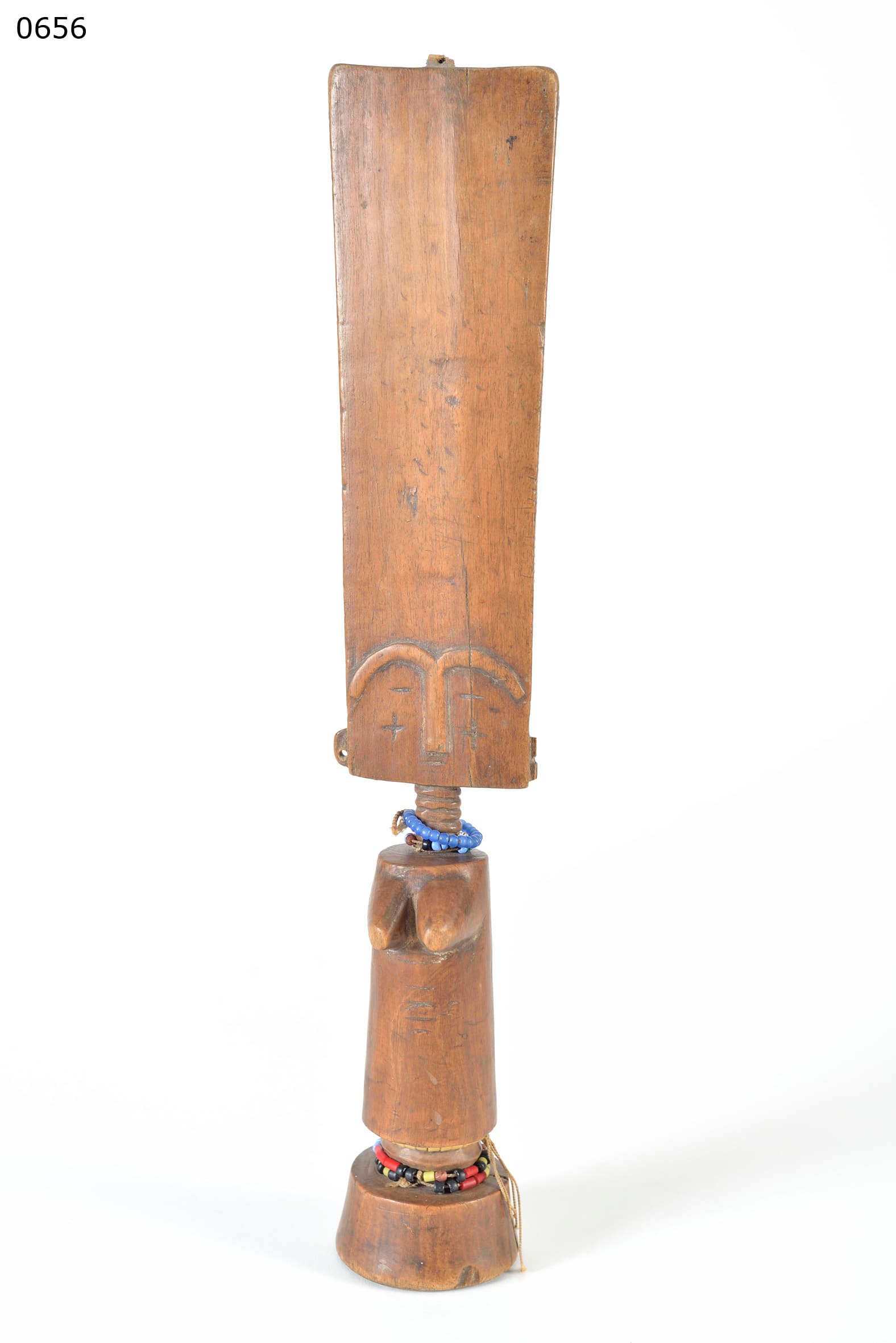
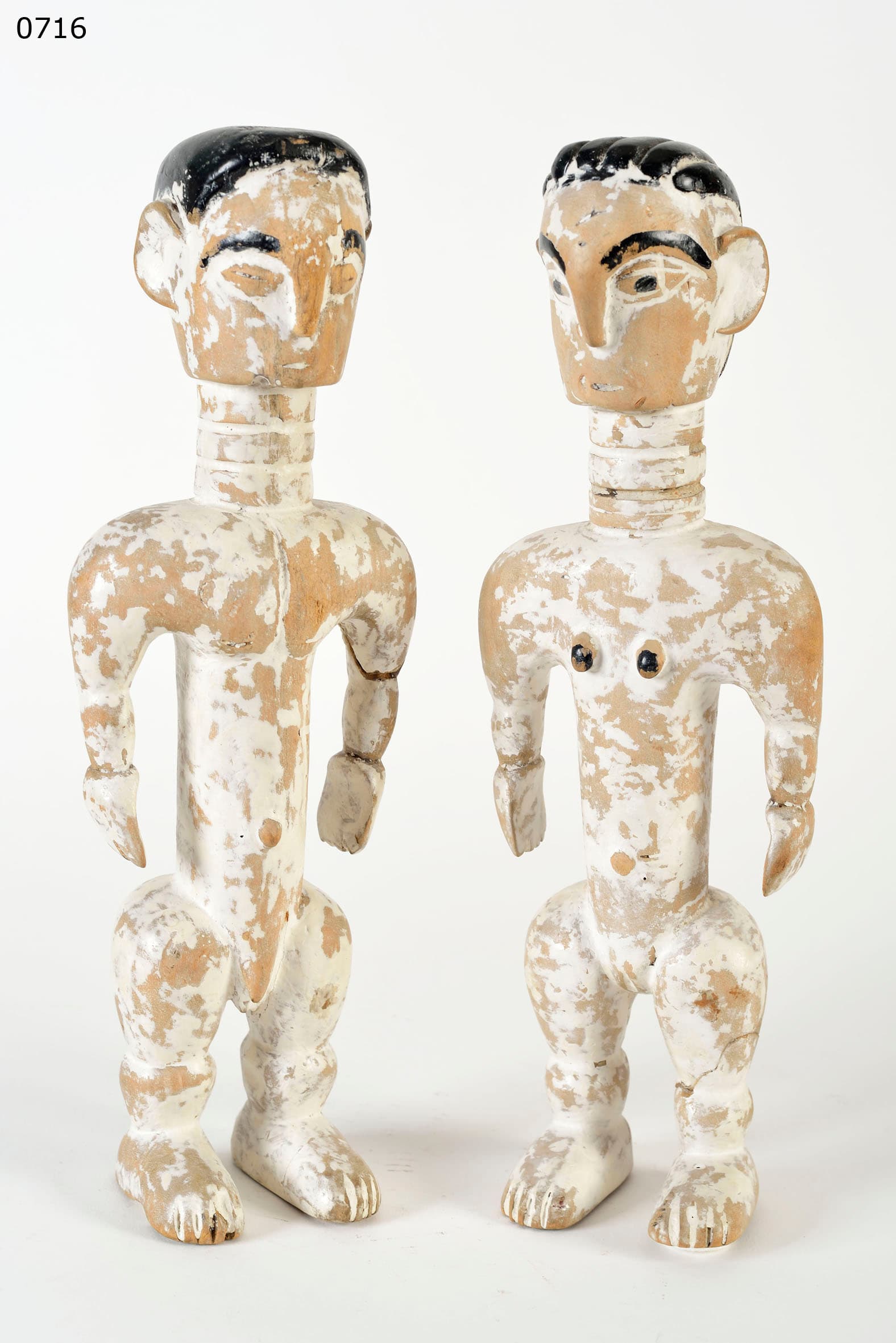
In the field of figurative wooden sculpture, the Fante-akua'ba (plural akua'maa), a ritual fertility doll, dominates. Conceptually, it is closely related to the world-famous akua'maa figures of the Asante, but morphologically it differs radically from them. The typical Fante akua'ba is characterised by a strongly elongated, rectangular head (in contrast to the circular disc of the Asante). The canon of proportions features a columnar torso, often without arms or with only tiny arm stubs, delicate facial features with curved eyebrows and characteristic "fat folds" (rings) on the neck, which in the local ideal indicate prosperity and health. The patina of activated figures is usually the result of physical handling (saliva, sweat, cosmetic oils) and is often left in the natural, lighter wood tone, which forms a strong contrast to the night-black coloured, polished aesthetics of the Asante figures. It is precisely this morphology that reveals a profound iconographic controversy in research. Author A (Doran H. Ross, 1996) interprets the Fante type of akua'ba primarily as a local morphological variant of the same universal Akan fertility myth. In stark contrast, researchers such as author B (Nii Quarcoopome, 1977/1996) or Maria Kecskési argue that the rectangular, lighter-coloured face shape and horn-like hairstyles refer to highly specific pre-colonial coastal aesthetics and possibly to interactions with other ethnic groups or European ideals of beauty, whereby the Fante figure has a completely autonomous historical line of origin and is not merely a derivation of the Asante canon.
The terracotta memorial heads (nsodie or mma) of the Fante, which were often mounted on pot lids, represent the ancestor cult of the matrilineage. They range in size from small, hand-sized tops to almost life-size busts. The heads, which were exclusively sculpted from memory by post-menopausal female potters, are stylistically highly idealised: they have downward-sloping elliptical eyes, ring necks, open oval mouths and a characteristic black clay slip coating that symbolises the transition into the dark spiritual world of the ancestors (Samanadzie).
Specific forgery criteria are highly relevant for the contemporary art market. The difference between a ritually activated object and a profane decorative piece can usually be seen in the texture. In the case of asafo flags, forgers often resort to methods such as outdoor scouring, tea baths for artificial patination, mechanical roughening or the deliberate sewing on of Union Jacks in order to visually simulate a pre-1957 date of origin. Today, authenticity tests make use of chemical forensics: chromatographic analyses (HPLC-MS) can identify synthetic textile dyes (such as Congo red, which was only invented in Europe in the late 19th century), which quickly exposes alleged originals from the early 19th century as modern copies. In the case of woodwork such as the akua'ba, artificially applied termite feeding marks or cracks in the heartwood created by rubbing artificial dust into the wood when it is damp are regarded as massive warning signs. In the Metropolitan Museum of Art (Met) in New York, excellently documented, authentic examples of Fante-akua'maa can be studied, whose haptic patina, deeply worked into the wood, has an inimitable auratic quality.
| Canonical object typology | Material & production | Iconographic significance | Distinctive masters / forgery indicators |
|---|
| Asafo flags (frankaa) | Application technique (cotton, silk, rayon) on fabric ground | Visualisation of proverbs (mockery, threat, power) | Masters: Badowah, Kakanu, Amoaku, Acquah. Forgery: Artificial ageing, tea baths, synthetic dyes |
| Cement shrines (posuban) | Cement, stone, colour on esoteric mound (esiw) | Syncretic symbols of power (warships, freemasons, cannons, predators) | Architectural icons: Mills, Kwamina Amoaku (Anomabo) |
| Fertility dolls (akua'ba) | Light-coloured wood, pearl necklaces, rarely patina applied | Rectangular, flat head, neck rings (health), missing arms (fertility ideal) | Forgery: artificial dust in cracks, simulated termite traces, atypical black paintwork |
| Memorial heads (nsodie / mma) | Terracotta, black slip coating, often as pot lid | Idealised portraits of ancestors of the matrilineage (elliptical eyes, ring neck) | Forgery: Illegitimate attribution to the "Twifo Hemang" excavation, missing ash layers |
Ritual practice
The ontological dividing line between profane, handcrafted production and a ritually charged, ontologically "living" object is drawn by the Fante through precisely choreographed activation rituals. Only performative use and theological consecration transcend pure materiality into a spiritually effective entity.
The performative practice of the asafo flags is the visual, auditory and emotional centrepiece of the patrilineal militias. Once a new frankaa has been sewn by a master craftsman in the workshop, its motif remains strictly secret in order to maintain the element of surprise vis-à-vis rival companies. The flag is only activated when it is publicly "unveiled" (outdooring) at the annual Akwambo festival (a cleaning and renewal ritual in late summer) or at the ceremonial installation of a new safohen (captain). The actual performance is the responsibility of the frankaakitanyi (flag dancer), a specially trained member whose choreography is much more than physical acrobatics. The dance consists of an elaborate technique of "concealing and revealing", in which the flag is whirled through the air, artfully wrapped around the body and unfurled jerkily in the direction of opposing companies in order to mock their symbols and demonstrate one's own superiority. The dense polyrhythm of the accompanying drums (asafokyin) often puts the dancer in a trance-like state; at this moment, he is understood as a physical medium (Spirit Possession) for the heroic ancestors of the company and the asafo gods of war. After the performance, the flag is not stored profanely, but carefully folded and kept as a sacred artefact in the holy of holies of the company.
This holy of holies is the posuban shrine. The actual ritual core of any posuban, even monumental three-storey cement castles, is the esiw, a modest sacred mound of earth or pile of stones in the centre, often covered by a massive tortoise shell, which marks the actual residence of the company god. The ritual use of the altar is closely synchronised with the social calendar: the asafo leaders gather at the shrine for initiations of new warriors, mourning ceremonies for high-ranking members or before political negotiations. Libations (high-proof alcohol, historically palm wine, today mostly imported gin) are poured on the ground and animal sacrifices (e.g. chickens or sheep) are offered to provide the spirits with food and honour. The blood of the sacrificial animals is deliberately poured over the esiw and the sacred drums, which is seen as an act of revitalising the divine energy.
In contrast to the loud asafo cult, the ritual dynamics of the akua'ba (fertility doll) operate in the extremely intimate, feminine sphere. If a Fante woman is diagnosed as infertile, a local okomfo (priest) orders the carving after a divination session. The newly carved, still profane wooden object must be consecrated by the priest in a shrine ritual. Ritual ablutions are performed and specific prayers are said in order to invite the spirit of the future, healthy child into the object. From this moment on, the activated ritual object goes through the lifecycle of a real baby: it is carried by the mother on her back in a sling (wrapper), symbolically placed on her breast, ritually washed, put to bed and adorned with real glass beads and rings. If the woman becomes pregnant and gives birth to a healthy child, the akua'ba undergoes a final transition: it is either given to the priest's shrine as a sign of deep gratitude (where it is accumulated in collections of dozens of figures as a votive offering, thus visualising the power of the shrine) or it is passed on to the growing daughter as a profaned object of teaching to prepare her for her maternal duties.
A complex mourning performance takes place in the context of the nsodie memorial heads. Historically, they were usually made weeks after the physical burial of a high-ranking member of the matrilineage. The post-menopausal potter was called to the deathbed or shortly after death to capture the physiognomic essence of the individual and later fire it in clay from memory. During a second, elaborate burial ceremony, these terracottas were taken in procession, accompanied by laments, to a sacred grove (asensie - "place of pots") away from the normal cemetery. There they were arranged on special hearths; family members periodically brought offerings of food and drink, as the Fante believe that the ancestors can continue to intervene in the fate of the living in times of crisis.
In terms of formal deactivation and disposal, this is the most elusive part of Fante object history. The sources are extremely ambiguous as to the exact ritual whereabouts of worn-out asafo flags. While there are detailed reports of ritual burning, deliberate insect consumption or burial in the ground for worn ancestor figures or masks from other regions of Africa (as the objects do not lose their spiritual charge through material fatigue, but must be returned to the earth), research into the Fante often only notes profanely that damaged banners are simply replaced by new examples with an identical motif (often with the original Union Jack sewn on as a rescued relic). The dilapidated nsodie terracottas in asensie, on the other hand, were deliberately left to decay through the jungle and the weather, symbolising the slow, final passage of the soul into the afterlife. Numerous historical asafo flags and terracotta fragments that have incompletely completed the ritual lifecycle were snatched from the cycle by collectors and missionaries and secured by the Musée du quai Branly in Paris, for example, where they are now preserved, deprived of their sacred context, primarily as exhibits of African art history.
Historical context
The genesis of today's Fante society is the subject of intense ethno-historical debate, which relies heavily on the discrepancy between oral myth-making and hard archaeological evidence. According to prevalent oral tradition, the ancestors of the Fante, led by the three mythological, partly theriomorphic warlords Oburumankuma (whale), Odapagyan (eagle) and Osun (elephant), migrated southwards from the northern Bono-Manso region around the city of Techiman to the coast. After long migrations, they established their spiritual and political nucleus in the sacred grove complex Nananom Mpow near the present-day town of Mankessim. This is where a significant dating controversy manifests itself in research: traditional historians (such as the renowned Ghanaian scholar A. Adu Boahen) rely on genealogical lists and date the arrival in Mankessim very precisely to the year 1252. However, modern archaeologists and revisionists such as James Anquandah and Ray Kea argue that while the first scattered settlement activities existed early on, the complex city-state structure of the Mfantsefo was not consolidated until much later, in the late 16th and 17th centuries respectively. This later dating harmonises conclusively with the massive economic and demographic upheaval triggered by the massive European presence on the coast.
The colonial encounter on the Gold Coast (today's Ghana) radically shaped the culture and art of the Fante. From the late 15th century, the Portuguese, Dutch and later the British built massive fortifications (e.g. in Elmina, Anomabo and Cape Coast) directly on the Fante coast. The Fante brilliantly exploited this geopolitical constellation by positioning themselves as irreplaceable middlemen (compradores) in the lucrative gold trade and later in the devastating slave trade between the rising, militaristic Asante empire inland and the European fleets. The influx of European firearms, textiles and currency led to a rapid militarisation of society, which enabled the asafo system to achieve its historical potency and competitiveness. This intercultural confrontation manifested itself directly in the production of art: European fortress architecture ("castles") inspired the formal language and cement moulding of the posuban, while European ship and military regimental flags served as a technical and aesthetic model for the applied frankaa banners.
In the 19th century, the geopolitical situation escalated into the long, gruelling Asante-Fante wars. Between 1868 and 1873, the autonomous Fante states formed the so-called Fante Confederacy to defend themselves against the constant invasions of the Asante from the north and at the same time to withstand growing British pressure. Led by a Western-educated, Christian African bourgeoisie, this alliance strived for a modern constitution, a parliament, a judiciary and a national army in order to achieve complete sovereignty. A project that the British ultimately destroyed through diplomacy and coercion as a threat to their own coastal hegemony, before officially declaring the area a British Crown Colony after the final victory over the Asante in 1874.
The history of Fante art on the Western collectors' market is inextricably linked to these military developments. The brutal sacking of the Asante capital of Kumasi by British troops in 1874 (and in later punitive expeditions in 1896/1900) flushed immense quantities of Akan gold and royal regalia into Europe, which today form the core holdings of institutions such as the Victoria and Albert Museum (V&A) and the British Museum. However, the specific textile and cement-based Fante art remained in the shadow of the shiny Asante gold for a long time. Early pioneers of systematic ethnological collecting in the first half of the 20th century, such as the banker Eduard von der Heydt, acquired early Fante pieces, often without precise provenance, through Parisian art dealers, and these objects now form the centrepiece of the Museum Rietberg in Zurich.
The actual academic and commercial breakthrough for the specific coastal art of the Fante came late, in 1977, with the groundbreaking exhibition "The Arts of Ghana" at UCLA, comprehensively curated by Herbert M. Cole and Doran H. Ross. This show established the asafo flags and posuban shrines as high-calibre narrative textile and architectural art for the first time. A second tipping point was the publication "Asafo! African Flags of the Fante" by Peter Adler and Nicholas Barnard in 1992. This visually opulent publication popularised the genre so rapidly among private collectors worldwide that an unprecedented wave of mass productions and forgeries was triggered on the international market in Accra and Europe.
This massive forgery problem dramatically changed the way academics and auction houses dealt with Akan artefacts. Dealers began systematically adding the British Union Jack to newly sewn flags and leaving them to weather in the rain on rooftops to simulate the great age of the coveted pre-colonial era. At the same time, the archaeological market fell into disrepute. After archaeologist James O. Bellis uncovered nsodie terracottas in Twifo Hemang in the 1970s, auction houses began to use this specific site in an inflationary and often unfounded manner to guarantee the authenticity of looted or faked terracotta heads - a practice criticised by experts such as Timothy F. Garrard and James Anquandah as unethical and scientifically unfounded.
Today, museums such as the Royal Museum for Central Africa (RMCA) in Tervuren and the Rietberg are increasingly turning to chemical forensics to verify textiles. High-performance liquid chromatography (HPLC) on the finest textile fibres is used to decode the chemical signature of historical imported dyes. If synthetic pigments are detected that, like Congo red, were only available in this molecular structure after 1884 or 1897, then a supposed banner from the early 19th century is necessarily identified as a modern copy. Such interdisciplinary approaches, which combine iconography, historical documentation and hard forensic material analysis, are today the indispensable tools of every serious private collector and curator of African art in order to preserve the true value of Fante culture beyond the colonial gaze.
| Historical & Market Milestones | Event & Relevance for Art Production |
|---|
| ca. 16th/17th century | Formation of the Mfantsefo states on the coast (dating controversy 1252 vs. 17th century) |
| 1868 - 1873 | Fante Confederacy: high point of intellectual and military self-assertion against the British and Asante |
| 1920s | First systematic purchases of Fante art by Eduard von der Heydt (now Museum Rietberg) |
| 1977 | The Arts of Ghana exhibition (UCLA, Cole/Ross): Academic breakthrough for Asafo art |
| 1992 | Publication of Asafo! (Adler/Barnard) triggers global hype and massive wave of forgeries |
| Present | Forensic authentication (HPLC-MS) of dyes exposes counterfeit textiles |