Overview
The archaeological entity known as the "Koma Land Culture" or sometimes referred to as the "Civilisation of Komaland" represents one of the most important prehistoric to early historical find complexes on the West African continent, albeit one that has been characterised by considerable gaps in research and massive looting up to the present day. The geographical distribution of this specific material complex extends over an estimated area of 9,000 square kilometres in the far north of today's Republic of Ghana. The concentration of sites - primarily marked by anthropogenic mound structures - lies within the hydrographic basins of the Sisili and Kulpawn rivers, both of which are important and historically relevant tributaries of the Volta system in terms of settlement geography. The remoteness of this terrain, which is almost impassable even by off-road vehicles during the rainy season, has both contributed to the late scientific discovery and favoured specific, highly localised cultural developments.
A precise population-statistical classification of the prehistoric actors in the present is methodologically extremely complex and first requires an unambiguous conceptual separation. According to the Ghanaian census of 2021 and linguistic estimates, the recent Koma ethnic group - linguistically classified as Konni speakers -, which is located in today's Moagduri District of the North East Region of Ghana, comprises a marginal population of only around 3,800 individuals. This recent group has no scientifically proven, linear ancestral relationship to the prehistoric producers of the Koma Land terracottas, even though it occupies the geographical space. A strict differentiation must also be made from the Koma people of the same name in the Adamaua Mountains on the border between Nigeria and Cameroon, who are completely unconnected. The latter ethnic group, which is sometimes characterised by anachronistic and evolutionist tropes in the popular press, has no linguistic, cultural or genetic relationship to the Ghanaian region.
The current population of the Koma Land area belongs linguistically primarily to the Gur language family, which includes subgroups such as Konni, Mampruli, Buli and Sisali. The linguistic, ethnic and socio-political categorisation of the historical creators of the Koma Land terracottas, however, remains the subject of intense and profound academic debate. The research controversies regarding classification and cultural categorisation are profound and define the theoretical basis of any interpretation of the collection. James Anquandah (1985, 1998), the pioneer of the excavations there, advocated the hypothesis of an autochthonous "Kingdom of Komaland" that was economically highly networked through the trans-Saharan caravan trade. He interpreted the concentration of material culture and the uniformity of ritual practice as indicators of a centralised, hierarchical political entity. David C. Davis (1987, 1988), on the other hand, postulated a deviating identity of the originators in a widely received iconoclastic thesis: he identified the producers not as autochthonous Gur speakers, but as ancestors of the Kantonsi. The Kantonsi are a Mande-speaking group who, according to historical tradition, migrated from the Niger Arc as mercenaries, traders and highly specialised craftsmen and established themselves in the Mamprugu region through their expertise. Davis argued that the virtuosity of the terracotta craftsmanship correlated exactly with the traditional craft specialisation of the Kantonsi.
The sources are ambiguous and highly fragmented. Archaeogenetic evidence of continuity is lacking, and the present-day inhabitants (the Konni speakers) have no coherent ethno-historical connection to the artefacts. In isolated cases documented by the anthropologist Franz Kröger from 1978 onwards, present-day inhabitants have integrated found terracotta fragments into their recent earth shrines (e.g. among the Zamsa) and venerate them as "first ancestors" (Anaanateng). However, this post-depositional appropriation should not be misunderstood as proof of unbroken cultural continuity.
The subsistence of the prehistoric Koma Land population was primarily based on sedentary agriculture, as evidenced by the massive presence of grinding stones (querns) in the archaeological layers. However, this local agricultural economy was complemented by highly complex, trans-regional and potentially trans-Saharan trade networks. Finds of cowrie snails, copper ornaments and specific biochemical remains indicate an involvement in far-reaching West African economic cycles. Given the lack of settlement architecture, the social structure can primarily only be extrapolated indirectly from the mortuary and ritual findings: The existence of highly specialised craftsmen, the monumental concentration of ritual deposits and the hierarchical iconography of the equestrian figures suggest a complex, stratified society with specialised religious elites.
For private collections and world-class public institutions - such as the Metropolitan Museum of Art in New York (Met), which evaluates secure holdings of African terracottas in the context of their historical networks and points to the fundamental difficulty of historically contextualising isolated coma pieces - an accurate understanding of this discrepancy between prehistoric production, hypothetical provenance (Kantonsi vs. autochthonous Gur) and recent ethnic identity is of absolutely central importance. An erroneous classification that declares the Koma Land artefacts to be direct products of present-day local groups or even of the Cameroonian ethnic group of the same name lacks any scientific basis.
| Classification approach | Author / representative | Core hypothesis on origin | Socio-political implication |
|---|
| Autochthonous kingdom | James Anquandah (1985, 1998) | Local precursors of today's populations, enriched by trade. | Centralised, hierarchical structure ("kingdom"). |
| Mande migration | David C. Davis (1987) | Ancestors of the Mande-speaking Kantonsi from the Niger Arc. | Immigrant specialists, mercenaries and traders. |
| Gur continuity | Franz Kröger (1982, 2010) | Linguistic relationship to Buli/Mampruli; ritual appropriation by descendants. | Decentralised, locally anchored agricultural societies. |
| Ritual specialists | Timothy Insoll / B. Kankpeyeng (2012) | Focus on practice rather than ethnic labelling; undefined prehistoric group. | Society characterised by complex shrine systems and healing cults. |
Cultural context
The religious system and cosmological order of the archaeological Koma Land culture are revealed to today's researchers almost exclusively through the meticulous contextualisation of the recovered material culture within specific landscape and architectural structures. The undisputed ritual centre of this civilisation was formed by thousands of systematically constructed stone and earth mounds (mounds), which are arranged in dense, organised clusters both in the vicinity of now abandoned settlements (such as Zoboku and Fagusa) and in the vicinity of recent villages (Yikpabongo, Tando, Nangruma). The academic interpretation of these mounds is undergoing a profound paradigm shift and represents the second major academic research controversy in Koma Land archaeology.
The primary controversy centres on the functional and ontological definition of the enclosures. In the initial phase of research, James Anquandah (1985, 1998) declared the formations after the first scientific excavations to be primarily monumental burial mounds (burial mounds). In this interpretation, the mounds represented the burial sites of an elite social class that was buried with a rich inventory of terracotta, copper alloys and grinding stones to perpetuate the status of the deceased in the afterlife. This necropolis hypothesis dominated early reception in the Western art world.
In diametric contrast, archaeologists Benjamin Kankpeyeng and Timothy Insoll (2011 onwards) argue, based on recent stratigraphic analyses and taphonomic evaluations, that the structures were primarily complex, multifunctional sanctuaries (shrines). This revision is based on the nature of the osteological finds: the human bones deposited in the mounds are highly selected - primarily skulls, mandibles (lower jaw) and teeth - and completely disarticulated. This necessarily indicates a curative or protective ancestor cult and complex secondary burials in which specific body parts were treated as spiritual relics, but not primary, intact cemeteries.
This revised explanatory model, characterised by Insoll, manifests a profound cosmology in which physical illness, social imbalance, drought and metaphysical suffering were understood as symptoms of spiritual disturbances. These disorders had to be diagnosed and corrected through the targeted intervention of ritual authorities - priests, healers or diviners, analogous to the concept of the Tengdaana (earth shrine priest) in neighbouring Gur groups. The ritual authority functioned as an indispensable mediator between the sphere of the living on this side and the otherworldly dimension of the ancestors and nature spirits. According to the well-founded thesis of Kankpeyeng et al. (2011), the terracotta figures served primarily as physical representations of illnesses, as votives or as proxy objects for the transfer (transference) of spiritual and physical afflictions from the suffering patient to the artificial artefact.
Structurally, this metaphysical system differs significantly from the religions of neighbouring, historically documented groups (such as the Akan culture in southern Ghana) due to the extreme focus on the destruction and ritual deactivation of the cult objects. While the Akan placed terracottas (Mma) in an intact state on burial sites (Asensie) to serve as a permanent, static memorial to high-ranking deceased persons, the Koma Land artefacts indicate a highly dynamic, performative practice. The artefact was deliberately broken after fulfilling its curative, protective or divinatory function and sealed in the mound along with grinding stones and pottery shards. This concept is interpreted by Timothy Insoll and Benjamin Kankpeyeng as archaeological evidence of "ritual failure" or at least systematic ritual closure. The rituals that kept the population alive for centuries were intensified in times of crisis (epidemics, droughts, external raids). If they did not bring the desired success, the physical manifestations of the rite - the figures - were deconstructed and buried in the shrines, ultimately documenting the collapse or exodus of the population.
The role of women in the Koma cult can only be deduced iconographically due to the lack of direct written or ethno-historical records. However, the present and dignified representation of decidedly female figures in the archaeological corpus, which are equipped with elaborate body jewellery, scarification and specific rectangular pubic aprons (as analysed in detail by Kröger), indicates with high probability that women were of enormous social importance both as central addressees of healing rituals (for example in the context of fertility crises) and potentially in priestly or divinatory functions.
Institutions such as the Manchester Museum, which organised the groundbreaking academic exhibition Fragmentary Ancestors: Figurines from Koma Land, Ghana (2013-2014) in cooperation with the University of Ghana, emphasise precisely this epistemological shift from the static tomb to the performative shrine hypothesis in their curatorial framing. The aim of this museum re-contextualisation is to present the fragmentary nature of the pieces - the broken head, the isolated torso - to the collector and viewer not as mere taphonomic damage or defect, but as the intended core feature of their final ritual identity.
Aesthetic features
The aesthetic corpus of the archaeological Koma Land culture is characterised by a canonical, highly stylised and highly consistent object typology in terms of formal language, which can be regarded as almost unique in the art history of West Africa. The formal size spectrum is mostly in the moderate range of 10 to 35 centimetres in height, although occasionally recovered monumental fragments suggest the former existence of much larger original sculptures.
The formal language is characterised by a strong emphasis on the head, which often takes up a third to half of the overall proportions, which refers to the classical African theory of proportions, in which the head is regarded as the seat of identity, mind and spiritual essence (Ashe/Nyama in other regions). In terms of materials, all the sculptures are made of a highly ferrous, porous, reddish to orange-coloured clay that has been intensively mixed with very large quartz particles (quartz-tempered clay). This unusually high proportion of quartz was a deliberate technological decision: it reduced the degree of shrinkage and the formation of cracks during the open field firing of solid sculptures. For regular, utilitarian vessel ceramics, this coarse levelling would have been completely dysfunctional due to the massive risk of breakage (Insoll et al. 2012). The construction of the pieces was partly solid from a central clay block, partly by the additive addition of separately modelled extremities and applications.
The typology is essentially divided into the following canonical subtypes, to each of which specific iconographic meanings are assigned:
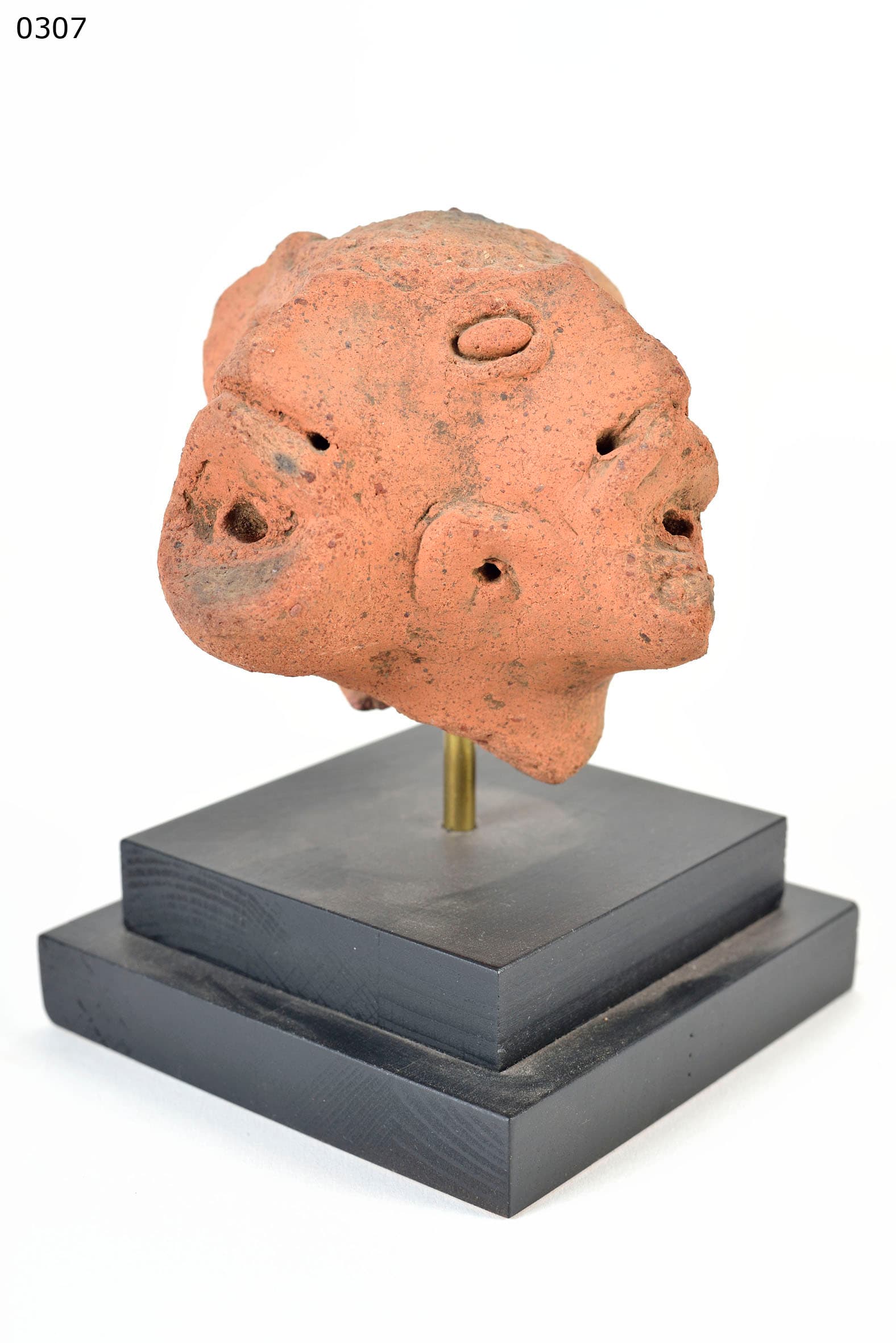
- Single heads (Single Heads) and anthropomorphic full figures: This is the most common type. The faces are characterised by deep-set, often disc-shaped, bulging-rimmed eyes and a strongly pronounced, often wide-open mouth, which occasionally exposes bared teeth. A singular feature of many heads is a deep, bowl-shaped concave indentation at the crown. These figures presumably functioned as representatives for ancestors or physically ill individuals in the healing cult.
- Janus figures and polycephali (multi-faced figures): Figures with two, three or up to four faces arranged in oppositional alignment on a cylindrical body or neck. Iconographically, Janus representations in West Africa classically encode omniscience, divinatory omnipresence and the ability to transcend the boundary between this-worldly physical reality and the spirit world.
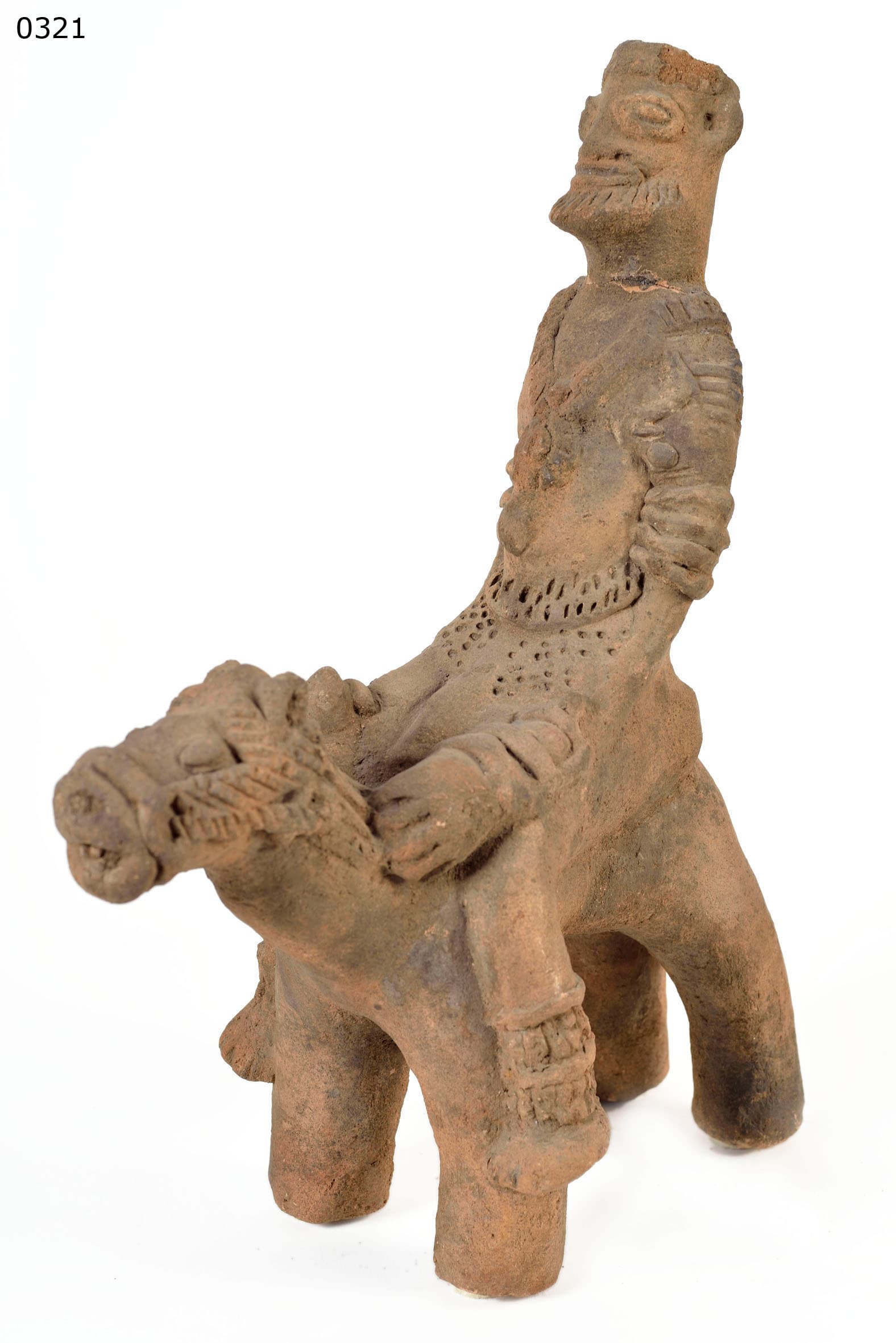
- Equestrian figures (Equestrians): This type represents the artistic and elitist pinnacle of the corpus. They often show bearded, male figures sitting on highly stylised mounts (morphologically oscillating between horses and camels). The riders are richly adorned: they wear caps with chin straps, chest amulets, complex arm and ankle bracelets and often a dagger on their left arm. They represent socio-political prestige, military or spiritual leadership and unmistakably point to links with the trans-Saharan trade networks (as horses and camels were imported goods in this tsetse fly-infested zone).
- Zoomorphs and hermaphrodites: Animal bodies fused with human facial features (therianthropy), or birds and reptiles. They refer to nature spirits, complex totem connections or served as alter ego representations in the context of shamanistic healing cults.
There is a significant iconographic controversy within the discipline regarding the morphological peculiarity of the concave skullcaps and the deep perforations on the eyes, noses and ears often associated with them. The art historian E. A. Dagan (1989) postulated in her work Spirits without Boundaries that the bowl-shaped indentations on the heads were divination bowls and interpreted the clay reliefs applied to the bowls as depictions of cowries that were consulted for oracles (Dagan 1989). More recent archaeological research by Kankpeyeng and Insoll vehemently contradicts this early thesis. Using state-of-the-art computer tomography (CT), the research team from the University of Manchester was able to prove beyond doubt that the cavities actually formed complex internal pipe systems (hidden channels) that connected the crown inside the figure directly to the orifices (ears, nose, mouth). These elaborate architectural hydraulics were undeniably designed for the pouring of liquids and did not serve as a static oracular bowl.
The difference between a profane clay object and an activated ritual object thus manifests itself in three dimensions: the internal structure (channels vs. solid), the iconography and the patina. While profane pottery (pots) shows signs of utilitarian wear and soot deposits, the ritual terracottas often show an encrusted sacrificial patina. Anthropological theories on production communities (such as the application of C. Kramer and P. Rogers' "Communities of Practice" theory in archaeological discourse) point to the existence of "master hands" and highly specialised workshops. Despite the anonymity of the prehistoric creators, certain stylistic coherences - such as the specific modelling of the eyebrows or the draping of the decorative elements (Kröger 1988) - show that the elite pieces were created by highly specialised virtuosos, while simpler fragments could point to apprentices (apprentices).
For the international collectors' market and renowned institutions such as the Museum Rietberg in Zurich - which plays a leading role in Switzerland and has significant coma holdings thanks to the extensive donation by the collector René David in 1989 - the forensic analysis of these internal canal structures is a decisive criterion for forgery today. Since mass looting in the 1990s brought a flood of forgeries onto the market, which often only imitate the external, archaic form without being able to reproduce the hidden functional hydraulics of the original, radiological examination of the aesthetics offers definitive proof of authenticity.
Ritual practice
The ritual dynamics, the functional embedding and the life cycle of a Koma Land object can now be reconstructed in impressive detail thanks to the advanced synthesis of stratigraphic field findings, ethnographic analogies and modern biomolecular forensics. The process followed a strictly regulated choreography: from the intentional creation in the workshop to the performative activation at the shrine to the final ritual deactivation and careful disposal in the mound complex.
The beginning of the ritual practice already lay in the conception and modelling. The fact that many figures were provided with the highly sophisticated internal cavity channel system described above proves beyond doubt that these objects were designed a priori for a dynamic, fluid-based performance. After the field firing, the freshly carved or modelled, formally still uncharged (profane) object was transferred to the cult and activated by the priest or healer.
The activation and actual use of the altar consisted of the application of highly specific sacrificial materials. While the source material on the exact spoken rites or seasonal occasions remains archaeologically mute by nature, the groundbreaking work of palaeogeneticist Terry Brown and his team (2017) has provided unprecedented details on ritual performance. DNA analyses carried out using generic polymerase chain reaction (PCR) and forensic swabs inside the cavities of 14 terracotta figurines provided revolutionary evidence of plant material that is by no means indigenous to the West African savannah. The researchers identified DNA from bananas (Musaceae) and pines (Pinus). This empirically proves that not only local millet beers or animal blood were used as elite offerings at the Libations, but also high-priced exotic liquids, resins or extracts imported through transcontinental long-distance trade. Bananas and pine products could only reach northern Ghana via complex trade routes that included North Africa, the Mediterranean and potentially Asian networks.
The performance of the rite was highly theatrical and visceral: the liquid offering was poured into the concave indentation of the figure's head, passed through the internal canal system and emerged from the prepared perforations at the eyes, nose or ears. This performance simulated living, sweating, excreting or weeping entities. In the context of healing rituals, this marked the climax of ritual communication to appease ancestors or exorcise demons of illness (Insoll et al. 2011).
This phase of active use - which, depending on social needs, took place in private residential complexes, at central village open-air altars or in specialised secret society shrines - was inevitably followed by the phase of deactivation. Ethnographic analogies from West Africa and the massive, methodical fragmentation of the find complexes prove that the terracottas were ritually "killed" or deactivated after the fulfilment of their purpose (such as the healing of an illness), after the death of their owner or when a rite definitively failed (ritual failure - when drought or illness persisted despite offerings). The figures were deliberately smashed: the heads were separated from the torsos and the limbs broken off. This destruction was not vandalism, but a necessary act to allow the stored, potentially dangerous spiritual energy to flow out in a controlled manner.
The final disposal of these fragments then took place in the stone circle and earth mounds (as in Yikpabongo or Zoboku). As Kankpeyeng and Nkumbaan (2008) emphasise, these depositions were not chaotic heaps of waste (Middens), but strictly curated, cosmologically determined spatial arrangements. The shattered fragments of the figurines were systematically placed together with hundreds of grinding stones (representing agricultural subsistence), layers of broken pottery and highly selected human remains (skullcaps, teeth). The architecture of this deposit functioned as a permanent seal.
It is precisely this final stage of the life cycle that can be seen in the fragmented pieces that now circulate in the holdings of the British Museum in London or in European private collections. The museum is increasingly emphasising the need not to read these pieces, which have been isolated through looting, as defective works of art, but to understand their fragmentation as an expression of their complete ritual biography. However, the violent separation of the object from its stratigraphic mound context by modern looters irrevocably robs the artefact of its fundamental archaeological and ritual legibility.
Historical context
The development of the historical chronology and dating of the Koma Land culture was characterised by significant methodological debates for decades. In the early phase of research, initiated by the German ethnologist Franz Kröger, the first thermoluminescence dating (TL) was carried out on individual terracotta heads at the Max Planck Institute for Nuclear Physics in Heidelberg in May 1984. These early physical analyses provided dates of 405 ± 135 years, which placed the culture in the 15th to late 17th century (Kröger 2017). This seemingly young age evoked theories linking the terracottas to post-medieval migratory movements. However, more recent, stratigraphically rigorous radiocarbon dating (C14) of organic material and refined TL analyses by the archaeological teams of the University of Ghana (under Kankpeyeng) and the University of Manchester (under Insoll) have massively revised this assumption into the depths of time: the peak phase of the construction of the mounds and the production of the figurines is now scientifically dated primarily between the 6th and 14th centuries AD (Insoll et al. 2012). This places the Koma civilisation in a pre-Islamic era in West Africa, long before the consolidation of the great Sudanese empires and before the direct colonial encounter.
Knowledge of this civilisation disappeared completely from regional memory for centuries. The historical migration movements prior to and during the colonial period led to the recolonisation of the Sisili-Kulpawn basins by present-day Gur speakers who had no oral tradition regarding the builders of the mounds. The rediscovery in Western perception was almost profane: in the 1960s and 1970s, inhabitants of the village of Yikpabongo came across the buried figures while digging clay for traditional house construction (Kröger & Saibu 2010). It was not until 1978 that Franz Kröger scientifically documented the first objects that had been misused in Zamsa earth shrines (Kröger 1982). Following his information and that of the local informant Ben Baluri Saibu, Prof James Anquandah initiated the very first systematic scientific excavations in 1985.
Tragically, however, this scientific exploration also marked the beginning of a devastating market history in the West. Between 1985 and the late 1990s, Koma Land experienced an unprecedented, commercially driven looting boom. Local networks and international middlemen ruthlessly ransacked and destroyed thousands of the existing mounds to cater to the lucrative Western European art market (Anquandah 1998). The commercial breakthrough in the West was rapid: as early as 1987, the prestigious Walu Gallery in Zurich organised a major sales exhibition entitled Découvertes - Discovery - Entdeckungen. New Cultures from Komaland, which triggered an enormous price increase (Kröger). Subsequently, overexploitation escalated to such an extent that today it is estimated that 95% of the world's coma terracotta comes from illegal or undocumented excavations; only just under 5% has been excavated under controlled scientific conditions.
In order to counter the rampant export, the International Council of Museums (ICOM) was forced to explicitly place coma artefacts on the Red List of highly endangered West African cultural assets in 2000. Renowned institutions such as the Musée du quai Branly - Jacques Chirac in Paris, which occupies a central, highly sensitive position in the discourse on the return of African cultural assets (restitution) and historical provenance research into objects acquired in the 1980s/90s, are now faced with the enormous ethical and archaeological challenge of transparently processing these isolated market specimens. The year 2003 marked a turning point when the Swiss collector René David voluntarily restituted 47 cultural artefacts, including coma figurines, to Ghana as part of a UNESCO appeal.
The price boom in the late 1990s inevitably led to a considerable counterfeiting problem. Local copyists quickly learnt to imitate the crude iconography of the horsemen and Janus figures in order to satisfy the immense Western demand. Since then, the authenticity criteria for collectors and museums have become drastically stricter. While forgery features such as artificial termite damage or manipulated heartwood cracks are examined in the case of wooden objects, superficial indicators such as applied earth patina are easy to manipulate in the case of terracottas. Modern forensics therefore requires technological effort: TL dating remains the absolute gold standard for determining the age of ceramics, even though it requires invasive core drilling that causes minimal damage to the object (Brown 2017). For non-invasive forensic expertise, specialists and auction houses (such as Sotheby's, who are increasingly demanding radiological reports for elite pre-colonial African objects such as Mali riders) are turning to medical CT scans. As forgers primarily target the visual surface value, they usually model the pieces from solid clay. The highly complex internal hydraulic infrastructure - the delicate tubular connections between the concave apex and the exit openings - that defines the authentic coma ritual object is almost impossible to imitate by hand and is instantly exposed in the three-dimensional X-ray image (Insoll et al. 2011). Today, this synthesis of physical dating and radiological interior analysis forms the indispensable basis of interpretation and value for every serious private collector of African antiquities.