Overview
The Akan are one of the most important and complex ethno-linguistic groups in the West African forest belt. Their self-designation is Akanfoɔ, their territory is referred to as Akanman. The settlement area extends primarily across southern and central Ghana and the south-eastern part of Côte d'Ivoire, with smaller enclaves in Togo. Current estimates for 2024/25 assume a total population of Akan speakers of between 25 and 34 million people - in Ghana, around 80% of the population speak Akan as a first or second language, with the Akan making up the largest ethnic group at around 47.3%. In Côte d'Ivoire, the proportion is around 38%. The historically most influential subgroups are the Asante (Ashanti), Fante, Akuapem, Bono (Brong), Akyem, Akwamu, Wassa, Denkyira and the Baule and Anyi, who are native to Côte d'Ivoire.
Linguistically, the Akan languages belong to the Central Tano branch of the Kwa language family, which in turn is part of the Niger-Congo macrophyllum (Stewart 1989; Blench 2006). The classification follows the model of John Stewart (1972) and Florence Dolphyne (2006), which distinguishes between the Bia languages (Baule, Anyi, Nzema) and the actual Akan dialect continuum; the latter includes Twi with the sub-dialects Asante, Akuapem and Akyem as well as Fante and Bono. The predominance of Asante-Twi as the lingua franca in modern Ghana reflects the cultural hegemony of the historical Asante empire.
The construction of identity - Akan internal vs. external - is controversial in the history of research. historically, "Akan" was often a foreign term used by European observers; coastal peoples defined themselves primarily through their city-states (Elmina, Cape Coast). The classification of the Guan as Akan remains controversial - they have adopted central cultural characteristics, but linguistically form their own subgroup; oral traditions and archaeological findings prove that they settled in what is now Ghana before the Akan and were largely assimilated through war and alliances in the 15th to 18th centuries. The attribution of the Baule is similarly debated: their founding ethos is based on the migration of the Akan princess Aura Poku from the Asante empire, but their material art production developed stylistically in completely different ways from the art of the Ghanaian heartland through intensive interaction with Guro and Senufo.
The social structure is strictly organised along matrilineal lines. Each person belongs to one of seven to eight exogamous clans (Abusua) whose descent goes back to a common ancestor - the basis for land ownership, inheritance rights and the allocation of political offices. Parallel to this exists the paternal principle of Ntoro, which transmits spiritual qualities, taboos and moral discipline, while the physical blood (Mogya) is passed on exclusively from the mother and immovably anchors the individual in the Abusua. In the strongest conceivable contrast to the acephalous segmentary societies of the West African savannah belt (Lobi, Bobo, Tallensi), the Akan developed highly centralised, stratified state organisations. The prototype is the Asante empire (Asanteman), which was consolidated at the end of the 17th century under Osei Tutu I (Rattray 1927; McLeod 1981; Wilks 1975). It is headed by the Asantehene, to whom the regional Paramount Chiefs (Amanhene) and local village chiefs are subordinate; strictly organised craft guilds operate in parallel. The Ohemaa (Queen Mother) is equal to the Ohene as a moral authority, guarantees the purity of the matrilineal bloodline and has the sole right to nominate the succession to the throne. This centralised, imperial identity is today preserved in exemplary institutional form in the Manhyia Palace Museum in Kumasi, set up in the former exile residence of the Asantehene Prempeh I.
Subsistence was historically based on a combination of slash-and-burn agriculture (yams, plantains, cassava) and gold mining; from the 19th/20th century onwards, the globally decisive cash crop production of cocoa was added. Control over the alluvial gold deposits in the forest belt made the Akan central players in the trans-Saharan trade with Djenné and Timbuktu as well as in the later Atlantic trade with the Portuguese, Dutch and British - a control that enabled both the wealth of the elite and the tragic involvement of the Akan in the transatlantic slave trade, in which prisoners of war were exchanged for firearms and luxury goods. Gold was not merely an economic commodity, but was regarded as the earthly equivalent of the sun and a manifestation of the life force (Kra).
Cultural context
The cosmological order of the Akan is a complex structure in which the visible world of the living is inextricably interwoven with the invisible sphere of spirits and ancestors. At the head of the pantheon is Nyame (also Onyankopon, Odomankoma), the all-powerful creator god - theologically a classical deus otiosus, who receded into the background after creation. The daily ritual acts are therefore not dedicated to Nyame, but to the lesser deities (Abosom) and the ancestors (Nsamanfo) (Rattray 1927). The Abosom inhabit prominent topographical points - river systems such as the Tano, mighty trees, mountains, rock formations - and act as executive forces of the creator god. Asase Yaa, the earth goddess, is closely associated with fertility, agriculture and ethical behaviour.
The ontological conception of the person is tripartite. The Kra (the life force or soul) is a divine spark that comes directly from Nyame and determines the individual's destiny - linked to the day of the week of birth, the so-called "day names" (Kwadwo for Monday, Akua for Wednesday), which help to shape the individual's ritual identity. The sunsum (spirit, ego, personality) is inherited through the patrilineal Ntoro lineage and shapes character and charisma. The mogya (physical blood) comes from the mother and establishes the Abusua affiliation. At death, these elements separate: the body (Honam) returns to Asase Yaa, the Kra ascends to Nyame, the Sunsum of the ancestors remains in Asamando and continues to influence the lives of the descendants.
Religious authority is distributed among specialised functionaries. The priests (Okomfo) serve as a bridge to the Abosom - often called through states of possession, they undergo several years of training in shrines, where they learn divination, the art of healing, defence against witchcraft and trance communication with the deities. However, the care of the ancestral altars, communication with the deceased kings and the performance of state rituals (Adae, Odwira) is not the responsibility of the priests, but of the political rulers and their highest-ranking advisors and spokesmen, the linguists (Akyeame). The basic matrilineal structure gives women considerable ritual influence: the ohemaa has her own court and the right to nominate the successor to the throne, central rites of passage such as the bragoro (puberty rite for girls) are led by older women. At the same time, there are strict ritual restrictions: menstruating women are considered taboo for the repositories of spiritual power - they are not allowed to enter the stool houses (Nkonnwafieso) in which the blackened and ancestor-spiritually charged throne stools rest.
A unique structural feature of the Akan religion in West Africa is the close interweaving of reasons of state and sacredness, which culminates in the Golden Chair (Sika Dwa Kofi). Tradition has it that in the late 17th century, the priest Okomfo Anokye - himself a Guan Kyerpon priest - invoked the Golden Chair from heaven so that it would land on the lap of Osei Tutu I - an act of divine legitimisation of the Asante empire. The chair is not considered a throne to sit on, but a transcendent receptacle for the collective soul (sunsum) of the entire nation; it must never touch the ground (Rattray 1927: 289-295; McLeod 1981). A fundamental research controversy exists around this mythology. Ivor Wilks (1975, 1993 Forests of Gold) and representatives of modern political anthropology interpret the rituals surrounding the Golden Chair and the Okomfo-Anokye foundation myth primarily as calculated state-political propaganda that served to consolidate the military hegemony of the Oyoko matrilineage in the 18th century. In sharp contrast to this, Rattray (1927) and McLeod (1981) postulate that such a reductionist, Western political reading misses the essence of the Akan ontology - the myths were experienced by the historical actors as absolute spiritual reality, and they derived their power precisely from this unbroken spiritual authenticity.
Another prominent research controversy in the field of Akan art is the function of the Akuaba figures. The classics - Rattray (1927) and Cole & Ross (1977) - interpret them primarily as fertility amulets worn by women on their backs to induce pregnancy or to influence the beauty of the unborn child. Malcolm McLeod (1981) has diametrically relativised this reading on the basis of extensive field studies: a significant number of these sculptures did not serve to promote conception, but as physical proxies for prematurely deceased children. The figures had to be fed, bathed and carried by the mother as a proxy in order to appease the spirit of the dead child and induce rapid reincarnation into the matrilineage. In many documented cases, the same figurine may have fulfilled both functions sequentially or in parallel - the source situation is deliberately ambiguous.
Aesthetic features
Akan art follows a strict canon that combines mathematical precision with a profound symbolic language. At the centre is the "verbal-visual nexus" described by Cole and Ross (1977): every object, every colour and every pattern corresponds to a proverb (Abebuo) or a historical narrative. Aesthetics are not merely decorative, but serve to communicate social values and legitimise power.
To this day, handicraft production is strictly organised in guilds, which are located in specific villages on the outskirts of the capital Kumasi. Ahwiaa is the historical centre of wood carving; Krofrom is home to master brass/bronze casters; Ntonso is known for Adinkra fabric stamping; Bonwire and Adawomase hold the monopoly on kente weaving; Pankrono is the centre of terracotta potters. This geographical specialisation is not a mere organisational feature, but can be read in the aesthetics of each object as a signature of origin.
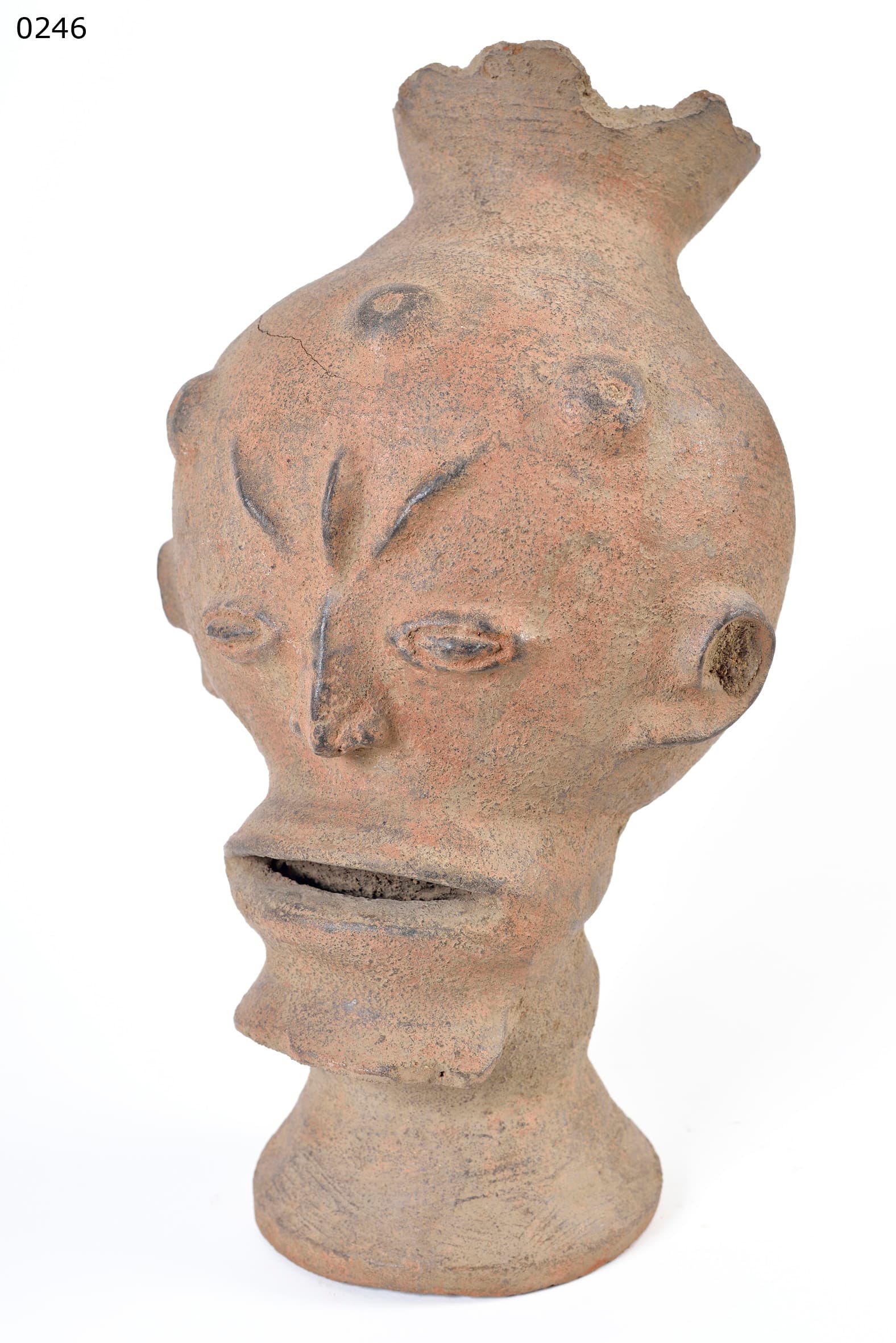
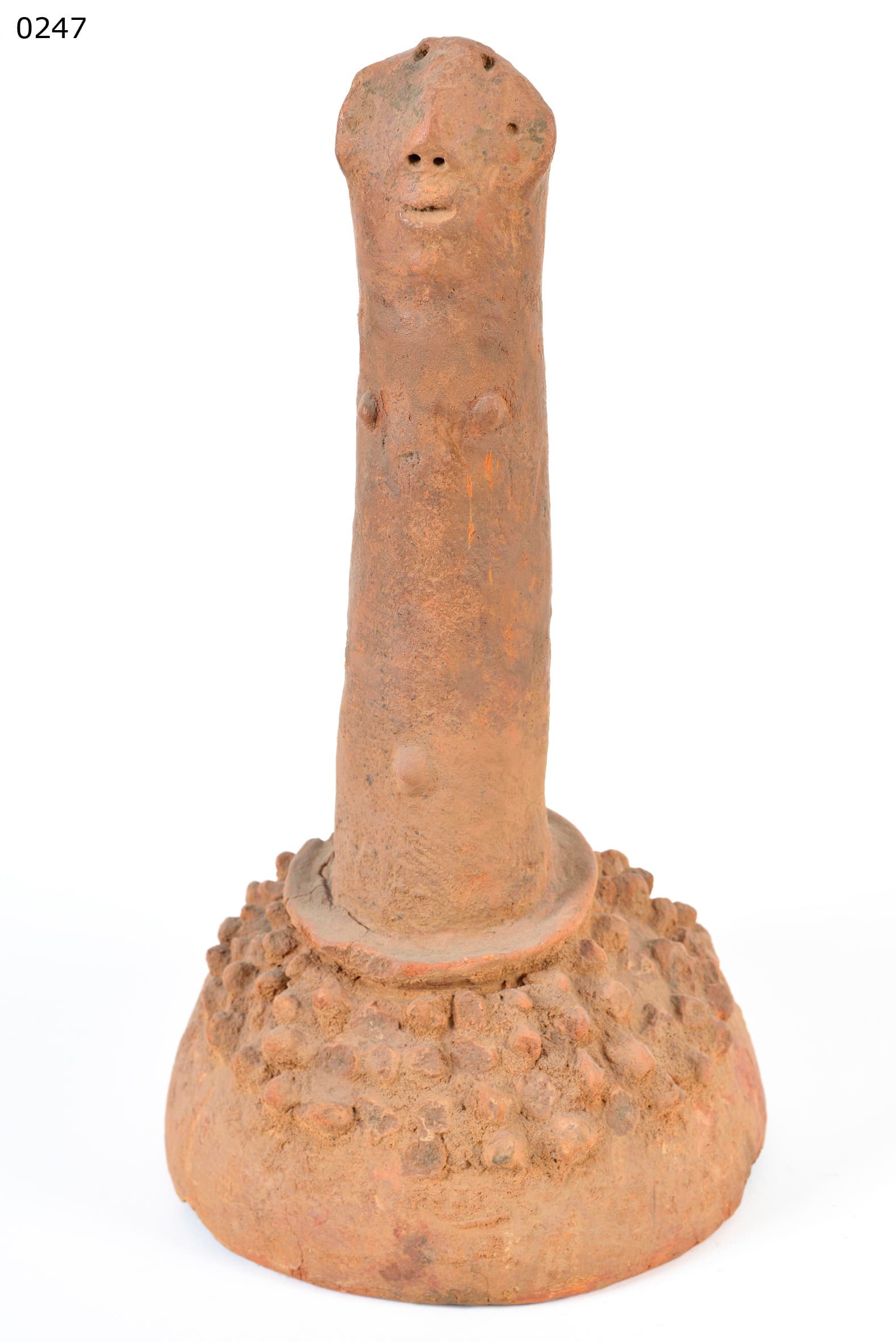
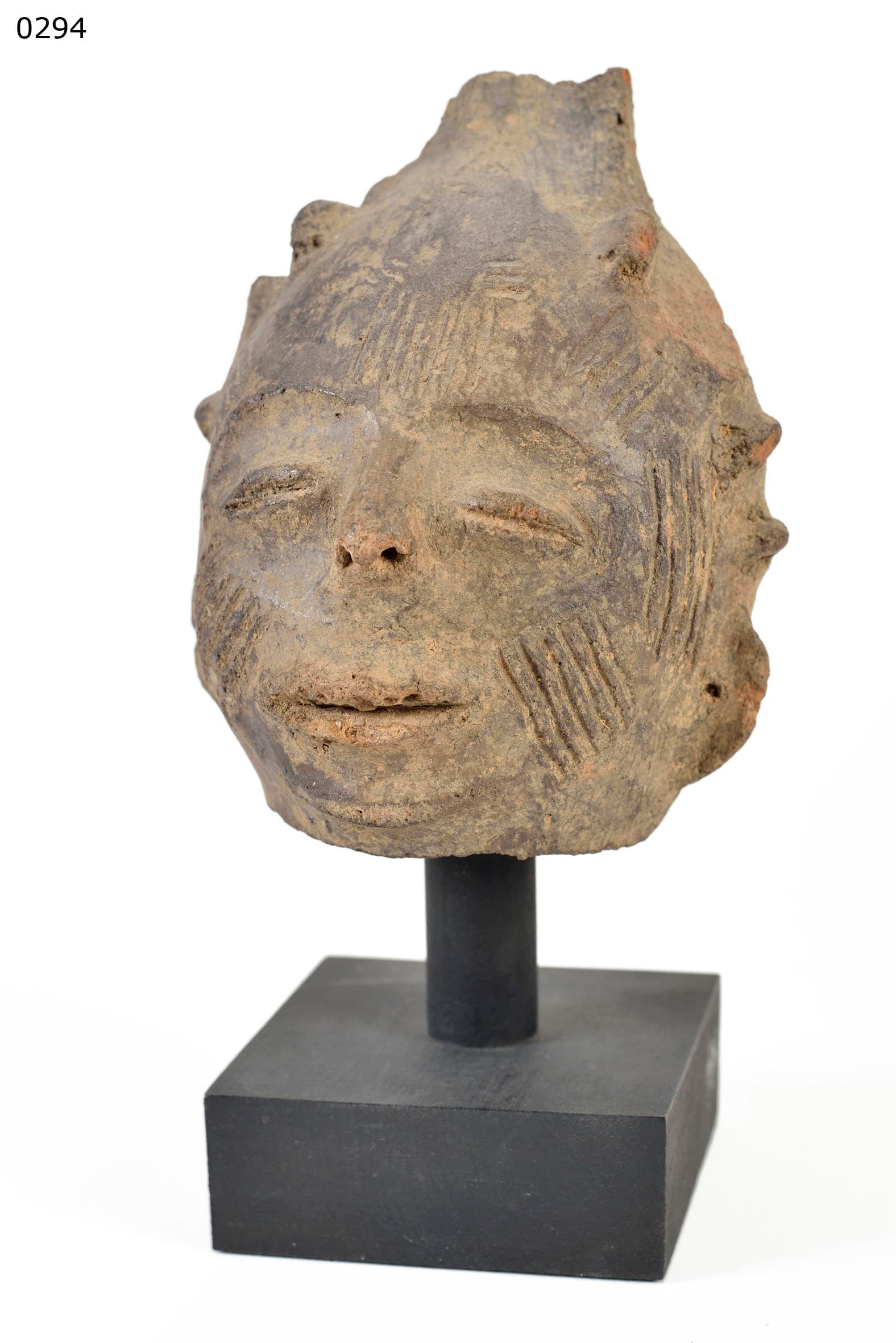
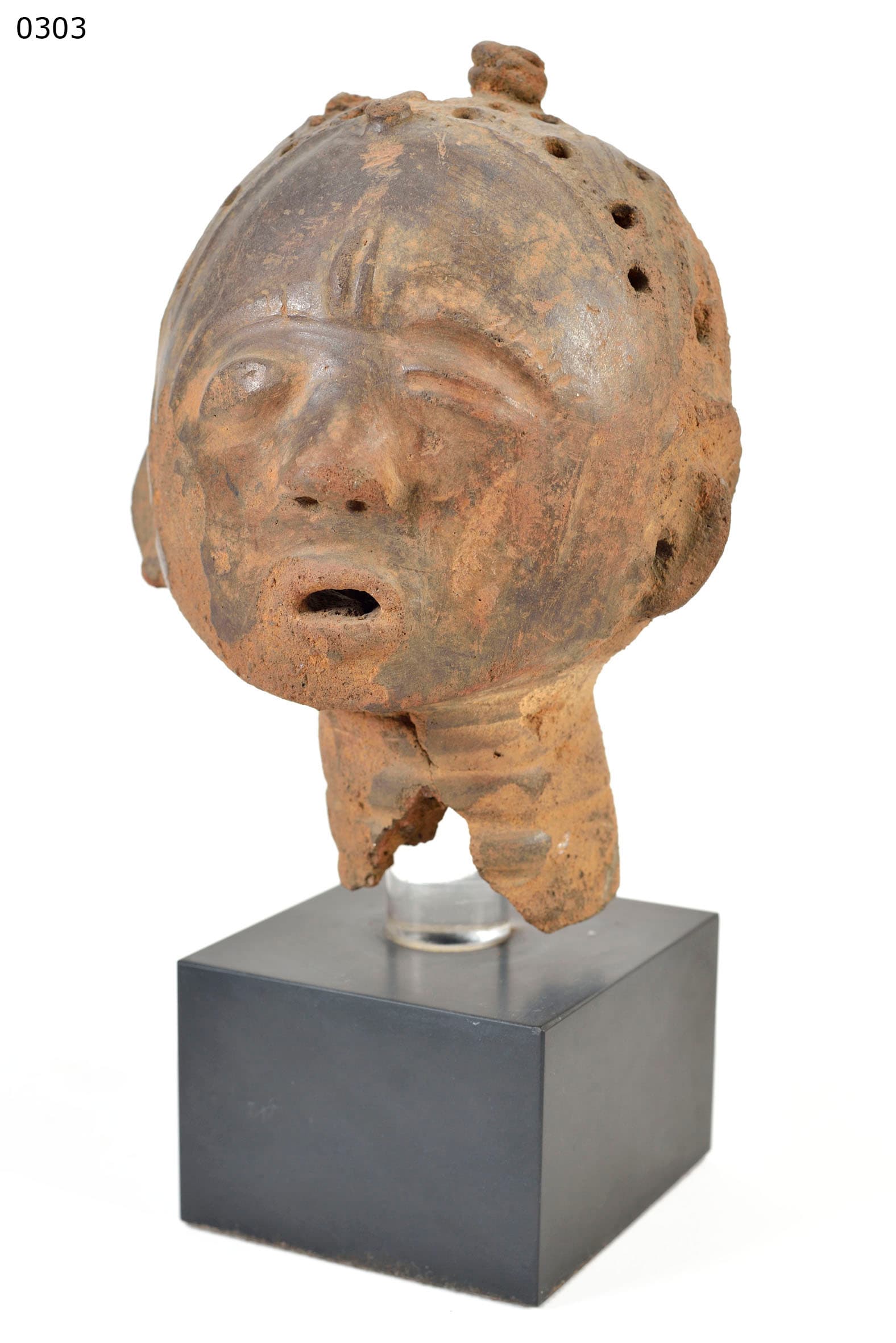
The anthropomorphic terracotta sculptures - primarily the memorial heads (Nsodie, also Mma or Ohoni Ti) and the ritual memorial vessels (Abusua kuruwa) - are an outstanding identifying feature of Akan art and form the core of the present collection. The 17 objects in the collection, the majority of which date from the 12th to 18th centuries, exhibit highly specific stylistic conventions that clearly identify them as works of Akan culture.
The faces of the Nsodie are generally flat and modelled like discs, with an upper part of the head that is wider than the lower part. The eyes are striking - stylised, raised coffee bean eyes or fine, deeply incised slits under strongly arched eyebrows. A dominant ideal of beauty is the grooved or ringed neck: these horizontal rings symbolise wealth, health and elite status (Cole & Ross 1977). The facial expressions are almost invariably neutral, serious and distant - the Nsodie is not a realistic portrait, but an idealised image embodying wisdom, life experience and regal dignity. Identity markers are provided by details of hair treatment and scarification: elaborate hairstyles with small circular tufts of hair, completely shaved heads as a sign of priestly office or mourning, three small scarifications on the temples or forehead as status symbols. A small hole is often worked into the back of the heads - a technical necessity that prevented the clay from cracking during the firing process.
Within the terracotta tradition, clearly differentiated regional styles can be identified: the Twifo Hemang style (particularly long, ringed necks, fine grey-brown patina - the presumed origin of some of the objects in this collection), the Adansi style (hollow, often darker fired heads) and the Kwahu style (expressive, slightly asymmetrical facial features). The natural grey-brown or reddish-brown colour of the clay was historically often enhanced with ochre-red or kaolin-white lines, symbolising affiliation to the maternal line or spiritual purity and mourning.
Alongside terracotta, brass is a central material in Akan art, as evidenced by the prestige ring in this collection (no. 0766) - cast using the sophisticated lost wax process (cire perdue). Iconographically, the ring belongs to the broader field of courtly metal art, which includes the world-famous gold weights (mrammuo): small brass objects whose iconography developed from early geometric forms (15th century, based on North African models) to highly naturalistic figurative representations (from the 17th century onwards). Motifs such as the scorpion, the elephant or the bird turning its head back (sankofa - "turn back and fetch") serve as visual mnemonics for philosophical concepts; they are part of the broader Adinkra sign system that also appears in fabric stamping (ntonso) and courtly architecture. Related object genres are the okyeame poma (linguist's staffs of court speakers covered in gold leaf) and the kuduo (brass vessels for storing gold dust, stylistically influenced by the Islamic metal art of the Maghreb). Kente weaving itself is the subject of a second research controversy: while Akan orthodoxy locates the invention in the Bonoman Empire, Ewe scholars (supported by Malika Kraamer's analyses in 2005) argue that the weaving technique was originally imported into the Asante Empire by Ewe craftsmen.
Western art historiography has largely revised the long-held fiction of anonymous African artists. Osei Bonsu (1900-1977) from Kumasi, who served three successive Asantehenes, is now considered one of the most important Akan carvers of the 20th century; his workshop established the modern morphological canon for linguist staffs and throne stools, and his works are in the collections of the British Museum and the Metropolitan Museum of Art.
For collectors, the distinction between an activated ritual object and a profane art object is crucial. A ritually active stool (Dwa) can be recognised by its "blackening" - a thick, crusty patina of repeated offerings, in contrast to the polished surfaces of export goods. In the case of the nsodie, traces of use and surface weathering that has developed over centuries in the asensie indicate ritual use; in the case of gold weights, the presence of lead or copper inserts to adjust the weight is an indication of actual use as a trading instrument.
Ritual practice
Akan ritual practice is inextricably linked to the deep reverence for the Nsamanfo (ancestors), who are regarded as active protectors and moral guardians of the community. The terracotta heads and memorial figures in this collection were not art objects in the Western sense, but highly charged ritual instruments with a central role in the complex burial and mourning rituals for deceased kings (Ahene), queen mothers (Ohemaa) and high-ranking priests.
The production of the nsody was subject to strict ritual conventions. After the death of a prominent personage, they were made by experienced, older women artists - women who had passed the menopause, which in Akan cosmology spiritually purified them and enabled them to deal safely with the energies of death and the ancestral world. About 40 days after death, during the final and most elaborate funeral ceremonies, the Nsodie served as physical surrogates for the deceased: the terracotta figures were wrapped in royal Kente robes, adorned with jewellery and presented to the community so that the living could pay their last respects to the deceased.
At the conclusion of the public ceremonies, the heads and figures were taken to the Asensie - literally "place of pots", sacred groves or specialised cemeteries on the outskirts of settlements that served as spiritual interfaces between the world of the living and the Asamando. Together with the nsodie, the abusua kuruwa (family pots) were placed there - ritual vessels, often with figurative lids, which were filled with the shaved hair and fingernails of the deceased and those of his blood-related family members. This symbolises the unbreakable unity and continuity of the matrilineal Abusua beyond physical death. The women of the family erected small clay hearths at the asensie and prepared ritual dishes (palm wine soup, mashed yam), which were left in the vessels as food for the ancestors. Important: these terracottas were never buried with the body in the grave, but were transported in ceremonial processions to the Asensie and left there to weather (Cole & Ross 1977).
Probably the most complex ritual lifecycle of Akan materiality concerns the throne stool. A newly carved stool is initially mundane - a "white chair" (fufu dwa), a mere piece of seating furniture. As Hale (2013) shows, the enthronement (enstoolment) of a ruler is ritually conceived as a "rebirth" from the matrilineage. When the ruler dies, his personal chair undergoes a drastic metamorphosis: it is ritually "blackened" and elevated to the status of an ancestral altar. This dangerous activation takes place deep within the secrecy of the chair house (Nkonnwafieso). The chair is rubbed with a top-secret mixture of crushed cobwebs, egg yolk, soot and the blood of sacrificial animals - preferably sheep that are slaughtered over the chair. Through this act, the chair permanently binds the soul essence (sunsum) of the deceased to the wood. From this moment on, it is an independent, living entity: it may never be used as a seat again and may not touch the ground; from then on, it rests on a blanket, an animal skin or its own smaller frame (Asipim).
The objects in the chair houses and Asensie were not forgotten relics, but active focal points of regular rituals. The Akan calendar is divided into cycles of 42 days (Adaduanan), in which the Adae festival is celebrated twice: as Akwasidae on a Sunday and as Awukudae on a Wednesday. On these sacred rest days, when agricultural work is strictly forbidden, the Ahene, accompanied by their elders, enter the chair houses and the sacred groves. As a sign of humility, they bare their shoulders and take off their sandals. They invoke the names of the ancestors one by one and pour libations - drink offerings of palm wine or imported liquor - on the ground and over the objects, while female members of the matrilineage offer unseasoned food such as pounded yam to nourish the ancestors. The annual Odwira festival marks the purification of the nation and the renewal of the ruler's power in the annual cycle; the ancestral chairs of the deceased kings are taken out of the sacred chambers, washed with water and herbs and ritually served (Rattray 1927; McLeod 1981). The priests use Okyeame Poma to convey the prayers to the ancestors in highly formalised language.
The ritual performance of the Akuaba figures is organised as an intimate, highly individualised female cult. After completion by the woodcarver, the doll is still ineffective. The woman takes it to an okomfo, who charges it by incantations, sprinkling it with herbal brews (aduro) and placing it on the altar of a local deity for several days. From then on, the woman carries the figure wrapped tightly in her back cloth - exactly in the anatomical position in which Akan women carry live babies. Activation requires the woman to treat the figurine like a human child: it is washed daily, symbolically fed, put to bed and adorned with precious glass beads (waist beads) and miniature earrings. The deactivation and disposal rituals vary considerably from region to region: in many districts, the akuaba is given to the priest's shrine after a successful birth as a votive offering and token of gratitude (often dozens of such figurines accumulate there as a visual documentation of the healer's potency); in other regions, the figurine is given to the growing girl as a toy to prepare her for motherhood at an early age; if the pregnancy does not occur or the woman dies childless, the figurine is often buried with her to finally close the cycle. One controversial aspect of contemporary practice is commercialisation: many objects are now made for sale without ever having been ritually activated, making them purely decorative objects.
Historical context
The ethnogenetic and historical formation of the Akan civilisation is the result of centuries of migration, assimilation and consolidation processes. Oral traditions (abakwasem), supported by linguistic and archaeological evidence, locate the cultural, economic and political heartland of the Proto-Akan in the medieval kingdom of Bonoman (Bono Manso), which existed between the 11th and 15th centuries north of the rainforest belt (Dumett 1979). Bonoman acted as a hinge between the goldfields of the forest and the trans-Saharan trade networks of the Mande influence area on the middle Niger, in particular through the control of trading centres such as Begho. From this epicentre, various Akan groups successively migrated southwards into the rainforest areas and finally to the Atlantic coast, displacing, fighting or assimilating the Guan-speaking groups. The dating of these early migrations is controversial - while archaeological excavations in Begho reliably date urban structures to the 12th century, more recent linguistic analyses (Blench 2006) push the separation of the Tano languages much further back into prehistory, which challenges the chronology of oral traditions.
The decisive turning point occurred in 1701, when the Asante Empire under Osei Tutu I - with ideological backing from Okomfo Anokye and the Golden Chair - broke the hegemony of Denkyira. Supported by military innovations, efficient administration and spiritual unification through the cult of the chair, the Asante Empire developed into one of the most powerful, best-organised empires in West Africa (Wilks 1975, 1993).
The colonial period in the 19th century was characterised by decades of fierce resistance to British expansion. In a series of bloody Anglo-Asante wars (1824-1900), the Asante defended their sovereignty. A traumatic turning point was in 1874 (Sagrenti War): British troops under Sir Garnet Wolseley captured Kumasi, plundered the royal palace and confiscated countless regalia, gold objects and works of art as "spoils of war" and compensation payments fixed under the Treaty of Fomena. in 1896, the reigning Asantehene Prempeh I was exiled to the Seychelles - he was not allowed to return until 1924. The last major uprising under the Queen Mother Yaa Asantewaa (1900) was suppressed and the Asante kingdom was formally incorporated into the British colony of the Gold Coast; the British colonial administration temporarily suppressed public gatherings and festivals such as the Adae, which led to massive disruption of traditional ritual cycles.
The plundering campaigns left a legacy that is still disputed today - the so-called "Kumasi Loot" included massive goldsmithing, hundreds of mrammuo, silk textiles and throne stools and formed the basis of the large Akan holdings in the British Museum, the Wallace Collection, the Victoria & Albert Museum and other European institutions.
The market history of Akan art in the West underwent a fundamental transformation. Until the middle of the 20th century, gold weights were primarily collected as numismatic curiosities, chairs as ethnographic artefacts. Cole & Ross' The Arts of Ghana (UCLA 1977) and McLeod's 1981 exhibition Asante: Kingdom of Gold at the Museum of Mankind (London), flanked by the canonical companion volume The Asante (1981), were groundbreaking for the paradigm shift in reception. Today, Akan masterpieces at Sotheby's and Christie's achieve estimates and hammer prices of up to 250,000 USD for rare early yellow-cast works and chairs.
Ghana's independence in 1957 under Kwame Nkrumah marked the beginning of a complex post-colonial era. Today, the office of the Asantehene and the regional Ahene no longer have absolute executive power, but still exercise immense cultural, moral and legal authority. Traditional festivals such as the Adae Kese ("Great Adae") have been revitalised and today serve as powerful symbols of cultural resilience and identity.
The restitution debate has recently developed a historical dynamic in the Akan context. In 2024, exactly 150 years after the Looting of Kumasi, groundbreaking restitutions took place: the Fowler Museum of the University of California (UCLA) transferred permanent and unconditional ownership of seven looted royal artefacts back to the Asante kingdom. In parallel, the British Museum and the Victoria & Albert Museum - prevented by British law from making a permanent return - agreed to long-term loans of 32 important gold artefacts to the reigning Asantehene Otumfuo Osei Tutu II. These events, celebrated with grand ceremonies in Kumasi, mark a paradigm shift: the Akan no longer appear merely as historical victims of colonial exploitation, but as active, sovereign actors who are reclaiming their cultural heritage and playing a decisive role in shaping the global museum ethic of the 21st century.
The problem of authenticity and forgery remains methodologically central for collectors. Parallel to the increase in value, a highly professionalised market for forgeries was established from the 1970s onwards, produced specifically for unwary Western collectors. Authentic ancestral chairs that have been used ritually for decades exhibit extremely dense, irregular incrustations of coagulated blood, organic fats and soot that have formed a molecular bond with the wood tissue; counterfeiters often use superficial, artificial darkening using shoe polish, tar or chemical stains. Other critical authenticity features: natural heartwood cracks due to decades of drying out in the Harmattan climate change (cannot be simulated by machine), deep-seated historical feeding marks of specific termite species, the unmistakable handling patina on the edges of the Akuaba heads due to decades of skin friction, micro-cracks in the clay of terracottas due to historical temperature cycles and feeding marks of soil organisms, and in the case of gold weights, adjusting lead/copper inserts as an indication of actual trade use. The Museum Rietberg Zurich, the Fowler Museum UCLA, the Musée du quai Branly (whose material science analyses of patina layers can now chemically verify the cumulative practice of sacrifice) and the Royal Museum for Central Africa Tervuren (computer tomography-assisted unmasking of composite forgeries) consistently apply these multidisciplinary criteria as part of their provenance research.