Overview
The geopolitical core territory of the Asante, today's Ashanti Region of the Republic of Ghana, has a total population of 5,440,463 individuals according to the latest data from the Ghana Statistical Service (GSS) from the 2021 census. The population density is 223.1 people per square kilometre. Around 82.9 per cent of the Akan population there explicitly identify as Asante, while the remaining demographic is made up of other subgroups or migrants.
| Demographic & Linguistic Key Figures (Census 2021) | Specification |
|---|
| Total population Ashanti Region | 5,440,463 |
| Area | 24,389 km² |
| Population density | 223.1 / km² |
| Proportion of regional Akan population | 82.9 % |
| Linguistic classification | Twi dialect continuum (Kwa language family) |
Linguistically, the Asante are part of the Twi dialect continuum, which belongs to the broader Niger-Congo language family (subcategory Kwa). Twi is spoken today by over 9 million Asante as their mother tongue; in the English-language research tradition, the ethnic group is also regularly referred to as "Ashanti" (Wikipedia EN, as of 2026). Within the Akan cultural complex, the Asante are also considered to be the last subgroup to emerge from the various Akan civilisations (Wikipedia EN, as of 2026), which ethnogenetically underlines the historical late consolidation of the Asanteman confederation around 1701. The self-designation of the people is Asantefoɔ, while their geopolitical territory and the historical state organisation are defined as Asanteman. The social structure is strictly hierarchical and extremely centralised, which represents a significant contrast to the acephalous organisation of neighbouring peoples. At the top of the socio-political pyramid is the Asantehene (king), whose authority is legitimised by the Golden Stool (Sika Dwa Kofi). He is assisted by the Asantehemaa (Queen Mother), who usually holds the genealogical authority, advises the king and has privileges in the nomination of the succession to the throne.
The kinship system operates under a dual epistemology: society is fundamentally organised on a matrilineal basis; membership of the primary descent group (Abusua) and the inheritance of land rights and political office run through the maternal bloodline (mogya). In contrast, the spirit or character essence (ntoro) is transmitted patrilineally. The subsistence strategy was historically based on the geopolitical control of trans-Saharan trade routes (gold dust, kola nuts) in cooperation with centres such as Begho and Bonduku, while agricultural yields were secured through yams and later cocoa as a cash crop. The relationship with neighbouring peoples such as the Adanse, Denkyira and Bono was historically characterised by military expansion, compulsory tribute and hegemonic assimilation.
The sources are ambiguous with regard to the exact ethnic demarcation within the contemporary administrative framework. In the run-up to the 2021 census, for example, the GSS was confronted with methodological classification controversies in which various Akan subgroups complained of insufficient differentiation of their specific identities in relation to macrogroups. These definitional tensions are also reflected in Western collection strategies, where institutions such as the Royal Museum for Central Africa (Tervuren/RMCA) or the British Museum often subsume Asante artefacts under the generic macro-label 'Akan' with insufficient differentiation.
Cultural context
The Asante religious system operates under the premise of a distanced creator god, Nyame (or Onyame), who, according to the cosmological order, withdrew from the direct concerns of the material world after the initial creation. Instead, active ritual practice is directed towards a complex hierarchy of intermediate entities: the Abosom (lower deities or localised natural beings), the Asuman (man-made amulets and objects of power) and the Nsamanfo (revered ancestors).
Ritual authorities are primarily composed of the Okomfo (priests) and divinators, who act as physical mediums for the Abosom and orchestrate healings or conflict resolution in trance states. Women play an essential role in the cult, a role often marginalised by early Western observers. The Asantehemaa presides over ritual cycles that guarantee the preservation of matrilineal purity. Central rites of passage such as the Bra goro (female puberty and initiation ritual) manifest this ontological status transition materially by ceremonially placing the initiate on a special stool, formalising her maturity for marriage and motherhood.
| Cosmological structural comparison (West Africa) | Asante (Ghana) | Ewe (Ghana/Togo) | Baule (Côte d'Ivoire) |
|---|
| Central cult insignia | Stool (Dwa), yellow cast iron (Kuduo) | Decentralised earth shrines (Trokosi) | Spirit spouse figures (Blolo bian/bla) |
| Ancestor worship | Centralised, hierarchised | Pantheistic, localised | More individual, mask-associated |
| Performative practice | throne desacralisation, trance | oracle beings, vaudou derivatives | mask dances (e.g. Mblo, Goli) |
Structurally, the religion of the Asante differs massively from that of the neighbouring peoples. While the cosmology of the Ewe in the east prioritises a pantheistic epistemology with a focus on shrine systems and interactions with earth deities, the religion of the Asante is inextricably linked to the centralised state apparatus and dynastic ancestor worship (represented by chair altars). In addition, the Asante lack the distinct mask performance tradition that dominates among the linguistically related Baule.
There are profound controversies regarding the genesis of this cosmological apparatus. The sources are ambiguous: Eva Meyerowitz (1951) dates and localises the origins of the Akan/Asante state culture extremely early and traces them back to external waves of migration from the far north (as far as Ethiopia). In sharp contrast, archaeologists such as Merrick Posnansky (2009) and James Anquandah use ceramic stratigraphy to prove that cultural evolution took place autochthonously in the West African forest zone. Such divergent narratives must be explicitly balanced in curatorial practice, for example in the Musée du quai Branly's inventory catalogues, when contextualising shrine figures.
Aesthetic features
The aesthetic vocabulary of the Asante is highly formalised and inextricably interwoven with verbal proverbs and the concept of ritual functionality. The canonical object typology is centred on four main categories: Akua'ba figurines, Adwen (gold weights), Dwa (carved stools) and Okyeame poma (linguist's staffs).
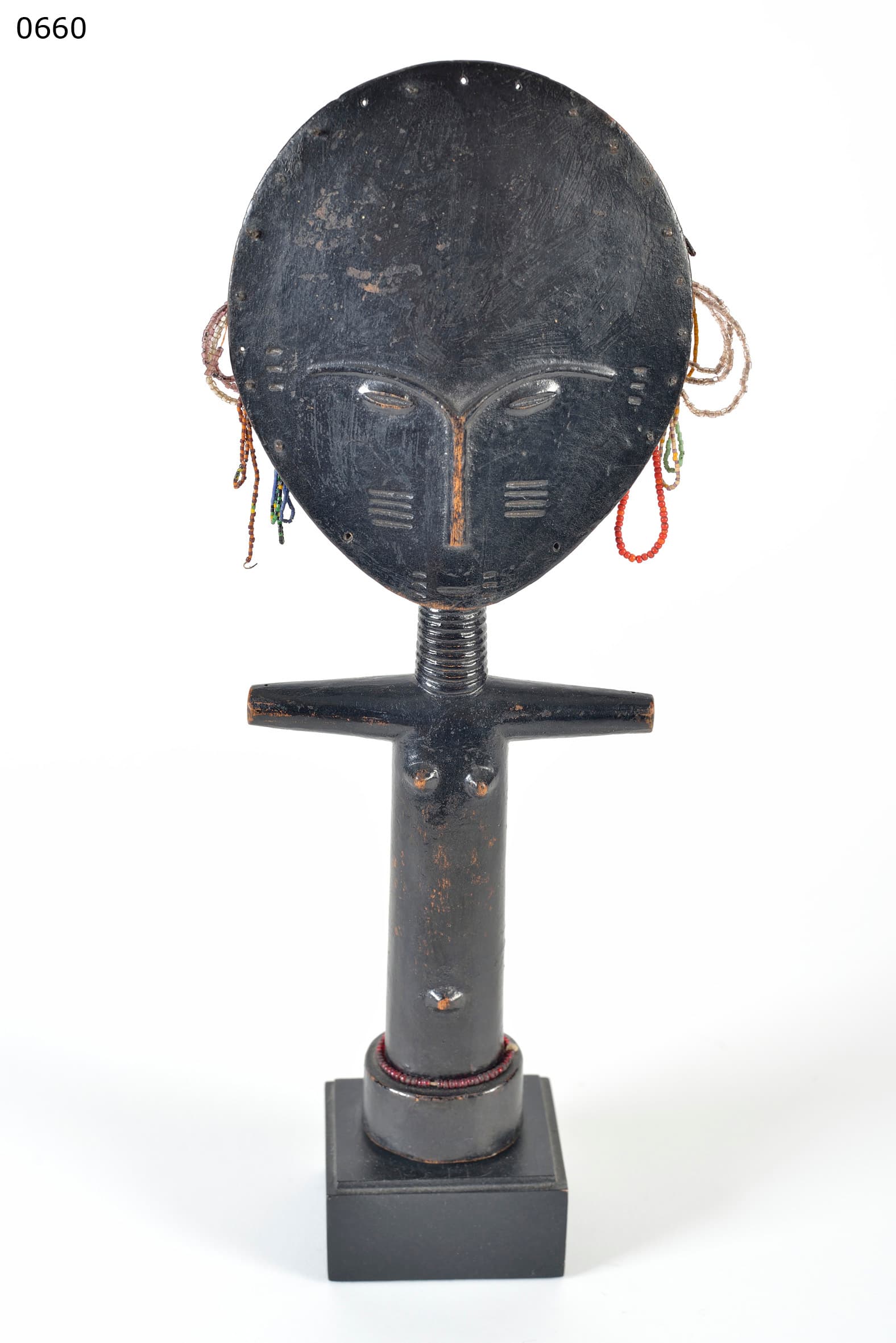
The Akua'ba (plural: Akua'mma) is defined by a rigid canon of proportions: A disc-shaped flat, oversized head on a cylindrical, often ringed neck with rudimentary, orthogonally projecting T-arms and a columnar torso. The flattened head reflects the ideal of beauty of the Asante, while the neck rings symbolise prosperity, health and the mythological connection to aquatic spirit worlds.
There is a significant controversy in iconographic research regarding the primary function of these objects. Doran H. Ross (1996) interprets the figures in standard academic readings primarily as figures to aid conception; infertile women carried them like infants in backcloths and nursed them to evoke spiritual interventions. In direct contradiction to this, Malcolm McLeod (1981) of the British Museum formulates the thesis that the Akua'ba should not be read purely instrumentally as a fertility aid, but was often intended to alleviate grief for a deceased child or served as a representation of a mythical daughter (Akua) for childless women in the context of ancestor worship.
The adwen (gold weights) demonstrate the mastery of the cire perdue (lost wax process). The miniatures, mostly cast from copper alloys (brass), range in size from a few millimetres to centimetres. They translate complex philosophical proverbs into figurative iconography (crocodiles, warriors, birds), which structured the elite discourse at court. The carved ruler's stools (Dwa) are canonically made of the light-coloured wood Triplochiton scleroxylon (Sese wood) and encode social hierarchies in their openwork central supports. Okyeame poma (linguist's staffs) use finials (tips) covered in gold leaf, such as the motif of two warriors or the armed bird, to visually flank diplomatic and martial proclamations of power by royal speakers.
| Material and aesthetic parameters of canonical objects | Specification |
|---|
| Material preference sculpture | Sese wood (Triplochiton scleroxylon) |
| Material preference metal | copper alloy / brass (Cire perdue) |
| Proportional canon (Akua'ba) | Disc head (ideal of beauty), ringed neck |
| Documented masters (20th century) | Osei Bonsu (Kumase), Ahwiaa workshops |
A unique feature of Asante art is the documentation of individual master hands. Osei Bonsu (1900-1977), who acted as chief carver for three Asantehene, established a naturalistic workshop style. His works are characterised by egg-shaped heads, almond-shaped eyes with projecting upper eyelids and an extremely smooth surface treatment, as he rigorously rejected rough chisel marks and used sandpaper. Such attributions are of enormous taxonomic value for collections such as that in the Fowler Museum at UCLA (where Herbert Cole published).
Crucial to the interpretation is the ontological difference between the profane and the activated ritual object. A newly carved stool (Mmaa dwa) is profane. Only through ritual incrustation with animal blood, egg yolk and soot (asesedwa) after the death of the owner does a sacred patina develop, transforming the wood into a vessel for the soul. Market-relevant forgery criteria focus precisely on this: while genuine antiques show natural heartwood cracks with decades-old, oxidised dust deposits, forgers use ink to darken recent cracks or provoke artificial termite damage by burying them in order to simulate the ageing profile for Western collectors.
Ritual practice
The performative ritual practice of the Asante largely dispenses with the mask dances dominant in other parts of West Africa and concentrates on complex interactions at altars, shrines (Gyase Kesie) and the venerative treatment of insignia. The ritual utilisation axis is primarily through contact with the Abosom and the faded Nsamanfo to maintain cosmological balance, social protection and somatic healing.
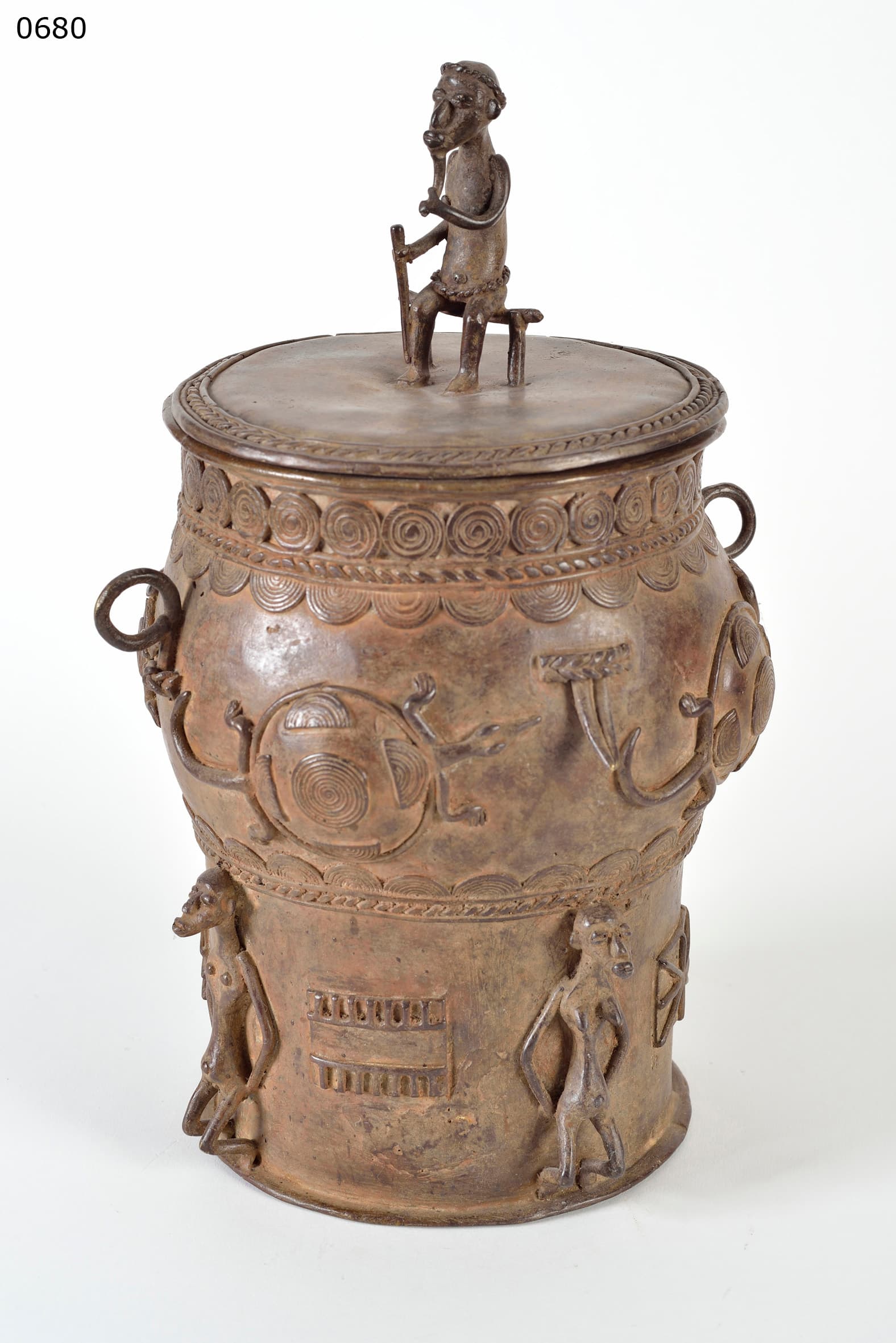
The structural design of an altar is centred around a primary container that holds the material essence of the deity or power being addressed. Here, massive, ornamented brass vessels (kuduo) often function as sacred matrices that hold earth, aquatic substances and organic extracts. Figurative sculptures, asuman (activated amulets) and ceremonial bells are arranged around this centre of gravity. The activation of these shrines requires highly specialised performative sequences. Under the direction of the Okomfo, the ritual space is acoustically conditioned by specific drum rhythms, signalling the descent of the entities and often culminating in the priest's trance possession, through which the Abosom speak directly to the petitioners.
The material supply and binding of the spiritual forces takes place through precisely choreographed offerings. Libations form the basis of the interaction: while reciting genealogical praises and proverbs, palm wine or imported schnapps is poured onto the earth or directly over the objects. At cyclical state festivals (such as the Adae) or in times of crisis, the sacrificial hierarchy increases to animal blood sacrifices (poultry, sheep). The cumulative layering of these substances - consisting of coagulated blood, white clay (hyire), egg yolk and vegetable fats - creates a heavily textured, almost crusty sacrificial patina over decades, which visually testifies to the accumulated agency (nyama) of the object.
| Phases of the object's life cycle | Ritual status & agency | Material manifestation |
|---|
| Profane moulding | Inanimate, passive (Mmaa dwa) | Fresh sese wood, raw yellow casting |
| 2. ritual activation | spiritual binding (Abosom / Asuman) | libations, blood sacrifice, building up of the sacrificial patina |
| 3rd zenith of utilisation | Active oracle, healing or ancestor function | Accumulated incrustations, trance performances |
| 4. deactivation / disposal | "cooling", profanisation or ossilegium | loss of patina care, museum conversion |
The life cycle of a ritual object is highly fluid. An Akua'ba figure leaves the carving workshop as a purely formal construct. Only through the intervention of the Okomfo, who washes it with herbal brews and ritually binds it, is it activated as an auxiliary spirit for the woman carrying it. After fulfilment of its purpose (successful birth), the object is often reintegrated into the shrine as a votive offering. The deactivation and disposal of artefacts follows strict protocol-based cooling rites. If a priestly line dies out or an abosome fails, the shrine is physically and ritually neglected; the power "cools".
In colonial and post-colonial times, this loss of status often resulted in a "cumulative conversion", in which desacralised shrine figures were confiscated by colonial or missionary pressure (documented in the Dutch Spiritans collection, for example) and passed into the collections of Western museums such as the Metropolitan Museum of Art (Met) as profaned "tribal art". Extremely complex desacralisation and burial rituals (Ossilegium) also exist for the highest political offices, such as the Asantehene, which aim to metaphorically isolate the immortal character of the office from the physical decay of the ruler's body.
Historical context
The historical trajectory of Asante art is directly linked to imperial state formation and the deep cut of colonial subjugation. Migration history locates the proto-Asante in the Adanse-Amansie basin before Osei Tutu consolidated the Asante confederacy in Kumase around 1701 following military liberation from the Denkyira state. The chronology of the predecessor states is subject to academic dating controversies: while classical ethnography dates the establishment of the Bono Empire back to the 11th century, archaeological evaluations argue for a later consolidation from the late 14th century onwards.
Contact with the European powers culminated in the devastating Anglo-Asantine Wars in the 19th century. A turning point was the "Sagrenti War" in 1874, when British troops under Sir Garnet Wolseley captured Kumase and systematically plundered the palace. After the banishment of King Prempeh I (1896) and the last uprising led by the Asantehemaa Yaa Asantewaa (1900), Great Britain annexed the territory. These conflicts forced a massive outflow of artworks; enormous quantities of gold regalia were confiscated as reparation payments (Indemnity payments), auctioned in London and today form the basis of the Asante holdings in the British Museum and the Museum Rietberg.
This colonial intervention seriously altered the artists' iconography and production. in 1889, the colonial administration replaced the currency system based on gold dust with the British pound sterling. The Adwen (gold weights), previously indispensable economic measuring instruments, suddenly became obsolete. The yellow casters reacted to this loss of function by switching their workshops to the lucrative souvenir and export market, which triggered a proliferation of figurative miniatures that are now over-represented in Western collections.
| Forensic markers for authenticity testing (copper alloys) | Analytical findings / indication |
|---|
| Material basis (alloy) | Brass/bronze with Cu 7.8%-8.4%, Ag 10.7%-11.1% in gold alloys |
| Authentic casting (Cire perdue) | Natural copper sulphides, grain boundary weathering |
| Forgery detection (LA-ICP-MS/EDXRF) | Recent zinc/lead signatures, lack of surface oxidation |
There is a fundamental controversy in research regarding the origins of this weight system. The sources are ambiguous: Timothy Garrard dates the introduction of the system to the 15th century in his definitive study (1980) and postulates that the units of measurement and geometric forms of the Adwen were direct adaptations of the Islamic Trans-Saharan standards (Mitkal and Wakia). Georges Niangoran-Bouah, on the other hand, rejects this exogenous derivation, arguing that the system was based autonomously on indigenous Ghanaian plant seeds (such as damma and taku), which were only subsequently adapted to Arabic units of weight.
The market history for Asante objects underwent a radical change of meaning in the 20th century. After early collectors such as Thomas Bowdich (1817) or R.S. Rattray acted primarily as colonial ethnographers for the 1924 Wembley Exhibition, exhibitions such as Arts of Ghana (Cole/Ross 1977, Fowler UCLA) and Asante, Kingdom of Gold (McLeod 1981, British Museum) brought about the final breakthrough as recognised "high art". This led to an explosion in prices on the international auction market, where African masterpieces at Sotheby's and Christie's New York are now fetching record sums in the millions.
The immense increase in value has generated a professionalised counterfeiting problem. To authenticate gold weights, museums now use metallurgical forensics such as energy-dispersive X-ray fluorescence analysis (EDXRF) and laser ablation (LA-ICP-MS) to distinguish recent zinc and lead anomalies and artificial ageing processes from authentic, intercrystalline weathering. In the case of wooden objects such as stools and Akua'mma, macroscopic indicators - such as genuine heartwood cracks versus artificial termite damage and the analysis of tool marks (traditional chisels versus modern milling machines) - serve as decisive parameters for determining museum legitimacy.