Overview
The Haya (self-designation: AbaHaya, historically often subsumed as Ziba or Waziba) represent a linguistically and culturally closely connected Bantu population group whose primary settlement area extends in north-western Tanzania (Kagera region) along the western shore of Lake Victoria. The territory borders Uganda to the north and Rwanda and Burundi to the west, which has historically led to a dense network of transregional migrations and socio-economic exchange processes. Based on the results of the Tanzanian Population and Housing Census of 2022, the total population of the Kagera region is around 2,989,299 individuals (NBS 2022: 17). As the Tanzanian state has refrained from collecting ethnic affiliations in censuses since 1977, specific Haya population data is based on demographic extrapolations, which currently put the group at around 2,685,000 to 2,773,000 members. This means that the Haya make up around four per cent of the total national population (NBS 2022: 18).
Linguistically, Ruhaya (or OruHaya) is categorised within the Niger-Congo language family in the cluster of so-called Lakes-Bantu languages (Guthrie zone J22) (Meeussen 1976: 12). However, this linguistic classification is the subject of ongoing debate in research. The sources are ambiguous about the extent to which Ruhaya represents a distinct linguistic entity or is to be regarded as a dialect continuum of neighbouring Rutara languages (such as Nyambo, Ankole or Kiga). In this context, there is also a significant discrepancy between the self-designation and colonial foreign designations. The ethnographer Hans Cory postulated in the 1940s that the term "Bahaya" (literally: fisherfolk) primarily served as an exonymous term of demarcation to distinguish the lake-dwelling, agrarian-maritime populations from the purely pastoral Banyambo of the Karagwe region (Cory 1945: 262). In early Western collection registers, for example in the historical inventory catalogues of the British Museum in London, Haya artefacts were erroneously inventoried for decades under the ethnonym "Ziba" (e.g. BM Af1947,31.15). This taxonomic error resulted from the fact that Kiziba represented only one of eight pre-colonial Haya kingdoms, whose members were perceived as pars pro toto for the entire ethnic group due to early contact with the Ganda and Europeans.
With regard to the classification of social structure, ethnographic studies mark a pronounced controversy. Pre-colonial Haya society was by no means acephalous, but was defined by a highly stratified, hierarchical system of monarchical character. Until its administrative dissolution in post-colonial Tanzania, there were eight to nine independent kingdoms (including Kiziba, Kyamtwara, Ihangiro, Karagwe and Bugabo), each headed by a sacredly legitimised king (Omukama) (Ishumi 1980: 72). Below the monarch, the administration was organised into a prime minister (omukuru we kibuga, later replaced by the Ganda term katikiro), regional ministers (batongole), advisory bodies (lukiiko) and local village chiefs (bakungu). Society was characterised by a strict separation between the ruling, presumably pastoral elite of the Hinda dynasty (related to the Hima) and the agriculturally active Commoner clans (Bairu). Kinship systems are strictly patrilineal and exogamous, with each clan (oluganda) having specific totem animals, the consumption of which is subject to taboo sanctions (Cory & Hartnoll 1945: 14).
The economic subsistence of the Haya is fundamentally based on a semi-permanent agricultural system known as ekibanja. This system focuses on the cultivation of plantains (matoke) and beans as primary foodstuffs, which are intensively fertilised through the use of cattle dung by the pastoral elites. The symbiosis of cattle farming and banana cultivation formed the economic backbone of royal power. Land rights were granted via the feudal nyarubanja system, in which the king delegated lands to aristocrats, who in turn demanded tribute from the Bairu farmers (Hyden 1980: 82). In the late 19th and early 20th centuries, the ekibanja system was deeply commercialised with the introduction of Robusta and Arabica coffee as the dominant cash crop resources. The relationship with neighbouring peoples, especially the expansive Buganda kingdom to the north, was historically characterised by asymmetrical alliances and military conflicts, which massively catalysed cultural and linguistic exchange in the Interlakustrin region.
| Demographic and socio-cultural parameters | Specification in the context of the Haya |
|---|
| Geographic epicentre | Kagera region, northwest Tanzania (western shore of Lake Victoria) |
| Estimated population | ~2.68 to 2.77 million (based on NBS 2022) |
| Linguistic classification | Ruhaya / OruHaya (Lakes-Bantu cluster, Guthrie zone J22) |
| Primary subsistence form | Ekibanja agricultural system (plantains, coffee) coupled with cattle farming |
| Pre-colonial system of rule | 8-9 centralised monarchies (Omukama as sacred ruler) |
| Social stratification | Hinda (royal dynasty/pastoralists) vs. bairu (commoners/agriculturists) |
| Kinship organisation | Patrilineal, exogamous clans (oluganda) with totemic proclivities |
Cultural context
The religious paradigm of Haya defies simple monotheistic or purely animistic categorisations and operates within a dual cosmological order. At the top of the cosmic hierarchy is a creator god who is alternately invoked as Katonda or Kazoba. This deus otiosus is regarded as the all-encompassing author of the universe, but does not actively intervene in the profane concerns of people and is therefore rarely the object of direct cult worship. Instead, the operative religious practice is centred around a highly complex pantheon of nature spirits and deified ancestors, which is dominated by the Bacwezi (also Chwezi) (Schoenbrun 1998: 108). The Bacwezi are conceptualised in the oral tradition as mythical heroes, prehistoric rulers and founders of the interlacustrine civilisations, who ascended to the status of omnipotent spirits after their physical disappearance.
Specific responsibilities exist within this pantheon: Wamara acts as the supreme spirit of the underworld and fertility, while Mugasha is considered the ruler of the storms of Lake Victoria and the rain. Structurally, the Haya religion differs significantly from the purely ancestor-based lineage cults of West African or Congolese societies. Among the Haya, the cult of the Bacwezi merges inseparably with the royal cult of the Hinda dynasty; the kings derived their secular hegemony directly from the genealogical and spiritual connection to the Bacwezi (Beattie 1969: 14). Ritual authority is distributed among various actors: the institutional priests (muhigi) administer the royal shrines, while diviners and healers (mfumu) operate at the local and familial level to diagnose the causes of disease or drought.
The most dynamic and historically researched element of the Haya religious system is the Kubandwa or Epeme possession cult. In times of crisis or unresolved social conflict, the Bacwezi spirits manifest themselves by taking possession of specifically initiated mediums (emandwa). The role of women in the Kubandwa cult is of outstanding analytical importance. Secular Haya society is organised in an extremely patriarchal way; land ownership, inheritance rights and political offices are almost exclusively male. Within the ritual sphere of the possession cult, however, the social paradigm is inverted. Women often function as emandwa and acquire absolute, albeit transitory, ritual and social authority through the temporary incorporation of a male bacwezi spirit. This structural function of the cult as a social outlet for marginalised demographics is intensively discussed in anthropological literature.
The central initiation into the cult involves the transition from a profane identity to a sacred vessel. The novice must go through a phase of ritual isolation and endangerment (mahano). During this time, he is considered liminal; he is withdrawn from social norms and learns an esoteric secret language as well as specific trance techniques (Stroeken 2006: 23). Only after ritual acceptance by the spirit is the medium reintegrated into the community.
With regard to the historical resilience and current relevance of this ritual order, there is a profound debate among authors. The research controversy manifests itself pointedly between Lesley Stevens and contemporary anthropologists such as Koen Stroeken. In her study, Stevens postulates that the Kubandwa cult and the associated communal sacrificial practices in north-western Tanzania can be classified as "extinct or nearly extinct" as a direct consequence of colonialism, forced modernisation and rigorous Christian missionary work (especially by the White Fathers) (Stevens 1991: 22). Stroeken, on the other hand, vehemently disagrees with this linear secularisation thesis. He argues that the cult merely lost its public visibility and transformed itself into clandestine, syncretic healing rituals. Stroeken documents that the concept of spiritual occupation and the consultation of mfumu continue to be an integral part of disease etiology among the Haya, even among formally Christian or Islamic populations. This persistence is also evident in museums: divination tools and amulets from the late 20th century archived at the Royal Museum for Central Africa (RMCA / Tervuren) attest to the continuous material evolution of these practices beyond dogmatic categorisations.
| Hierarchical Level | Entity / Actor | Function & Cosmological Relevance |
|---|
| Supreme Deity | Katonda / Kazoba | Deus otiosus; unapproachable creator of the universe, passive |
| Spirit pantheon | Bacwezi (e.g. Wamara, Mugasha) | Deified ancient rulers/heroes; actively intervening in nature and fate |
| Royal authority | Omukama | Sacred ruler, legitimised by genealogical bridge to the Bacwezi |
| Ritual specialist | Mfumu (divinator/healer) | Diagnostician of taboo violations; preparer of ritual objects and amulets |
| Spiritual medium | Emandwa (often female) | Liminal vessel for Bacwezi in the Kubandwa cult; temporary ritual immunity |
Aesthetic features
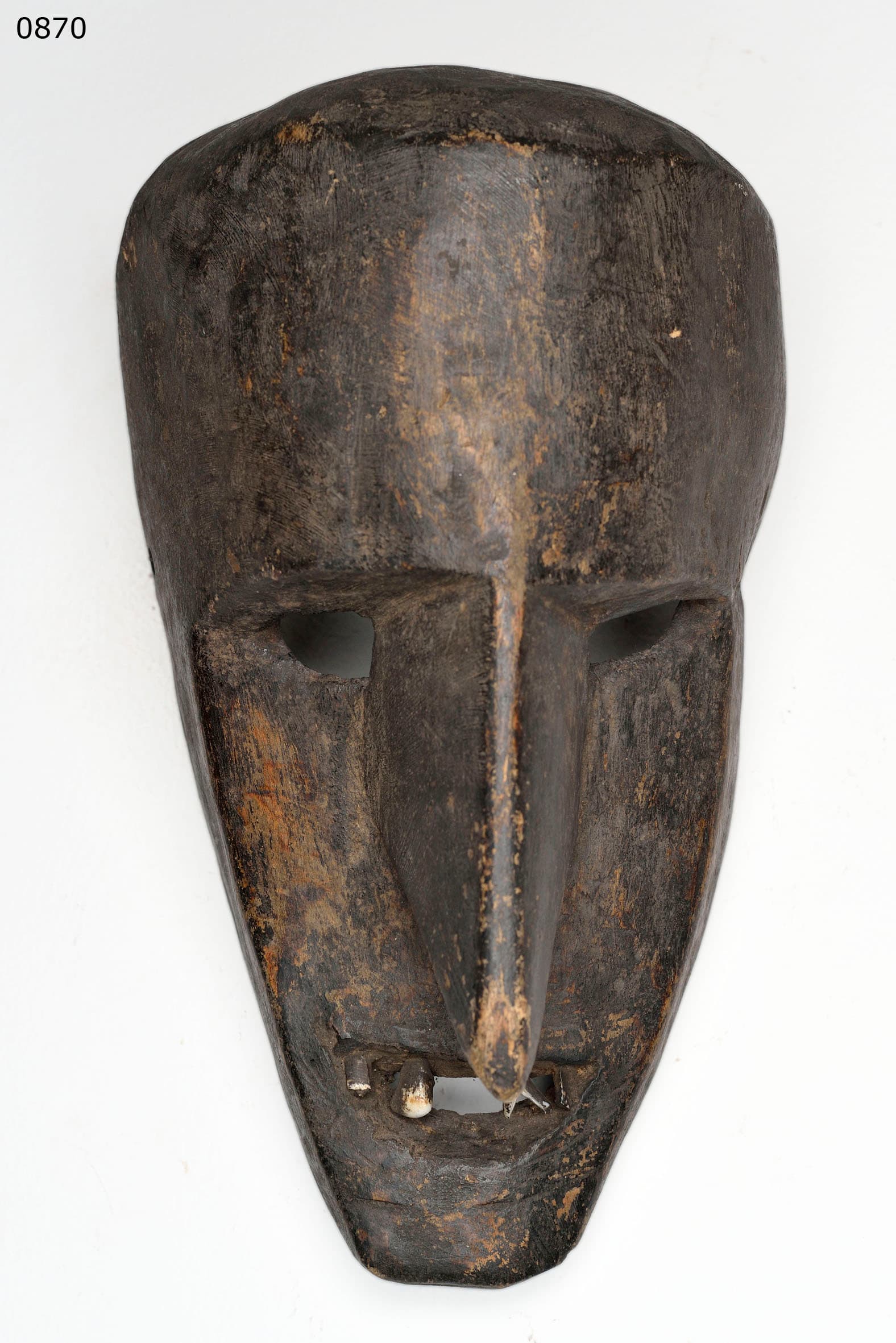
The material culture of the Haya eludes the Eurocentric focus on classical African wooden sculptures and instead establishes its own, strongly metallurgically characterised canon of objects. The canonical object typology of the Haya primarily comprises highly complex ironwork that goes far beyond utilitarian utility value. The central artefacts include ceremonial spearheads, Hinda dynasty sceptres and elaborate imitation cowrie shells forged from iron. The latter functioned not only as currency, but also as materialised status badges within the royal networks. In the area of woodwork, functional-sacral objects such as carved bowl forks for initiation and solid-walled wooden vessels for the ritual consumption of orubisi (banana beer) dominate.
Anthropomorphic wooden sculptures are an absolute exception in the corpus of Haya art and are extremely rare on the Western art market. Where they do appear, they usually serve as ritual anchor points (emandwa) for the ancestor or bacwezi cult. The proportions of these rare figures are strictly stylised: The sculptures are mostly cylindrical-columnar in structure, which refers to the shape of the branch of origin. The limbs are often rudimentarily indicated or remain closely attached to the torso. The size spectrum usually varies between 20 and 60 centimetres. The anatomical reduction of the facial features in favour of a pronounced emphasis on the abdominal region, especially the navel, which is considered the energetic epicentre of the lineage in interlacustrine cosmology (Ishumi 1980: 72), is striking.
It is precisely at this point that a profound iconographic controversy arises in research (Cory vs. Schmidt). In his early surveys, Hans Cory argued that the sculptural protrusions of the abdomen in Haya wooden figures represent direct, dynastic portraits of specific Hinda kings, in which the physical corpulence must be decoded as an icon of economic prosperity and the Nyarubanja tribute system (Cory 1945: 84). In sharp contrast, archaeologist and anthropologist Peter R. Schmidt (1997) argues that the figures are not individual portraits but generalised, functional vectors for the Bacwezi spirits. Schmidt postulates that the abdominal emphasis does not serve to represent physicality, but is purely instrumental: it marks the hollow space (receptacle) into which the mfumu introduces the magical charge (bijongo), without which the figure would remain ritually completely worthless. The source situation in this respect is still ambiguous today, as historical context documentation for the few existing pieces is mostly lacking.
For the Haya, the ontological difference between a profane wooden object and an activated ritual object is defined exclusively by the presence of bijongo (or dawa). A masterfully carved but unprepared piece of wood has no ritual valence. Only when sacrificial essences, resins or animal components are added by the divinator does the figure become an accumulator of spiritual power. The materials chosen for these objects are specific hardwoods from the region that are shrouded in myth. The formation of the patina is a gradual, cumulative process. Authentic Haya ritual objects have a deep, rough and often heavily encrusted patina resulting from repeated libations with banana beer, the application of sacrificial blood and years of exposure to the soot of the domestic fireplaces inside the traditional mushonge roundhouse.
Due to the rarity of canonical Haya anthropomorphs on the Paris or Brussels art market, the problem of forgery is highly relevant to the market. Unscrupulous dealer workshops in East Africa simulate the complex incrustation by applying acids, animal faeces and industrial soot. Relevant forgery criteria include the homogeneity of the patina: while authentic objects show signs of wear at specific handling points (such as the flanks) due to ritual use, forgeries often have an unnaturally uniform crust. Forensically verifiable authenticity criteria also include the presence of deep heartwood cracks, which are only caused by natural drying out over decades, as well as genuine, localised termite feeding marks. In the holdings of the Musée du quai Branly (Paris) or the Museum Rietberg (Zurich), these material ageings can be morphologically compared with reference pieces from neighbouring East African peoples (such as the Nyamwezi or Sukuma) in order to make interpolations for the authentication of Haya wood objects. Documented master craftsmen or individualisable workshops are completely unknown in the pre-colonial Haya context; the carver did not act as an artist in the Western sense, but as an anonymous link in a ritual chain.
| Aesthetic criterion | Specification in Haya art production |
|---|
| Materials | iron (prestige objects), hardwood, resins (bijongo), cowrie shells |
| Shaping (wood) | Cylindrical canon of proportions, reduced limbs, abdominal emphasis |
| Patina genesis | Incrustation through libations (orubisi, blood) and smoke/soot (mushonge) |
| Ritual consecration | Transformation of wood into emandwa through the introduction of bijongo |
| Iconographic discourse | portraiture (Cory) vs. instrumental spirit receptacle (Schmidt) |
| Indicators of authenticity | Natural heartwood cracks, heterogeneous wear, genuine termite traces |
Ritual practice
Among the Haya, ritual performance and the use of sacred artefacts are firmly integrated into the rhythm of agrarian cycles and family crisis management. The use of altars and performative objects follows a strictly codified protocol that regulates the dividing line between the world of the living and the sphere of the Bacwezi spirits. The ritual epicentre in the domestic context is the ekikalo (the family ancestral shrine), which is administratively managed by the male head of the household. At the dynastic level, there is a parallel nyaruju, the royal palace shrine, in which the insignia of power and central emandwa figures of the Hinda rulers are concentrated.
The structure of such an altar is organised spatially and conceptually hierarchically. The representations of the primary spirits (such as Wamara) are positioned in the centre of the shrine, surrounded by subordinate objects representing local nature beings or specific lineage ancestors. The lifecycle of a ritual object begins with the careful selection of the material. A carver or smith instructed by the mfumu (divinator) crafts the raw physical shell. At this unprepared stage, the object is profane and can be handled by laypeople without any loss of taboo. The transformation into an active ritual object takes place through the act of activation. In a closed ceremony, often to the exclusion of women and non-initiated children, the mfumu applies the bijongo mixture to the designated cavities of the wooden figure or binds it to the iron sceptre in cloth and leather bandages. By reciting archaic incantations in the secret language of the cult members, the specific bacwezi spirit is ritually forced to accept the object as an earthly anchor point.
Once the object is activated, it requires continuous maintenance by the clan head or spiritual medium. Offerings are essential to appease the spirits and ensure their benevolence for harvests, fertility and protection from calamities (such as droughts or storms on Lake Victoria). The types of offerings vary depending on the severity of the occasion. In the regular liturgical cycle, for example at new moon ceremonies, primarily agricultural products are offered: orubisi (fermented banana beer), unripe bananas and dried coffee beans. These are placed in close proximity to the figures or poured over them (Rehse 1910: 136). In phases of existential crisis, such as serious illness or the threat of succession war, the sacrificial protocol escalates to animal sacrifices (goats or cattle). The blood of the sacrificial animals is painted onto the emandwa objects, which over decades leads to the thick, deep black and textured patina that is considered proof of ritual depth on the Western collectors' market.
The most dynamic interaction with these objects takes place during the Epeme or Kubandwa night dances. These performances are multi-sensory events. With the polyrhythmic use of drums and rattles, the dancers call out the specific names of the spirits. The medium (often a woman) physically interacts with the altar; contact with the activated objects and hyperventilation induce a state of trance. The medium temporarily loses her own identity, her voice modulates into the sonorous ductus of the Bacwezi spirit, and she proclaims diagnoses about the causes of illness or social misdemeanours that have evoked the spirits' anger.
The deactivation and disposal of a ritual object demonstrates an epistemological difference to the Western concept of the museum, which aims at the eternal preservation of the physical shell. For the Haya, the artefact has no inherent eternal value; it is a machine for communication. If the wood fails structurally due to the omnipresent termite infestation, rots due to climatic influences or the line of initiated ancestors dies out, the artefact ceases to be effective. There are no elaborate disposal rituals for destroyed figures. The mfumu performs a ritual extraction of the essence, after which the physical relic is left to decay naturally in the forest or scrubland as a worthless shell.
This processuality poses challenges for Western conservators. When institutions such as the Metropolitan Museum of Art or the Fowler Museum at UCLA reconstruct African altars, they inevitably freeze a singular, static moment. The private collector of African art must be aware that a Haya object separated in a vitrine is not only deprived of its contextual space, but has been ontologically relegated to a state of ritual deactivation through the isolation of blood, beer, song and trance. Regional variations of ritual practice can be seen on the peripheries of the Haya territory: while in northern Bugabo the influence of the Ganda pantheon determines stronger animal sacrifice cycles, in southern Ihangiro agrarian libations dominate, reminiscent of the closely interwoven Sukuma traditions.
Historical context
The historical genesis of Haya society is characterised by successive waves of migration and technological innovations, the dating of which is still the subject of archaeological controversy today. The foundation of the interlacustrine civilisation was laid by the expansion of Bantu-speaking agriculturalists (associated with the Urewe ceramic culture) who settled the western shore of Lake Victoria between 500 BC and 500 AD. In the 16th to 17th centuries, this population was overlaid by the pastoral Hima and Hinda groups migrating from the north. The latter established the centralised monarchical structures and legitimised their rule ideologically by monopolising the Bacwezi cult.
However, the most significant scientific and historical controversy in the context of the Haya does not concern migration, but the dating of their metallurgical achievements. in 1978, the scientists Peter R. Schmidt and Donald H. Avery published groundbreaking results of ethnographic and archaeological field research in the Kemondo Bay area in the scientific journal Science. Based on reconstructions (reenactments) of traditional smelting processes with Haya elders, Schmidt and Avery postulated that the Haya were already able to produce medium carbon steel 2,000 years ago. The central argument of their thesis is that the Haya invented a preheating system (preheating) by pushing the ceramic blowpipes (tuyères) far into the interior of the blast furnace. The air flowing through was thus preheated, which led to furnace temperatures of over 1800 °C - a metallurgical masterpiece that could only be reproduced in Europe in the 19th century by the Siemens-Martin process (Avery & Schmidt 1978: 1086; Schmidt 1997: 15).
In the 1990s, the archaeometallurgist David Killick sharply intervened against this narrative of technological autochthony and superiority. Killick (1991, 1996) vehemently contradicted the preheating hypothesis on the basis of thermodynamic calculations. He deconstructed Schmidt's and Avery's mathematical models as speculative and unproven. Killick argued that the high temperatures could also be achieved through simple forced ventilation without a preheating effect and criticised the methodological validity of proving prehistoric findings through modern reconstructions initiated by researchers (Killick 1996: 252). Schmidt, in turn, accused his critics of a neo-colonial bias that denied African societies complex physical innovations as a matter of principle. This debate (Schmidt vs. Killick) is considered one of the most fundamental discourses in African technological history, although the sources and metallurgical interpretation remain polarised (Childs 1996: 277).
The arrival of the European colonial powers marked a profound turning point. With the Anglo-German Heligoland-Zanzibar Treaty of 1890, the Haya Territory fell under the control of German East Africa, followed by the British League of Nations mandate after the First World War. The impact of colonial history on traditional art and technology production was fatal. The import of industrially manufactured European steel tools caused the highly specialised iron forging craft of the Haya to collapse economically within a few decades; the furnaces almost completely died out in the 1920s. At the same time, the missionary work of the White Fathers eroded the patronage system of the Hinda kings. As Christian missionaries classified the ancestral sculptures and Kubandwa artefacts as fetishes and destroyed them, the production of canonical wooden sculptures came to a standstill (Iliffe 1979: 173).
The market history of Haya art in the West is accordingly dated late and characterised by extreme scarcity. While Congolese masks were already being received by the Parisian avant-garde in the early 20th century, the interior of Tanzania remained a blind spot. The first comprehensive ethnographic surveys and object acquisitions were carried out in the 1940s and 1950s by the Austrian-British government sociologist Hans Cory. Cory documented the customary law of the Haya and secured numerous initiation artefacts, which today form the basis of the collections in the National Museum of Tanzania (Cory 1945: 8). The breakthrough of East African art on the Western art market only occurred in the course of large-scale exhibitions in the late 1990s (such as "Tanzania: Masterpieces of African Sculpture"), which heightened awareness of the abstracted, cylindrical aesthetic of the region.
Due to the extremely small corpus of Haya wooden figures in terms of quantity, the price trend has increased exponentially in the 21st century, which has led to a massive counterfeiting problem. As stylistic comparative objects are rare, provenance research is indispensable for private collectors. Today, authenticity criteria are based on interdisciplinary forensics: in addition to stylistic coherence, radiocarbon dating of the heartwood and CT scans are used to analyse manipulated termite passages. Macroscopic examinations of the patina must identify layers of organic lipids (from banana beer) and genuine blood proteins in order to unequivocally exclude African dealer forgeries that have been artificially aged with chemical stains and glue-soot mixtures.
| Historical phase | Central events & transformations in the Haya context |
|---|
| ca. 500 BC - 500 AD | Bantu expansion; establishment of early iron smelting (Urewe culture) |
| 16th-17th century | Immigration of pastoral groups; consolidation of the Hinda kingdoms |
| Late 19th century | Colonisation by Germany (from 1890); missionary work (White Fathers) |
| 1920s-1950s | British Mandate; decline of the indigenous iron forging tradition; ethnographic surveys by Hans Cory |
| 1978-1996 | Development of the archaeometallurgical debate: Schmidt/Avery (high-carbon steel, preheating) vs. Killick (thermodynamic limitations) |
| Late 20th century - present | Increasing western market demand for interlaustrine art; increase in forgeries; use of forensic authentication |