Overview
The Hehe (historically often referred to as Wahehe in Swahili) form a demographically and culturally significant ethno-linguistic group in the south-central highlands of present-day Tanzania. Their primary area of settlement and influence is concentrated in the Iringa region and the neighbouring districts of Mufundi and the foothills of the Uzungwa Mountains. Current demographic estimates based on linguistic and regional census data put the population at around 750,000 to over 805,000 individuals (Redmayne 1968: 409). This marks a substantial demographic growth compared to the 1957 census, which showed just over 250,000 members and classified the Hehe as the eighth largest ethnic group in Tanganyika at the time (Redmayne 1968: 409). Linguistically, the Hehe (Kihehe) are assigned to the Nyakyusa-Bantu cluster, which implies deep historical migration and kinship lines in the East African Rift Valley system.
The nomenclature and classification of the ethnic group illustrates a highly complex process of identity formation rooted in the pre-colonial and colonial eras. The self-designation "Wahehe" is a re-appropriated exonym. Originally, the term is derived from the specific battle cry of the warriors ("Hee-hee-hee") and was initially used by opposing groups as a descriptive term. It was not until the late 19th century, when the term was charged with considerable prestige due to unprecedented military successes, that the Hehe adopted this name as an affirmative self-designation, with the German and British colonial administrations cementing this process through the standardised administrative use of the term (Redmayne 1968: 410).
| Demographic and Geographical Parameters | Specification |
|---|
| Primary settlement region | Iringa Region, Mufundi, Uzungwa Highlands (Southern Tanzania) |
| Population estimate (current) | ~750,000 - 805,000 (including diaspora in Uganda) |
| Linguistic classification | Kihehe (Nyakyusa-Bantu language family) |
| Subsistence strategy | Agropastoralism (cattle breeding and crop farming) |
| Traditional architecture | Tembe construction method (clay-plastered flat roof structures) |
From the middle of the 19th century, the social structure of the Hehe was strictly hierarchical and highly centralised, which fundamentally distinguished them structurally from many neighbouring acephalous societies. Under the leadership of expansive rulers (Mtwa), especially Munyigumba and later his son Mkwawa, a highly militarised, tightly organised kingship developed from a conglomerate of around 30 local chiefdoms (Redmayne 1968: 411). In terms of kinship, the Hehe are primarily organised along patrilineal lines. Land rights, political status and ritual obligations were generally passed down through the male line (from father to son or brother), with the consolidation of land ownership within the lineage taking absolute priority (Kivaria 2020: 12). Nevertheless, equalising legal and social mechanisms existed: the authority of the male head of household over women and children was not absolute, but was significantly mitigated by the vested right of the wife's patrilineage to intervene in intra-family conflicts (Redmayne 1983: 22).
It is worth noting a sociological anomaly within the loyalty structures that illustrates the depth of military state formation. Ethnographic surveys show that loyalty to the chief (Mtwa) often overrode traditional family ties among the Hehe. When asked about their primary affiliation, Hehe informants named the political leader significantly more often than a blood relative. This distinguishes them significantly from neighbouring groups and indicates a profound socio-political shift from a segmentary kinship society to a state-centred military society (Pizzo 2007: 52).
In terms of subsistence farming, the Hehe combined agriculture with pastoral elements. They cultivated various crops (such as millet and later maize) and practised intensive cattle breeding, which served not only for protein-rich nutrition, but primarily for capital accumulation, bride price (lobola equivalents) and social status. Architecturally, the region is characterised by the so-called tembe building style. These are rectangular, flat-roofed houses constructed from a robust wooden or bamboo frame and plastered with solid clay. This architecture offered considerable thermal advantages in Iringa's cool highland climate and served as a defensive structure in times of conflict (Kurapkat 2020: 15).
The political and economic relationship with the neighbouring peoples - including the Bena, Sangu, Kinga and Ngoni - in the late 19th century was primarily characterised by military expansion, raids and the obligation to pay tribute. Under Mtwa Munyigumba, the Usangu plain and large parts of Ungoni were systematically conquered and incorporated into the Hehe empire (Redmayne 1968: 412). These warlike assimilations have led to considerable controversy in ethnographic classification in museum practice to this day. The source situation with regard to the precise ethnic categorisation of material culture is ambiguous. In the collections of the Ethnological Museum Berlin or the British Museum, material culture from the Iringa region is often generally attributed to the Hehe inventory. However, historical evidence shows that these artefacts often originate in terms of craftsmanship or style from incorporated Bena or Sangu groups who produced for the Hehe as vassals (Schnee 1921: 120). Koponen and Redmayne criticise the static "tribal concept" of the colonial period as inadequate, as it ignores the fluid economic and social structures of pre-colonial Tanzania, which were shaped by war and marriage (Koponen 1988: 44).
Cultural context
The religious and cosmological system of the Hehe is deeply rooted in the permanent interaction between the living and the spirit beings. At the centre of the ritual practice is not the worship of an omnipotent, distanced creator god, but an elaborate ancestor cult, for which the term "ancestor worship" (ancestral cult) is considered more precise in the anthropological literature than the often erroneously used term "ancestor worship" (ancestor worship) (Brain 1973: 122). The cosmological order and the moral balance of society are largely maintained and regulated by the mizimu (singular mzimu).
The taxonomy of the Mizimu is polyvalent. On the one hand, the term encompasses the spirits of recently deceased family members (lineage ancestors) whose remains rest in the family soil. On the other hand, it includes older, territorially bound spirits of powerful historical figures, legendary chiefs or high-ranking healers (Gonzales 2009: 31). The Mizimu are considered highly active observers of the agricultural, social and ethical practices of their descendants. They have the agency to sanction moral lapses, neglect of duties or disrespect with disease, drought or infertility. Conversely, they reward ritual fidelity and correct living with agrarian fertility and physical health (Brain 1973: 123). Territorial spirits inhabit specific sacred landscapes, especially prominent mountain massifs, deep rock formations and isolated sacred forests. In these numinous zones, they perform macrocosmic functions, most notably the control of regional rainfall (Sunseri 1997: 243).
Ritual authority in pre-colonial Uhehe was not vested in an isolated priestly caste, but was institutionally divided between the political rulers (chiefs) and highly specialised divinators. The chiefs functioned not only as administrative and military leaders, but also as the highest ritual mediators to the territorial mizimu. An absolutely central element of this authority was the ritual of rainmaking (matambiko). There is a sharp research controversy regarding the socio-political function of the Matambiko (Sunseri vs. Snow). Early colonial observers and administrators such as Heinrich Schnee (1921) argued that the political power of the Hehe chiefs resulted from their magical ability to make rain - a classic projection of European ideas of the "magical African king". The environmental historian Thaddeus Sunseri dates and contextualises this phenomenon in a fundamentally different way: Sunseri postulates that rainmaking was rather an institutional practice through which power that had already been accumulated elsewhere (for example through military force or trade) was subsequently sacralised, consolidated and ideologically legitimised (Sunseri 1997: 244).
While the chiefs dominated the macrocosmic cult, local diviners and healers were responsible for dealing with microcosmic crises, in particular for diagnosing and combating witchcraft. The accusation of witchcraft in Uhehe was a potent means of informal social control that regulated social tensions, but at the same time harboured the danger of escalating counter-witchcraft and fatal tribunals (Redmayne 1968: 415).
Despite the strongly patrilineal and patriarchal social structure, women played essential and influential roles in the cult of the Hehe, especially in initiation and transition rituals. The liminal phases of childbirth and the associated rites were almost exclusively controlled by female ritual specialists (McClain 1982: 36). These older women possessed specific, closely guarded mystical knowledge that allowed them to manipulate spiritual entities during the dangerous phase of pregnancy and birth and to create protective spaces for the birthing woman. Their authority in this area was absolute and was not questioned by the male hierarchy.
Structurally, the religion of the Hehe differs from that of their acephalous neighbours in the Rift Valley in the radical centralisation of ancestor worship. While acephalous societies leave rituals at the local lineage level, the Hehe empire focussed the cult on the royal lineage (the Muyinga clan ancestors). The royal mizimu were held responsible for the well-being of the entire state, which spiritually cemented the subjugation of conquered territories (Bucher 2016: 285). Modern presentations of this complex belief system, such as those occasionally undertaken in exhibitions at the Musée du quai Branly or the Mkwawa Memorial Museum in Kalenga, face the curatorial challenge of conveying the invisible networks of the Mizimu through the often sparsely preserved, highly abstracted material culture of the Hehe (Savoy 2018: 44).
Aesthetic features
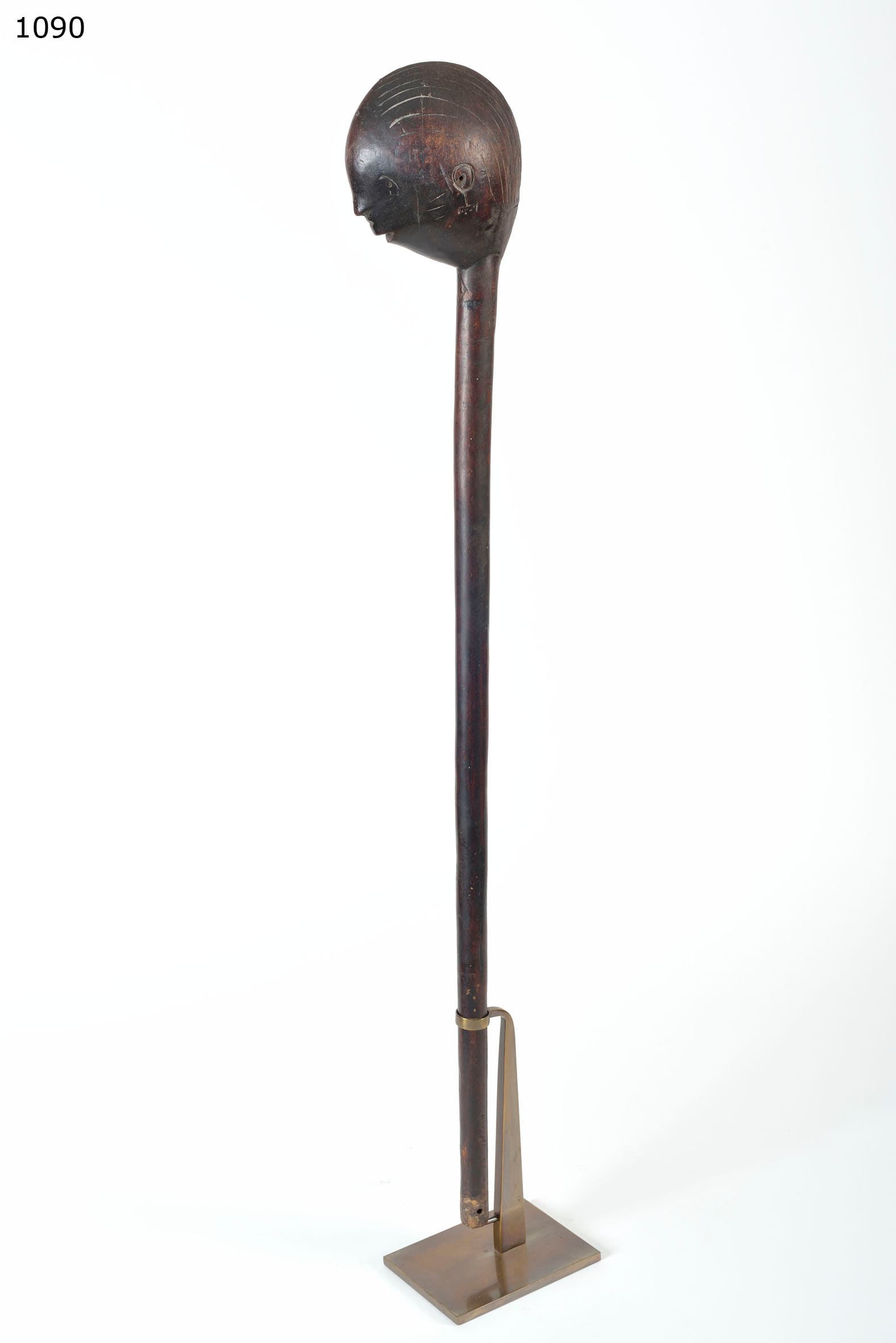
The material culture and aesthetic production of the Hehe differs radically from the inventory of West or Central African societies that is often received as "canonically African" in the Western art market. A figural mask complex, elaborate ancestral statuary or large-scale ritual sculptures are almost completely absent among the Hehe. Instead, the aesthetic expressivity is uncompromisingly concentrated on insignia of power, highly specialised weapons and prestigious everyday objects (Felix 1994: 112).
The canonical object typology of the Hehe primarily comprises circular hardwood shields, extremely well-balanced spears, purist wooden neck rests and elaborately beaded tobacco pipes. An outstanding example of the very rare figurative carving art of the region can be found in the holdings of the Rietberg Museum or in private collections such as the Edwin and Cherie Silver Collection (Metropolitan Museum of Art). A small-format Hehe stool documented there is an absolute exception; such works often show strong stylistic cross-contamination in their formal language with neighbouring, more carved groups such as the Kamba or Nyamwezi (Cole 1980: 27).
| Object Typology of the Hehe | Materiality | Iconography & Meaning |
|---|
| Hardwood shields | Local heartwood, animal fat, pigments | Abstract-geometric (black-white-red); symbolism for war, ancestors, rain |
| Tobacco pipes | Horn, wood, bamboo, glass beads | Status indicator; trade prestige through coloured imported beads |
| spears | forged iron, wood | impeccable balance; indicator of military rank |
| Neck rests | Monoxylated wood | Puristic, mostly unadorned; physical and spiritual support during sleep |
The canon of proportions and the choice of materials for the Hehe shields are strictly formalised and testify to a masterly command of the science of wood. Carved from the durable heartwood of local tree species, they have a slightly convex shape designed to deflect maximum kinetic energy from enemy projectiles. The iconography of the shields is purely abstract and highly symbolic, dominated by a characteristic black, red and white polychromy. Far from being purely decorative, this colour scheme is deeply rooted in the cosmology and heraldry of the region: red symbolises vitality, passion, blood and relentless military strength; white stands for peace, sincerity and the bridge to the bright ancestral world; black associates constancy, mourning, rain clouds and the deep, earthbound power of the mizimu (Kecskési 1994: 88; Kurapkat 2020: 16). Concentric, radial or zigzag patterns often structure the shield surface in quadrants, which ethnographers interpret as an abstract representation of cosmological principles of order and the four cardinal points (Kurapkat 2020: 16).
Another prominent identification feature are the chief's tobacco pipes. These often consist of a highly polished horn or wooden bowl with a filigree bamboo shaft. The stem is densely wrapped with imported, bright glass beads, with geometric patterns in white, dark blue, green and yellow dominating (Brincard 1982: 45). The wealth of glass beads acted as a direct material indicator of the owner's economic status, diplomatic connections and involvement in the extensive East African caravan trade networks that reached as far as the Swahili coast.
There is a sharp controversy in art history regarding the authorship and identification of "master hands", which fundamentally problematises the genesis of the so-called Hehe shields. The research situation is diametrically opposed. In her early work, the anthropologist Alison Redmayne (1968) tended to classify the shields as an integral, autochthonous component of Hehe military identity and material culture. Modern colonial historian David Pizzo (2021) dates and contextualises artisanal production in a completely different way. Pizzo and other revisionist historians argue that the Hehe under Mkwawa primarily formed a military and administrative caste. The time-consuming, highly specialised production of the shields mainly took place in the workshops of subjugated Bena or Sangu craftsmen, who had to deliver these objects to the Hehe army as tribute payments (Pizzo 2007: 76).
The search for documented workshops is also thwarted by a historical caesura: The continuity of these production sites was almost completely destroyed by the unfathomable devastation of the colonial wars, especially the Maji Maji Rebellion (1905-1907) (Iliffe 1979: 202). Entire lines of craftsmen were wiped out, which is why later attributions to master craftsmen known by name, as is common in West Africa (e.g. among the Yoruba), are virtually impossible among the Hehe.
For private collectors and museum curators, this results in specific, market-relevant forgery criteria. The difference between an activated ritual or war object and a profane object manifests itself microscopically on the surface. Authentic shields from the 19th century have a specific, deeply penetrated patina. This was caused by the repeated application of animal fats for wood care, by ritually applied plant substances, campfire smoke in the tembe houses and, in some cases, by blood sweat during combat use (Chapman 1999: 98). Forensic signs of extreme ageing, such as natural heartwood cracks spreading along the radial grain and inactive, patinated termite damage to the edges, are almost impossible to reproduce artificially and serve as primary markers of authenticity over modern reproductions. A spiritually activated object is also usually distinguished by applied material (such as beeswax, resin or trapped fabric remnants) inside pipes or on the hidden handles of shields, which should physically hold the magical charge.
Ritual practice
In contrast to many highly performative West African cultures, the ritual practice of the Hehe is less focussed on theatricality and mask dance, but rather on concrete actions, the manipulation of substances and the sacred charging of specific places. An absolutely central concept of religious materiality and practice is the use of bugota. In the language of the region, this polysemic term describes both profane medical remedies and strongly spiritual-magical substances prepared by diviners (Cory 1955: 112).
The lifecycle of a ritual object - be it a painted hardwood shield for a high-ranking warrior, an ancestral pipe or a medicine horn (pembe) - begins profanely in the hands of the carver. As long as the wood is only moulded, it has no inherent power. It is only through the ritual insertion of bugota by a specialised healer that the inanimate object is transformed into an active agent imbued with spiritual power. This ontological transformation process is usually accompanied by specific ritual chants that invoke the mizimu. The bugota substances are pressed into tiny, hidden cavities in the object or rubbed onto the surface with intense friction in order to bind the kinetic and spiritual power of the spirits indissolubly to the matter (Brain 1973: 124).
The concrete altar use and sacrificial practice (Matambiko) primarily takes place at two types of sites: the ancestral shrines within the settlements or at large-scale, untouched natural sanctuaries in the bush. The architectural structure of such sacrificial sites is often inconspicuous to the untrained eye and of an ephemeral nature - they usually consist of a carefully cleared piece of ground, specific plantings (such as the jujube tree) or special rock and stone formations. The site is activated before a ritual through precise libations and the laying down of offerings. The primary offerings include locally brewed, fermented millet or maize beer (pombe), fine snuff and the first agricultural products of the harvest (Bucher 2016: 288).
The cyclical, manorial sacrifices of the Chief Mkwawa are a phenomenon that has been precisely documented in colonial records and oral history in the vicinity of the British Museum. The practice shows strong regional variations. At new moon, Mkwawa would leave his fortress and visit Rungemba, the sacred burial place of his father Munyigumba. This mausoleum, around 60 kilometres from the district headquarters, consisted of an area measuring around 20 by 7 metres, surrounded by a dense, living palisade of oval-planted trees. There were 16 or 17 burial mounds of the royal family in this sanctuary. There, Mkwawa sacrificed animals, spilled blood and pombe to ask the Mizimu of his ancestral line for direct military assistance and tactical visions against the advancing German colonial troops (Brockmeyer et al. 2020: 118).
In the event of supra-regional, territorial crises, especially devastating droughts, delegations travelled to remote sacred forests to appease the powerful territorial spirits there. The highest and most potent form of offering in these Matambiko rituals was often black cloth (black cloth) or the sacrifice of dark animals. In this ritual context, the colour black operates as sympathetic magic: the black of the cloth is said to mimetically evoke the dark, heavy and rain-bringing storm clouds in order to fertilise the land (Sunseri 1997: 243).
The deactivation or disposal of a ritual object at the end of its ceremonial life cycle is a highly precarious and anxiety-ridden process. If a container loaded with bugota loses its effectiveness, if a sacred shield breaks in battle, or if the rightful owner of an ancestral pipe dies, the object must under no circumstances be carelessly thrown away or profanely burnt. The Hehe fear that uncontrolled residual energies will be released or that the wrath of the Mizimu will fall back on the community (Cory 1955: 114). Such objects are often ritually neutralised by divinators, deposited in extremely remote, inaccessible places in the bush, hidden in caves or buried directly with the owner. The profane recycling of sacred objects is subject to strict taboos.
This ongoing spiritual charge poses considerable ethical and conservation dilemmas for museum collections. Curators at the Royal Museum for Central Africa (RMCA) in Tervuren or the British Museum (where, for example, historical Xhosa and Hehe pipes and snuffboxes have been extensively radiologically and chemically analysed and conserved) have to constantly weigh up the options when restoring such objects: To what extent does the chemical cleaning of adhering tobacco, grease and bugota residues not only destroy the materially evolved, historical patina, but at the same time irretrievably destroy the intended spiritual integrity and ontological status of the object? (Masele 2012: 45).
Historical context
The historiography of the Hehe is inextricably linked to the massive social, economic and military upheavals of the East African 19th and early 20th centuries. The formation of the Hehe into a centralised, dominant state is a relatively recent historical phenomenon, dating primarily to the mid-19th century. Under the military leadership of Chief Munyigumba, the empire expanded massively from its core area in the Usungwa Mountains into the Usangu Plains and deep into Ngoni territory through aggressive campaigns of conquest (Redmayne 1968: 411). This relentless expansion phase not only laid the foundation for the wealth of the Hehe elite, but also preconditioned the empire for the inevitable, dramatic conflict with the advancing German colonial power.
The colonial encounter escalated on 17 August 1891 in the legendary Battle of Lugalo (more precisely: valley floor near Rugaro/Lugalo, Iringa region). In this battle, around 3,000 Hehe warriors armed with shields and spears under the leadership of Mkwawa (Munyigumba's son) crushed a heavily armed German military expedition under the command of Emil von Zelewski. Zelewski's battalion consisted of 13 officers, 320 Askari soldiers and 170 porters with machine guns and light field guns; the Schutztruppe's Mauser rifles (M71/84) were disabled in the first ten minutes of the ambush - Zelewski and the majority of his men fell before the Maxim machine guns could even be brought into action (Masele 2021: 17-25; Masele 2025 archaeological cartridge forensics). The event sent deep shockwaves through the German Empire and permanently stigmatised the Hehe in colonial perceptions as a formidable, 'martial race' (Masele 2012: 45; Pizzo 2007: 76). The ensuing seven-year guerrilla war, characterised by extreme brutality, only ended in July 1898 with the suicide of Mkwawa. In order to escape imminent capture by German pursuing troops under Sergeant Merkl, the chief shot himself in the Mlambalasi rock shelter (Iringa region) - a place where a Mauser 71 cartridge case produced in Danzig in 1877 was archaeologically found in 2010, which refers directly to the pursuit battle (Willoughby et al. 2019). With Mkwawa's death, the organised primary resistance in Uhehe collapsed (Garsha 2020: 54).
This brutal historical rupture had fatal and irreversible effects on the production of art and culture in the entire region. The violent "pacification" by the Schutztruppe, immediately followed by the even more devastating tactic of "scorched earth" during the Maji Maji Uprising (1905-1907), led to the physical destruction of entire villages, agricultural bases and sacred sites. A prominent victim of this destructive fury was the Rungemba mausoleum, which was razed to the ground by the Schutztruppe on the direct orders of Captain Tom von Prince between late 1896 and early 1897 in order to break the spiritual morale of the Hehe (Wimmelbücker 2005: 112). The Maji Maji War irreparably destroyed internal artisanal continuity; traditional shield and weapon production collapsed completely as the artisanal elites were killed, driven into flight or forced into forced colonial labour on plantations by the tax system (Iliffe 1979: 202). Consequently, the pre-colonial Hehe artefacts in Western museums come almost exclusively from the looting of the early colonial wars. They were collected in the 1890s as "spoils of war" by officers and civilian officials such as Magdalene von Prince or Heinrich Schnee, the later governor, and shipped to Europe (Schnee 1921: 120).
| Chronology of the Historical Context | Key Event / Significance |
|---|
| Mid-19th century | Expansion under Munyigumba; conquest of Usangu and Ungoni |
| 1891 | Battle of Lugalo; Hehe destroy German expedition (Zelewski) |
| 1898 | Suicide of Mkwawa; decapitation and transfer of the skull to Bremen |
| 1905-1907 | Maji Maji uprising; destruction of the craft continuity and workshops |
| 1919 | Treaty of Versailles (Art. 246) demands restitution of the Mkwawa skull |
| 1954 | Official (but historically controversial) return of the skull to the Hehe |
By far the best-known and most politically charged "artefact" of this era is not a classic work of art, however, but a human relic: the skull of Chief Mkwawa. After his suicide in 1898, Mkwawa's head was cut off by a sergeant of the Schutztruppe as a war trophy, forensically measured and finally taken to Bremen to what is now the Übersee-Museum, where it was instrumentalised in the context of colonial racial studies (Pizzo 2007: 78). The restitution of this skull developed into an international political issue of the first order. Under massive British pressure, the restitution was even enshrined in international law in Article 246 of the Treaty of Versailles of 1919. Nevertheless, the actual restitution was delayed until 1954, when the skull was ceremoniously handed over to Mkwawa's grandson in Kalenga under the aegis of British Governor Sir Edward Twining (Bucher 2016: 284).
One of the most profound research controversies in provenance research manifests itself in this context. While traditional colonial narratives (represented by Twining and older historians) portrayed the restitution as an act of respect, British benevolence and justice, the historian Holger Stoecker (2020) deconstructs this process relentlessly. Stoecker argues that the source situation regarding the identity of the Bremen skull is extremely ambiguous; based on intensive archival studies, he postulates that the skull handed over in 1954 was most likely not Mkwawa's at all. The British forced the search in Bremen primarily for reasons of realpolitik. Rather, the British administration used the ceremonial restitution of any anthropologically suitable skull as a calculated psychological instrument of Indirect Rule. The aim was to ideologically bind the Hehe elites to the British colonial power in the tense context of the emerging Cold War and growing anti-colonial endeavours in Tanganyika and to keep them away from more radical independence movements (Brockmeyer, Edward, Stoecker 2020: 117).
On the Western art market, East African objects - due to the lack of classical masks - were for a long time blatantly marginalised compared to the mask-rich cultures of West and Central Africa (Congo, Côte d'Ivoire). It was not until later, primarily due to ground-breaking breakthrough exhibitions, that this field experienced a re-evaluation. In particular, the monumental exhibition "Tanzania. Masterworks of African Sculpture" (1994, shown at the Haus der Kulturen der Welt in Berlin and the Lenbachhaus in Munich, curated by Marc L. Felix and Maria Kecskési), broke with the previously prevailing doctrine of art criticism that East African art was low in quantity and inferior in quality. The exhibition presented more than 400 high-calibre pieces from depot collections and unleashed a rapid price development and scientific reappraisal of Tanzanian artefacts (Kecskési 1994: 12).
For today's private collectors, this historical genesis results in extremely strict authenticity criteria: Genuine Hehe shields, untouched spears and pipes loaded with bugota from the pre-colonial era (before 1891) are extremely rare on the open market. Detailed forensic material analyses are essential in order to distinguish historical originals from elaborate re-carvings that were produced for the East African curiosity market in the course of tourist marketing from the 1960s onwards. The examination for organic residues in the deep patina (real blood, sweat, animal fat) as well as the examination of natural wood degradation (deep, organically grown heartwood cracks and the presence of heavily patinated, old termite damage in non-visible areas) form the absolute basis of any serious provenance and authenticity examination (Chapman 1999: 98).