Overview
The Kaguru, often subsumed under the exonymous collective terms Wakaguru, Megi, Wetumba, Solwa or Mangaheri in the older colonial as well as in parts of the early ethnographic literature, represent a matrilineal, Bantu-speaking ethnic group in the central east of the United Republic of Tanzania. The geographical epicentre of their traditional settlement area, historically referred to as Ukagura, manifests itself primarily in today's Morogoro region. The topography of this territory, which covers an area of around 3,600 square miles, is characterised by extreme ecological diversity. It ranges from the humid, cold, heavily forested highlands of the Itumba and Nguru Mountains to the arid, lower plateaus and savannahs at altitudes between 600 and 2,100 metres above sea level. This complex ecological matrix historically determined not only the subsistence strategies, but also the defensive settlement patterns of the Kaguru, who preferred to build their villages on inaccessible mountain ridges to protect themselves from the constant raids of pastoralist neighbours.
The demographic recording of the Kaguru was subject to considerable methodological and historical fluctuations in the course of the 20th and 21st centuries, which makes it difficult to quantify ethnic affiliations in a rapidly growing, multi-ethnic nation state such as Tanzania. While the British social anthropologist T.O. Beidelman estimated the population at around 100,000 individuals during his extensive field research in the late 1950s and early 1960s, demographic projections in 1987 already recorded around 217,000 members. Current linguistic-demographic estimates based on the spread of the Chikaguru (also Kikaguru) language put the population at approximately 544,000 individuals. In order to contextualise this massive demographic pressure on the traditional clan territories, it is essential to look at the macro data of the Morogoro region. The most recent Tanzanian national census from 2022 shows exponential growth in the primary settlement districts of the Kaguru, namely Kilosa, Mvomero and Gairo.
| District (Morogoro Region) | Population (2012 Census) | Population (2022 Census) | Percentage growth | Demographic density (2022) |
|---|
| Kilosa | 438,175 | 617,032 | + 40.8 % | 52.4 inhabitants/km² |
| Mvomero | 312,109 | 421,741 | + 35.1 % | 63.6 inhabitants/km² |
| Gairo | 193,011 | 258,205 | + 33.7 % | n/a A. |
| Morogoro (total region) | 2,218,492 | 3,197,104 | + 44.1 % | 45.2 inhabitants/km² |
The linguistic and cultural categorisation of the Kaguru reveals a deep affinity with the so-called "matrilineal belt" of the East African coastal and hinterland regions. This cultural continuum includes the Zaramo, Luguru, Kutu, Kwere, Zigula and Vidunda. However, the controversies of classification in the ethnographic literature are evident and must be explicitly marked. The source situation is ambiguous with regard to the strict dividing lines between the Kaguru and their direct eastern neighbours, the Ngulu. Historical migratory movements, inter-ethnic marriages and fluid topographical transitions have led to a strong linguistic and ritual syncretism. Beidelman 1971 dates the consolidation of the Kaguru as a distinct ethnic group to the phase of the late pre-colonial caravan economy (mid-19th century), while revisionist anthropologists such as Iliffe 1979 argue that ethnic differentiation was artificially cemented by the rigid administrative classification of the German and British colonial authorities. The self-designation of the groups was historically highly localised and was primarily based on clan affiliation or topographical specifics (e.g. Wetumba for mountain dwellers), while the foreign designation "Wakaguru" represents an external attribution by Swahili traders and colonial Akidas.
The social structure of the Kaguru is fundamentally acephalous and characterised by a strict matrilineal kinship system. The society is segmented into over one hundred exogamous matri clans, which often have totemic or environmental names such as Cat, Goat, Rain, Beads or Messenger. Identity, social affiliation, "flesh and blood" and basic inheritance rights are passed down exclusively through the female line. This structure creates an inherent, profound tension in the distribution of authority and resources: the primary power of disposal over land use rights, ritual obligations and the bride price does not lie with the biological father of a family, but with the mother's brother (the avunculate). This system means that husbands are structurally forced to divide up their resources and often have to show more loyalty and economic care to their own sister's children than to their biological children, which, as recent sociological studies confirm, generates permanent family and psychological lines of conflict. Although the tendency is matrilineal, it is by no means a matriarchy in the political sense; executive leadership and legal decision-making power within the clans are almost exclusively the responsibility of the male elders.
Economically, the subsistence of the Kaguru was traditionally based on labour-intensive slash-and-burn agriculture. On the rainier plateaus, they primarily cultivate maize, sorghum, millet, sweet potatoes and manioc, supplemented by small livestock such as goats, sheep and poultry. However, agricultural production was constantly threatened by cyclical droughts, devastating floods and pest epidemics, which historically regularly culminated in acute famines. The relationship with neighbouring peoples was utilitarian, symbiotic and at the same time highly conflictual. While there was a lively exchange of goods with other arable farming groups, the relationship with the semi-nomadic Baraguyu and Maasai pastoralists was extremely ambivalent. Although trade relations were maintained - the Kaguru traded tobacco, calabashes and agricultural produce for animal products - they were constantly involved in violent territorial conflicts due to competition for pasture and cattle theft. Historical expedition reports and colonial administrative records, which are now preserved in the British Museum, document these precarious inter-ethnic tensions and the resulting militarisation of the Kaguru villages during the late pre-colonial phase in rare detail.
Cultural context
The religious and metaphysical system of the Kaguru is deeply rooted in the physical topography as well as the matrilineal social order and structures all aspects of daily, agrarian and social life. At the centre of the cosmological order is the creator god Mulungu. He is understood as an omnipotent, yet largely distant and remote entity (Deus otiosus) who initiated the universe, but is hardly ever directly worshipped or invoked in the everyday ritual practices of the Kaguru. The ethnographic sources make it unmistakably clear that spiritual and ritual practice is almost exclusively dominated by ancestor worship (the cult of the dead).
The ancestor spirits function as omnipresent, active and strictly moral authorities in the life of the Kaguru. They are by no means exclusively benevolent guardians, but reflect the conflicts, ambivalences and tensions of the living. They are regarded as demanding, punitive and quick to anger if social taboos are broken, exogamous marriage rules violated or necessary offerings (tambiko) omitted. The worship of these ancestors materialises at specific, often inconspicuous but topographically significant altars: at the base of mighty old trees, on prominent rock formations, in caves or directly at the unmarked graves of the matrilineage. These shrines serve as liminal zones where contact between the spheres is maintained through offerings such as sorghum beer, flour porridge or ritual animal blood.
Structurally, the religion of the Kaguru differs significantly from the highly centralised, theocratic systems of West Africa (such as the Yoruba or Edo) or the elaborate priestly castes of the interlacustrine kingdoms. The Kaguru do not have a professional, hierarchically organised caste of full-time priests. Instead, ritual authority is extremely decentralised and rests on the shoulders of the male clan elders and highly specialised individuals: diviners, healers and rainmakers. The latter possess the esoteric knowledge to identify the causes of social misfortune through dream interpretation, divinatory instruments and trance states. Within the Kaguru worldview, drought, disease, infant mortality or infertility are never interpreted as purely biological or meteorological phenomena, but almost invariably as manifestations of ancestral anger, moral failure or malignant witchcraft.
The central initiation and transition rituals (Miviga) form the absolute foundation of moral, sexual and social education. These rites mark the most critical ontological turning point in an individual's life: the transformation from the asocial childhood stage to a fully-fledged, procreative adult integrated into the matrilineage. Male initiation involves circumcision, combined with isolation and physical hardship (hazing), designed to instil in boys respect for their elders and the secrets of male solidarity. Even more central to the preservation of the matrilineal order, however, is female initiation. Immediately with the onset of menarche, the girl is abruptly separated from society and isolated in a special dark hut for a period that historically could last several months. During this strictly regulated liminal phase, the initiate is instructed by older, ritually experienced women in the fundamental aspects of sexuality, reproductive duties, obedience to the future husband and the complex taboos of society. The initiation concludes with a lavish public celebration, the highlight of which is the digubi dance. This performative act celebrates the return of the now "cooled" and morally stable woman to the community and signals her marriageability.
The interpretation and theoretical interpretation of these female initiation rites forms the core of one of the most prominent and sharpest research controversies in the history of East African anthropology. The discourse is polarised between the structural-psychoanalytical reading of T.O. Beidelman and the material-historical criticism of Pat Caplan.
Beidelman formulated his theses decisively in his main work The Cool Knife: Imagery of Gender, Sexuality, and Moral Education in Kaguru Initiation Ritual (1997). He approaches the rites from a strongly structuralist and Lacanian-influenced perspective. For Beidelman, the central purpose of the isolation and the ritual acts is the "cooling" (cooling) of the young woman. According to Beidelman's understanding of Kaguru, the first menstruation "heats up" the girl, making her sexually uncontrollable, morally unstable and thus a potential danger to the patriarchal order of the matrilineage. Initiation serves to symbolically tame this wild, natural energy. Beidelman argues that the rites represent a highly complex ideological metaphorical didactic (mediated by songs, riddles and physical discipline) in which men symbolically compensate for their inability to bear children themselves through ritual control and establish a social, transcendent authority over biological reproduction.
Pat Caplan, a pioneer of feminist and historical-materialist anthropology, vehemently disagreed with this aestheticising, psychoanalytical interpretation. Caplan accuses Beidelman of marginalising the harsh socio-economic realities and the exploitation of female labour in the subsistence economy in favour of an abstract, symbolic superstructure. From Caplan's perspective, the initiation rituals are not elaborate metaphors for psychological "cooling", but rather institutional mechanisms of subjugation. They serve to cement real gender hierarchies (gender stratification) and to control female agrarian labour and reproductive power. Caplan argues that the rites subject young women to extreme psychological stress in order to prepare them for their precarious and subordinate role in a polygynous system in which, as farmers, they bear the main burden of daily food procurement and child rearing, but without having political control over these resources.
This profound controversy exemplifies how scholarly interpretive authority over ritual practices - and thus inevitably over the objects used in these rites - diverges. The original field notes, transcriptions of initiation songs and archival correspondence on these paradigm shifts are of immense scholarly value and are preserved for subsequent research at the Fowler Museum at UCLA and in university anthropological archives, among other places.
Aesthetic features
The sculptural corpus of the Kaguru - and the neighbouring matrilineal peoples of the Tanzanian hinterland - presents itself as quantitatively limited in comparison to the quantitatively exuberant and stylistically extremely diversified art traditions of West and Central Africa (such as in the Congo Basin), but as highly specific and ethnographically excellently documented in its formal rigour. The aesthetic repertoire is dominated by a function-bound object typology in which stylised, architectural and often radically reduced forms have the upper hand. The undisputed canon of Kaguru art primarily comprises small anthropomorphic wooden standing figures, apotropaic amulets (made of wood or soft tuff), calabash rattles for divinatory use and instruments for healers.
The archetypal and most relevant object type for collectors is the so-called mwana hiti figure (literally translated from Swahili as "child made of wood"). These sculptures embody a strict, almost immovable canon of proportions. They have an average size range of just 10 to 20 centimetres and are characterised by an almost cylindrical basic geometry. Iconographically, two elements dominate: a large, round or slightly oval head, which disproportionately often accounts for around a third of the object's overall proportions, and a striking, voluminous, usually bifurcated (divided in two in the centre) crested hairstyle. The facial features are radically abstracted; eyes and mouth are often only indicated by fine, horizontal notches or small burn holes, ears are often missing altogether or are highly stylised. The trunk (torso) is block-like and cylindrical. Extremities such as arms and legs are completely absent in the canonical form or are only carved out of the wood volume as rudimentary, close-fitting stumps. Despite this abstraction, primary sexual characteristics - often stylised, conical breasts - and a protruding navel are prominently emphasised. This iconography clearly deciphers the mwana hiti as a representation of idealised femininity, potential fertility and as a spiritual anchor of the continuous matrilineage.
The choice of materials for these ritual objects is limited almost exclusively to dense, extremely hard and resistant tropical woods (such as mpingo / African blackwood or specific yellow hardwoods of the region), which gives the sculptures considerable durability if they have not been exposed to the elements. A decisive authenticity and quality feature is the formation of the patina. In the case of genuine, ritually activated objects, the patina is the result of a lengthy, physical-spiritual interaction. The mwana hiti figures were handled intensively by the initiators during their months of isolation, washed, rubbed with castor oil and symbolically "fed" with porridge. Over time, this creates a deep, shiny, almost organically greasy patina of use (handling patina). In the recesses of the hairstyle or body notches, authentic pieces often have thick incrustations of red tukula powder (camwood), soot from the hut fires or dried remains of organic offerings.
A central problem of art-historical classification in museum and private collections is the fine stylistic distinction between the works of the Kaguru and those of the directly neighbouring Zaramo, Kwere, Luguru or Doe. Due to their common matrilineal roots, geographical proximity and centuries of ritual exchange, the carving styles often merge into an unspecific "Zaramoid" over-style in Western reception. The source situation was ambiguous for a long time until the Belgian researcher Marc L. Felix proposed a solution in his standard work Mwana Hiti: Life and Art of the Matrilineal Bantu of Tanzania (1990). Felix used Olbrechts' triangulation method to isolate the provenance on the basis of minute morphological deviations. According to this method, Kaguru works can be distinguished from the often somewhat more softly proportioned Zaramo works by extremely fine deviations in the geometry of the bifurcated coiffure, the specific angulation of the navel carving and the radicality of the reduction of the extremities.
The identification of specific, documented master carvers (Master Carvers) for the historical art of the Kaguru remains a gap in research. While workshops in the Congo Basin or the Ivory Coast can be attributed to individual masters, the Kaguru carvers remained largely anonymous. However, it is documented that the art of carving was often passed down from generation to generation as a specialised craft within certain family lines.
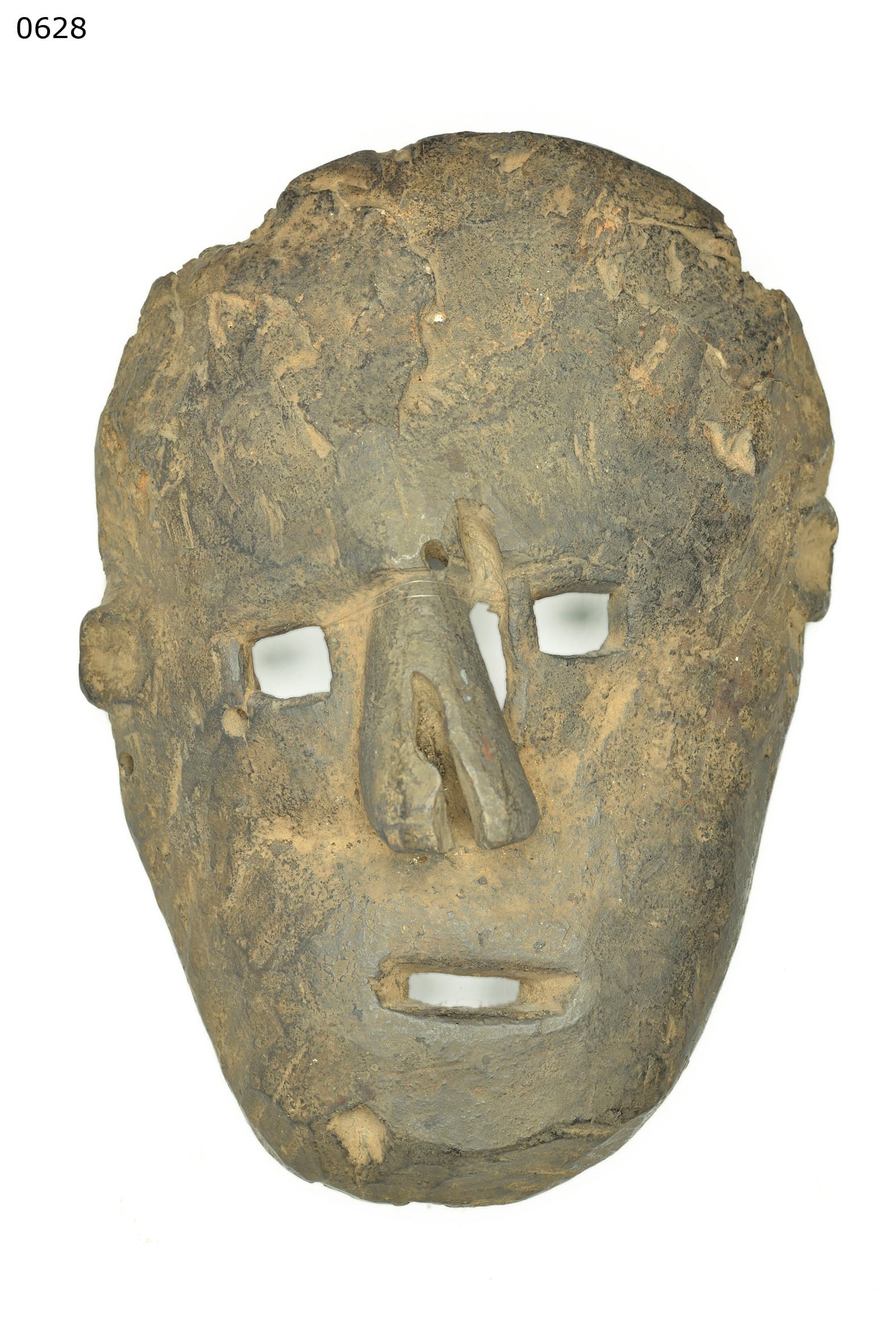
In addition to wooden sculptures, the Kaguru also made apotropaic amulets, which were often made of soft tuff or wood. These amulets usually have rudimentary, carved faces and were worn on the body to ward off evil, witchcraft or the attacks of hostile spirits. Calabash rattles (gourd rattles) form another essential segment of the aesthetic-ritual corpus. These idiophonic instruments consist of dried, emptied gourds filled with special ritual seeds, shells or small pebbles. The calabashes are often decorated with fine branding (pyrogravure) showing abstract, geometric patterns. A wooden stick pierces the calabash as a handle, whereby there are highly significant examples in which the upper end of the handle (the stopper) is designed as a miniaturised mwana hiti head. Such combined works interweave musical divination with ancestral representation.
Knowledge of forgery criteria is extremely relevant for the contemporary art market and private collections. As the authentic, pre-colonial and early colonial corpus of the Kaguru is quantitatively minimal, the international demand for "zaramoid" figures increased massively after the groundbreaking exhibitions of the 1990s, resulting in a veritable flood of imitations. From the late 1960s, large commercial carving workshops in the capital Dar es Salaam (often initiated by Makonde carvers) began mass-producing mwana hiti figurines as souvenir and export art (airport art).
The difference between a spiritually activated ritual object and a profane export piece is physically manifest. Market-relevant forgeries often have an absolutely uniform patina, artificially created using shoe polish, tea or industrial stains. Under a magnifying glass, these pieces show traces of modern sandpaper running across the wood fibres. Authentic pieces, on the other hand, were almost exclusively carved with a dexel (adze) and small knives, which leaves behind fine, faceted surface structures. Genuine ritual pieces also show material-related signs of ageing that are almost impossible to replicate authentically in forgery workshops: natural cracks in the heartwood caused by decades of drying, asymmetrical termite damage (caused by the traditional method of ritual disposal) and rubbed edges in the places where the figures were primarily gripped. In order to train the eye for these quality and authenticity features, the comparative study of reference pieces is indispensable. Such undoubtedly authentic, historically authenticated examples of the Kaguru and Zaramoid traditions can be studied in detail in the collections of the Museum Rietberg in Zurich and the Metropolitan Museum of Art (specifically in the holdings of the Michael C. Rockefeller Wing, such as the Endicott Collection).
Ritual practice
The ritual practice of the Kaguru is deeply performative and object-centred. Understanding the ontology of these objects is essential for the interpretation of their art: a carved piece of wood is completely profane at the moment of its completion by the craftsman. Only through an elaborate act of consecration and a specific performance is it transformed. The activation transforms the dead material into an entity that functions as a vessel, resonating body or direct point of contact with the ancestral spirits, comparable to the principles of the nkisi power objects in the Congo Basin, although formally less complex.
At the absolute centre of ritual object use is the handling of the mwana hiti figure during the initiation rites of girls (miviga). When a girl reaches the biological stage of menarche, she is immediately separated from the village community and transferred to a specially designated, darkened hut. A mwana hiti is provided for this highly significant occasion. The sources show that this figure is either freshly commissioned from a carver by a male relative (primarily the mother's brother, in accordance with the matrilineal authority structure), or a pre-existing, historical figure of the clan is used, in which the presence of earlier ancestors is already accumulated.
The activation of the figure is done in secret by the initiators (the somba or teachers). This process often involves smearing the sculpture with ritually significant plant extracts, human spit or castor oil. Through this anointing, the spiritual connection to the matrilineage is forged. During the isolation phase, which historically could last from several months to a year, the figure of the young novice serves as a highly complex didactic and metaphysical tool. The girl learns to treat the rigid wooden figure not as an object but as a living child: she bathes the sculpture, continuously anoints it with oil, decorates it with beads, symbolically "feeds" it and wears it on her own body. This repetitive, tactile practice physically and psychologically conditions the initiandin for her future maternal duties and prepares her for her essential role as guarantor of matrilineal reproduction. In Beidelman's theoretical framework, this role play functions as a ritual condensate through which unstructured, wild female sexuality is forced into the tight corset of socially sanctioned motherhood.
The absolute climax and conclusion of the ritual performance is the novice's "coming out". The now marriageable woman is presented to the entire community. In this liminal final phase, the initiate usually sits on a special, three-legged ceremonial stool with a high backrest. This stool is a strong symbol of authority and anchoring in the ancestral lineage; sitting on it elevates the woman to the status of mwali ya kiti ("the initiate of the stool"). The mwana hiti figure, in this phase often ritually wrapped in printed kanga fabrics or hung with imported glass bead necklaces, is presented to the public by the initiate or novice herself. This serves as visible, material proof of the successful transition from girl to adult woman and the attainment of full ritual purity.
Apart from female initiation, ritual practice manifests itself primarily at ancestral altars and in divination. Altars among the Kaguru are rarely monumental, artificial structures. They are integrated into the natural topography: The base of a mighty tree in the bush inhabited by spirits, a prominent crevice in the rock or a simple branch fork (mihama) rammed into the ground within the family homestead. Both male and female diviners and healers operate at these interfaces to the afterlife. The calabash rattle is the central instrument for energetic manipulation. The monotonous, rhythmic shaking of the rattle breaks through spiritual barriers, summons the ancestors and induces trance states (Spirit Possession) in the divinator. According to cosmological logic, the stones, shells or plant seeds hidden in the calabashes represent the earth and nature spirits, whose polyrhythmic sound is interpreted as the "silent voice" of the ancestors.
The offerings made at these altars or directly via the amulets and figurines depend on the severity of the crisis. Regular, cyclical offerings to maintain the cosmic balance usually consist of locally brewed beer (made from sorghum or millet) or simple flour porridge, which is placed in tiny vessels or smeared directly on the objects. In times of acute crisis - extreme drought, epidemics or suspected witchcraft attacks - the sacrificial practice escalates to blood sacrifices (chickens, goats or sheep), whose blood serves as the strongest vital essence to appease the spirits.
The lifecycle of a ritual object among the Kaguru is ephemeral in nature and often ends with its drastic deactivation. Once an amulet or mwana hiti figurine has fulfilled its specific function - for example, when the woman has successfully completed the initiation cycle and given birth to her own children, and the figurine is not passed on to a niece - the object loses its spiritual charge. It is not conserved as a work of art worth preserving, as in the Western conception of art, but profaned. The objects are often carelessly thrown into the dark rafters of the hut, where they are left to the thick smoke of the hearth fire, to dry out and to be eaten by insects for years. Alternatively, they are carried into the forest and disposed of in the vegetation, where they are left to rot naturally.
This specific ritual disposal practice explains on a forensic level why in world-class museums, such as the Musée du quai Branly - Jacques Chirac, which is known for its excellent historical documentation of performative object lifecycles, or in Western private collections, intact and flawless authentic pieces of old Kaguru are extreme rarities. If they have survived, they almost invariably show strong traces of this discarding process: pronounced heartwood cracks, deep gnaw marks from termites at the base and thick soot crusts.
Historical context
The historical genesis of the Kaguru and the evolution of their artistic-ritual production are inextricably linked to the massive demographic, economic and political upheavals that shook East Africa in the 18th, 19th and 20th centuries. The precise migration history of the Kaguru remains a source of dating controversy in historical research. However, the archaeological and ethnological consensus indicates that they migrated to the Itumba Mountains from more southern or western regions several centuries ago. This migration was less of an expansive land grab than a retreat: the Kaguru developed an extremely defensive settlement pattern on inaccessible mountain ridges in order to defend themselves against the constant raids and cattle raids of militarily superior, pastoralist neighbours, namely the Baraguyu and the Maasai groups.
A dramatic turning point in the socio-economic history of the ethnic group occurred in the 18th and especially the 19th century. One of the most central and lucrative caravan routes on the entire continent ran through the core area of the Ukagura - along the courses of the Kinyasungwe and Mkondoa rivers. This route connected the ivory and slave markets of the deep hinterland on Lake Tanganyika with the prosperous coastal harbours of Saadani and Bagamoyo on the Indian Ocean. This forced, brutal opening of their isolated territory brought the Kaguru into permanent, intensive contact with Arab and Swahili traders from the coast. These interactions had far-reaching consequences: on the one hand, the contact led to a gradual, albeit strongly syncretic Islamisation on the peripheries of their settlement area, which challenged traditional matrilineal structures. On the other hand, trade initiated the import of Western and Asian industrial goods, especially glass beads. These beads were rapidly integrated into the aesthetic repertoire and henceforth served as essential jewellery and status indicators on mwana hiti figurines and amulets.
With the brutal establishment of the colony of German East Africa in the late 19th century and the subsequent takeover by the British Mandate after the First World War, the political architecture of the Kaguru changed drastically. The colonial powers, anxious for control and tax collection, implemented a system of often alien district administrators (Akidas) and relied on the principle of "Native Authority". This system, dictated from above, systematically undermined and dismantled the traditional, decentralised authority of the matrilineal clan elders.
Parallel to the administrative subjugation, Christian missionaries, especially the Church Missionary Society (C.M.S.), developed an aggressive agenda against the indigenous belief systems. The missionaries regarded ancestor worship and elaborate rites of passage as pagan customs that needed to be eradicated. The influence of this colonial encounter on traditional art production was simply catastrophic. Initiation rites for girls were often banned, regulated or forced underground by the authorities and missions. Ritual objects such as calabash rattles and mwana hiti sculptures were confiscated as "idols" or publicly burnt. As a result, the commissioning and carving of sculptures for authentic ritual use by the Kaguru people declined drastically; the traditional craftsmanship of the master craftsmen threatened to erode.
The market history and reception of Tanzanian art in the Western world developed extremely late, in stark contrast to the artworks of West and Central Africa. While sculptures by the Fang, Dan or Kota were already enthusiastically discovered by the Cubist avant-garde in Paris in the early 20th century and marketed by dealers such as Paul Guillaume, the Tanzanian hinterland was long regarded as "artless" in Western art discourse. Early collectors, colonial ethnologists and museum buyers often dismissed the abstract pile figures from the east coast, reduced to rudimentary cylinders, as "primitive" or insufficiently crafted. A massive, almost explosive breakthrough on the art market and a complete aesthetic re-evaluation only took place in the late 1980s and especially in the early 1990s.
This renaissance was catalysed by two publishing and curatorial milestones: The publication of Marc L. Felix's systematic foundational work Mwana Hiti: Life and Art of the Matrilineal Bantu of Tanzania in 1990 and the groundbreaking exhibition Tanzania: Masterpieces of African Sculpture (curated by Marc L. Felix and Maria Kecskési, shown in 1994 at the Haus der Kulturen der Welt in Berlin and the Lenbachhaus Munich; published by Fred Jahn, Munich). These events suddenly brought the radically abstract art of the Kaguru, Zaramo and Luguru, reduced to essential volumes and geometric rigour, to the attention of top international collectors. This late but all the more vehement appreciation evoked a rapid price development for authentic, historically authenticated pieces at international auctions (Sotheby's, Christie's) and in galleries in Paris and Brussels.
This sudden market pressure and exorbitant international demand generated a massive forgery problem that still characterises the art market today. In the wake of Tanzanian independence (1961) and the proclamation of the socialist Ujamaa policy, large commercial art galleries (such as the Paa ya Paa Gallery) and huge carving workshops emerged in the economic metropolis of Dar es Salaam. Since genuine Kaguru pieces that had been used ritually for decades were extremely rare due to colonial destruction and the ephemeral nature of disposal, these urban workshops began to mass-produce "zaramoid" figures for export distribution (airport art) from the 1960s onwards.
For modern collectors and curators, knowledge of forensic authenticity criteria is therefore the conditio sine qua non. Forensics is based on hard physical parameters: Authentic Kaguru sculptures from the 19th or early 20th century are characterised by material-related signs of ageing that can hardly be simulated to the necessary depth in workshops. These include genuine cracks in the heartwood (caused by decades of natural drying out of the dense hardwoods), asymmetrical termite damage that often runs from bottom to top (the result of disposal in the bush or roof beams) and microscopically verifiable smoothing and compression of the wood fibres at the points where the figures were handled by generations of initiators. Modern forgeries often bunglingly imitate these traces by artificially burning out cavities, sandblasting techniques or the use of chemical stains to generate patina. A profound understanding of the colonial, demographic and ritual distortions is therefore essential in order to correctly decipher the ethnographic and artistic value of these fragile testimonies to East African art history. The Royal Museum for Central Africa (RMCA) in Tervuren offers an excellent example of how such provenance histories and the intertwining of colonial acquisition, loss and market dynamics have been dealt with, as it has recently been working intensively on the recontextualisation of its historical, albeit primarily Congolese-influenced, holdings.