Overview
The demographic survey and ethnographic classification of the Luba (historically also referred to as Baluba in older literature) reveals the immense complexity and fluidity of post-colonial identity constructions in the Central African region. Geographically, the recent main settlement area of this people is primarily concentrated in the south-central and south-eastern provinces of today's Democratic Republic of Congo (DRC), especially in Haut-Lomami, Kasai, Kasai-Oriental, Kasai-Central, Lualaba and large parts of Katanga and Maniema. The total population of the DRC is estimated by official UN projections to be around 109.2 million in 2024 and 112.8 million in 2025, with a significantly low, albeit slowly increasing, average life expectancy of 61.9 years. Within this massive national structure, the Luba form by far the largest linguistic and cultural cluster. Extrapolations of current demographic surveys put the population that identifies as Luba or originally related to the Luba at between at least 14 million and 28.8 million people. This striking statistical variance results from the question of whether peripheral and strongly assimilated groups are included in the estimate.
The internal dynamics of this population are currently subject to extreme demographic shifts. The latest mobility data analyses (for example by Flowminder from 2025) show massive internal migration to the mining centres of the south. Areas such as the province of Haut-Katanga and the Manika health zone (Kolwezi) are experiencing excessive population growth of up to 6.7 per cent per year, which far exceeds official forecasts and is permanently changing the traditional settlement structure of the Luba through economically motivated urbanisation.
Linguistically, this cluster belongs to the extensive family of Bantu languages. Two primary, albeit highly differentiated dialect groups dominate: Tshiluba (also known as Luba-Kasai), which is spoken primarily in the western Kasai provinces and is widely used there as a written language in education and the clergy, and Kiluba (Luba-Katanga), which is spoken in the south-eastern heartland around Kamina, Kabongo and Malemba Nkulu. Swahili and Lingala also function as inter-ethnic lingua franca, while French forms the formal administrative superstructure of the nation.
With regard to nomenclature, a strict distinction must be made in the ethnographic analysis between endonymic self-designations and exonymic foreign designations. Today, the term "Luba" operates as an ethnic umbrella term for a wide-ranging conglomerate of different peoples who, although they have historical, linguistic and cultural overlaps, do not necessarily share a direct, homogeneous lineage. Ethnology traditionally divides this cluster into three main fluid groups: the Luba-Shankadi (or Luba-Katanga) in the historical south-eastern heartland, the Luba-Kasai (or Luba-Bambo) in the west and the Luba-Hemba in the north and east, who are strongly intermixed with neighbouring peoples.
The social structure and kinship system of these subgroups is one of the most prominent points of discussion in recent anthropology. The source situation here is highly complex, as the Luba present an amalgam of the most diverse social orders. The Luba-Kasai are predominantly characterised by a patrilineal and patrilocal organisation, in which descent and property rights are strictly handed down through the paternal line. In drastic contrast to this, the Luba-Katanga in their historical heartland are characterised by pronounced bilateral to matrilineal tendencies. These groups are located in the so-called Matrilineal Belt of Central Africa. In current research (e.g. Fortunato 2019; Lowes 2018), there is intense debate as to whether these matrilineal structures represent original evolutionary adaptations to historical horticulture or are the result of exogenous shocks, as matrilineal systems tend to give women greater bargaining power within the household. The extent to which the genetic and social heterogeneity of the Luba is the direct result of historical processes of state centralisation is also the subject of controversy. Similar to the genetic mixing during the formation of the neighbouring Cuban kingdom (cf. PNAS studies on the genetic legacy of centralised states), the imperial growth of the Luba led to the violent or diplomatic incorporation of previously isolated lineages.
The traditional subsistence economy of the Luba is based on a dual, ecologically highly adaptive system that utilises the humid gallery forests and the vast tree savannahs of the Lualaba basin. Intensive arable farming, historically based on sorghum and millet and replaced in modern times by cassava and maize, is complemented by extensive fishing in the marshy lake systems of the Upemba depression (such as Lake Kisale). In addition to agrarian subsistence, metallurgy - especially the masterful smelting of iron and copper - formed the central economic pillar of the pre-colonial economy. This control of resources enabled the Mulopwe (the sacred royal elite) to establish far-reaching tributary trade networks that reached as far as the East African coast.
The political relationship with neighbouring peoples - such as the Lunda in the west, the Songye in the north, the Hemba in the east and the Chokwe - is historically characterised by phases of rapid imperial expansion, inter-dynastic alliances and warlike hegemonic ambitions. The classification of the historical Luba empire itself is a fundamental historiographical point of contention. While early colonial ethnographers (and in some cases older holdings in the Royal Museum for Central Africa in Tervuren) assumed a tightly centralised "empire", more recent research (such as Mary Nooter Roberts & Allen F. Roberts 1996) describes the historical polity as a flexible, "multi-centric constellation" of autonomous chiefdoms and secret societies. These peripheries were bound to an ideal, sacred centre less by military coercion than by shared mythical concepts, ritual authority and the emulation of courtly Luba aesthetics.
| Ethnic group | Primary region (DRC) | Kinship system | Subsistence focus | Political organisation |
|---|
| Luba-Katanga (Shankadi) | Southeast, Haut-Lomami, Upemba depression | Tends to be matrilineal / bilateral | Fishing, sorghum, copper metallurgy | Historical centre of sacred kingship (Mulopwe) |
| Luba-Kasai (Bambo) | Northwest, Kasai provinces | Strictly patrilineal, patrilocal | Agriculture (manioc, maize), hunting | Historically decentralised, later assimilation |
| Songye (neighbours) | North, Lomami | Patrilineal, gerontocratic | Agriculture, trade | Strongly hierarchical, military |
Cultural context
The religious and cosmological system of the Luba is an intricate structure that is deeply rooted in the physical and political topography of their settlement area and is structurally radically different from the gerontocratic, male-dominated orders of neighbouring peoples such as the Songye or Hemba. At the top of this cosmological hierarchy is an all-encompassing but remote creator deity known as Leza or Shakapanga ("the universal creator"). Although Leza is regarded as the source of all life and the moral judge in the afterlife, this entity is rarely invoked directly in everyday ritual practice. Instead, the operative spiritual power lies with two primary categories of spirits: the mikishi (or bakishi), the personal ancestral spirits of the lineage, and above all the bavidye. The bavidye are immensely powerful, often heroic nature and ancestral spirits who reside not in an abstract sky, but in striking landscape elements - the hot springs, dark caves and especially the lakes of the Upemba depression (such as Lake Kisale). They act as the ultimate patrons of the territory; without their ritual sanction, no legitimate exercise of power by the political elite is conceivable.
The central foundation of this political-religious order is the Luba creation myth, whose scientific exegesis has given rise to one of the most striking research controversies in African studies. The narrative describes the conflict between Nkongolo Mwamba, an indigenous, cruel despot described as incestuous, and Mbidi Kiluwe, a beautiful, cultivated black hunter who immigrated from the East (often associated with the Lunda Empire). Mbidi Kiluwe brought new standards of civilisation, refined court etiquette and the sacred concept of rulership to the region. From the fleeting union of Mbidi Kiluwe with Nkongolo's half-sister emerged Kalala Ilunga. This heroic warrior finally defeated his tyrannical uncle Nkongolo, beheaded him and established the sacred kingship to which all subsequent Mulopwe (kings) refer.
The historiographical controversy centres on the question of the historicity of this epic. Representative A (Jan Vansina, 1981) long read these narratives as coded but real historical documents of invasions, dynastic changes and territorial expansions. In contrast, representative B (the structuralist anthropologist Luc de Heusch) argues that Nkongolo and Mbidi Kiluwe are not historical actors, but purely symbolic armatures and myth complexes that encode the transition from nature to culture and the definition of political order. Mary Nooter Roberts and Allen F. Roberts add that this narrative serves primarily as a "political charter" that is flexibly adapted to current power relations.
What fundamentally distinguishes the Luba religion structurally from its neighbours is the central, absolutely sacred role of women in the cult. In Luba cosmology, the axiomatic principle prevails that only a woman's physical body is strong enough to absorb and contain the powerful, dangerous spiritual essence of a king. This premise manifests itself in two extraordinary ritual institutions: the Kitobo and the Mwadi. The Kitobo are female priestesses who often live in pairs (representing sacred twins) and act as exclusive guardians of the sacred lakes and shrines of the bavidye. Only through them can the spirits allow humans to access the resources of the lakes.
The role of the mwadi is even more important for the state structure. If a mulopwe (sacred king) dies, his court is not dissolved or destroyed, but transformed into a kitenta (an eternal spiritual capital). A specially chosen woman, the mwadi, takes the spirit of the deceased ruler into herself, embodies him physically and rules in his name from then on. She is treated with the same honours as the living king, her village is exempt from paying tribute to successive monarchs, and the new king is strictly forbidden from ever entering her territory under threat of taboo punishments (bizila). Through this institution, the female body is stylised as the ultimate lieu de mémoire (place of memory) and the microcosmic vessel of Luba history.
This female monopoly is flanked by complex, highly regulated secret societies, the most important of which is the Mbudye society ("men of memory" or bana balute). The Mbudye are recruited from the social elite and serve as a political-religious supervisory body that can limit the power of the reigning king. They preserve the esoteric knowledge of the Luba through rigorous initiation rites that simulate the physical and intellectual death as well as the ritual rebirth of the novice. They are the sole interpreters of historical and genealogical mnemonics. The Bilumbu, highly specialised divinators, operate alongside the Mbudye. These ritual authorities enter into communication with the bavidye through deep, often drug- and rhythmically-induced trance states to diagnose social crises, causes of illness or witchcraft. The collection of the Fowler Museum at UCLA (Los Angeles), strongly influenced by the field research of Mary Nooter Roberts, holds some of the world's most important objects from these secret and divination societies for scientific analysis.
Aesthetic features
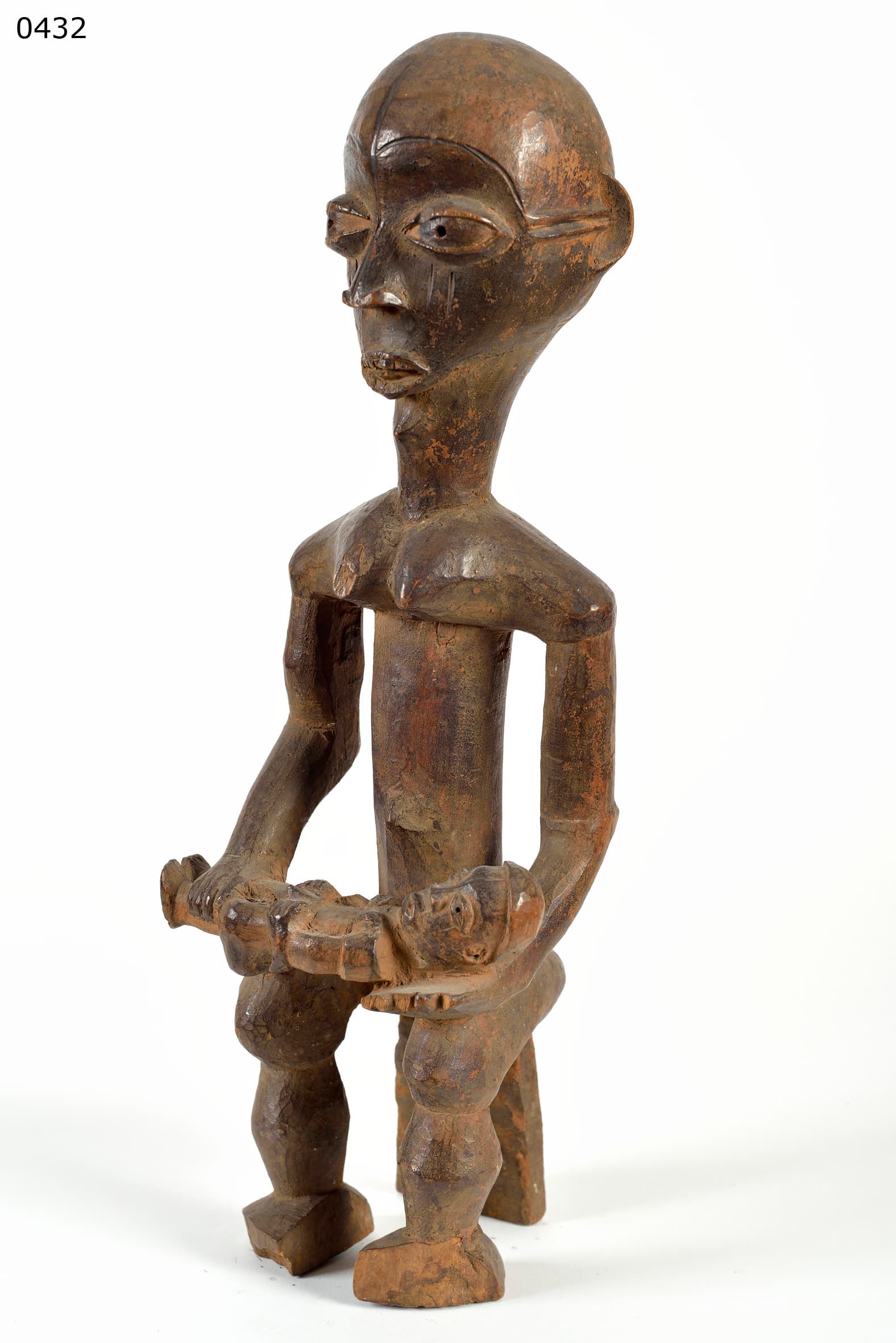
The aesthetic vocabulary of Luba art is unique in the Central African context and is canonically defined by a pronounced curvilinearity, introspective serenity and a highly formalised iconography that primarily serves the spiritual legitimation of the political elite. The female body is at the centre of this canon of proportions. Since, as explained in the cultural context, only women can grasp the spiritual power of rulers, almost all insignia of power are adorned with elaborate female sculptures that radiate physical perfection and moral purity through luminously polished skin, closed eyes and deep scarification tattoos (scarifications).
The canonical object typology comprises several highly specialised subtypes. A central ritual instrument is the mboko (shell bearer). These are anthropomorphic, kneeling female figures holding a spherical bowl in front of their abdomen. Iconographically, these figures represent the first mythical divinator of the Luba or the spiritual wife of the contacting bavidye spirit. The bowl itself serves as a sacred container for divinatory objects and pemba (white kaolin chalk). Another iconic object is the lupona (the caryatid stool). These ceremonial ruler's seats, which are carried by one or more female figures, function as containers for the ruler's spirit. The iconography of the carrying woman explicitly refers to the fact that the chieftain inherits his right to rule through matrilineal ancestors and that his power rests on the foundation of female authority. This spectrum is complemented by ceremonial axes, ceremonial bow frames (kibango), neck supports and sceptres wrapped in copper wire, all of which follow the same morphological principles: The head is greatly enlarged as the seat of dreams and prophecy, and the navel, the symbol of cross-generational ancestry, is prominently accentuated by geometric keloid scarification.
The lukasa (memory board), a hand-sized, waisted wooden board densely covered with different coloured glass beads, kauri shells and metal pins, demands special scientific attention. This object is the centre of one of the most important research controversies in African art history. Older researchers and colonial collectors had long categorised the arrangement of the beads as purely abstract or aesthetically decorative patterns. This view was vehemently contradicted by Mary Nooter Roberts and Allen F. Roberts in their groundbreaking publication Memory: Luba Art and the Making of History (1996). They proved that the lukasa represents a highly complex "historical mnemonic". The reverse of the panel shows geometric carvings representing the shell of a tortoise - a symbol of the deeply hidden secrets of the Luba empire and the strict taboos of rule (bizila). On the obverse, the large beads act as representations of kings or bavidye, while surrounding small beads symbolise the court, migration routes or mythical events (such as the journey of Mbidi Kiluwe).
In the history of Luba art, individual sculptor's workshops and master craftsmen known by name could be identified, similar to the research into European Gothic and Renaissance masters (cf. the methodology of Frans Olbrechts in the 1930s). The most famous is the "Master of Buli", whose identity was deciphered through later field research (e.g. François Neyt, Marilyn Stokstad) as Ngongo ya Chintu ("Father of Carved Things") from the village of Kateba in the Hemba region. The morphological structure and iconography of a traditional Luba caryatid stool (as prominently displayed in the Metropolitan Museum of Art in New York) attributed to this master reveals highly deliberate distortions of proportion. A significantly enlarged head symbolises the spiritual centre, while the highlighted navel, surrounded by precise keloid scarification patterns, encodes metaphysical concepts of continuity. The strongly elongated, almost tragically melancholic facial features with half-closed eyelids and oversized hands form the unmistakable diagnostic feature of the Buli master. Another sculptor established by François Neyt is Kiloko from Busangu, known in Western literature as the "Master of the Cascade Hairstyle". His works, excellently documented in the Musée du quai Branly and the British Museum, are characterised by dynamically asymmetrical poses (one leg bent at an angle, arms pointing in opposite directions), coffee bean eyes and the virtuoso three-dimensional realisation of the multi-level Shankadi hairstyle. Harold Womersley, an English missionary who sheltered Kiloko at his mission in the 1940s, described him as the "last great traditional carver" of the region, whose later works - often hairpins for European travellers - ironically remained unpatinated.
The choice of material rigorously dictates the ritual purpose of the Luba. Extremely dense, durable hardwood such as Crossopteryx febrifuga was used for elite objects such as neck rests and heavily used ancestor figurines. In contrast, soft, porous light wood such as Ricinodendron heudelotii was deliberately chosen for funerary figurines whose ritual purpose dictated rapid physical decay in the open air.
Due to the immense market value of these objects in the West, material-scientific forgery criteria are essential for the collector. The ritual difference between a profane carving and an activated ritual object is visually evident in the patina, which is created by decades of rubbing with palm oil, red tukula powder (camwood), sweat and kaolin and penetrates deep into the heartwood. Forgers simulate ageing processes superficially through aggressive smoke colouring or tea baths. Modern art historical forensics uses optical coherence tomography (OCT) to scan the morphology of wood cracks (craquelure) in the micrometre range. The sources clearly show that original cracks caused by decades of natural ageing are usually deep and rectangular in cross-section, while artificially induced cracks form flat, inverted V-shapes (triangles). Termite feeding traces (especially of the species Coptotermes sp.) are also examined entomologically for the naturalness of the feeding tunnels.
| Master hand / workshop | Identified artist | Region | Diagnostic aesthetics | Typical objects |
|---|
| Master of Buli | Ngongo ya Chintu | Kateba (Hemba influence), 1810-1870 | Elongated faces, melancholic expression, oversized hands | Caryatid stools (lupona), bowl bearers |
| Master of the cascade hairstyle | Kiloko | Busangu (near Kamina), 1920s | Asymmetrical poses, coffee bean eyes, layered hairstyle | Neck supports, hairpins, mboko |
Ritual practice
For the Luba, the ontological dividing line between profane woodcarving and sacred cult object is determined by the act of ritual activation. A freshly carved sculpture, even if it comes from a master such as the Buli master, is initially merely an aesthetic wooden body without inherent power. The transformation into a powerful manga (plural for magical amulets or charged objects) is carried out exclusively by initiated divinators or priests who apply so-called bijimba. Bijimba are highly potent conglomerates of animal, plant and human residues (such as leopard bone fragments, claws, hair or ash) that are inserted into specific carved cavities in the figure. These cavities are often significantly located on the head (the seat of dreams and prophecy) or in the abdomen (the origin of matrilineal continuity) and are hermetically sealed after being filled with resin or clay. These bijimba substances act as a magnetic anchor point; they force the spirits of the ancestors or the bavidye to take up residence in the sculpture.
A central element of the ritual practice is the performative use of the altars by the bilumbu (the divinators), who are systematically possessed by spirits. In a typical divination session, the priest sits on the floor in front of the activated mboko bowl bearer. In order to make the liminal transition into the spirit world, the divinator smears himself excessively with pemba, the white kaolin chalk from the figure's bowl. The white colour is not decorative, but symbolises moral purity, the light of the new moon, enlightenment and the ectoplasmic presence of the spirit world. Through physical contact with the mboko and under rhythmic chanting, the divinator reaches a deep trance state in which the bavidye guardian spirit speaks through him and relentlessly reveals hidden social conflicts, causes of illness or attacks by witchcraft.
The ritual performances of the masked societies obey a completely different, extremely choreographed rhythm. The focus here is on the kifwebe masked being, which makes a strict distinction between male and female spirits. The female masks - hemispherically round and characterised by concentric, exclusively white groove patterns - represent benevolent spirits. They are associatively linked to the new moon, fertility cycles and healing and are danced by men in slow, set movements. This is contrasted by the elongated male masks, often with deep red pigments (blood, danger) and striking, high crests. These appear in aggressive, unpredictable and explosive choreographies to exert police-like social control or physically expel malevolent spirits from the village community.
The use of the lukasa memory board by the Mbudye elite is equally performative and kinetic. The board is never used in isolation as a silent act of reading, but always in a strictly regulated, theatrical setting that includes singing and dancing. The bana balute ("man of memory") holds the board in his left hand and runs his right index finger over the raised beads and metal pins. The "reading" is not a static reproduction of a fixed, linear text, but a dynamic generation of history. As memory is understood by the Luba as a "generative process" (Roberts 1996), no two recitations are identical. Depending on the current political requirements, the dignitaries present or specific legal disputes in the village, the reader focuses on completely different genealogical lines or moral precedents, which are encoded multifocally in the bead clusters of the board.
The life cycle of Luba ritual objects inevitably leads to the phase of deactivation or disposal, the course of which depends strictly on the status of the object. Highly sacred insignia of kings, such as the caryatid stool (lupona), were wrapped in white cotton cloths almost in panic when not in use and protected from profane eyes in special residences. If the ruler died, his most important insignia were not destroyed, but remained in the kitenta (the spiritual residence of the Mwadi) as eternal dynastic reference points. Other activated objects, especially funerary sculptures made of light ricinodendron wood, followed a completely different paradigm. They were deliberately placed in outdoor altars or burial sites. Paradoxically, their ritual 'deactivation' consisted of consciously allowing their physical decay; they were ritually abandoned to the rains and termites in order to close the cycle of organic matter and released spirit in nature. Here, the death of the sculpture does not mark a museum tragedy, but an intended spiritual dissolution that stands in radical contrast to the Western, static idea of conservation. There is also regional documentation of practices in which the magical charge (bijimba) was surgically removed from the figure after the death of a powerful divinator or the statue was buried together with its owner in order to remove its uncontrolled power from this world's grasp once and for all.
Historical context
The historical reconstruction of the Luba cultural area is based on a sophisticated synthesis of traditional oral epics, archaeological findings in the Katanga Plateau and comparative linguistic research. Archaeological excavations in the Upemba Depression (especially at sites such as Sanga) impressively demonstrate that the region of the vast lakes around the Lualaba River was continuously inhabited by highly complex Iron Age cultures as early as the Kisalian period, from the 5th to the 14th century AD. The evidence of elaborate children's graves, rich pottery finds and iron ceremonial shoulder axes - exactly the type that was still carried by Luba kings in the 19th century - indicates an early development of hereditary hierarchical elites. Nevertheless, there is a long-lasting and fundamental controversy among historians about the dating of the actual formation of the Luba empire. Representative A (Jan Vansina and Harry Langworthy) dated the institutional consolidation of the state to the late 15th century or even earlier based on the extrapolation of royal lists. Representative B (Thomas Reefe and later Mary Nooter Roberts), on the other hand, strongly tended to place the earliest reliable institutional consolidation in the late 17th or even 18th century. They interpret the broad temporal scope of the Kalala-Ilunga epics as mythological prospection, in which recent claims to power were anachronistically projected into a deep past in order to establish legitimacy. It is undisputed that the Luba empire reached its absolute greatest territorial and cultural hegemony between the late 18th and mid-19th centuries under rulers such as Kumwimbe Ngombe and Ilunga Kabale. This zenith ended abruptly in the late 19th century, when the empire was successively destabilised and fragmented into splinter states by the massive, violent invasion of Arab-Swahili slave and ivory traders from the east coast, by Luso-Africans from Angola and by the expansive war campaigns of the neighbouring Chokwe and the Yeke king Msiri.
The subsequent colonial encounter with the Belgian state (initially as the private Congo Free State from 1885, from 1908 as the Belgian Congo) led to the final dissolution of the old political centres through the system of "Indirect Rule" and massive labour migration to the mines of Katanga. A particularly influential but highly ambivalent actor in this transition era was the English Pentecostal missionary William F. P. Burton. Burton began to operate in the Katanga region in the 1920s. Initially driven by an aggressively intrusive iconoclasm aimed at eradicating traditional institutions - which he saw as an existential theological threat to his mission - Burton's attitude soon changed to a deep anthropological interest. He began meticulously documenting the language, rituals and material cultures of the Luba and collected a massive amount of artefacts that today form the core of the collections of the Royal Museum for Central Africa (RMCA) in Tervuren and the University of Witwatersrand. Through his linguistic translations (which led to the establishment of standardised Christian "Linguistic Zones"), Burton paradoxically contributed significantly to the construction of a fixed, pan-ethnic "Luba identity" ("Lubaland"). The previously highly fluid and pluralistic boundaries of pre-colonial identity were thus pressed into rigid colonial taxonomies through missionary science (ethnography and photography).
The Western market history of Luba art ran parallel to this systematic ethnographic reappraisal. The first prominent collectors emerged in the early 20th century, including the Belgian civil servant Emil Torday and the German ethnologist Leo Frobenius, who collected numerous pieces - especially early kifwebe masks - for the European market during his DIAFE-I expedition (1904-1906). The aestheticisation of African sculpture beyond the colonial "fetish" stigma experienced an enormous upswing in the 1930s, significantly flanked by the Brussels World Exhibition in 1935, at which works from the Luba Empire were presented to an audience of millions, and by the auctions of the Georges de Miré collection (Paris 1931), at which artists such as Charles Hug sketched and acquired Luba artworks. The breakthrough exhibition Memory: Luba Art and the Making of History at the Museum for African Art in New York in 1996, curated by Mary Nooter Roberts, was an academic and reception-historical milestone. This show finally revealed to the Western art world the immense intellectual and conceptual depth of Luba mnemonics and elevated the objects far beyond the status of naïve folk art.
On the global art market, this price and appreciation trend culminated in December 2010 at Sotheby's in Paris: a caryatid stool by the Buli master (Ngongo ya Chintu), which had already been acquired by Harry Bombeeck in 1896 during the brutal years of the Congo Free State and brought to Belgium in 1899, was knocked down for the record sum of 5.4 million euros (7.1 million US dollars) at the centre of a top-class bidding war. This sale marked the stool as the second most expensive African artwork in auction history at the time.
Due to these extreme monetary incentives, the problem of forgery is a key challenge for museums and private collectors today. Forensic authentication (as practised by luminaries such as James Martin at Orion Analytical) utilises state-of-the-art scientific methods alongside traditional provenance research. As explained in the Aesthetic Characteristics section, in addition to optical coherence tomography (OCT) for the analysis of heartwood cracks, Raman microscopy is also used to distinguish colour pigments and artificially applied patina (e.g. using modern chemical binders or artificial smoke staining) from the historical organic mixtures of palm oil and tukula. Dendrochronological methods and mass spectrometry are also used to verify the exact age of the felled wood, as many forgeries imitate the style perfectly but use recent tropical woods.
Finally, a persistent and highly charged iconographic controversy pervades the historical localisation of Luba art: the actual origin of the striped kifwebe masks. Representative A (the Canadian anthropologist Dunja Hersak, based on her research from the late 1970s, supported by early data from Alan Merriam) locates the undisputed origin of the kifwebe tradition deep in the territory of the neighbouring Songye and interprets the round, feminine Luba masks as later, formal appropriations or derivatives. Representative B (François Neyt and Julien Volper, curator at the RMCA Tervuren), on the other hand, argues that both cultures influenced and developed this ritual form bidirectionally over decades in the eastern Congolese border regions as a reciprocal co-tradition. The source situation is fascinatingly paradoxical in that the Luba indigenous people often claim that the mask is a dangerous import from the Songye, while the Songye proclaim exactly the opposite. According to ethnologists, this is not a historical error, but a highly conscious ritual strategy of both peoples to mystify the uncanny, transcendent "strangeness" of the masked spirits and maximise their psychological power in performance.
Sources & References
This dossier draws on standard scholarship in Luba studies. For deeper reading and image archives, see:
Inline citations in this dossier refer to canonical scholarly works on Luba art; full bibliographic resolution is pending a researcher pass.