Overview
The Chokwe (historically also recorded as Tshokwe, Cokwe, Tchokwe, Kioko, Ciokwe, Badjok or Djok) are among the most culturally and politically influential Bantu-speaking societies in Central and Southern Africa. The multitude of spelling variants reflects a long history of transliteration by Portuguese, Belgian and French colonial administrations; in current scientific nomenclature, Chokwe has established itself as the canonical form, while terms such as Kioko or Badjok are considered obsolete and sometimes pejorative. The slugs Chokwe and Tchokwe, which are listed separately in this collection, refer to the same ethnic group.
The primary settlement area extends over three nation states: the north-east and east of Angola (provinces of Lunda Norte, Lunda Sul, Moxico, Cuando Cubango), the south-west of the Democratic Republic of Congo (Kasai, Kwango, Lualaba, Katanga) and the north-west of Zambia (Kabompo District, Upper Zambezi), with peripheral extensions into the Namibian Kavango region. Current estimates converge to a total population of around 4.16 million individuals: around 2.5 million in Angola, 1.52 million in the DRC, 136,000 in Zambia and just under 10,000 in Namibia. The age structure is markedly expansive - almost 45 per cent of the population is under 15 years old - which underlines the continuing relevance of initiation rites and their material culture.
Linguistically, Chokwe (or Cokwe, Guthrie zone K.11) belongs to the central Bantu subgroup of the Niger-Congo language family. It has deep structural affinities with the languages of the neighbouring ethnic groups Lunda, Lwena (Luvale), Luchazi, Mbunda and Pende and functions as an interethnic lingua franca in large parts of eastern Angola and north-western Zambia - a direct consequence of the historical trade and military dominance of the Chokwe in the late 19th century.
The founding mythology inextricably links the Chokwe with the Lunda Empire. According to oral tradition, in the early 17th century, the Luba prince and master hunter Chibinda Ilunga married the Lunda queen Lweji, bringing the concept of balopwe, sacred kingship, to the region. Some of the old Lunda nobles did not accept this foreign rule and migrated westwards into the forest and savannah areas of present-day Angola, where they formed the nucleus of the Chokwe people; for centuries, these descendants remained tributary to the Lunda rulers (Mwata Yamvo), but already functioned as court artists for their aristocracy. This relationship was radically reversed in the 19th century: Through the dominant ivory, beeswax and later rubber trade with Portuguese coastal structures, local mwanangana ("overseers of the land") gained immense wealth and access to modern firearms. in 1887, Chokwe forces conquered the Lunda centre, marking the geopolitical upheaval of the region and providing the historical matrix for the flowering of classical Chokwe art.
The social structure is organised along matrilineal lines: Descent, clan affiliation, inheritance rights and succession to ritual offices run through the maternal line and the mother's brother. Political authority, on the other hand, is predominantly exercised by men, and the rule of residence after marriage is typically virilocal. In the socio-economic debate on "matrilineal puzzle" societies (Greif, La Ferrara, List), the Chokwe are discussed as a prime example of those dual systems in which economic continuity and political violence follow different axes; the older literature, which frames the Chokwe as purely matrilineal, abbreviates this complexity. The political organisation is decentralised: autonomous chiefdoms under a mwanangana who acts as a sacred intermediary between ancestors and community, linked by a common cultural grammar, not by a centralised state system.
A strictly stratified order of artists is decisive for the categorisation of the collection. The songi are the regular carvers for village use - everyday objects, initiation masks, family mahamba shrine figures. The fuli, on the other hand, form an exclusive caste of court artists who work exclusively for the mwanangana and produce courtly representational art (caryatid thrones, sceptres, monumental ancestor sculptures, prestige pipes). This differentiation can be empirically demonstrated in the corpus of the travelling exhibition catalogue Chokwe! Art and Initiation Among Chokwe and Related Peoples (Birmingham Museum of Art / Baltimore Museum of Art / Minneapolis Institute of Arts, 1998) and is fundamental for the stylistic and functional categorisation of the objects in this collection.
Cultural context
The religious and cosmological system of the Chokwe is strictly hierarchical. At the top is the creator deity Kalunga (regionally also Nzambi or as a double designation Kalunga-Nzambi) - an omnipotent, primordial being who created the cosmos, but who withdrew from the everyday concerns of people after the act of creation. Kalunga-Nzambi is a classic deus otiosus: He receives no offerings, has no priests and is not figuratively depicted in art. Instead, the operative ritual practice focuses on an intermediate level: the mahamba (Sg. hamba), an ontologically far-reaching category that includes ancestor spirits as well as nature and disease spirits. Within this complex, the tuponya denote the spirits of close relatives (intimate protective instances); wanga, on the other hand, is an ambivalent form of protective or harmful magic that is manifested in material objects.
The ritual authority is distributed among several specialised roles, which are often erroneously combined into one figure in the older literature. The mwanangana secures the cosmic order on the macro-political level through the cult of the royal ancestors. Three distinct figures operate at the micro level of individual suffering: the nganga is a ritual technician and healer, responsible for activating objects by introducing yitumbo medicine. The tahi (divinator) diagnoses the hidden causes of illness, infertility or social misfortune using the divination basket ngombo ya cisuka. Once the tahi has identified the specific hamba, he hands the case over to the cimbanda - a cult leader and exorcist who was usually himself once afflicted by this very spirit, healed and thus initiated into the authority for this cult.
The role of women is structurally central, even if it is not visible in the male-dominated mask performance. The matrilineal lineage is the backbone of social identity; the ritual and aesthetic celebration of the fertile, mature woman in the Pwo or Mwana-Pwo mask is thus not a decorative addition, but the systemic core of Chokwe cosmology. In her study "Women=Masks" (African Arts 1998), Elisabeth Cameron has shown how women remain involved in the performance even beyond their active touching of the masks as a ritual audience, as the beat makers of the music and as a moral ideal - without their cosmological acceptance, the masquerade would be ineffective. The masculine (represented in the aggressive Cihongo mask) and the feminine (Pwo) act as absolutely complementary cosmic forces.
The central rite of passage that inscribes this gender complementarity into social time is the mukanda: an initiation camp for boys lasting several months that begins with circumcision, marks the ritual death of childhood and culminates in rebirth as an adult within the framework of van Gennep's three-stage model (separation / liminality / reintegration). During the liminal stage, boys are completely separated from the female-maternal village space and are ritually treated at sacred trees such as the muyombu (ancestral tree) or the mukula (whose red resin represents the blood of hunting and circumcision). The Mukanda pedagogy includes historical lore, moral obligations, craft knowledge and the secrets of the masquerade; Vilombola act as supervisors and teachers of the novices.
One of the most significant research controversies in Chokwe scholarship concerns the epistemological status of divination. In Revelation and Divination in Ndembu Ritual (1975), Victor Turner, who conducted field research among the neighbouring Ndembu and on the Chokwe borders from the 1950s to the 1970s, argued that the divinator often operated with low cunning when manipulating the basket objects; he interpreted divination primarily as a socio-psychological mechanism for channelling village tensions and naming scapegoats - Turner himself spoke of "social cybernetics". This functionalist reading is fundamentally rejected by modern Chokwe research, prominently by Sónia Silva (Along an African Border, Penn 2011) and M.L. Rodrigues de Areia (Les symboles Divinatoires, Coimbra 1985). Silva and Areia postulate that divination is a highly complex epistemological cosmology in which the basket is in fact a "miniature replica of the universe". The divinator does not consciously manipulate the objects, but is guided - within the emic Chokwe understanding - by metaphysical entities, in particular the divination spirit Kayongo, which grants him insights into hidden social orders. The debate today runs along the axis between functionalist-sceptical anthropology and post-colonial-emic religious studies and has not been settled.
Aesthetic features
The visual canon of the Chokwe is one of the best documented corpora of African sculpture, structured in two pillars: an elaborate mask culture and a courtly representational sculpture.
The most prominent mask-complementary pairing is Pwo and Cihongo. The Pwo (or Mwana Pwo for the young fertile woman) represents the female ancestor; her facial shape is formally harmonious and slightly convex, with half-closed "coffee bean eyes" in deep-set concave sockets (symbol of inner wisdom and inward presence), a small mouth with often pointedly filed teeth (historical ideal of beauty of the elite), and a hairstyle made of plant fibres impregnated with mukundu (red clay) and oil. The identity-forming scarifications are carved into the relief: the cingelyengelye (also chingelyengelye, tschingelyengelye) - a cross-shaped forehead motif whose widespread interpretation refers to Portuguese Capuchin monks' tin crosses of the 17th century, which were used as amulets. The masoji (tears) under the eyes symbolise the mother's pain over the loss of her son to the world of men and mortality. Other scar patterns such as mijikwa or mitelumuna can be found regionally. The collection contains two examples of this type: the Pwo mask no. 874 (32 cm, wood/plant fibres, 1st half of the 20th century) and the smaller Mwana Pwo no. 3 (18 cm, wood).
The Cihongo mask symbolises wealth, male authority and judicial power; historically, only the sons of chiefs were allowed to dance it. Its signature is the broad, horizontally protruding chin beard and a flatter, more angular facial structure. Mask no. 1169 (40 cm, wood with appliqués) in the collection could fall into this category due to its size and more masculine features - alternatively, it could be classified as a Kalelwa (bark-resin construction for Mukanda discipline) or Cikunza (with conical headdress, "father of the novices") and cannot be definitively decided without analysing the material.
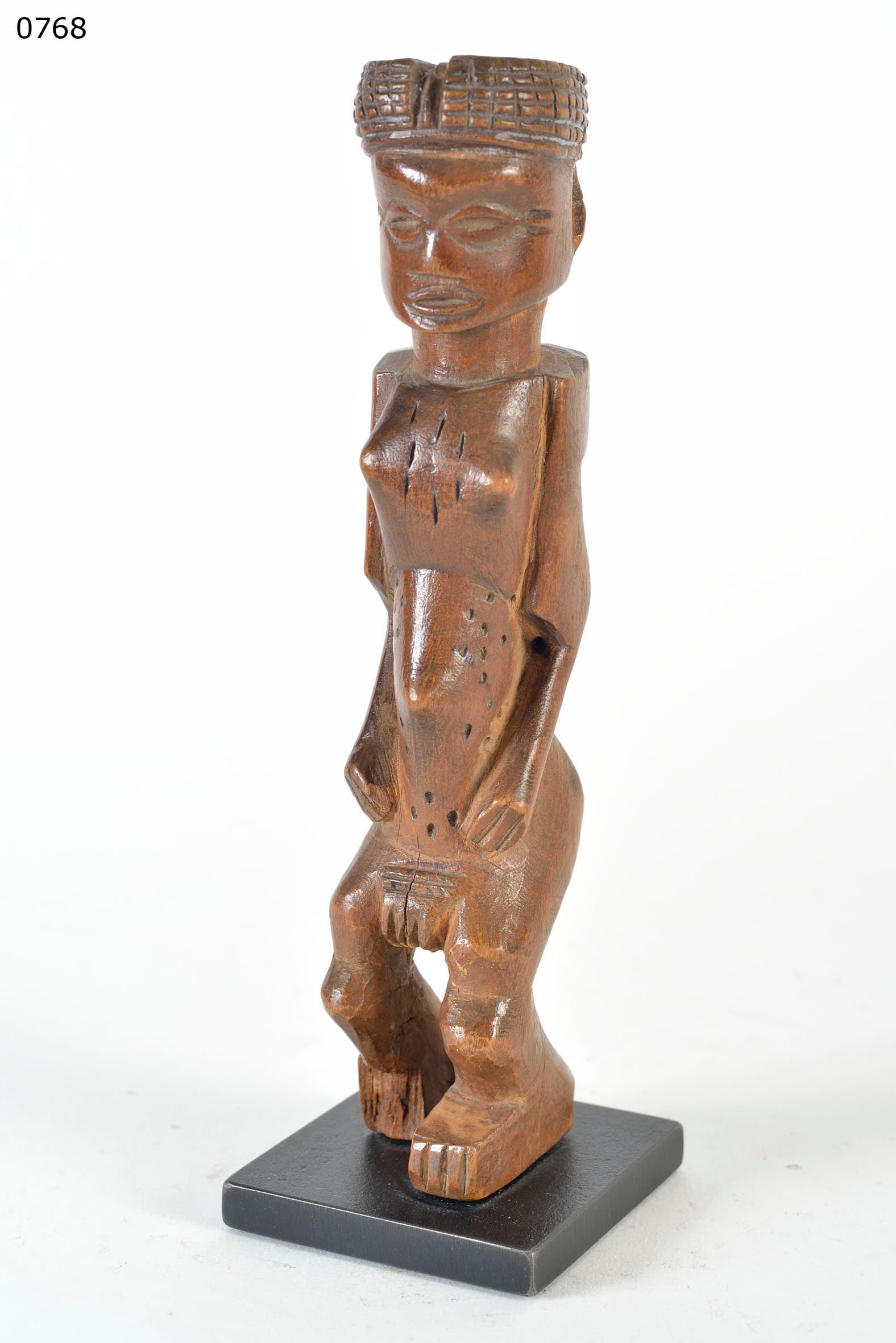
The courtly sculpture culminates in the figure of Chibinda Ilunga. Marie-Louise Bastin analysed the canon of proportions in detail in Art Décoratif Tshokwe (1961) and La Sculpture Tshokwe (1982): a stocky body with a slight bend in the knee and arched back (permanent kinetic readiness to jump), sculpted musculature, and the characteristically disproportionate hands and feet as a symbol of physical strength and hunting endurance. Mandatory iconographic attributes are the Portuguese flintlock rifle (in post-1860 variants), the ritual walking stick cisokolu, the medicine horn, and the voluminous headdress mutwe wa kayanda - a wing-like form that Bastin metaphorically associated with the black stork khumbi ("lord of the water", symbol of fertility and vitality). The ancestor figure no. 664 (35 cm, wood) is in the formal tradition of this canon of figures. The Mukanda panel no. 847 (64 cm, wood) with a male initiation figure represents the pedagogical type of sculpture that functioned as a visual teaching panel or protective object in the initiation camp. The prestige pipe no. 362 (mutwe wa mbanza, 30 cm, wood/copper) is a classic courtly status object - the copper trimming refers to commercial power and wealth and situates the pipe in the chota, the central meeting house, where ritual smoking by the mwanangana initiated legal negotiations.
The courtly repertoire also includes chitwamo thrones (formally derived from 17th century Portuguese chairs, but iconographically fully translated into the Chokwe symbol system), caryatid stools (in which the female figure bearing the weight of the ruler visualises the matrilineal support of the political system) and muyombo sceptres with ancestor depictions.
Bastin differentiated three primary workshop traditions for the assignment to regional style schools: the Muzamba school (north-east Angola) with aggressive, mask-like facial design and emphasised filed teeth; the Moxico school (central Angola) in a more naturalistic style with polished surfaces and contemplative posture; and the Lwena interference in the border region to the Luvale, characterised by rounder forms and "softness of lines".
Material and patina follow a ritually coded logic. Dense hardwoods are favoured: mubanga (Pericopsis angolensis) and especially mukula (Pterocarpus angolensis) because of its deep red hue, which in Chokwe colour symbolism signifies life, blood and magical potency. The red, shiny surface patina is created by repetitive treatment with mukundu and vegetable oils. However, the decisive ontological distinction between decorative and ritual object lies not in the surface, but in the activation by the nganga, which inserts the medicine yitumbo into carved cavities in the head or abdominal cavity. Without this medicine chamber, the sculpture, however masterful, remains inert wood; only yitumbo makes it the seat of the hamba.
The most market-critical research controversy concerns the dating of the classical style. Bastin (1982) postulated that the zenith - especially of the Chibinda-Ilunga figures - fell into the pre-expansion period at the Lunda court (before 1860) and later degenerated; she called this the court style. Joseph C. Miller (Cokwe Expansion 1850-1900, Wisconsin 1969) and Manuel Jordán (ed., Chokwe! Art and Initiation Among Chokwe and Related Peoples, Birmingham Museum of Art / Prestel 1998) vehemently disagree: for them, the classical style with rifle attributes and expansive proportions is the product of the prosperity phase 1860-1880 - the Expansion Style. A third position is held by Daniel Crowley**, who interprets the standardisation of certain forms as a reaction to early European contact and the emergence of an exotic market. This three-way debate is not settled and has direct consequences for the valuation of the objects in this collection. The Chibinda Ilunga figurine in the Kimbell Art Museum (Acc. AP 1978.05) serves as a benchmark specimen.
Ritual practice
The life cycle of a ritual Chokwe object follows a rigid, cosmologically based sequence: from the selection of the tree in the forest to the ritual activation and performative utilisation to the formal deactivation.
The creation of a mask or ancestor figure does not begin in the workshop, but in isolation in the forest. The songi selects the appropriate hardwood - often mubanga or mukula - and appeases the spirit of the tree with offerings (typically tobacco, which is lit at the base of the trunk) and a prayer for permission to cut it down. The raw log is then carried to the secluded carving camp in the bush; this spatial segregation protects the liminal object from profane eyes and the women of the village from the uncontrolled energy of the not yet integrated spirit. Courtly prestige objects (fuli production), on the other hand, are made in the palace workshops under the direct supervision of the mwanangana.
After physical completion, the object must be ritually activated. This act is the responsibility of the nganga in the case of protective, vengeful and healing figures. He mixes the yitumbo medicine - a highly potent combination of plant, animal and mineral substances, calibrated to the specific social crisis or the invoked hamba - and places it in the pre-drilled cavities of the figure, which are sealed with antelope horns or resin. Through this act, the spirit moves into the wood; the object is transformed ontologically from inert material to active ritual agent.
The performative highlight is the mask performance as part of the Mukanda cycle and related festivals. The Mwana Pwo mask (Collection No. 874 and No. 3) is danced by men without exception. The dancer wears a skin-tight, hand-knotted net suit made of plant fibres with integrated wooden breasts and a loincloth. The performance is not a comedic spectacle, but a didactic, dignified choreography with controlled, flowing and majestic steps. The dancer acts as a moral mirror: he teaches the young girls of the village the dignity, elegance and manners of the idealised Chokwe woman. The women are not passive spectators - they can force the dancer to retreat by shouting and gesticulating if his performance does not fulfil their expectations. The cihongo mask, historically only worn by the sons of chiefs, is ceremonially paraded through the village to demand tribute and visualise mwanangana authority.
The microcosmic altar of the tahi, the divination basket ngombo ya cisuka, operates parallel to the masquerade. This flat, woven basket contains around 60 miniature objects - the tupele - which in their entirety represent a "miniature replica of human social life". The props include natural artefacts (bird claws, animal teeth, stones, seeds) as well as anthropomorphic figures carved by the songi to represent specific archetypes: such as the chamutang'a figure (a crouching figure as an expression of moral ambivalence or hidden conflict) or hunting dog figures as "tracker spirits". The tahi activates the session through rattle shaking and rhythmic chanting, rubs the basket with red pigment and oil to connect to the divination spirit kayongo, and throws it into the air. The interpretation does not read the isolated meaning of the individual parts, but their spatial interaction - how objects touch, overlap or turn away from each other - in relation to the colour markings on the basket rim: the red line mukundu stands for aggression, danger and the wrath of the spirits, the white line mpemba for purity, healing and the favour of the ancestors. An intact historical ngombo ya cisuka with a complete tupele is documented in the Musée du quai Branly (Inv. 71.1912.15.67.1-32).
The ancestor figure no. 664 (35 cm, wood) in the collection is primarily located in the kachipango - the small ancestral shrine in the village or family household - where the nganga or cimbanda makes offerings to the specific hamba. The initiation figure no. 847 belongs to the educational context of the Mukanda camp: as a visual teaching board for the novices and as a protective object against external witchcraft.
The life cycle ends with the death of the owner or the compulsory ritual deactivation. An activated Pwo or Cihongo mask is considered highly dangerous outside of the performance: if an unauthorised spectator touches it, there is a risk of infertility, illness or death. After the dancer's death, the mask is not disposed of but treated with the respect due to a human corpse - ritually buried in the forest to release the attached spirit back into the ancestral world. With other objects, the yitumbo must be carefully removed from the nganga in order to "discharge" the figure; only then can it be profanely bequeathed or sold. This tension between active ritual loading and museum deactivation became tragically topical in the context of the looting of the Museu do Dundo during the Angolan civil war (1975-2002): Fences tore off plant fibre hairstyles and sanded down characteristic scarifications such as the cingelyengelye in order to disguise the institutional provenance - a practice that not only destroyed the aesthetic integrity but also the overall ritual biography of the objects and made provenance research (largely conducted by the gallery owner Didier Claes on the basis of Bastin's publication photos) an urgent ethical task.
Historical context
The history of the Chokwe is not a static continuum, but a sequence of dramatic transformations - from a split-off Lunda branch to a hunter-trader people to the dominant mercantile-military power of Central Africa in the late 19th century.
The pre-colonial ethnogenesis of the Chokwe began in the 16th or early 17th century with the migration of dissatisfied Lunda nobles to the west, triggered by a succession conflict surrounding the Chibinda-Ilunga marriage to Lweji. In the forest and savannah areas of present-day Angola, the migrants mixed with indigenous populations and formed the nucleus of the Chokwe identity; they perfected their skills as hunters and blacksmiths and remained bound to the Lunda empire (Mwata Yamvo) as tributary vassals for over two centuries.
The historical caesura took place between 1850 and 1900 in a socio-economic metamorphosis of historic proportions. Driven by the insatiable European hunger for ivory (billiard balls, piano keys) and beeswax, and later rubber, the Chokwe built up a transregional trade network to the Portuguese Atlantic coast in just a few decades. The exchange for modern firearms gave them military superiority, which ironically allowed them to conquer the centre of their former rulers in 1887 and temporarily destroy the Lunda Empire. The newfound wealth was channelled into an unprecedented art patronage system at the mwanangana courts. The fuli court artists produced monumental throne chairs, sceptres and sculptures; Chibinda-Ilunga figures were now given Portuguese flintlock rifles as an attribute, which condensed the entry into the global arms economy into art history.
From 1890 onwards, the courtly tradition began to decline rapidly. Devastating smallpox epidemics and famines decimated the population, while the Portuguese colonial administration in Angola and the Belgian administration in the Congo systematically crushed the autonomy of the chiefdoms. With the loss of the client market, monumental formats disappeared; the art created after 1900 tended towards simplification or small-scale private ritual forms. The founding of the Companhia de Diamantes de Angola (Diamang) in 1917, which established the Museu do Dundo in Lunda Norte in 1936, marked a structural turning point. Diamang systematically accumulated thousands of Chokwe artefacts, financed field research and in particular the canonical publications by Marie-Louise Bastin (Art Décoratif Tshokwe 1961, La Sculpture Tshokwe 1982), and thus had a lasting impact on the Western perception of the ethnic group - at the same time, however, it integrated art production into a colonial corset of mass production for European expatriates. Researchers such as Hermann Baumann, Manuel Redinha and the Belgian missionary F. Roelandts (whose notes from the 1930s are kept in the RMCA archive in Tervuren) documented the ritual practice in parallel; objects from their time are now regarded as provenance-privileged reference pieces.
The Angolan civil war (1975-2002) brought the next caesura. The core region of Lunda Norte became the scene of decades of violence; millions of people were displaced, many Chokwe fled to the diaspora in Zambia, the Congo or to Angolan urban centres. The Museu do Dundo was systematically looted in the late 1990s; high-ranking masks and throne chairs appeared years later on European and North American auction markets - often barbarically mutilated to disguise their institutional origin. Through meticulous comparative work with the historical photographs from Bastin's Art Décoratif Tshokwe (1961), researchers and gallery owner Didier Claes were able to re-identify a number of objects - including two important Pwo masks - and the cases have become a central reference in the restitution debate on the Angola collections.
The modern market history of Chokwe art in the West begins in the late 19th century with collectors such as Robert Visser, who acquired excessively along the coasts and deep in the hinterland. The international breakthrough as fine art - detached from its ethnological curiosity status - came in the late 1960s and 1970s through Bastin's systematic publications in the UCLA journal African Arts and the accompanying academic canonisation. Today, the most important holdings can be found in the Museu do Dundo (reconstituted after the war), the Royal Museum for Central Africa Tervuren, the Museum Rietberg Zurich (with Angola-specific curatorial work), the Smithsonian National Museum of African Art, the Fowler Museum UCLA, the Birmingham Museum of Art (travelling exhibition Chokwe! 1998-2000, ed. Jordán), the Metropolitan Museum of Art (Mwanangana statue Acc. 2019.477.3), the Kimbell Art Museum (Chibinda Ilunga Acc. AP 1978.05), the Ethnologisches Museum Berlin and the British Museum.
The current curatorial debate has shifted massively towards provenance forensics and restitution ethics. Stylistic coherence analysis (comparison with Bastin, Jordán, Hans Himmelheber), patina examination under UV light, entomological feeding duct analysis and archival provenance examination form the new standard. For the six pieces in this collection - the Pwo masks no. 874 and no. 3, the mask no. 1169, the ancestor figure no. 664, the Mukanda panel no. 847 and the prestige pipe no. 362 - this means a differentiated categorisation: objects from the first half of the 20th century are chronologically after the classical Hofzenith, but before the wave of Dundo looting, and can therefore be classified typologically as part of post-Hohen, local ritual art production. At the same time, civil society initiatives such as the Mutuelle Chokwe in the diaspora and in Angolan urban centres are committed to the preservation of language and traditional knowledge; the Angolan government and private foundations are pushing ahead with the first restitution talks with Western museums. The ethical preservation of Chokwe art in the 21st century thus requires a combination of curatorial care, forensic precision and active dialogue with the communities of origin.
Sources & References
This dossier draws on standard scholarship in Chokwe studies. For deeper reading and image archives, see:
Inline citations in this dossier refer to canonical scholarly works on Chokwe art; full bibliographic resolution is pending a researcher pass.