Overview
The geographical and demographic location of the Mbole - often subsumed under the prefixed ethnonym "Bambole" in older colonial literature and early ethnographic classifications - is centred on the dense, inaccessible equatorial rainforest areas in the central basin of the present-day Democratic Republic of Congo (DRC). The primary settlement area extends over the administrative provinces of Tshopo and Maniema, specifically southwest of the urban centre of Kisangani and along the extensive courses of the Lomami River, one of the most important tributaries of the Congo River (Biebuyck 1976: 54). Current demographic estimates put the population of the Mbole at approximately 150,000 individuals, although exact census data in the region is subject to significant statistical fluctuations due to the massive infrastructural deficits, the fluid semi-nomadic migration movements and the historical destabilisation of the region. The self-designation of the group is Mbole, while foreign designations in the archives of the colonial administration often contain incorrect transcriptions or collective terms of neighbouring ethnic groups.
Linguistically, the Mbole are assigned to the central Bantu language family and form an integral part of the extensive Mongo language and culture cluster, specifically the Anamongo group (Vansina 1990: 189). However, the scientific classification of their exact cultural relationships is the subject of ongoing ethnographic and historiographic debates. The source situation is ambiguous and highly controversial in research: While early systematists such as A. Moeller in his fundamental work Les grandes lignes des migrations des Bantous de la Province Orientale du Congo belge (1936) classified the Mbole as a pure subgroup of the Mongo and mapped their migration routes primarily linguistically (Moeller 1936: 45), more recent analytical approaches emphasise the strong socio-political and ritual affinities of the Mbole to more easterly and southerly neighbours. Researchers such as Daniel Biebuyck point out that the art and initiation structures of the Mbole have far closer parallels to the Yela, Pere, Lengola, Komo and Metoko than to the classical Mongo nucleus in the west (Biebuyck 1977: 52). This discrepancy between linguistic affiliation and ritual practice impressively illustrates that linguistic homogeneity in Central Africa does not necessarily correlate with aesthetic or ritual congruence.
The traditional social structure of the Mbole presents itself as strictly acephalous and segmentary. In the absence of a centralised, royal authority, a distinct courtly culture or hierarchical chieftainship - as can be found among the Kuba or Luba in the south of the DRC - the socio-political power vacuum is filled by other mechanisms. Society is fundamentally based on patrilineal kinship groups and localised lineages, which are organised in autonomous village communities. In order to guarantee social cohesion across lineage boundaries and to establish an overarching jurisdiction, Mbole society relies on an all-encompassing, esoteric brotherhood: the Lilwa society (often also called Lilwakoy) (Kalala Nkudi 1979: 12). The village chiefs are almost without exception recruited from the highest ranks of this brotherhood, whereby sacred and secular power merge inseparably (Biebuyck 1986: 242).
| Social stratification of the Mbole | Functional and ritual description |
|---|
| Lilwa (Lilwakoy) | The dominant, hierarchical male society that controls all judicial, executive, economic and educational aspects of life and provides the political authority. |
| Ekanga | A specialised class of healers, ritual experts and diviners responsible for the spiritual diagnosis and physical health maintenance of the community. |
| Oruku | An exclusive female grouping comprising the wives of high Lilwa dignitaries and fulfilling peripheral ritual functions. |
| Yeni | The absolute high nobility within the Lilwa hierarchy; decision-makers over life and death and keepers of the ultimate esoteric secrets. |
The subsistence strategy of the Mbole is dual-organised, strongly gendered and adapted to the harsh conditions of the equatorial rainforest. Women dominate the agricultural sector and cultivate primary staple foods such as manioc, bananas (plantains) and rice as part of traditional slash-and-burn agriculture (Turnbull 1965: 45). This agricultural base is supplemented by the rearing of small livestock such as goats and poultry, which ensures the protein supply of the villages. The men are traditionally responsible for hunting with bows, arrows and co-operative net hunts, fishing in the fish-rich tributaries of the Lomami and collecting specific forest products (Turnbull 1965: 45). Pre-colonial relations with neighbouring peoples were characterised by a complex interplay of marriage alliances, ceremonial exchange and territorial conflicts. These interactions led to a continuous hybridisation of material culture, a process that can be seen particularly clearly today in the historical collections of recent institutions such as the Royal Museum for Central Africa (RMCA) in Tervuren (Couttenier 2014: 66).
Cultural context
The religious paradigm of the Mbole is based on a highly complex, syncretic combination of belief in the high god, a specifically calibrated cult of ancestors and spirits and the absolute regulatory postulates of Lilwa society. At the top of the cosmological order is the creator god, who is simply referred to as Mongo in the indigenous nomenclature (sometimes merged with the ethnonym of the superordinate language group in the literature). This creator acts as a classic deus otiosus: he initiated the universe, the natural order and the primordial laws, but has withdrawn into a transcendent distance. Consequently, he only very rarely actively intervenes in the profane, everyday affairs of mankind and is therefore rarely the object of direct cultic worship, intensive invocations or regular acts of sacrifice (Dieterlen 1965: 135).
Instead, the operative spiritual level with which the Mbole interact in everyday life is dominated by a multitude of nature spirits and ancestors. This reveals a significant structural difference to neighbouring and West African cultures: it is striking that ancestor worship does not have absolute, all-pervading exclusivity in everyday religious life among the Mbole. While societies such as the Fang or Kota cultivate complex relic cults for the permanent consultation of ancestors, ancestor worship among the Mbole primarily culminates in the weeks immediately following a death (Kopytoff 1971: 129). These ritual acts primarily serve to ensure the transition of the soul into the realm of the dead and to prevent the spirit from returning to the world of the living as a restless entity; thereafter, active worship recedes into the background.
The undisputed ritual authority, the moral backbone and the de facto government of society is the Lilwa. This exclusive, esoteric and strictly hierarchically structured male alliance permeates all judicial, executive, economic and educational aspects of life (Kalala Nkudi 1979: 14). The Lilwa watches over social harmony with draconian rigour and punishes any deviation from the normative canon. The main structural difference to neighbouring initiation societies - in particular the much better known Bwami League of the Lega - is the excessive and institutionalised use of the death penalty. While the Bwami system is primarily focussed on the successive acquisition of prestige, philosophical wisdom and social elevation through the interpretation of moral aphorisms (Biebuyck 1973: 20), the Lilwa acts as a rigorous, merciless tribunal. Offences such as destructive witchcraft, murder, serious adultery and, above all, absolute sacrilege - the betrayal of Lilwa secrets to non-initiates or women - were traditionally punished with death by hanging without exception (Biebuyck 1976: 54).
| Aspect of ritual practice | Lega (Bwami society) | Mbole (Lilwa society) |
|---|
| Primary focus | Acquisition of wisdom, prestige and moral perfection. | Social control, jurisdiction and drastic prosecution. |
| Teaching medium: aphorisms, proverbs, small sculptures (everyday objects). | Theatrical staging of death, hanging figures (ofika). | |
| Sanctioning | Social degradation, exclusion, fines. | Institutionalised death penalty by hanging. |
| Role of art | Cumulative, en masse (objects are collected in baskets). | Singular, exclusive and deeply feared (presented in isolation). |
The role of women within this patriarchally dominated cult complex is highly restrictive, but has highly specific, institutionalised exceptions, which are documented in the archives of the Musée du quai Branly. Although women are indirectly present in the peripheries of the cult as Oruku (the wives of the Isoya dignitaries), they remain strictly excluded from the core esoteric knowledge. One notable ritual exception, however, is the initiation of daughters of the highest dignitaries, the Yeni. Through massive ritual payments and the transfer of goods to the hierarchs (wilangi), such a daughter can attain the exceptional status of a lumongo. After completing specific initiation rites, she is socially, legally and ritually classified as a man. She receives insignia of male power - such as a neck muzzle made of leopard's teeth and a carved staff symbolising male genitalia - as well as a servant named opika, who accompanies her as an assistant to the secret Lilwa rites (Fraser & Cole 1972: 7). From then on, such elite lumongo women were only allowed to enter into marriages with other Yeni members, which cemented social stratification.
The central rite of passage for adolescent male Mbole (aged around seven to twelve) involves a traumatic, multi-stage initiation. This begins with the physical circumcision by the local blacksmith and continues in a long phase of segregation in the forest (the initiation camp). The novices undergo a staged symbolic death and a subsequent spiritual rebirth. They are subjected to massive physical and psychological trials, including severe flagellation, strict fasting and the extremely painful rubbing of the eyes with a strong burning white paste. This act simulates temporary blindness, which must be metaphorically overcome in order to enable the subsequent "seeing" of the spiritual truth of society (Binkley 1987: 75). Substantial controversy exists in recent scholarship regarding the exact sequencing and teleological orientation of these rituals. While early colonial officials and ethnographers of the 1930s (such as A. Moeller) spoke of a purely disciplinary and almost sadistic measure, more recent postcolonial analyses suggest that it was a profound philosophical reconstruction of the male psyche designed to implant unconditional obedience to the collective in the initiates (Couttenier 2014: 66).
Aesthetic features
Compared to the productive carving centres of the Luba or Songye, the artistic corpus of the Mbole is quantitatively extremely manageable and is treated as an absolute rarity of the highest order in the collections of Western institutions such as the Metropolitan Museum of Art (Met) in New York or the Rietberg Museum in Zurich. The canonical object typology of the ethnic group is essentially limited to two main categories, both of which are inextricably linked to the judicial and initiation apparatus of the Lilwa: the anthropomorphic hanging figures, known in the specialist literature as ofika (plural: tofika), and the extremely rare, highly stylised face masks (e.g. the Lilwa Nkoy type).
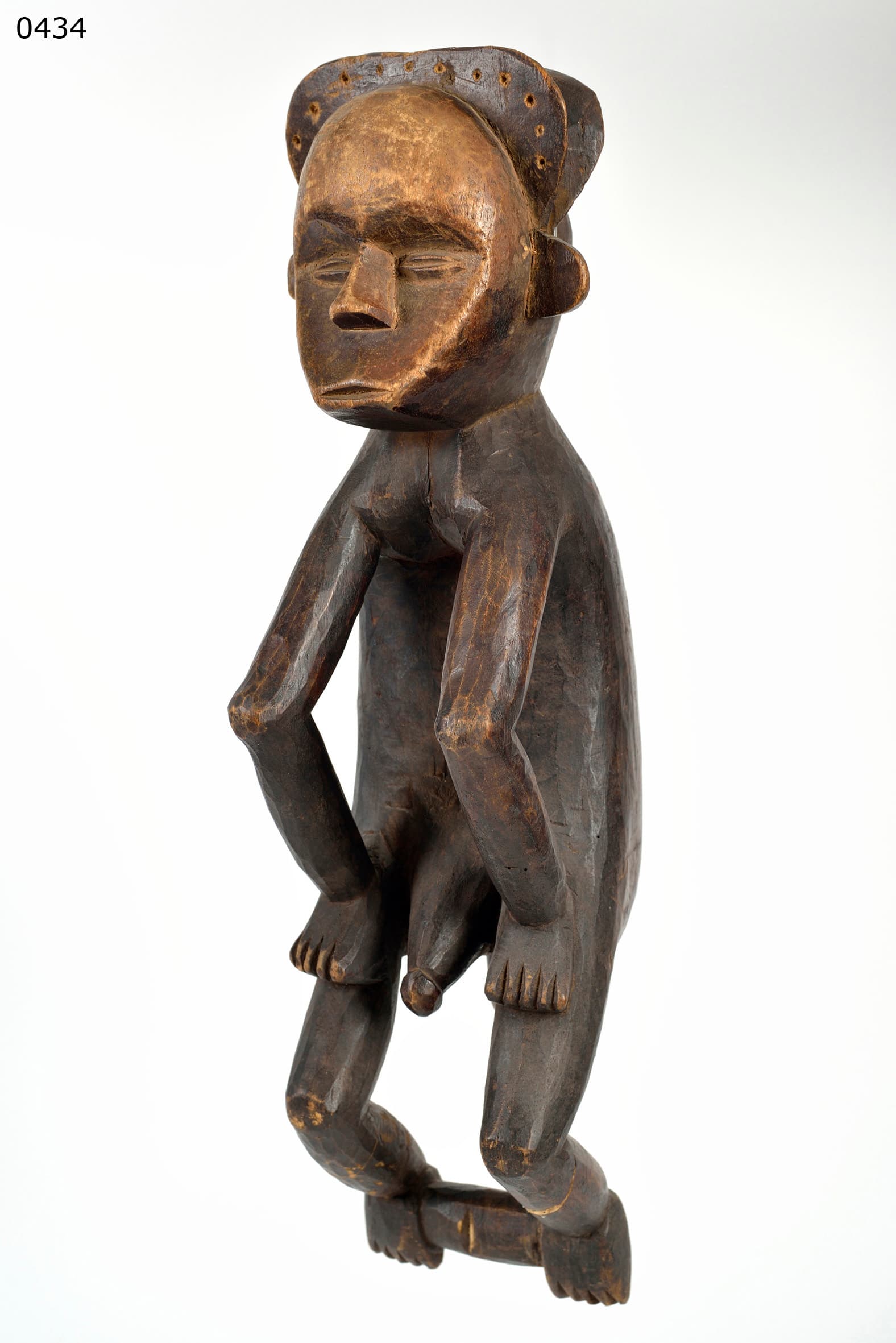
The ofika figures represent the undisputed visual canon of Mbole aesthetics and represent one of the most radical formal abstractions in Central African art history. Their canon of proportions usually varies in size between 40 and 70 cm, although in rare exceptional cases monumental works of over one metre in height have also been documented (Schweizer 2014: 242). Iconographically, they are characterised by an unmistakable, slender and almost expressionistically reduced morphology that makes the act of hanging visually and physically tangible. The figures are not standing, they are literally or metaphorically hanging: the legs are always slightly bent, the wedge-shaped feet often point rigidly downwards, as if they were not touching the ground and swinging in a vacuum. The torso is often carved concave and strongly elongated, the shoulders hang down unnaturally steep, and the arms are deeply undercut by the torso, with the hands usually resting on the narrow hips or thighs (Biebuyck 1986: 242). The head dominates the composition with a heart-shaped, concave and strongly inwardly curved facial panel with a flat, almost geometric snout, narrow, sinister eye and mouth slits as well as a striking bi-ridged transverse coiffure (de Grunne 1987).
The choice of materials traditionally favours extremely light but durable woods. Forensic analyses of museum specimens have often identified species such as Crossopteryx febrifuga or Ricinodendron, whose macroscopic and microscopic cellular characteristics can now be precisely verified by modern forensic botany.
The patina of these objects is of the highest diagnostic and art-historical importance for authentication, especially as forgery criteria are extremely relevant to the market in this high-price segment. Authentic ofika have a thick, encrusted surface coating that has grown over generations and consists of a complex mixture of ritually applied palm oil, sacrificial ashes and local mineral pigments. The Mbole ritually painted specific parts of the figures' faces with white kaolin, which in their cosmology symbolises the ashes of the dead, the spirit realm and the concept of death in general, while red tukula paste (made from crushed camwood) stands for blood, vitality and liminal transitional states (Biebuyck 1976: 54).
The Lilwa masks form the second, even rarer segment of material culture and are among the rarest mask types in Africa. They are usually carved flat or slightly convex, have a polychrome finish and demonstrate extreme graphic minimalism: the sculptor uses rhythmic, vertical slits for the eyes (often flanked by white pigmentation), a long, unnaturally rectangular nose and - particularly significant for the level of meaning - a tiny or completely absent mouth. The absence of the mouth is the primary iconographic sign of the Lilwa's absolute commandment of silence (Vogel 1999: 43). An activated ritual object differed from a profane wooden carving solely through the ritual consecration and the successive application of the sacrificial substances; unpainted, freshly carved pieces that had not undergone the consecration process possessed no inherent power for the community (Petridis 2001: 24).
The search for individual "master hands" or specific workshops, as Western art history has successfully reconstructed in the case of the Baule or Yoruba, for example, can hardly be realised with the Mbole due to a lack of historical field identification. The renowned historian Jan Vansina correctly notes that the anonymity of the carver - who always had to be a high-ranking Lilwa adept himself, as outsiders were not allowed to make cult objects - was a fundamental, conceptual part of the secret society (Vansina 1984: 43). Creation was not an act of individual artistic expression, but submission to a collective, esoteric will to form.
Ritual practice
The ritual activation and performance of the mbole objects is inextricably linked to the drastic jurisprudence and liminal phases of initiation. The ofika hanging figures were never displayed in public, profane spaces under any circumstances, but were kept strictly hidden within special and guarded Lilwa shrine houses in the forest. During the complex initiation cycles for the male novices, these sculptures acted as relentless, didactic reminders and bearers of absolute moral authority.
The ritual process of initiation was a masterpiece of psychological manipulation: the novices, physically and mentally extremely weakened by days of fasting, floggings and the toxic eye drops administered beforehand, were put into a state of extreme psychological receptivity and shock paralysis. At precisely this calculated moment of metaphorical "awakening" and the recovery of sight, the ofika figures were abruptly presented to them (Binkley 1987: 75). The high Isoya initiates wore the figures on straps around their necks or presented them on specially erected racks, which visually simulated the act of hanging in a drastic way. According to orthodox interpretation, the sculptures were identified to the novices as manifestations of real, named individuals from the past who had been hanged from the tree for capital offences - such as the revelation of secret society knowledge or destructive witchcraft (Biebuyck 1976: 54). The novice learnt the names of the victims and their specific transgressions; the figure thus served as an unmistakable, material anchor for the legal and moral absoluteness of the Lilwa.
| Author / Scholar | Theoretical approach to the ofika function | Argumentation basis |
|---|
| Daniel Biebuyck (Orthodox reading) | Execution Memorial | The figures literally represent specific, named criminals who were hanged for betraying Lilwa secrets. The art serves purely as a deterrent. |
| David Binkley (Revisionist Reading) | Initiation Memorial (More General Initiation Memorial) | The figures function as broader "avatars of power". They symbolise not only criminals, but the general liminal sacrificial state of the initiates and the transcendent power of the covenant. |
This deep interpretative divide in art history remains unresolved to this day. A dates and interprets the figures strictly as mimetic documentations of historical executions (Biebuyck), while B postulates that this exclusive focus on the "criminal" could be a Western morbid misinterpretation and that the extreme abstraction of the faces - which lacks any individual portraiture - supports Binkley's thesis of generalised, symbolic ancestral power. The source situation is absolutely ambiguous in this respect, as the primary informants of the Lilwa never fully revealed their esoteric knowledge to ethnographers.
The figures were also used in collective crisis resolutions. In the event of severe social disturbances, prolonged droughts or epidemics, ofika were reactivated as intermediaries between society and the ancestors, often accompanied by animal sacrifices and the reapplication of palm oil and kaolin, which built up the encrusted, dark lustre (patina) of the pieces over decades (Morigi 2002: 12). The situation was similar with the extremely rare Lilwa masks. A special Lilwa officer, the kumi (the executioner or person ritually responsible for the restoration of cosmic order), wore the flat Lilwa Nkoy mask during the actual execution of a condemned person or during the subsequent ritual purification of the community. The mask transformed the wearer from a human agent who might incur bloodguilt into an impersonal, divine instrument of collective justice.
The lifecycle of such a highly sacred object began with the ritually supervised procurement of wood by a master carver. If the objects lost their ritual coherence due to massive termite damage, fire cracks or the death of their individual custodian (without an adequate successor), they were deactivated. Such 'dying' objects were either ritually buried with the owner or left deep in the forest to decay in a controlled manner (abandonment) in order to return the spiritual energy bound up in them to nature (Schoffel 2012: 47). This partly explains the extreme rarity of intact, historical Mbole artefacts in European collections, such as those curated at UCLA's Fowler Museum or the Quai Branly.
Historical context
Recent historiography locates the ethnogenetic origin of the Mbole far north of the Congo River. According to consistent oral-historical and linguistic reconstructions, the ancestors of the present-day ethnic group crossed the mighty Lualaba/Congo River in the late 17th or early 18th century near the present-day town of Basoko and migrated southwards in several demographic spurts into the dense forest basin of the Lomami. This historical migration was primarily triggered by the massive expansion pressure and territorial displacement struggles of the more northerly Bombesa peoples (Moeller 1936: 45). In the 18th century, the Mbole population fragmented into five separate, regionalised subgroups, which nevertheless remained ideologically and legally connected through the overarching, rhizome-like Lilwa network.
Contact with European actors in the late 19th century marked the absolute trauma in the history of the Mbole, which permanently decimated their social and artistic production. With the establishment of the Congo Free State by the Belgian King Leopold II from 1885, the territory of the Mbole became the focus of brutal, resource-exploiting rubber concessions. The Compagnie du Lomami in particular forced the Mbole to extract wild rubber (Landolphia lianas) using massive physical violence, hostage-taking of women and systematic amputations, which was enforced by the notorious colonial army, the Force Publique (Casement 1904: 12). The Mbole called this exploitative system wando wo limolo in their language - which can be translated as "tax-induced weight loss" or "the taxes that make us lose weight"; a harrowing linguistic testimony to systematic malnutrition and over-exploitation. Mbole resistance was fierce; they repeatedly attacked colonial rubber factories (for example in Lokilo) and labelled the Belgian agents as atama-atama (slave traders), conceptually equating the European colonialists with the Arabic-Swahili speaking slave hunters who had ravaged the region shortly before (Vansina 1990: 189). The impact of these violent excesses led to a demographic collapse and a temporary destabilisation of Lilwa production. Between 1945 and 1946, the Belgian administration tried in vain to ban the secret society completely and legally, as its independent jurisdiction (especially the hangings) was perceived as an unacceptable threat to the colonial monopoly on the use of force (Comhaire 1955: 60-62).
The reception of Mbole art on the Western art market was very delayed, as the terrain was inaccessible and the objects were strictly concealed by the indigenous people. The first isolated pieces were brought to the West by colonial judicial officials and military officers. Noteworthy here is the collection of Camille D'Heygere, a Belgian magistrate who was stationed in Boma and New Antwerp between 1893 and 1898 and brought one of the earliest documented ofika figures to Europe. In the 1920s and 1930s, renowned Antwerp and Brussels dealers such as Henri Pareyn and Jeanne Walschot began to systematically acquire rare Central African objects. As Mbole sculptures never reached the quantity of Baule or Luba objects, they quickly established themselves on the market as extremely high-priced rarities for connoisseurs. Prices have recently reached new record highs: The auction of the collection of the Belgian scholar Baudouin de Grunne at Sotheby's New York (2000), where a masterful ofika figurine was knocked down for over USD 100,000, and the prestigious auction of the Daniel and Marian Malcolm collection in Paris (2016) caused a sensation.
As the market prices for Mbole objects are astronomical today, a massive forgery problem is rampant. Modern authenticity tests, as carried out by institutions such as the British Museum or specialised forensics laboratories, are no longer based solely on style analysis (connoisseurship), but on hard material science data. Forensic botany analyses the exact wood density and species, while optical coherence tomography (OCT) is used to scan the 3D morphology of heartwood and craquelure cracks. Authentic, age-related cracks show deep, rectangular or wide, shallow profiles ("thin/deep" or "wide/shallow"), while modern forgeries, where the patina has been forced by heat or chemicals, usually show tell-tale, simple inverted triangular cracks ("inverted triangles"). The ultimate forensic evidence, however, remains C-14 radiocarbon dating of the organic patina or wood: objects that show isotopic traces of the so-called "bomb curve" effect (caused by atmospheric nuclear testing after 1950) are inevitably unmasked as recent, illegitimate market fabrications, which can spell financial ruin for unwary collectors.