Overview
The ethnographic and art-historical recording of the Ngombe (historically also referred to as Bangombe, Lingombe, Bagondo or in regional subgroups such as the Moswea-Ngombe and Ngombe-Doko) poses complex taxonomic challenges for African provenance research. Geographically, the primary settlement area of this people is centred on the northern districts of present-day Équateur Province and the Mongala region in the Democratic Republic of the Congo, primarily along the Congo River and its tributaries such as the Lualaba and Ubangi (Omasombo Tshonda et al. 2015: 45). This region is ecologically characterised by a mosaic of tropical rainforest, gallery forests along the watercourses and savannah-like grasslands on the plateaus, which largely determines the subsistence strategies of the local populations (Wolfe 1961: 8).
Demographic and linguistic estimates vary considerably in the specialised literature, which is primarily due to the fluid ethnic boundaries and the historical assimilation of marginalised groups. The current research situation is ambiguous in this respect.
| Demographic Model | Population Estimation | Linguistic Classification | Territorial Concentration |
|---|
| Conservative core model | approx. 150,000 individuals | Bantu language family (ISO 639-3: ngc) | Bosobolo, Lualaba-Ufer |
| Extended cluster model | approx. 797,000 individuals | Adamawa-Ubangi affinity cluster | Entire northern DRC |
| Historical census data (BMS) | fragmentary | Lingombe / Ngombe-Doko dialects | Upoto region |
This striking statistical variance illustrates a fundamental controversy in classification. While linguists strictly assign the Ngombe to the Bantu language family (Burssens 1958: 12), broader demographic and theological models often aggregate them with the Adamawa-Ubangi cluster (Nunn 2022: 4). This taxonomic vagueness repeatedly leads to reclassifications in the inventory registers of large institutions such as the Royal Museum for Central Africa (RMCA) in Tervuren, as Ngombe artefacts have historically often been incorrectly attributed to the Ngbaka or Ngbandi (Felix 1987: 43). The self-designation of the groups varies greatly depending on the local lineage, while the foreign designation "Ngombe" was historically consolidated by early colonial administrators and neighbouring peoples.
The social structure of the Ngombe is fundamentally determined by a patrilineal and patrilocal segmentary lineage system. In contrast to highly centralised African kingdoms, the Ngombe exhibit acephalous tendencies, but integrate context-specific, hierarchical authority figures within the village structures. A typical Ngombe village comprises thirty to one hundred huts arranged linearly along forest paths (Wolfe 1961: 30). The communities do not have rigidly defined land boundaries in the Western sense; rather, political lineages occupy contiguous, fluid territories (Wolfe 1961: 36). The leadership level is not formed by absolute monarchs, but by a triumvirate of functional authorities: The Kumu acts as ceremonial chief and lineage elder, the Mowe acts as spokesman and primary judge in civil disputes, and the Elombe assumes the role of war leader in times of crisis (Wolfe 1961: 14). Social prestige and political influence correlate directly with age, demonstrated wisdom, hunting valour and strict adherence to ancestral obligations.
The subsistence economy of the Ngombe is based on a strict, ritually sanctioned gender-specific division of labour. Women are responsible for the most essential, calorie-generating activities, primarily the cultivation of manioc and beans as well as river fishing (Wolfe 1961: 15). Men, on the other hand, are responsible for building residences and communal hunting. It is noteworthy that hunting is declared by the male actors to be their most important economic activity, although it contributes less quantitatively to food security than agriculture. Hunting functions primarily as a mechanism of social stratification and the accumulation of ritual prestige (Burssens 1958: 45). The economic cohesion of the lineage is enforced by an imperative system of generosity. Withholding resources (such as hunting spoils or bride price accumulations) within one's lineage is considered an antisocial act and is sanctioned by social exclusion, a mechanism that stands in stark contrast to formal jurisdictional systems.
The historical and contemporary relationship with neighbouring peoples is characterised by a complex dialectic of violent conflict and cultural exchange. The oral history of the neighbouring Mongo peoples to the south records a massive territorial expansion of the Ngombe in the early 19th century, which entered the collective memory as the "Lufembe War" or "War of the Dog" and led to massive demographic upheavals in the Congo Basin (Vansina 1984: 61). These warlike interactions forced the development of specific weapon technologies and defence strategies. At the same time, the geographical proximity to the Ngbaka, Ngbandi and Zande in the north led to a significant transcultural osmosis in material culture, which makes the identification of a "pure" Ngombe style one of the greatest challenges of Central African ethnography to this day.
Cultural context
The religious and cosmological system of the Ngombe presents itself as a highly complex, dual structure that combines a transcendent, distant creator god with an immanent, highly active ancestor pantheon. At the centre of the cosmogony is the creator entity Akongo (sometimes called Nzambi in regional dialects). The theological conception of Akongo differs fundamentally from Abrahamic or purely animistic models. Akongo is not conceptualised as universally benevolent or impersonal; rather, he is a conscious but ambivalent force (Zuesse 1975: 168). According to the central Ngombe Genesis narrative, Akongo physically coexisted with humans in the primordial era. However, confronted with the endless belligerence and social frictions of early humanity, he retreated into the firmament (Leeming 2010: 371). His daughter Mbokomu, who caused trouble in heaven, was lowered to earth in a basket and is regarded as the primordial mother of contemporary civilisation. Due to this withdrawal, Akongo does not de facto intervene in everyday profane life, which is why active cultic practice, libations and sacrificial rituals are almost exclusively focussed on the entities that still operate in the material sphere: the ancestors (bakulu) and local nature spirits.
The ancestors (bakulu) act as critical mediators between the decoupled divine sphere and the fragile human existence. They are not seen as metaphysically "absent", but reside in trees, Congo River currents and atmospheric phenomena. They guide the destiny of their descendants through dreams, intuitions and somatic symptoms (Wolfe 1961: 72). The ritual authorities who channel this communication are composed of an alliance of secular leaders with sacred rights and specialised metaphysical technicians. The kumu (chief) has exclusive ritual privileges that transcendentally legitimise his political power. This includes above all the mbela dance, a highly formalised sacral-political performance that may only be performed by the kumu, his principal wife and a ritually designated dancer under threat of metaphysical sanctions (Wolfe 1961: 32).
In addition to the kumu, the nganga (divinator and ritual specialist) acts as an essential authority in times of crisis. The role of women in the cult is characterised by a deep ambivalence and is strictly tied to the physical life cycle. Institutions such as the lingondo serve to prepare young girls physically, socially and ritually for marriage, with scarification and initiation into the duties of the lineage taking centre stage (Wolfe 1961: 15). A woman's spiritual and social prestige reaches its absolute zenith during her fertile years and child rearing; after menopause, this status structurally erodes unless the woman has accumulated exceptional ritual knowledge.
Central initiation and transition rituals mark the neuralgic points of human existence. Birth is not a purely biological act, but is seen as a direct theological confirmation from the ancestors that the father is worthy to carry the genetic and spiritual code of the lineage into the future (Burssens 1958: 91). The afterbirth is buried in a rigorous rite - often on the threshold of the uncultivated bush - to protect it from hostile witchcraft, which could otherwise retroactively induce sterility. Marriage is less an individual contract than a transcendent alliance of two economic lineages, cemented by a transfer of bride prices (formerly in the form of hanga manga blades or copper currency) that often lasts for years (Wolfe 1961: 17). Deaths, on the other hand, are handled remarkably pragmatically, almost profanely. In contrast to the elaborate burial cults of West African peoples, the bodies of the Ngombe are often buried without extensive public ceremonies on a framework of branches within a simple grave and are merely protected from direct contact with the earth by mats (Wolfe 1961: 20).
A structural feature that has triggered profound research controversies is the existence and origin of secret societies, especially the Mani cult. The Mani League, a closed society with hierarchical grades and strict initiation rites, operates primarily in the northern distribution area of the Ngombe and focusses on magical healing, protection against witchcraft and securing hunting success (Burssens 1962: 45). The research situation here is highly polarised: Author A (Burssens) argues that the Mani cult and the associated Yanda statuettes are an original creation of the Zande and Banda, which were merely adapted by the Ngombe through cultural diffusion. Author B (Wolfe), on the other hand, emphasises the specific modifications and the autochthonous ontology that the Ngombe lent to this cult, which makes a pure reception thesis fall short of the mark.
Structurally, the religion of the Ngombe differs massively from that of their southern neighbours, the Mongo. The Mongo cultivate a strongly centralised metaphysical system of legitimation based on the myth of the singular ancestor ("AnaMongo") and attribute misery primarily to malicious sorcery (ndoki) by envious people (Vansina 1984: 65). The Ngombe system, on the other hand, is much more decentralised, focusing on segment-specific ancestral intercession and harmonisation with local natural forces. Recent socio-economic studies also identify a controversy regarding the genesis of deeply rooted witchcraft beliefs in the region. Using archival data from the Musée du quai Branly and colonial documents, researchers such as Nunn (2022: 12) argue that the extreme fear of witchcraft, often misunderstood today as a relic of pre-colonial 'tradition', was massively radicalised by the violent social disruptions of the colonial period and the psychological pressures of early Christian missionary work (such as the Baptist Missionary Society). The current state of the belief system is thus a complex syncretism of autochthonous ancestor worship and post-colonial trauma.
Aesthetic features
The material culture and aesthetic canon of the Ngombe occupy an exceptional and highly controversial special position within Central African art history. In contrast to peoples such as the Luba or Pende, whose understanding of art is primarily defined by an enormous and highly differentiated corpus of wooden sculptures and masks, the artistic genius of the Ngombe manifests itself historically above all in applied metallurgy and the moulding of insignia of power. The classification and authentication of these objects poses considerable challenges for collectors and institutions.
The canonical Ngombe object typology comprises four primary categories that differ fundamentally in their ritual and social function:
| Object subtype | Materiality & patina | Iconographic meaning & function | Proportional canon / size range |
|---|
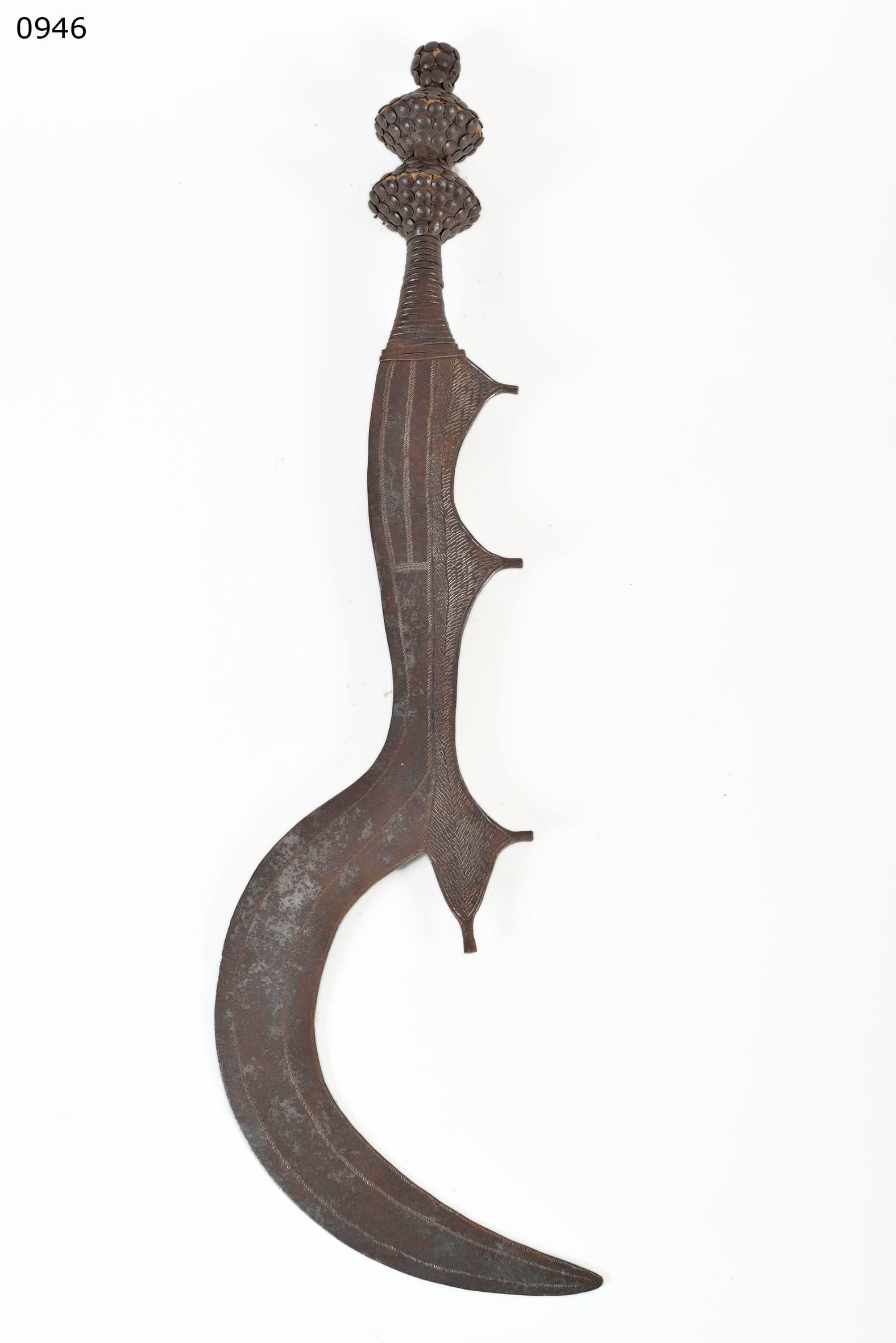
| Throwing knife (Hanga Manga / Ikula) | Forged iron, wooden core on the handle, plant fibre wrapping. Patina due to oxidation and handling. | Status symbol, bride price currency, insignia of the Elombe (war leader). Testimony to metallurgical mastery. | Razor-sharp, multi-bladed patina from 40 cm to 65 cm (extreme forms for chieftain blades). Razor-sharp, multiaxial blades. |
| Magical figures (Yanda / Butti-related) | Hard heartwood (Alstonia), gola paste (Camwood), sacrificial blood, animal fats. Deep, incrusted patina. | Hunting fetishes, protection from witchcraft, container for ancestral essences. Intercession with the bakulu. | 15 cm to 65 cm. Flattened faces, rigid limbs, rectangular cavities (Magic Cargos). |
| Anthropomorphic chieftain stools, wood, brass nail fittings, partly polychrome pigmentation, seat patina. | Symbol of the physical and political stability of the Kumu. Legitimisation of sacred rule. | Height 30 cm to 50 cm. Often integrated caryatid figures or geometric abstractions. | |
| Reliquary containers woven rattan, textiles, bone fragments (skull caps), animal skins. | Highest ritual instance for divinations and oaths. Dwelling of the direct ancestral presence. | Small in size (10 cm to 30 cm). Inconspicuous appearance contrasts with maximum ritual charge. | |
The iconographic foundation of Ngombe art is dominated by the Hanga Manga blades. In their evolution, these throwing knives have almost completely emancipated themselves from a utilitarian weapon. The Ngombe blacksmiths developed a formal language of extreme asymmetrical exaggeration: multiple blades projecting at complex angles no longer serve primarily for aerodynamics in battle, but for visual intimidation and the demonstration of wealth (Felix 1987: 43).
The sculptural tradition in wood forms the centre of gravity of one of the fiercest iconographic controversies in Central African ethnology. Following his field research in the 1950s, the American anthropologist Alvin Wolfe provocatively stated that the Ngombe did not originally have any autochthonous wooden sculpture (Wolfe 1961: 174). Wolfe based this thesis on the observation of the well-known hunter Bosokuma (one of the extremely rare documented master craftsmen of the region), who only began to make hunting fetishes under the influence of neighbouring Ngbaka carvers. This "adoption thesis" is sharply attacked by Marc L. Felix and Joseph Cornet. Felix (1987: 110) documented around twelve canonical main objects in the archives of the RMCA Tervuren, which provide evidence of a completely independent, albeit reduced Ngombe formal language.
The canon of proportions of these rare Ngombe sculptures is drastic and atypical. The figures largely elude the law of strict frontality often cited in Africa (Cornet 1972: 85). The heads have an extremely flattened relief on the shoulders, forehead and back of the head. The faces appear compressed, with noses that only emerge from the wood as a minimal relief, while the eyes and mouth are carved as deep, almost aggressive slits (Claes 2014: 22). The limbs are block-like, rigid and end in massive, unstructured feet that lend the figure metaphysical traction. The most significant anatomical-ritual feature, however, are the so-called Magic Cargos. These rectangular cavities, which are precisely chiselled out of the heartwood along the spine, buttocks and pubic area, serve to hold ritual substances and distinguish the object from profane carvings.
The formation of the patina is a gradual, sacred process. A profane object only has the light-coloured, dry texture of the raw wood. Only through repeated anointing with gola (an emulsion of red camwood powder and palm oil) and the application of sacrificial blood does a deep encrustation migrate into the cell structure over decades (MacGaffey 1988: 120). This patina is not merely decorative, but the physical manifestation of accumulated prayers and sacrificed life energy. The sculptures are often additionally provided with an opulent assemblage character: Monkey hair tassels, bird feathers, brass rings drawn into the ears and wrapped plant fibres often almost completely conceal the core sculpture.
For private collectors and institutions such as the Museum Rietberg Zurich or the Musée du quai Branly, the problem of forgery in Ngombe sculptures is highly acute. Due to the extreme rarity of genuine pieces, numerous workshop replicas made in Kinshasa flooded the market after the breakthrough of Central African art at Western fairs in the 1990s (Gryseels & Volper 2019: 50). The forensic forgery criteria are highly specific: forgers often imitate the magic cargos, but fill them with meaningless resin mixtures without organic traces of seeds or blood. The artificially applied patina flakes off when rubbed, as it has not penetrated deep into the wood. A decisive authenticity criterion are natural heartwood cracks, which are only caused by extremely slow, decades-long drying out in humid tropical climates, as well as specific, non-linear termite feeding marks at the base, which cannot be authentically reproduced in sterile workshop environments (Claes 2014: 25).
Ritual practice
The ritual practice of the Ngombe is deeply utilitarian, performative and bound to the material anchoring of metaphysical forces in physical objects. The lifecycle of a ritual artefact - from the freshly cut block of wood to its final disposal - is a strictly regulated, ontological transformation process. For the Ngombe, the act of carving itself is often still a largely profane, manual process. The freshly carved artefact has no inherent power; it is an empty vessel, a blank page in the cosmological fabric.
The critical transformation into a sacred instrument - the activation - is the exclusive responsibility of the nganga (ritual specialist) or high-ranking divinators within the Mani covenant (Burssens 1962: 46). The construction of a temporary altar, often at the base of a tree considered sacred at the edge of the village cultivation zone, marks the beginning. Activation takes place primarily through the preparation and injection of the "magic cargo" (bilongo in related Congo languages) into the cavities of the sculpture (Wolfe 1961: 72). This cargo is a highly complex, forensic composite: It consists of crushed bark from specific medicinal trees, river pebbles, agri-cultural seeds (symbolising fertility and reproduction), animal elements (claws, hair) and occasionally anthropogenic fragments (MacGaffey 1988: 122). Only by embedding this material and sealing the cavities with resin is the spirit (kulu) "anchored" in the sculpture.
After the initial anchoring, the object must be ritually "awakened" and continuously nourished through offerings. The types of offerings vary greatly depending on the occasion and regional variation. For everyday requests for agricultural protection, libations of palm wine or the spreading of red gola paste, which is considered to carry vitality due to its colour similarity to blood, are sufficient (Wolfe 1961: 10). However, significant blood sacrifices are mandatory in the event of existential crises, serious illness or in the run-up to the Bojongwa (the great communal hunt). A ram, goat or pig is slaughtered over the altar and the fresh blood is poured directly over the face and torso of the sculpture as well as over the accompanying hanga manga blades (Zuesse 1975: 168). This blood sacrifice is accompanied by loud, collective invocations and the rhythm of slit drums to rouse the spirits from their latency.
A special form of ritual practice that largely does without wooden sculptures is the use of skull relic containers. These woven baskets, which contain skulls or bone fragments of revered lineage elders, are used in extreme legal disputes or in cases of suspected fatal witchcraft (Omasombo Tshonda et al. 2015: 48). The oath taken over such a reliquary is considered absolutely binding; according to Ngombe belief, perjury would immediately result in madness or death at the hands of the ancestors. In contrast to the southern Pende or Kuba, mask performances play only a marginal, almost rudimentary role among the Ngombe. The few documented masks are often simple, plank-shaped constructions painted with kaolin (white) and charcoal (black) and primarily serve to discipline the novices in Moswea-Ngombe initiation contexts, but rarely choreograph the elaborate dance that is typical of West African cultures (Biebuyck 1986: 183).
The lifecycle of an object ends drastically. The relationship of the Ngombe to their ritual objects is not characterised by romantic reverence for the work of art as such, but by a pragmatic contract. If a hunting fetish fails despite correct offerings, if illness strikes the village or the hunting prey fails to materialise, the object is declared "empty", impotent or, in the worst case, occupied by enemy witchcraft (Wolfe 1961: 75). Deactivation does not require an elaborate ceremony of farewell. The object abruptly loses its sacred status and is physically disposed of: it is thrown into the deep bush, burnt or left to decay rapidly by termites on the outskirts of the village (Claes 2014: 24).
This physical materiality of the rites poses massive challenges for Western museums today. Institutions such as the Fowler Museum (UCLA) or the Metropolitan Museum of Art have to apply state-of-the-art ethnological conservation ethics when dealing with such pieces. The substances that have penetrated deep into the wood - human tissue, animal blood, highly toxic plant resins - not only harbour bioforensic risks for conservators, but also require spiritual sensitivity. In line with the NAGPRA (Native American Graves Protection and Repatriation Act) protocols in North America, objects with evident "magical cargo" are increasingly being stored in special, air-conditioned and light-protected quarantine depots and excluded from direct, context-free public display in glass cases.
Historical context
The historical localisation of the Ngombe and their material culture is a chronicle of uninterrupted spatial dynamics, violent disruption and complex adaptations to global markets. The migration history of the region is characterised by fundamental dating controversies. The leading anthropological opinion assumes that the ancestors of the Ngombe, starting from the region around Lake Victoria in East Africa, began a massive, decades-long migration towards the north-west in the late 17th century (Vansina 1984: 60). This migration brought them into direct contact - and inevitable conflict - with the established empires of the Congo Basin in the 18th and 19th centuries. The advance to the banks of the Lualaba and the bloody clashes with the Mongo (the aforementioned "Lufembe War") forced a militarisation of society, which was reflected in the elaborate forging of Hanga Manga blades. Ultimately, demographic pressure pushed the Ngombe to the middle and upper reaches of the Congo River and into the northern savannahs around Bosobolo (Burssens 1958: 40).
The colonial encounter in the late 19th century marked the most brutal break in the autonomy and ritual continuity of the Ngombe. Under the administration of the Congo Free State (declared as the private property of King Leopold II from 1885), the mercenary troops of the Force Publique combed the region. Forced labour in rubber mining, systematic raids and the destruction of entire villages drastically eroded the Kumu's power base (Kasfir 2007: 45). At the same time, Christian missions were established, above all the British Baptist Missionary Society (BMS), which set up a central station in Upoto (the core area of the Ngombe-Doko) in 1890 (Omasombo Tshonda et al. 2015: 142). Archive documents from the BMS dating from 1901 document the missionaries' deep fear of the "wild Ngombe tribes", but also bear witness to the rapid, often violently enforced destruction of indigenous religious artefacts. Numerous sculptures, stools and reliquaries were either publicly burnt as "pagan idols" or shipped to Europe by missionaries as evidence of their victory over darkness (Nunn 2022: 6).
This colonial missionary pressure had a profound impact on art production. As the art historian Sidney Kasfir explains in her work African Art and the Colonial Encounter (2007: 88), a radical paradigm shift took place: the production of sacred, metaphysically charged objects for internal use collapsed in many places. Instead, clever local master craftsmen adapted their skills to generate a completely new form of "export art". Carvers began to make stools, blades and stylised figures exclusively for barter with colonial officials, traders and soldiers. A dates the absolute end of authentic Ngombe ritual carving to the late 1920s, immediately following the consolidation of the Belgian Congo (Kasfir 2007: 90), while B (Marc Felix) argues that hidden secret societies operating deep in the humid forests maintained the traditional practice away from administrative control until the 1960s (Felix 1987: 110).
The history of the market for Ngombe art in the West was phased in comparison to the famous stocks from West Africa (Dogon, Dan). In the early phase (1890-1920), the objects were primarily stored as ethnographic curiosities or ethnological specimens in ethnological museums (such as the British Museum or the early Tervuren) (Gryseels & Volper 2019: 25). The aesthetic re-evaluation only began with the major "Art Nègre" exhibitions in Antwerp and Brussels from 1930 onwards (Claes 2014: 15). The first visionary collectors and dealers, such as the Claes brothers, Henri Pareyn and the eccentric Jeanne Walschot, recognised the reduced, almost cubist power of the ubiquitous Congo sculptures and began to actively position them on the art market (Gryseels & Volper 2019: 28). A massive commercial breakthrough took place in the 1980s and 1990s, driven by pioneering publications by Joseph Cornet and Marc Felix and the establishment of the Bruneaf fair in Brussels.
This breakthrough phase led to a veritable price explosion for Central African art, with excellently provenanced Ngombe throwing knives and the extremely rare Yanda figurines achieving top prices. However, this boom suffered severe reputational damage as a result of the Sotheby's/Christie's price-fixing scandal in 2000, in which the collusion of commissions led to fines totalling £390 million (Claes 2014: 30). This loss of collectors' trust in large auction houses massively shifted the centre of power of the trade in favour of curated galleries and strictly juried fairs such as TEFAF, where transparency and expertise were paramount.
This boom was accompanied by an increase in the problem of counterfeiting. Local manufacturers in the Congo, recognising the needs of the Western market, produced excellent stylistic copies from 1990 onwards. In order to counteract these forgeries, a strict regime of authenticity criteria was established in the evaluation process. Today, museum curators and top dealers no longer rely on stylistic criticism alone. Forensic methods are essential: the analysis of heartwood cracks (which differ significantly from natural, decades-long ageing in kilns), the microscopic examination of patina layering (whereby authentic animal fats and proteins in the Magic Cargos are chemically distinguished from modern shoe wax or tar) and expertise on specific, localised termite feeding patterns are now the gold standard of verification (Claes 2014: 32). The RMCA Tervuren (AfricaMuseum) in particular is doing pioneering work here with its PROCHE project by systematically analysing the history of colonial appropriation in order to differentiate between ritually confiscated looted art, early commissioned works for colonial officials and authentic objects of exchange from the pre-commercial era (Gryseels & Volper 2019: 12).