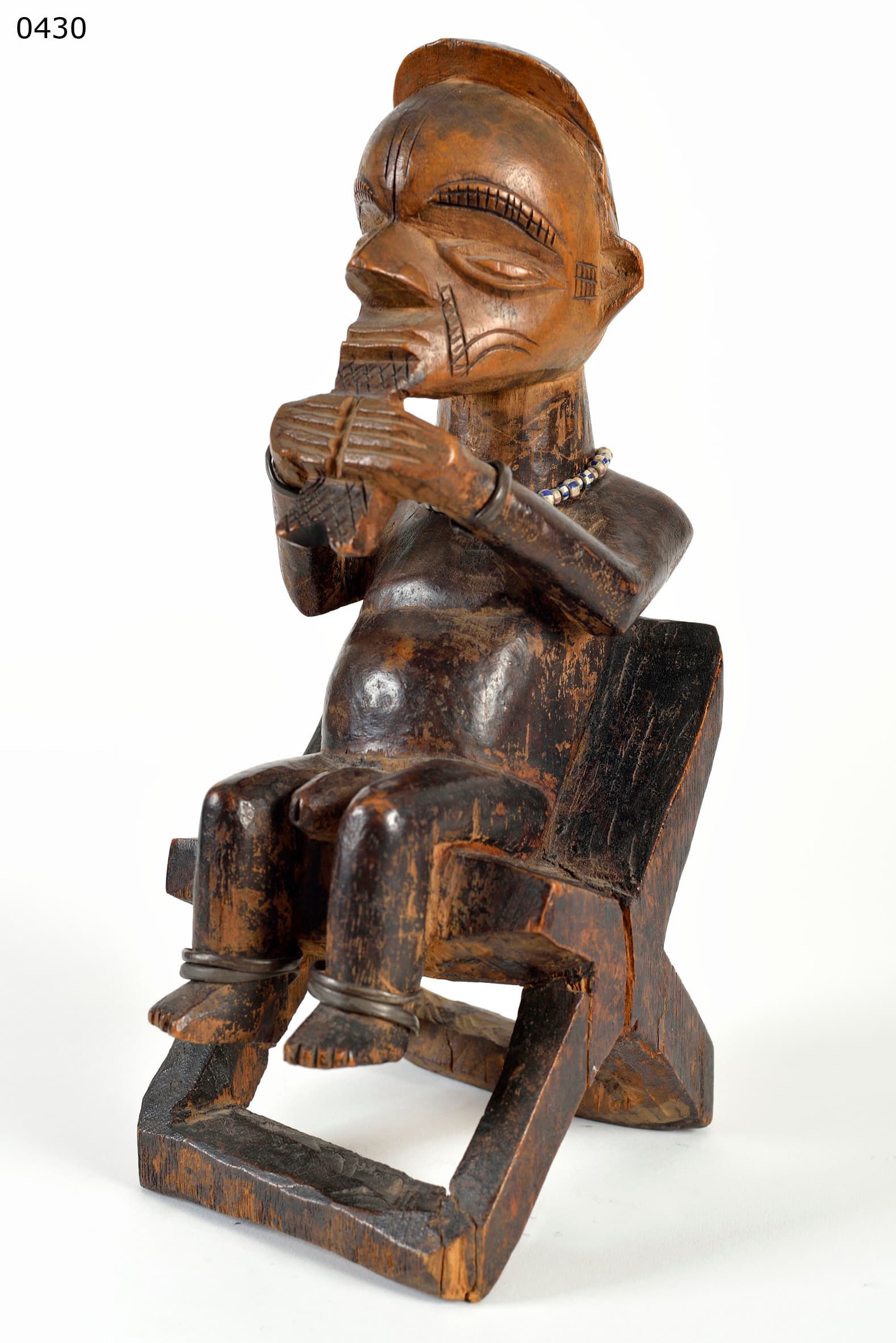
The Songye are a DR Congo people of the savannahs along the Lomami River, known for striated kifwebe masks and nkishi power figures with mask-derived faces.
Overview
The settlement area of the Songye - also referred to as Songe, Bassonge or Basonge in ethnographic and linguistic literature - extends over an extensive territory characterised by tree savannahs in the south-central region of the present-day Democratic Republic of the Congo (DRC). Geographically, this area is largely defined by the Sankuru and Lubilash river systems in the west and the middle course of the Lualaba in the east, which includes administrative parts of the present-day provinces of Kasaï-Oriental, Lomami, Tanganyika and Maniema. The exact demographic recording of this population group is subject to considerable methodological limitations, as no comprehensive, methodologically uncontroversial national census has been carried out in the DRC since 1984. Macro-demographic projections by the United Nations and the Institute of National Statistics (INS) put the total population of the DRC for the years 2024 and 2025 at around 105 to 112 million individuals with a constant annual growth rate of over three per cent. Within this macro-demographic framework, ethnolinguistic surveys estimate the population of Songye speakers at around 1.5 to 2.9 million people. The source situation for precise demographic and ethnic segmentation is therefore ambiguous and requires the extrapolation of older census data in combination with recent linguistic field studies.
| Demographic parameters (DRC & Songye) | Estimated values (2024 / 2025) |
|---|
| Total population DRC (2024) | approx. 105,625,000 - 109,276,000 |
| Total population DRC (2025 projected) | approx. 109,075,000 - 112,832,000 |
| Population growth rate DRC | approx. 3.24 % - 3.31 % p.a. |
| Life expectancy (DRC average) | approx. 61.8 - 61.9 years |
| Fertility rate (DRC average) | approx. 5.9 - 6.05 children per woman |
| Songye speaker (Kisonge) | approx. 1,500,000 - 2,910,000 |
Linguistically, Kisonge (or Songe) is classified as a Bantu language. Within the Niger-Congo language family (subcategory: Benue-Congo, Bantoid), it belongs to the so-called Luba-Songye group (Guthrie zone L). This linguistic relationship reflects deep historical and cultural ties with the neighbouring Luba to the south and east. In ethnographic classification, the nomenclature of the group is the subject of ongoing professional controversy. The term "Songye" functions primarily as an exonym; an umbrella term established primarily by colonial administrators and early ethnologists to unify the eastern factions of the settlement area. The populations in question, especially the groups in the western heartland along the Lomami River, identify themselves endogenously through one of about 34 to 35 autonomous socio-political units. Among the most prominent of these chiefdoms inhabiting the traditional heartland are the Kalebwe, Eki (or Beneki), Ilande, Bala, Chofwe, Sanga and Tempa. This sub-segmentation is of crucial importance for provenance research and stylistic classification in institutional collections, such as the Royal Museum for Central Africa (RMCA) in Tervuren or the British Museum, as significant morphological variations in material culture primarily run along these local dominion boundaries.
The social structure of the Songye is strictly hierarchical and thus contrasts with the acephalous social models of some neighbouring woodland populations. The political system is based on chiefdoms and established kingships. Each of the 34 to 35 sub-groups is subordinate to a central authority, the local chief or paramount chief (yakitenge), whose power is balanced and legitimised by a judicial and advisory council of elders and nobilities (the bilolo). These political offices are closely embedded in the patrilineal kinship system, with the succession to power usually passing from father to eldest son or younger brother. Political authority is conceptually derived directly from the mythical founding heroes, which is why the chief functions not only as a secular administrator but also as a sacred heir to the ancestry.
In terms of subsistence strategies, agriculture and hunting formed the economic foundation of traditional Songye society. The agricultural cycle was strictly linked to the lunar phases and the cosmological order. Interestingly, despite the proximity to large river systems, fishing was historically largely taboo and was only practised in times of extreme need. This restriction was rooted in the spiritual belief that watercourses were the resting places of deceased chiefs and spheres of ancestral spirits (bikudi), the disturbance of which would result in metaphysical sanctions. Metalworking also occupied a prominent economic and social position. The Songye blacksmiths were regarded as superior craftsmen throughout the regional network. Their products - from utilitarian tools to elaborate ceremonial axes and weapons - were coveted objects of exchange and were widely traded with neighbouring peoples such as the Tetela, Kusu and especially the Luba. This dense network of economic exchange and historical migration explains the complex and sometimes ambivalent relationship with neighbouring peoples, which oscillated between cultural symbiosis and territorial demarcation.
Cultural context
The metaphysical and religious system of the Songye operates within a dualistic cosmology, which is structurally determined by an ultimate but distanced creator deity and a highly active pantheon of ancestor and nature spirits. The highest entity in this system is the creator god Efile Mukulu (also Efile Mukulu Mulungu), who is regarded as the architectural cause of the universe, but does not primarily intervene in people's everyday lives. Instead, the direct influence on the physical world, individual destiny, health and agricultural cycles is dictated by the spirits of the deceased. A central paradigm of the Songye belief system, which distinguishes them significantly from many neighbouring peoples, is the belief in transmigration and reincarnation. Every person possesses a spirit (kikudi, plural bikudi). After physical death, the kikudi leaves the body to reincarnate into a newborn after a complex cosmic process involving entities such as the bat (kafulufulu), the rainbow, the wind and specific celestial bodies.
This doctrine of reincarnation results in a bipolar categorisation of the spirit world. Spirits who successfully pass through the cycle of reincarnation are considered benevolent ancestors (bikudi) who safeguard the continuum of the community. Spirits who are denied reincarnation, however, are doomed to remain on earth as malevolent, wandering entities (mikishi, singular mukishi), where they cause disease, dissonance and mischief among the living. There is a terminological controversy in the ethnological literature regarding this nomenclature. While some researchers emphasise that various subgroups strictly differentiate between the benevolent bikudi and the destructive mikishi, field research (documented by the Musée du quai Branly, among others) shows that dominant groups such as the Kalebwe often use the term mikishi as a generic umbrella term for all spirits of the deceased, regardless of their ethical valence.
The ritual authority to control and channel these metaphysical forces is not vested in the secular chiefs, but in a highly specialised divinator, healer and priest: the nganga (plural baganga). The nganga acts as an indispensable mediator between the physical and spiritual spheres. He diagnoses social and physical calamities, determines the necessary ritual countermeasures and is the sole actor who can give profane matter sacred power through the application of magical substances.
Institutionally, the spiritual and judicial order is maintained by the Bukishi Secret Society, a central initiation society that is closely interwoven with political power and functions as the primary instrument of social control. Initiation into the Bukishi takes place in a gradual process characterised by two symbolically strictly separated ritual phases:
- Bukishi wa ntoshi: This degree is associated with white earth (ntoshi). It symbolises the celestial sphere, purity, moonlight, reproductive health and the connection to benevolent ancestral spirits.
- Bukishi wa nkula: This higher grade is associated with red powder (nkula). It represents the earthly sphere, the solar principle, violence, blood and the domain of unpredictable, potentially malevolent spirits and witchcraft (masende).
The role of women within this cult system is complex and subject to anthropological analyses. Physically, women are excluded from active performance within the masked societies and the exclusive bukishi men's societies. Conceptually and symbolically, however, they occupy an essential position. The female version of the Kifwebe mask, which is worn without exception by initiated men, is colour-coded with the ntoshi degree (white) and evokes female attributes of peacemaking, fertility and lunar continuity. A structural difference to the religion of the neighbouring Luba manifests itself succinctly in the interpretation of the masks. While Luba women interpret dream images of kifwebe masks during pregnancy as a highly positive omen and ritually conceive the newborn as a manifestation of kifwebe, the Songye interpret such phenomena as dangerous omens induced by witchcraft that require ritual purification. This dissonance emphasises the fundamental ambivalence and deliberate aggressiveness of Songye cosmology, in which spiritual powers are primarily perceived as threatening scenarios that need to be domesticated through rigorous ritual-magical interventions.
Aesthetic features
The canonical object typology of the Songye is internationally defined by two dominant, visually highly distinctive complexes: the power figures known as nkishi (plural mankishi) and the striped helmet masks of the kifwebe type. Both categories are documented in renowned institutions such as the Metropolitan Museum of Art (Met), the Musée du quai Branly or the Rietberg Museum Zurich as absolute masterpieces of Central African sculpture and are subject to a strict canon of proportions that fuses volumetric presence with magical functionality.
**A nkishi is an anthropomorphic, usually male statue that is produced in a range of sizes from around 30 cm (for private, family altars) to monumental sculptures of over 120 cm (for communal village shrines). The canon of proportions of Songye sculpture, especially from the highly esteemed workshops of the Kalebwe subgroup on the middle reaches of the Lomami (e.g. Bena Nsala region), is characterised by geometric, almost cubist resolutions of form. The sculptor divides the body into clearly articulated segments. Typical features include massive, rectangularly cut shoulders, a cylindrical, often heavily ringed neck and a prominent, block-like abstracted mouth and chin, which often merges into an angular chin beard. The head is disproportionately large, which points to its function as the primary point of communication with the spirit world.
The fundamental difference between a profane carved wooden object and a ritually activated nkishi lies in the application of the magical charge, the bishimba (or bilongo in the wider Congo Basin context). A nkishi is inert and ineffective until the nganga installs these substances. The aesthetics of the figure are thus deliberately designed to be aggressive and terrifying (La redoutable statuaire, as François Neyt put it in 2004). The external attributes include copper plates that seal the navel (the primary opening for the bishimba), metal nails and iron blades driven into the wooden surface, reptile skins, feather crowns and chains with small fishhooks draped around the neck. The latter mythologically evoke the rainbow that captures the souls of the deceased. The metal also references the blacksmith as a primordial founding ancestor and creates optical reflections through the metal pins inserted into the eyes, visualising the omniscence of the spirit.
**The second canonical type, the Kifwebe helmet mask, is characterised by its volumetric abstraction and the deeply incised, concentric stripe patterns that cover the entire face. The masks usually feature cubist, strongly protruding mouth areas (often square or in the shape of a figure of eight) and slit-shaped eyes. The typology primarily differentiates between three gender variants, with the colour and the shape of the sagittal crest (the central crest of the head) serving as distinctive iconography:
- Male masks (kilume): Have a strongly accentuated, high crest, signalling metaphysical potency (masende). The stripes are mostly polychrome in black, white and a significant amount of red.
- Female masks (kikashi): Have no comb or only a minimally indicated comb. The outline is flatter and the stripes are mainly pure white on a dark background.
- Mythical-royal masks: Larger helmet variants with elaborate heraldry for the highest social representation purposes.
A significant research controversy manifests itself in the art-historical analysis of the stripe symbolism. The standard interpretation, largely influenced by Dunja Hersak (1986), is based on a structuralist reading: white (ntoshi) symbolises the moon, purity, health and peace; red (nkula) stands for the sun, blood, danger and fire; black represents the earth and the chthonic. More recent anthropological and art historical paradigms (reflected by Sidney Kasfir, among others, or in re-evaluations by Hersak himself in 2020) increasingly criticise this approach as a static, Western projection of structuralism. They argue that the meaning of the masks is not rigidly encoded in the colours, but is modified by the performative act (the "bricolage" in Lévi-Strauss' sense) in a more fluid and strongly context-dependent way.
**The materiality of authentic objects is subject to an evolutionary process. The ritual patina develops over years through the continuous application of tukula (red wood powder), palm oil, clay and animal offerings, resulting in a heavily encrusted, matt or partially shiny surface. In the recent art market, which is heavily infiltrated by forgeries (reproduction for the West began in the early colonial period), precise authenticity criteria are essential. In addition to classic wood technology parameters such as natural termite damage or cracks in the heartwood, modern forensics focus on the inner life of the sculptures. CT tomographic scans, such as those carried out at the Musée du quai Branly, reveal a complex network of tunnels in authentic mankishi that is invisible from the outside and connects the navel, spine, ears and crown. If this system is missing or if the abdominal cavities show no chemical relics of organic bishimba charges when analysed for traces (stomach content analysis), an object is considered to be discharged, profane or a modern forgery.
Ritual practice
The ritual operationalisation of Songye artworks is a dynamic process that transforms the physical body of the object into an accumulator of metaphysical powers. This lifecycle - from genesis to permanent maintenance to disposal - follows strict procedural parameters and performative choreographies dictated by the ritual authorities.
**The creation of a nkishi power figure begins with the ritually controlled selection and felling of the tree by the sculptor, often accompanied by initial propitiatory offerings to the spirits of nature. However, the carved wooden corpus is completely profane and powerless. The actual "birth" of the ritual object is the responsibility of the nganga. He activates the statue by inserting the bishimba (or bilongo). These magical formulas are primarily placed in the designated cavities in the abdomen (navel), on the crown of the head (often in an applied antelope horn) or in a cavity at the back. The composition of the bishimba varies depending on the regional Kalebwe, Eki or Tempa tradition, but always includes highly potent, secret ingredients: Umbilical cords of twins, human hair, claws of big cats, fragments of warrior bones as well as specific plant resins and earths. Once the cavities are sealed - often with a copper plate, mirror or resin - the statue is activated and is considered an animated vessel that anchors the spirit forces (mikishi) in the physical world.
**While small mankishi are used for individual or family apotropaics (defence against harm), the monumental community statues (often 80 to over 100 cm tall) are kept in the centre of the village in designated shrines (shibo ya bwanga). They are under the care of a specific guardian (nkunja) or the chief. The preservation of magical potency requires continuous ritual alimentation, which is usually carried out according to the lunar calendar, explicitly at new moon. On these occasions, the statue is placed on the chief's chair and revitalised by libations (drink offerings) of palm wine and by rubbing it with tukula powder, palm oil and the blood of sacrificial cocks. Food offerings such as chicken liver or manioc are also made. A striking detail of the ritual practice is the preservation of sacred purity: to prevent the power figure from being profaned by direct human contact or its energy being discharged uncontrollably, it must not be touched with bare hands. For transport during village processions, wooden sticks (known as katundu) are pushed through holes under the figure's armpits.
**Parallel to the static altar use of the mankishi, the kifwebe masks act in highly kinetic performances. These are staged by the Bukishi secret society for social control, circumcision rituals, funerals and to ward off witchcraft (masende). The appearance varies diametrically according to the gender type of the mask:
- Male performance: The wearers of the red, black and white masks with a high sagittal crest usually perform in broad daylight or in times of crisis. Their choreography is erratic, aggressive and unpredictable. They emit guttural, non-structural sounds, manipulate weapons and demonstrate their magical dominance over the nkula sphere. These performances are intended to scare away evil spirits and sanction deviant social behaviour.
- Female performance: The white, chamberless masks usually appear in groups during the new moon rituals. Their dances are controlled, gentle and elegant - comparable to a "corps de ballet" - and aim to invoke benevolent ancestral spirits (bikudi) to promote peace, agricultural fertility and human reproduction.
The masks are never presented in isolation, but always in combination with a voluminous, net-like costume made of plant fibres that completely conceals the identity of the wearer.
**Deactivation and end of lifecycle ** The lifecycle of a ritual object is finite. A nkishi loses its legitimacy and effectiveness when the nganga who activated it dies, as the metaphysical connection is severed. Alternatively, a figure can be deliberately deactivated by breaking the seal of the abdomen and extracting the bishimba - a physical state in which many objects have entered Western collections. Deactivated objects are either ritually disposed of in the bush (left to decay), burnt or left in secular contexts, as without their magical charge they are merely regarded as empty wooden vessels with no spiritual relevance.
Historical context
The historical genesis of the Songye culture is inextricably linked to the pre-colonial migration movements in the Central African savannah belt. Oral traditions and historiographical reconstructions place the origin of the ethnic group in the 16th century. According to this, the mythical founding heroes Tshimbale and Kongolo migrated northwest across the Lomami River as a result of profound political and dynastic dissonance from the lake district of the Shaba Province - the historical epicentre of the emerging Luba Empire. This physical separation established the independent cultural identity of the Songye, but at the same time led to a permanent osmotic relationship with the Luba, which remained characterised by trade, conflict and the transfer of ritual institutions.
**This close historical interdependence manifests itself in one of the most virulent iconographic controversies in Central African art history: the question of the geographical and cultural origin of the striped Kifwebe masks, which are used ritually by both the Songye and the Luba. The research debate is primarily polarised between two diametrically opposed positions.
On the one hand, the Canadian anthropologist Dunja Hersak argues, based on her extensive field research in the late 1970s (published in 1986 in the standard work Songye Masks and Figure Sculpture), that the kifwebe complex is a genuine Songye invention. Hersak localises the nucleus of this style in the central Songye region (especially among the Kalebwe) and postulates that the Luba only adopted this tradition in the course of the 19th century in an adapted and morphologically modified form (e.g. rounder, ball-like shapes).
This is vehemently opposed to the older doctrine, which was largely shaped by the Belgian curator Albert Maesen (1981) and former colonial officials such as Pater Colle (1913). Maesen and his contemporaries localised the origin of the masks in the Luba territory and stated a diffusionism in a western direction towards the Songye. Although the recent scholarly consensus (supported by researchers such as François Neyt and Julien Volper) tends to favour Hersak's thesis of Songye provenance, the dynamic of mutual appropriation remains a prime example of the hybrid character of African art styles.
**The arrival of the European colonial powers, especially the administration of the Congo Free State and later the Belgian Congo in the late 19th and early 20th centuries, evoked a fundamental caesura. The colonial administration and Christian missionaries categorised the complex religious networks as subversive and threatening. This was particularly drastic for secret societies such as the Bukasandji (often mistakenly confused or associated with the Bwadi bwa Kifwebe), which was falsely accused of "necrophagic rituals" by the administration. These accusations, which were mostly based on the misunderstanding of anti-exhumations, served as legitimisation for rigid persecutions. The confiscation and systematic burning ("cleansing") of thousands of masks and mankishi altars by officials and missionaries destroyed large parts of the historical corpus.
| Market-relevant collectors & curators (20th century) | Relevance for Songye corpus | Institutional connection |
|---|
| Emil Torday | fieldwork 1907/1908; documented early Songye figures in situ at the Sankuru River. | British Museum |
| Jeanne Walschot established the trade from the 1920s; accumulated >3,000 Congo objects. | RMCA Tervuren (estate) | |
| Albert Maesen | Curator, coined early diffusion theories (Luba origin) and collected systematically. | RMCA Tervuren |
| Jean Willy Mestach | artist/collector; shaped the aesthetic view of modernism with his high-calibre collection. | Various private collections |
| Dunja Hersak & François Neyt | Academic foundation and classification of the corpus from the 1980s and 2000s. | Various monographs |
**Parallel to the ritual deconstruction, the colonial period forced the commercialisation of Songye art. As early as the 1920s, Western traders and artists of the European avant-garde (Cubism, Surrealism) recognised the radical formal power of the Kifwebe masks and the block-like power figures. This led to the first wave of production of copies for the tourist and colonial export market, in which masks were carved without ceremonial legitimisation. The history of reception in the West was significantly influenced by pioneers such as the Brussels dealer Jeanne Walschot (1896-1977), whose estate is now partly managed by the RMCA Tervuren, and the collector Jean Willy Mestach.
The price trend for authentic Songye masterpieces on the global auction market has culminated in recent decades. A historic breakthrough was achieved in May 2019 when the famous "Walschot-Schoffel Kifwebe Mask" was auctioned at Christie's New York for a record price of 4.215 million US dollars.
This exponential increase in value has led to a massive counterfeiting problem in the Western collectors' market. The distinction between a ritually used pre-1920 object and a high-quality, artificially patinated replica of the mid-20th century is complex. Criteria for authenticity are increasingly based on a symbiosis of stylistic analysis and high-tech forensics. While traditional indicators such as natural termite damage, heartwood cracks and the layering of tukula offerings are still relevant, auction houses and museums now rely on analytical forensics. The so-called stomach content analysis (the chemical-toxicological examination of the cavities in the abdomen) is adapted to detect the remains of bishimba resins, fats or animal proteins. If a CT scan shows none of the characteristic inner tunnel systems or if chemical analyses prove that the cavity was never filled with organic ritual substances, the object - regardless of its purely sculptural quality - must be classified as ritually inactive or as a market-oriented production.