Overview
The settlement area of the Salampasu (often referred to as Basala-Mpasu or Asalampasu in ethnographic and linguistic literature) extends over a geographically and historically highly complex contact zone in southern Central Africa. The core area of this ethnic group lies in the high-altitude savannahs and gallery forests of the Kasaï-Central province (historically Kasaï-Occidental) of the present-day Democratic Republic of the Congo (DRC), primarily east of the Kasaï River and on the western headwaters of the Lulua River (Cameron 1988: 34). In the south, the territory extends directly to the state border with Angola, which has led to a transnational fragmentation of the historical lineages. The source situation regarding the current population figures is ambiguous and methodologically controversial: While historical inventory catalogues and older ethnographic censuses by the Musée royal de l'Afrique centrale (RMCA) in Tervuren traditionally assume a core population of around 60,000 individuals (Felix 2018; Cameron 1988), contemporary demographic projections (as of 2024) sometimes list up to 244,000 members. This striking discrepancy is the result of modern territorial mixtures, a high birth rate and inadequate statistical recording in regions where state infrastructure such as schools or clinics is largely absent.
Linguistically, the Salampasu language, Chisalampasu (also labelled as a language with the Bantu prefix Chi-), is classified in the macro family of Bantu languages. Specifically, it belongs to zone L (L50 group) and has morphological and lexical affinities with the languages of the neighbouring Lunda, Ruund (L53) and Luntu (L511) (Bostoen & Van de Velde 2014: 25).
The etymology of the ethnonym "Salampasu" refers to a historical foreign designation. In older literature, the term is often translated as "hunters of locusts", which could indicate subsistence farming practices during periods of drought. Alternatively, some linguists (such as Bogaerts 1950, cited in Biebuyck 1973) postulate that the name derives from a specific, traditional form of frontal scarification, the pattern of which is reminiscent of grasshopper wings. Together with neighbouring, decentrally organised groups such as the Lwalwa, Mbagani and southern Kete, the Salampasu are sometimes grouped together in the regional nomenclature as Akawaand (translated: "those living downstream").
The socio-political structure of the Salampasu is the subject of long-running debates in research. The traditional narrative describes the society as fundamentally acephalous, based on independent, patrilineal lineages that always rejected the formation of a centralised, dynastic kingship. Village chiefs were not determined by hereditary succession to the throne, but were elected on the basis of personal suitability, charismatic authority and military merit (achieved status) (Herreman 2024). However, this egalitarian structure based on individual merit was in constant dialectical tension with a rudimentary hierarchical system in which territorial chiefs stood above the village chiefs.
The subsistence strategy was based on a strict gender-specific division of labour. Hunting and warfare were historically regarded as the exclusive and most privileged domains of men, while basic agricultural tasks were almost entirely the responsibility of women. The relationship with the neighbouring peoples - especially the Lulua in the north and the Chokwe and Lunda in the south - was characterised by a duality of defensive warfare and commercial exchange. In order to defend their autonomy as an ethnic enclave against the expansionist ambitions of the Luba and Lunda, the Salampasu cultivated a reputation as fearless, brutal warriors. At the same time, they paid formal tribute to the powerful Lunda, which relativises the pure acephaly thesis.
| Demographic & Geographical Structure | Data and Classification |
|---|
| Primary settlement area | DR Congo (Kasaï-Central province), border area Angola; Kasaï and Lulua rivers |
| Population estimate | Historically (RMCA catalogues): approx. 60,000; current (2024): up to 244,000 |
| Linguistic classification | Chisalampasu (Bantu language family, zone L, L50 group) |
| Socio-political organisation | Acephalous patrilineages with territorial chiefs; dominance of warrior bands |
| Central neighbouring peoples | Chokwe, Lunda, Luba, Lulua, Kete, Lwalwa, Mbagani |
The controversies of classification in ethnography are obvious: while some researchers describe the Salampasu as a completely isolated, warlike anarchy, structural analytical approaches (supported by inventory analyses of the RMCA Tervuren, among others) emphasise their integration into the far-reaching commercial and tributary network of the Lunda hegemony. The identity of the Salampasu thus emerged as a conscious, defensive demarcation (invented ethnicity, following Nzongola-Ntalaja 2002) in a Kasaï basin destabilised by imperial expansion.
Cultural context
The religious and cosmological system of the Salampasu has structural overlaps with the pan-Bantu ontology, but is massively differentiated by an extremely warlike and exclusive ritual order that sanctions the military habitus. At the top of the cosmological hierarchy is the omniscient creator god Nzambi, who is conceived as the architect of the universe (Cornet 1974). However, in accordance with the concept of the deus otiosus, Nzambi is rarely invoked directly. Active spiritual intervention is the responsibility of the ancestors (bakulu) and various localised natural and spiritual beings, who are responsible for the well-being of the community, protection from enemy invasions and agricultural fertility.
In contrast to the highly centralised neighbouring kingdoms (such as the Luba), the Salampasu do not have a distinct priestly caste or the concept of divine kingship. Instead, ritual authority is decentralised and lies in the hands of divinators and, above all, the exclusive male and secret societies. Diviners use mechanisms such as basket oracles or rubbing oracles to monitor the cosmological balance, identify the causes of illness and appease spirits. However, the central pillar of ritual power and social control is the Mugongo warrior society.
Entry into Mugongo society marks the most important rite of passage in the life of a male Salampasu. Initiation begins with circumcision in isolated bush camps (mukanda) and requires strict physical and spiritual separation from the maternal sphere (Himmelheber 1979; Cameron 1988). The novices have to endure extreme physical stress - historically this included filing their teeth in order to demonstrate strength, discipline and aggression. Within the Mugongo there is a complex hierarchy of sub-societies, the highest grades of which are documented as Ibuku and Matambu (with the highest initiate level Mukish). Historically, promotion to these elite grades was inextricably linked to headhunting, a practice based on taking over the vital force of the slain enemy and occasionally ending in ritual suicide by hanging (Jobart 1925, after Biebuyck 1973).
The role of women in this system is highly complex. Vulgar ethnographic accounts often emphasise exclusively the exclusion of women from the cult: they were not allowed to enter the secret wooden ensembles and had to panic and flee at the mention of certain masks or their appearance (Cameron 1988). However, more differentiated research - based for example on objects in the collection of the Fowler Museum at UCLA - proves that women were indispensable for the cosmological stability of the patrilineages through their own rites of passage (which also included tooth filing) and essential fertility rituals (fecundity rituals). The subsistence provided by the women guaranteed the material basis that made it possible for the men to concentrate on war and ritual.
Structurally, the religion of the Salampasu differs from that of their neighbours in the radical link between spiritual power and military rank; there is no sharp distinction between the civil-sacred and martial spheres. This is also the source of one of the most profound controversies in Africanist art history. Maria Kecskési (1987) interprets the entire ritual world and in particular the iconography of the masks as direct derivatives of a warrior initiation. A dates and analyses the masks as insignia of real military violence, the possession of which necessarily required physical homicide. Marc Leo Felix (2018), on the other hand, argues that the Mugongo structures primarily corresponded to a more general secret society ritual. B argues that the masks functioned as civilian status symbols in an otherwise acephalous, egalitarian society in order to codify wealth and knowledge, even without constant real warfare. The sources are still ambiguous in this regard.
| Institution / Ritual | Cosmological and Social Function | Primary Actors |
|---|
| Nzambi & Bakulu | Creator god and ancestors; maintenance of cosmic balance | Ancestors, nature spirits, divinators |
| Mukanda | Circumcision and separation; entry into the male sphere | Boys, initiation masters |
| Mugongo | Warrior society; territorial defence and social control | Initiated men (various ranks) |
| Matambu / Mukish | Highest sub-society; ritualisation of headhunting and ancestor worship | Elite warriors, mask wearers |
| fertility cults | securing demographic continuity and agrarian base | women, female ancestors |
Aesthetic features
The sculptural oeuvre of the Salampasu is almost exclusively characterised by a highly standardised and visually iconic corpus of masks. Freestanding, fully sculpted ancestor figures or utilitarian carvings (with the exception of rare figuratively decorated wooden instruments, drums and iron swords) play a subordinate role. The typology of canonical Mukish face masks is strictly organised according to the hierarchical levels of warrior society and is differentiated primarily by the choice of material, while the canon of proportions and facial morphology remain consistent across all subtypes (Cameron 1988; Cornet 1974).
The canonical typology comprises three main groups:
- Idangani: These masks are made of woven plant fibres (knitted fibres, raffia). Iconographically, they represent the hunter and mark the lowest level of social advancement within the men's societies.
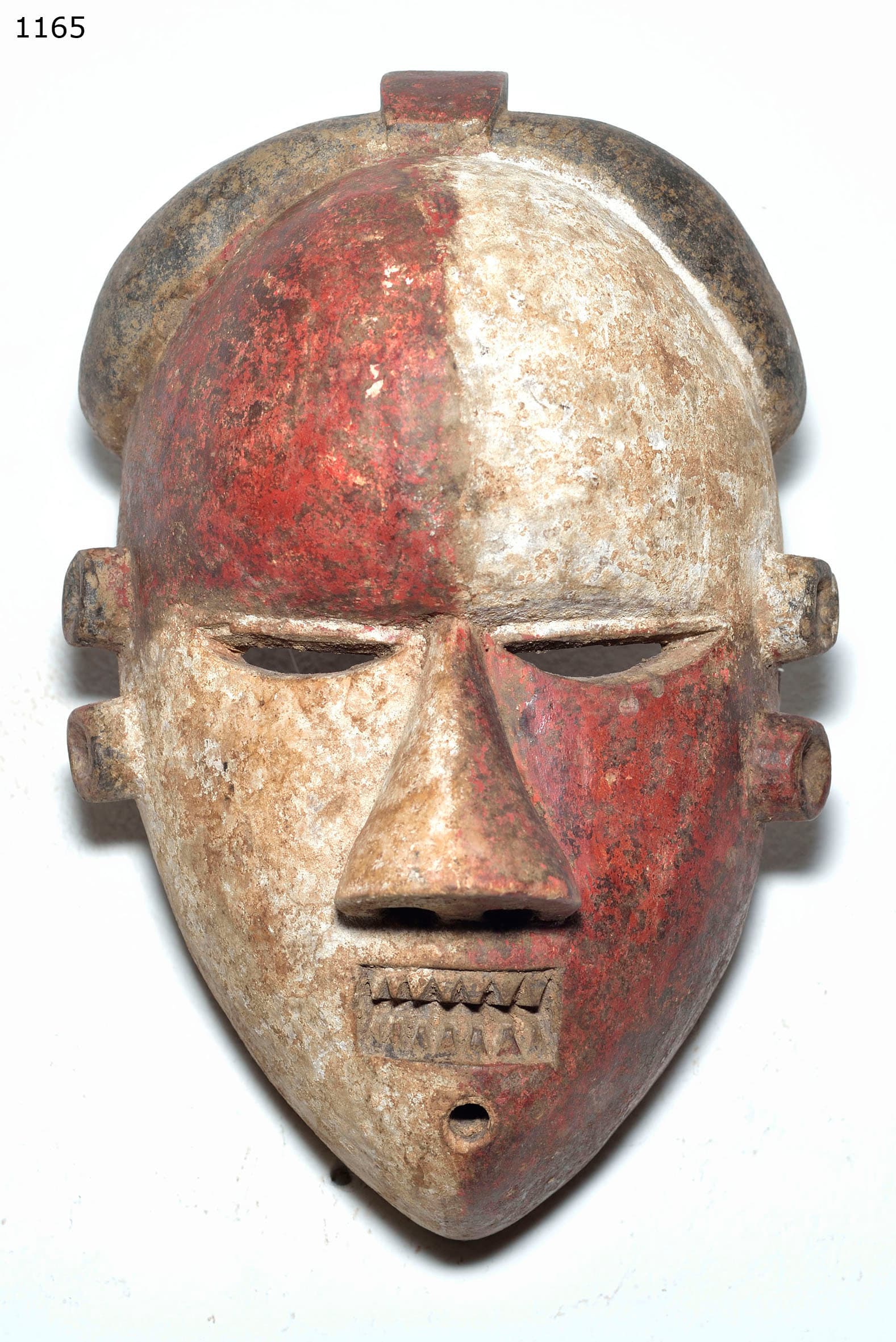
- Kasangu: Masks carved from soft wood. They represent the warrior. Aesthetically, they are characterised by a deep dark patina, often blackened or dyed red with redwood powder (camwood / tukula).
- Mukinka: The highest-ranking masks, which are reserved for the leader / chief. The wooden mask body is covered with fine, often cross-shaped copper sheets (Herreman 2024; Cornet 1974). Copper was an extremely valuable, hard-to-obtain import in Central Africa; its use thus signalled immediate material wealth, social omnipotence and the metaphysical conductivity of the material.
The iconographic vocabulary of the Salampasu masks is characterised by an aggressive, almost cubist abstraction. The canon of proportions is dominated by a massively bulging, spherical forehead that shadows deep, slit-shaped eyes. The nose is sharply triangular. The mouth is rectangular and wide open, exposing a row of sharply filed teeth, often highlighted with white kaolin. This tooth iconography directly references the real historical practice of filing teeth and acts as a visual synonym for martial dominance and unrelenting strength. The size range of the pure wood or copper face is usually between 20 and 35 centimetres. However, the visual impact is drastically increased by the obligatory mask accessories: A sweeping hairstyle made of rattan or raffia balls and a long, pointed beard made of plant fibres complete the canon.
It is essential to distinguish between the profane, freshly carved object and the activated ritual object. A mere piece of wood without a ritual context was worthless. The transformation into a sacred object (spirit vessel) took place through the addition of power substances (bonga), the rubbing with sacrificial blood and palm oil and the assembly of the costume.
Salampasu research has not identified any "master hands" documented by name (such as the well-known "Buli master" of the Luba). Nevertheless, detailed morphological comparisons within excellently documented collections, such as that of Hans Himmelheber in the Museum Rietberg in Zurich, allow the identification of specific regional workshops and individual carving manuscripts on the basis of proportions and scarification reliefs.
Due to the enormous demand on the Western art market, Salampasu masks are extremely susceptible to forgery. Market-relevant forgery criteria are primarily based on the forensics of ageing. An authentic dance patina is created through decades of contact with skin oils, sweat and atmospheric conditions, which leads to specific signs of wear on the mounting holes and the nose area (Top Banana Antiques 2024). Genuine ageing also manifests itself in deep cracks in the heartwood and traces of termite damage. Forgeries, on the other hand (often "airport art" from the 1970s), are artificially aged. A distinctive exclusion criterion is the pungent smell of smoke that arises when fresh replicas are artificially patinated over an open fire. In addition, the copper sheets of authentic pieces show a specific oxidisation on the back, which is often bunglingly imitated in fakes by acid treatments.
Ritual practice
The ritual practice of the Salampasu manifests itself primarily in the mask performance, which is choreographed as a multi-sensory drama. These performances are not profane entertainment, but highly esoteric acts of spiritual and social regulation. They mainly take place in special, hermetically sealed areas in the bush or in places surrounded by wooden enclosures, whose boundary posts are often carved with anthropomorphic reliefs (Cameron 1988).
The life cycle of a ritual object among the Salampasu is subject to a strict procedural logic. Initiation begins with the awarding of a carving contract to a local craftsman. At this point, the wooden or copper mask is a profane object. In order to gain the right to dance a specific mask within the Mugongo hierarchy, the novice must not only have completed the circumcision and the bush camp, but must also make enormous economic expenditures. The payment of an initiation fee in the form of cattle, palm wine and material goods to the older mask owners is obligatory (Felix 2018).
Once the fee has been paid, the mask is activated. The mask owners transfer the esoteric knowledge required to master the indwelling spirit to the new adept. The physical activation is carried out through animal sacrifice. The blood of chickens or goats is applied to specific areas of the altar or mask to bind the life force of the ancestors (analogous to practices of neighbouring groups as often described in museum contexts). An essential part of the activation is the donning of the full costume. A mask is never danced in isolation; only the combination of the wood/copper-carved face, a shirt made of woven plant fibres, animal skins and feather tufts completes the sacred object. The spirit lives in the entire ensemble, not just in the mask (Cameron 1988).
The primary occasions for the appearance of the masks are the funerals of high-ranking chiefs and successful warriors as well as initiation ceremonies. On these occasions, especially during the Matambu dance, the mask wearers are highly dynamic and aggressive. They are often armed with the traditional double-edged iron swords and antelope horns. The performance is designed to induce terror and awe. The choreographed aggression serves as a demonstration of power towards non-initiated village members and women, who are forced to flee in panic when the masks appear or when they hear certain chants.
The deactivation and disposal of the ritual objects of the Salampasu is characterised by a deep historical caesura. In the pre-war period, old, brittle masks were either left to decay naturally in ritual depots or burnt during specific rites. In the early 1960s, however, in the wake of Congolese independence and massive social modernisation efforts, a local iconoclastic movement swept through the Salampasu region. Many war alliances were dissolved and authentic Mukinka and Kasangu masks were collectively desacralised, destroyed or sold en masse to Western art dealers (Guggenheim 2020; Teuten 2011). This rupture largely ended traditional ritual practice.
Today, the regional variations of masks and costumes can be reconstructed almost exclusively from excellently documented field research collections. The Musée du quai Branly - Jacques Chirac in Paris offers a central reference for this, with its depots containing not only the isolated masks, but also the remains of the fragile raffia nets, costume parts and rattan structures, which bear witness to the complex structure prior to desacralisation.
| Phases of the ritual object | Actions and actors | Material and spiritual transformation |
|---|
| Production | Carver produces wood/copper base | Profane material without spiritual charge |
| Acquisition | Novice pays initiation fee (cattle, wine) | Socio-economic transfer of status |
| Activation | offerings (blood), assembly of the costume | spirit manifests itself in the ensemble |
| Performance | Matambu dances at funerals/initiation | Demonstration of power, terror, honouring ancestors |
| Deactivation | Natural decay or iconoclastic sale (1960s) | Desacralisation, loss of vital force |
Historical context
The historiography of the Salampasu is deeply interwoven with the large-scale migration and expansion movements in the Central African Congo Basin. The precise dating of the migration history is subject to scholarly controversy. While some historians assume a gradual immigration into today's Kasaï region as a result of early Bantu migrations, more recent analyses (cf. Vansina 2004) prove that today's territorial distribution is primarily the result of massive military pressure due to the expansion of the Luba empire from the 18th century onwards. At the same time, the Lunda Empire was consolidating in the south. Wedged between these two imperial giants, the Salampasu and neighbouring groups were forced into border areas that were more difficult to access. To preserve their independence, they developed their extreme martial social structure, which resisted any centralisation but ultimately became tributary to the Lunda.
The colonial encounter with European, especially Belgian, actors took place comparatively late. While the Kasaï basin had already been devastated by the rubber exploitation of the État Indépendant du Congo by the end of the 19th century, the Salampasu remained shunned and feared for a long time due to their reputation as ruthless headhunters. The Belgian colonial administration regarded the Salampasu warrior bands as an acute threat to the imperial civilisation narrative. The final administrative pacification of the region only took place in the 1920s and 1930s (Herreman 2024).
The influence of colonial history on local art production was initially characterised by the transfer of artefacts to Europe. Pioneers of scientific ethnography, such as the Belgian researchers Frans Olbrechts and Albert Maesen, undertook extensive expeditions between the 1930s and 1950s to systematically document ritual and utilitarian objects on behalf of the Musée du Congo Belge (now RMCA Tervuren) (Petridis 2001; Raymaekers 2016). These early collections formed the basis of academic reception, but initially remained in a purely ethnological discourse.
Market history in the West took a dramatic turn in the 1970s. Parallel to local iconoclasm, which flushed many old collections onto the market, researchers such as Joseph Cornet (1974) and later Marc Leo Felix published pioneering works on the art of Zaire, which put the Salampasu masks in the spotlight. Groundbreaking exhibitions, such as the show Face of the Spirits (1993) curated by Frank Herreman and Constantijn Petridis, cemented the status of the masks as masterpieces of African sculpture. The cubist-like abstraction and the elitist aura of the copper were exactly to the taste of European and American private collectors of primitivism. Prices exploded; authentic Mukinka masks realised record sums at auctions in Paris and New York. Exquisite examples of this early market phase can be found today in the Metropolitan Museum of Art (Rockefeller Collection, Accession Number 1979.206.236), where they are presented as icons of African art.
However, this immense commercial breakthrough generated a massive counterfeiting problem. As early as the mid-1970s, local workshops in the Congo began to produce masks exclusively for export (Teuten 2011). Strict authenticity criteria and forensics are therefore essential for modern collectors and curators. An authentic pre-colonial or early colonial mask shows complex traces: Oxidation patterns on the edges of the copper sheets that indicate decades of binding of tannins and palm oil, deep, irregular heartwood cracks caused by slow climatic drying, and natural feeding galleries of termites that often extend into the soft inner wood of the mask. Manipulated market replicas, on the other hand, often show acid damage to imitate patina, artificial layers of dirt from coffee or shoe polish and the aforementioned telltale smell of smoke. The ability to distinguish between an activated ritual object and a masterfully crafted commercial forgery requires a high degree of expertise in material science and iconography.