Overview
The Suku (plural: Basuku) historically and currently inhabit an irregularly shaped area, around 60 to 80 kilometres wide and 180 kilometres long, which is characterised by hilly savannahs and open forest areas. This territory is primarily located in the Kwango region of the south-western Democratic Republic of the Congo (Bandundu Province) and in neighbouring north-western Angola. The demographic development shows a significant increase: while surveys in the middle of the 20th century put the population at around 80,000 individuals with a density of five to six people per square kilometre, current estimates assume up to 150,000 to 200,000 members. It is estimated that a third of this population now lives in urban areas, particularly in the metropolis of Kinshasa, as a result of labour migration.
Linguistically, Kiyaka (or Kisuku) belongs to the Congo cluster of central Bantu languages and is morphologically and lexically closely related to the Yaka idioms and various Congo dialects. However, the nomenclature and classification of Suku is the subject of ethno-historical controversy. In early colonial records, especially in the registers of what is now the Royal Museum of Central Africa in Tervuren (RMCA), the Suku were often catalogued generally as "Yaka" or more specifically as "Yaka of Mini-Congo". This foreign designation refers to the traditional title of the Suku king (MiniKongo) in order to enforce a political differentiation from the Yaka ruler (Kasongo Lunda). Contemporary research marks this blanket classification as highly problematic and calls for the recognition of the Suku as a distinct ethnic unit, even if institutional parameters are strongly congruent with the neighbouring peoples.
The social structure operates via a complex dual system: it combines a strictly matrilineal descent with a patrilocal residence rule. Hereditary lines and kinship affiliations are derived maternally, but married women transfer their residence to their husbands' local groups.
| Parameters | Ethnographic specification of the Suku |
|---|
| Social structure | Matrilineal descent, patrilocal residence, centralised kingship parallel to strongly autonomous lineage groups. |
| Subsistence | Female-dominated shifting cultivation (manioc, yams, peanuts); male-dominated ritual hunting. |
| Linguistics | Kiyaka (Central Bantu, Congo cluster). |
| Neighbouring tribes | Yaka, Teke, Nkanu, Pende, Chokwe. |
Politically, there is a centralised royal authority, but in socio-political reality this is balanced by largely autonomous, segmentary lineage groups. Local authority is always vested in the oldest man of the respective lineage. Historically, the economic foundation was formed by itinerant agriculture practised by women. The parallel male hunting was nutritionally marginal, but enjoyed the highest social and ritual status within society.
Cultural context
The Suku religious system is structured by a cosmological hierarchy headed by a creator god. However, this is understood as a deus otiosus - a metaphysical entity that remained inactive after the creation of the world and is not directly addressed in everyday ritual practice. Instead, the operative centre of cosmology is formed by a detailed, omnipresent system of ancestor and elder worship. It is precisely in this nexus that one of the most prominent research controversies in African anthropology is located: in 1971, the ethnographer Igor Kopytoff vehemently argued that there is no ontological or terminological separation between living elders and deceased ancestors in Suku cognition; both cohorts operate within the same semantic and structural field of authority ("Ancestors as Elders"). This structuralist explanatory approach was sharply criticised by fellow researchers such as Meyer Fortes, who called for a more differentiated view of ancestor worship and referred to the eschatological power of the dead, which significantly transcends the authority of the living.
Ritual authorities are decentralised in Suku society and do not have a hierarchical clergy. The central actors include the nganga (divinators and healers), the isidika (ritual masters of the initiation camps) and the lineage elders. The nganga use complex mechanisms - including the mukoku slit drum - to diagnose the spiritual causes of physical or social pathologies, which are usually attributed to witchcraft (baloki) or the withdrawal of ancestral protection.
Contrary to androcentric colonial paradigms, women play a substantial role in the cult of the Suku, albeit one that is less documented materially in Western collections. Women are not only the exclusive producers of the ritual ceramics, but also participate in distinct initiation and rites of passage (kisungu) that exist parallel to the male institutions and ensure the spiritual integrity of the lineage.
However, the most influential structuring element of society remains the nkhanda complex (also mukanda), the circumcision and initiation institution for boys. The rites performed in isolated forest camps mark the social death of the child and reintegration as a member of society capable of hunting. Kopytoff demonstrated that the nkhanda deliberately crosses age and lineage boundaries and thus represents the primary mechanism for social cohesion in the fragmented village structures. Objects in university collections such as the Fowler Museum at UCLA prove that the masks used in this context primarily fulfil didactic functions and visually encode gender-specific and moral norms of behaviour for the initiates.
Aesthetic features
The object typology of the Suku is rigorously canonised and is almost without exception dominated by the insignia of the nkhanda initiation complex and the divination system. The leading iconographic fossil is the kakuungu helmet mask. It is one of the most monumental mask formats in Central Africa (with dimensions of up to one metre in height), is always polychrome in red, white and black earth colours and is defined by extremely exaggerated physiognomic features: strongly inflated cheeks, a massive chin, often framed by a thick bast beard, and occasionally mirror-glass eyes to ward off evil glances. Smaller types that complement the initiation theatre include the hemba masks (cylindrical, often with a figurative attachment) and kholuka masks for initiates.
The stylistic categorisation of these works of art is the subject of a vehement iconographic controversy. The Jesuit and ethnographer Léon de Sousberghe argued in his comparative works (e.g. 1958) that the art of the Suku and Yaka merged into an amorphous "Kwango style complex", which is why he methodically treated Suku artefacts as a sub-tradition of the Yaka. The art historian Arthur P. Bourgeois (1984) strongly disagreed with this in his standard work. He defended a distinct Suku idiom and postulated, among other things, a specific "Northern Suku style". Bourgeois identified the so-called "moustache" as an anatomical distinguishing feature - a flat mouth-nose complex that merges into the nostrils, often with an exposed row of teeth, which contrasts significantly with the canonical, strongly upturned snub nose of the Yaka.
Master hands documented by name are largely missing in the historical tradition of the Suku, but constant canons of proportion - such as spherical torsos on strongly angled, massive legs - can be attributed to specific, albeit anonymous, workshops.
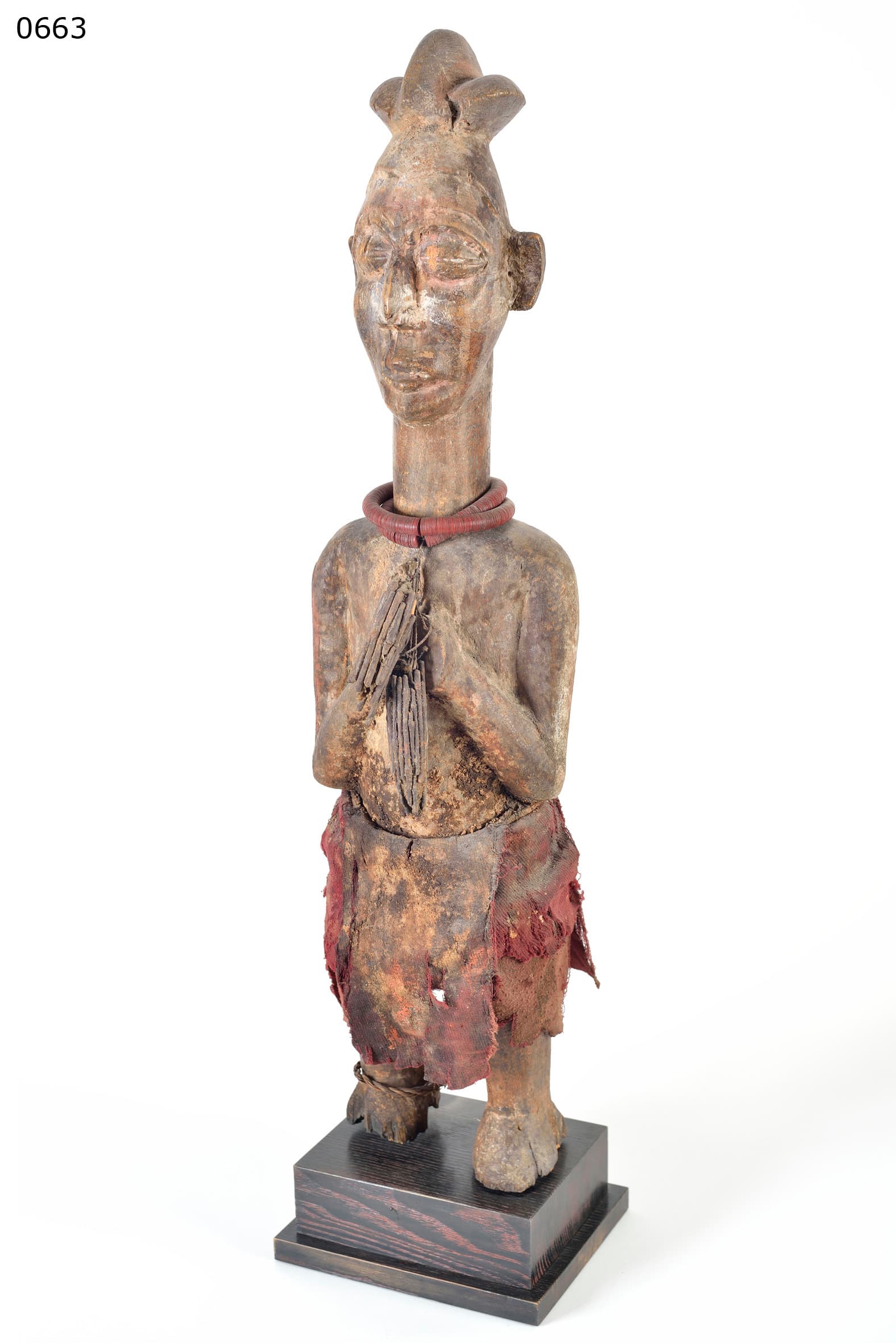
A fundamental aspect for understanding Suku art is the ontological difference between the profane, freshly carved object and the activated ritual object. A sculpture is considered ritually lifeless until the nganga inserts specific magical substances (nkisi) into prepared cavities in the wood (such as in the abdomen or crown). The Metropolitan Museum of Art illustrates this charging process precisely with power figures from the Congo region, in which earth, relics or animal matter transform the object into a functional tool. Conversely, these spiritual charging practices also define the forgery criteria: The market-relevant, mass-produced forged kakuungu type often lacks the organic deep patina and evidence of successive offerings applied in layers in contemporary replicas.
Ritual practice
The ritual performance of suku artefacts follows a strict choreographic and material protocol that governs the entire physical and spiritual life cycle of the object. The kakuungu mask acts primarily as an authoritative guardian of initiation. It is essential to emphasise that this type of mask does not "dance" for pure entertainment in the traditional context. Their performance is calibrated to pure physical presence and the generation of shock effect. Controlled by the isidika (master of ceremonies), the entity enters the camp of the nkhanda to create terror. This affective dominance fulfils a highly protective function: it is intended to deter witches (baloki) and ward off spiritual attacks on the extremely vulnerable initiates in the liminal state.
The ritual efficiency of the masks and altar figures (biteki) requires constant re-activation through libations. In a precisely defined sacrificial cycle, the wooden surfaces are anointed with a paste made from crushed red camwood (tukula) and palm oil. In acute crises - such as the outbreak of epidemics, agricultural droughts or for the treatment of sterility and impotence - this process is escalated by bloody offerings of chickens or pigs. These repeated material applications feed the spiritual entity and, over decades, generate the opaque, sometimes deep-crusted patina that is now regarded as the primary criterion of authenticity.
| Phase | Ritual actions on the object |
|---|
| Profane creation | Carving of the basic form by craftsmen; the wood remains inert and ineffective. |
| Activation | Insertion of nkisi matter; application of first offerings (tukula, palm oil) by the nganga or isidika. |
| Latency phase | Hidden storage of the kakuungu masks and figures in protective mbwoolo shrines away from public view. |
| Deactivation / disposal | Desecration after the nkhanda cycle. Abandoned to the elements, burnt or eaten by termites in forest areas. |
The process of deactivation and disposal is directly responsible for the rarity of authentic historical pieces in the West today. After the circumcision rites were completed, many masks of the nkhanda complex were deliberately desecrated. They were either ritually burnt or left to decay naturally in the forest due to meteorological influences and rapid termite infestation. Impressive evidence of this ephemeral understanding of objects can be found in the collection of the Museum Rietberg in Zurich: the archive of the anthropologist Hans Himmelheber, who conducted research in the region in 1938/39, documents the original, extremely fragile state of preservation (including fur and plant fibre applications) of a kakuungu mask he collected immediately after it was deactivated in the field.
Historical context
The historiography of the Suku is reciprocally linked to the massive migration dynamics and the founding of empires in Central Africa. The sources for dating these movements are ambiguous: while historians such as Lamal (1965) and Kopytoff (1965) contextualise the establishment of the Suku polity in the Kwango region as a direct refugee reaction to the warlike expansion of the Lunda empire in the 16th and 17th centuries, more recent oral-historical interpretations locate the final territorial consolidations only in the 18th and 19th centuries, when the Chokwe exerted military and economic pressure from the south. These violent processes of displacement manifest themselves narratively in the Suku insignia of power, which bear a strong Lunda imprint despite the ethnic independence claimed today.
The colonial encounter with the authorities of the Congo Free State (from the late 1890s) and later the Belgian Congo led to massive disruptions in local knowledge and art production. Missionaries and colonial officials systematically confiscated power figures in order to break the spiritual and political resistance. The actions of the colonial administrator Ferdinand Van de Ginste in the Feshi territory in the 1940s were an empirically documented turning point. He had hundreds of Suku ancestors exhumed and the skulls transferred to Tervuren for racially motivated anthropometric studies (in search of a specific "Suku bone"), which generated a collective trauma that continues to have a strong impact today (Mumbembele Sanger 2024).
On the Western art market, the aesthetic production of the Kwango region experienced its commercial discovery in the 1930s. Pioneers of field research such as Hans Himmelheber, who acquired artefacts from the direct ritual context for institutions in Basel and Zurich (Rietberg) in 1938/39, laid the foundation for museum reception. From the 1950s onwards, passionate Belgian private collectors and dealers, such as Willy Mestach, drove price development and academic cataloguing on a massive scale. The subsequent explosion in auction prices, particularly for the iconographically significant kakuungu type, led to the emergence of an industrialised forgery workshop culture. Modern provenance and authenticity research is therefore increasingly turning to forensic methods such as optical coherence tomography (OCT). This technology makes it possible to objectively analyse the three-dimensional morphology of drying cracks (craquelure) in heartwood and to differentiate natural ageing processes (deep, V-shaped cracks and authentic termite feeding galleries) from artificially induced traces of ageing in a way that can be used in court.
The most complex contemporary dimension, however, concerns the politically charged area of restitution. In 2022, an outstanding historical kakuungu mask was physically transferred from the Royal Museum of Central Africa (RMCA/Tervuren) to the National Museum of the Democratic Republic of the Congo (MNRDC). This act, which was legally declared by Belgium as a mere "loan", caused serious diplomatic upheaval in the Suku community and among critical researchers. As ownership remains with the Belgian state, the object is not regarded by the local Suku ritual authorities as repatriated cultural property, but as a spiritual leader imprisoned in museum custody, whose ritual life cycle remains forcibly blocked in the glass display case (Van Nieuwenhove et al. 2024).