Overview
The settlement area of the Yaka, historically and ethnographically often documented as Bayaka, extends primarily over the south-western territory of the Democratic Republic of the Congo, particularly within the present-day province of Bandundu, as well as over the neighbouring, highly permeable border regions in northern Angola. Topographically, this vast area is dominated by the Kwango-Kwilu basin, a landscape characterised by a high, sandy plateau with rolling tree savannahs and sporadic, barren steppes. The demographics of the Yaka are complex and the subject of ongoing debate in African studies, primarily due to historical demarcations, colonial categorisations and post-colonial migration dynamics.
The sources for exact population figures are ambiguous. Older art historical and ethnographic publications from the 1980s, which often form the frame of reference for historical art collections, assume a population of around 300,000 individuals in an extremely low population density of ten to twenty inhabitants per square mile. However, current demographic and ethnolinguistic surveys for the years 2024 and 2025 correct these figures significantly upwards and point to a total population of around 1.6 to 2.2 million people, with around 1.6 million speakers located in the Democratic Republic of the Congo and over 580,000 in Angola. This discrepancy results not only from natural population growth, but also from the methodological difficulty of quantifying fluid ethnic affiliations in an area characterised by centuries of assimilation processes.
| Demographic and Linguistic Classification | Specification |
|---|
| Primary settlement area | Kwango-Kwilu Basin, Bandundu Province (DR Congo), Northern Angola |
| Historical estimate (ca. 1980) | ~ 300,000 individuals |
| Current estimate (2024/2025) | 1,625,000 (DRC) to 2,207,000 (total) |
| Macro-linguistic classification | Niger-Congo phylum, Bantu language family |
| Micro-linguistic categorisation | West-Coastal Bantu (WCB), Kikongo Language Cluster (KLC), Kikongoid |
| Language / Idiom | Kiyaka (language code: yaf) |
Linguistically, the Yaka are firmly categorised in the Niger-Congo phylum and specifically in the Bantu language family, whose historical expansion profoundly transformed the Central African region. Within this large group, Kiyaka belongs to the so-called West-Coastal Bantu (WCB) and, together with neighbouring idioms such as Kisuku, Gisamba and Kihungan, forms the "Kikongoid" subcluster within the wide-ranging Kikongo Language Cluster (KLC). Phylogenetic analyses of the lexical vocabulary show that these languages form a distinct genealogical unit despite strong convergence through contact. The self-designation of the ethnic group is Yaka, while foreign designations in historical literature often show variations such as Bayaka or, erroneously in early colonial reports, Jaggas.
The social structure of the Yaka is decidedly hierarchical and patrilineal in organisation, which is a structurally significant distinguishing feature from the predominantly matrilineal Congo peoples (such as the Yombe) in the west. This political architecture is the direct result of the Lunda expansion in the 17th century. The ruling system is modelled on the historical Lunda state (Musumba). At the top of the hierarchy is the sacral king, who bears the title Kiamfu (a linguistic deformation of the Lunda title Yamwu) or Mwene Putu (Lord of the Portuguese). The state historically functioned as a strictly organised, militarised entity that forced surrounding societies into a system of vassalage and tribute. The kinship system is based on a segmentary lineage model in which patrilineal descent dictates access to land, ritual offices and political titles, although residual elements of older matrilineal structures persist in certain ritual contexts.
In terms of subsistence, the Yaka operate primarily as choppers in the savannah, supplemented by hunting and gathering activities in the gallery forests along the river courses. The division of labour is gender-specific: Women are responsible for the cultivation of staple foods such as manioc, yams and peanuts, while the men pursue hunting, which has a highly ritualistic and socially prestigious component in addition to the pure procurement of food.
The relationship between the Yaka and their neighbouring peoples is characterised by a dialectic of historical violence and profound cultural symbiosis. The warlike expansion of the Yaka state in the 18th century, fuelled by its monopoly on the ivory and slave trade, led to massive demographic upheavals. Peoples such as the Suku, Mbala, Pende, Hungaan and Mbuun were displaced from the upper Kwango Valley by the raids of the Kiamfu warriors and forced to flee to the north and east. At the same time, this forced proximity led to intensive cultural exchange processes. The controversies of ethnographic classification should be explicitly marked here: Leading authorities such as Arthur P. Bourgeois argue that the Yaka and Suku, although ethnically and historically distinct, share almost identical institutions of leadership, initiation and religious practice, which is why their art production is often analysed as a coherent complex in inventories - for example at the Royal Museum for Central Africa (RMCA) in Tervuren. However, later scholars and curators problematise this holistic view and point out that such an amalgamation marginalises local micro-stylistic identities and the specific historical traumas of the subjugated Suku.
Cultural context
The religious system of the Yaka is a complex fusion of ancestor worship, a strong belief in spirits and institutional healing cults that are deeply rooted in the social organisation. The cosmological order postulates the existence of a distant creator god, often referred to as Nzambi or Nzam-mbe, who is regarded as the primary initiator of the universe. Analogous to many Central African religions, however, this creator god does not intervene in people's everyday lives. Instead, the immanent, action-guiding religious sphere is dominated by the ancestors and a multitude of natural and spiritual beings. These entities actively intervene in the fate of the living, guaranteeing fertility and hunting success, but can cause illness, drought and social ruin if ritual duties are neglected.
Ritual authority is distributed among various complementary authorities. At the highest level is the Kiamfu (king) and the local chiefs, whose political power is sacredly legitimised by their direct genealogical connection to the deified Lunda founders. However, the most important operational authority in everyday ritual life is vested in the diviners (Ngoombu or N'Ngoombu) and the specialised priests (Isidika). The diviner acts as a diagnostic specialist: Using specific paraphernalia - including carved slit drums (mukoku) and medicine bundles - he determines the spiritual causes of individual or collective affliction. He is also the one who ritually activates the profane wood carvings by introducing magical substances and thus translates them into powerful entities. Secret societies, whose membership is often gained through initiations or the survival of specific illnesses, structure the social fabric and act as custodians of esoteric knowledge.
Although Yaka society is strictly patrilineal in organisation due to the Lunda conquest, a significant structural dichotomy manifests itself in the ritual role of women. Women occupy a central position in the cult, especially in the institutions of affliction and the fertility cults. This is illustrated by the wide spread of the Lemba cult and the specific cult around the Pfemba mother and child sculptures. These institutions serve the treatment of infertility, the safeguarding of lineage continuity and the metaphysical mediation between society and the ancestors.
Within Africanist art history and ethnology, there is a pronounced research controversy (author vs. author) regarding the iconographic and ontological interpretation of the Pfemba figures. John M. Janzen, a leading expert on the Lemba cult, interprets the name Pfemba as "the one who gives in-potentia to children". He argues that the child depicted on the mother's lap is not necessarily a physical infant, but a magically conceived Nkisi child - a Simbi water spirit or immaculate conception acting as a fragile emissary of the spirit world. This interpretation emphasises the woman's spiritual gift of vision. The scholar Raoul Lehuard formulates a diametrically opposed thesis: based on morphological analyses of the often rigid, outstretched legs of the infant figures, Lehuard postulates that these sculptures represent dead children who are mourned by their mothers in an institutionalised mourning ritual. Another etymological debate, influenced by the early records of the missionary Leo Bittremieux, discusses the colour symbolism: although the term Mpemba is primarily associated in the region with the colour white (kaolin) and the spirit world, the Pfemba figures of the Yaka and Yombe are often dyed deep red by anointing with tukula powder (camwood), which Bittremieux attributes to the blood symbolism of birth and ritual transition.
| Cosmological and Ritual Authorities | Function and Significance |
|---|
| Nzam-mbe / Nzambi | Distant creator god, no direct cult worship. |
| Ancestors and Simbi (nature spirits) | Immanent actors, responsible for hunting success, fertility and affliction. |
| Kiamfu (king) / chiefs | Sacredly legitimised political leaders; ancestor figures (Phuungu) at the entrances to their residences. |
| Ngoombu (Divinator) | Diagnostic expert; identifies causes of misfortune, activates Biteki by means of Bilongo. |
| Isidika (Ritual Specialist) | Head of the N-Khanda initiation camp, owner of the most powerful masks (e.g. Kakuungu). |
The foundation of male socialisation is the N-Khanda initiation ritual (also known as Mukanda), a complex rite of passage that transfers boys between the ages of ten and fifteen into the world of adult men. Historically, the initiates (kikumbi) were separated for a period of one to three years in a specially constructed camp outside the village boundaries; in modern practice, this phase is often reduced to a few weeks. The ritual begins with the physical test of circumcision, which marks the symbolic death of the child and the ritual cleansing. During the phase of seclusion, the boys receive systematic instructions on historical genealogies, hunting techniques, sexual behavioural norms and the esoteric songs of the ethnic group. Structurally, the N-Khanda of the Yaka differs from the initiations of their neighbours through an extremely differentiated hierarchy of masks. The masks do not function primarily as ancestral representations, but as abstract teaching aids and protective shields that protect the initiates from witchcraft in their phase of extreme spiritual vulnerability. Through visual and performative codes, the masks convey moral precepts and, paradoxically in an all-male ritual, fundamental lessons about gender differences and the complementary role of women. Artefacts from this initiation complex form a focal point in ethnographic museums, such as the N-kisyan-khanda headdresses in the collection of the Metropolitan Museum of Art in New York.
Aesthetic features
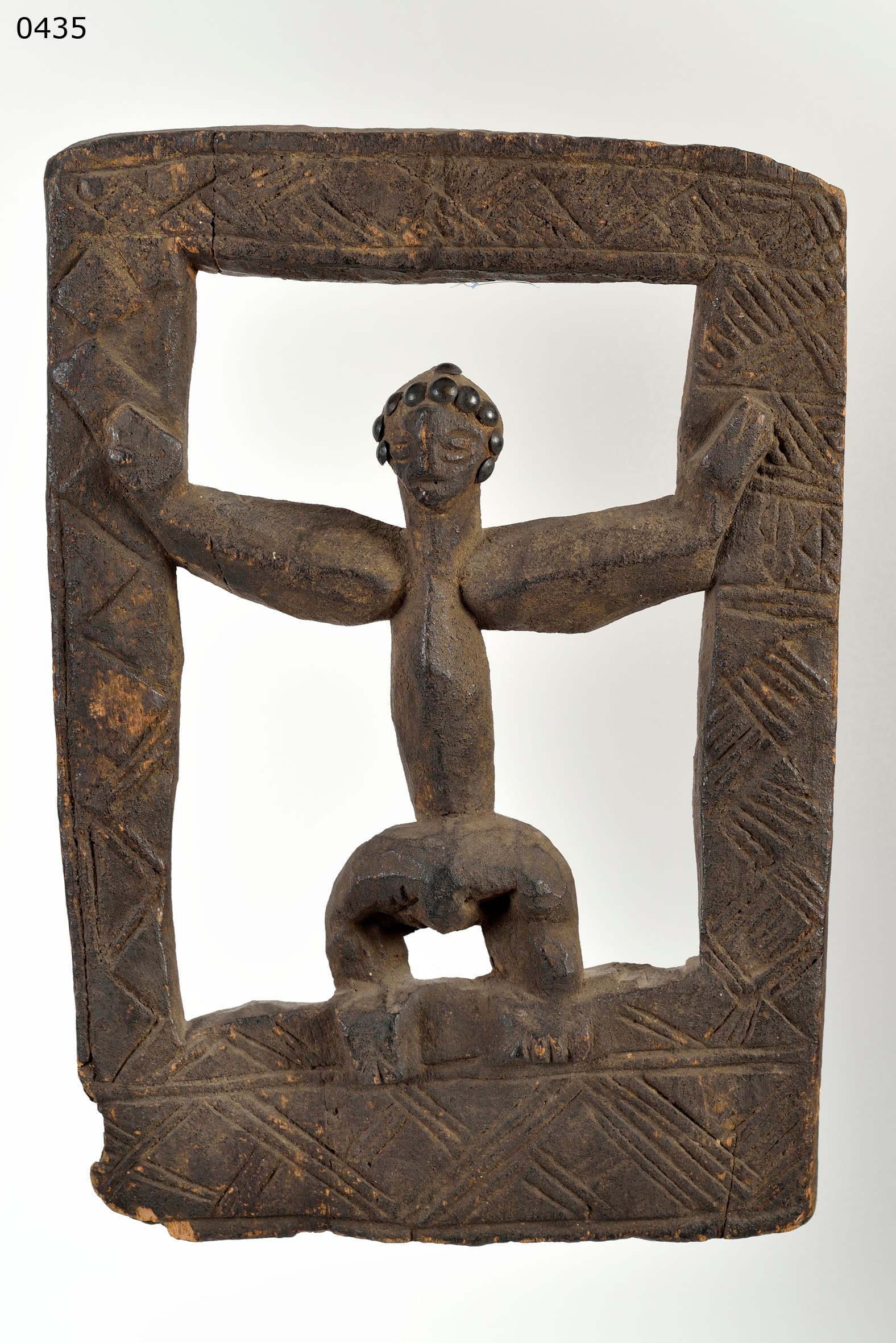
The aesthetic production of the Yaka is characterised by a highly stylised, expressive canon that is considered unmistakable in African art history. The material culture is rich, but the canonical object typology is primarily centred on the masks of the N-Khanda initiation complex, figurative sculptures (Biteki and Phuungu), polychrome chiefdom divination figures, Pfemba mother-and-child sculptures, and functional ritual and prestige items such as carved neck supports and slit drums (Mukoku).
The structural morphology of the masks can be divided into four distinct categories: 1) constructions of diverse materials applied to a net-like headdress; 2) constructions built on a rod frame and connected to a plank-like, wooden face; 3) helmet masks carved monolithically from a block of wood; and 4) large-scale, isolated wooden face deities. Within these structural categories exists a specific iconographic nomenclature. The Kakuungu mask (sometimes referred to as Kazeba) is a massive, often larger-than-life face with exaggerated cheeks and a pronounced chin that primarily fulfils apotropaic functions. The Mweelu mask, on the other hand, is a construction made of woven fibres, often with a hornbill beak made of wood or gourd. The Ndeemba masks are characterised by an abstracted human face, usually surmounted by a complex helmet or pagoda-like structure from which phallic rods or inverted cones protrude. Kholuka masks (often synonymous with mbaala) form the pinnacle of narrative expressivity, which captivate with explicitly didactic, often sexually connoted tableaus on the head section - such as depictions of copulation or masturbation - and serve to instruct the boys. The animal head masks (tsekedye) form the lowest hierarchical level and visualise animalistic, uncivilised instincts that are to be domesticated through the ritual.
| Typology and iconography of initiation masks | Iconographic specification and function |
|---|
| Kakuungu / Kazeba | Massive wooden face, drastically exaggerated features. Apotropaic, in possession of the Isidika, wards off witchcraft and keeps non-initiates away. |
| Ndeemba | Abstract wooden face with raphia collar, pagoda-like superstructures, phallic elements. Celebrates the boys' change of status. |
| Mweelu | Fibre weave, often with hornbill beak. Protects the camp, authorises the ritual theft of food from neighbouring villages. |
| Kholuka (Mbaala) | Polychrome face, pronounced spherical eyes, tableaus on the top of the head (often sexualised). Didactic mask for conveying moral and gender concepts. |
| Tsekedye | Leather or fibre-based animal representations. Represent uncivilised instincts; lowest level of prestige. |
The canon of proportions of Yaka facial depictions is unmistakable. The absolutely dominant feature is the extremely prominent, often strongly upturned nose ("hooked nose"). The iconography of this detail is discursive; some anthropologists interpret this characteristic as an allusion to the trunk of an elephant, a symbol of unbridled strength, endurance and virile longevity. Other canonical constants include elongated, narrow eyes or, in contrast, extremely protruding, spherical eyes in certain mask types, which are interpreted as a reference to lunar cycles and the feminine element. Open mouths that expose prominent rows of teeth and protruding ears complete the impression of extraordinary animalistic energy and alertness. The choice of materials for sculptures is mostly limited to soft, easy-to-work woods (such as Ricinodendron rautanenii or Alstonia boonei), combined with raffia, wickerwork, leather and plant fibres. The polychromy is essential and is mainly limited to red (tukula), white (kaolin) and black or indigo blue earth pigments.
There is a fundamental ontological difference between the profane, freshly carved object and the activated ritual object (nkisi). The carving itself has no inherent sacred value. The transformation is carried out exclusively by the divinator, who introduces magical-medicinal substances - the bilongo - into specific body cavities of the figure (mostly in the abdomen, sometimes also on the head). These charges, consisting of earth, claws, bone fragments, plants and organic materials, are then sealed with a resin plug. Without this activation, the sculpture is ineffective; with it, it becomes an accumulator of spiritual power, capable of healing or punishing.
The attribution of Yaka artworks to specific master craftsmen or regional workshops is the scene of intense scholarly controversy. In his seminal catalogue Art of the Yaka and Suku (1984), the American art historian Arthur P. Bourgeois established a strict morphological classification in which he divided the artworks into around six distinct regional sub-styles. Later research, above all by Constantin Petridis, criticised this approach as too rigid and severely problematised the selectivity of these sub-styles. Petridis uses detailed style analyses to argue that the fluid migration patterns, marriage practices and extensive trade networks in the Kwango-Kwilu Basin led to continuous stylistic overlaps. Many pieces show hybrid forms that integrate anatomical features of the Beembe, Teke, Kongo or Hemba. The sources for the exact geographical localisation of workshops on the basis of purely stylistic parameters are therefore increasingly ambiguous and are being critically questioned in current museum discourses.
Due to the enormous popularity of the Yaka aesthetic among Western private collectors, a massive volume of market copies has been established since the 1970s. Market-relevant forgery criteria focus on the development of patina and organic traces of ritual use. Authentic pieces from the pre-1930 era, such as those found in the Bourgeois collection of the QCC Art Gallery or in the Musée du quai Branly, show a deep, organically built-up patina resulting from decades of libations of palm oil, blood, tukula and earth. Forensic examinations of genuine ritual objects also reveal deep cracks in the heartwood caused by natural dehydration in a humid tropical climate, authentic termite damage that has not been simulated by modern mechanical tools, and remnants of the resinous Bilongo sealant. Many commercial replicas fail to correctly construct the basketwork-like substructures of the masks or show a too homogeneous, artificially applied surface treatment.
Ritual practice
The ritual performance and handling of Yaka objects are deeply embedded in the social and cosmological cycles of the community. The life cycle of a ritual object, especially the N-Khanda masks, follows a precise dramaturgy from profane creation to sacred use and eventual disposal.
The genesis of a mask begins in the liminality of the initiation camp. Before the rites are completed and the public celebrations begin, the Kahyuudi (the camp's leading teacher) commissions a specialised carver, the Nkalaweeni or Mvumbwa, to make a series of masks. The older initiates often actively participate in the construction process of the raffia and basket weave masks under supervision, as part of their craft and ritual training. After the purely physical completion, the ritual activation takes place to transform the wood from a mere object into a vehicle of spiritual power.
The use of altar statues (phuungu) and biteki requires a continuous protocol of care and interaction. These statues, often positioned under small shelters at the entrances of chiefdoms, serve to protect the lineage. Their power is not static, but must be regularly reactivated by the diviner. This is primarily done through offerings (libations). The occasions for this are manifold: before the start of a collective hunt, to ward off epidemic diseases or to sanction legal decisions, the objects are doused with the blood of sacrificial animals and rubbed with a mixture of red camwood powder (tukula) and palm oil. Over the decades, this ritual feeding leaves behind the thick, encrusted patina that characterises authentic pieces.
The mask performances reach their climax at the end of the N-Khanda cycle, when the initiates are symbolically reintegrated into the village community as adult men. The choreography of the dances varies greatly depending on the type of mask and regional variation. The massive Kakuungu mask is not danced for entertainment; its handling is reserved for the Isidika (ritual specialist). It is used to demarcate the ritual space, keep women away and ward off witchcraft (Kindoki). In stark contrast to this is the Mweelu mask, worn by an older initiate, whose wearer is sanctioned to break the social taboo of theft in order to confiscate food for the camp in the neighbouring villages. The educational finale is formed by the dances of the Kholuka and Ndeemba masks. The dancers, clad in expansive costumes made of raphia fibres that completely dissolve the human contour, interact with the audience. They translate the sung didactic poems of the initiation camp into performative gestures and pantomime scenes that illustrate complex social obligations, morals and gender dynamics.
The end of the life cycle of a ritual object is the subject of anthropological observation and marks a further blurring of research. The source situation is ambiguous with regard to the standardisation of disposal. The classical ethnographic literature postulates that N-khanda masks were strictly ephemeral in conception. As they embodied liminal entities, they were historically ritually burnt together with the structures of the initiation camp at the end of the festivities or left to decay naturally in the bush to prevent contamination of everyday village life. However, other evidence and field research reports indicate significant deviations: Particularly impressive specimens or those that had proved exceptionally powerful in times of crisis were recontextualised. They escaped destruction, were elevated to the status of shrine figurines, kept in the homes of high-ranking officials and repeatedly repainted with kaolin and tukula over generations. The mere existence of historical Yaka masks from the early 20th century in the holdings of the Brooklyn Museum (e.g. inv. no. 73.179.3) or the RMCA proves that the practice of destruction was either not absolute or was interrupted early on by the acquisition of Western collectors.
Historical context
The historical development of the Yaka and the genesis of their art forms are inextricably linked to the far-reaching migration and conquest dynamics of Central Africa. The chronology of the colonisation of the Kwango-Kwilu basin by the Yaka is characterised by dating controversies, but there is a consensus that the decisive political transformation took place in the late 16th to mid-17th century. During this period, the Lunda Empire expanded under the leadership of warlords who left the heartland (Musumba). The charismatic leader Mwene Putu Kasongo crossed the Kwenge River with his followers - a logistically and emotionally significant event in oral history, during which his brother Mwaku drowned in the falls. Kasongo subjugated the indigenous populations on the right bank of the Kwango, including the Tsaam and early Suku groups, and installed the hierarchical, militarised state structure of the Lunda.
This newly formed Yaka state established itself as an aggressive hegemon and economic "broker state" in the 18th and 19th centuries. In order to control the lucrative trade with the Atlantic coast, the Kiamfu secured an absolute monopoly on ivory and slaves. They strictly prevented Portuguese and Angolan traders (the Pombeiros) from crossing the Kwango and instead organised their own devastating slave raids into the Pende, Mbala and Mbuun regions. These forced population displacements caused massive socio-political trauma, but at the same time catalysed an intense stylistic transfer that still characterises the hybridity of Central African savannah art today.
| Historical Chronology | Event and Relevance |
|---|
| Late 16th / 17th century | Lunda expansion; Mwene Putu Kasongo crosses the Kwenge and founds the Yaka state. |
| 18th century | Establishment of the Yaka state as a hegemonic broker state; monopoly in the ivory and slave trade. |
| From approx. 1890 | Beginning of the Belgian colonial encounter; restriction of Kiamfu authority. |
| Early 20th century (pre-1930) | First systematic ethnographic collections by Leo Frobenius, Leo Bittremieux and missionaries. |
| 1938/39 | Field research by ethnologist Hans Himmelheber; documentation of art production in situ. |
| Post-1970 | Boom in the international art market; mass production of forgeries for export. |
The direct colonial encounter, primarily with the Belgian colonial state (the Congo Free State from 1885), led to the gradual disempowerment of the Kiamfu and their integration into the administrative colonial system. The influence of colonial history on art production was drastic. The introduction of the European monetary economy, Christian missionary work and colonial taxation systems undermined the traditional patronage networks that had previously financed carvers. Even more serious were the endogenous "anti-fetish" movements, partly catalysed by colonial pressure. Similar to the iconoclastic massa cults in West Africa, prophetic revivalist movements in the Congo forced the population to burn their ancestral figures and ritual minkisi en masse or hand them over to the missionaries in order to purify themselves of supposedly ominous witchcraft. This iconoclasm considerably decimated the stock of historical Yaka objects in situ.
At the same time, the market history of Yaka art began in the West. Even before 1930, significant artefacts were brought to Europe by traders, military personnel and missionaries - such as Léo Bittremieux, who collected for the RMCA in Tervuren. A scientific milestone was the expedition of the German art ethnologist Hans Himmelheber in 1938/39. Himmelheber's archive, which is now kept at the Museum Rietberg in Zurich, not only includes hundreds of artefacts, but also photographs and diaries that document the production conditions and social status of the carvers in detail before the Second World War.
The absolute breakthrough on the Western art market came in the late 1960s and 1970s. Catalysed by landmark auctions at Sotheby's and Christie's as well as exhibitions that finally elevated African artefacts from the status of ethnographic curiosities to high-priced "primitive art", prices exploded. Genuine Yaka-Pfemba figurines or important helmet masks realised record sums.
These astronomical market values, however, evoked a massive counterfeiting problem. As authenticated pieces created before 1930 are extremely rare, the market was flooded with an immense volume of freshly carved, artificially aged Yaka objects from the late 1970s onwards. The establishment of rigorous authenticity criteria is therefore essential for collectors and institutions. Forensic analyses focus on the evidence of natural ageing processes: An authentic ritual patina has organically penetrated deep into the wood structure and cannot be adequately reproduced by superficial acid or mud baths in the forger's workshops. Deep heartwood cracks, caused by slow, decades-long drying out of the wood in the tropical climate, as well as authentic termite damage, which traces the inner grain of the wood and was not applied by modern mechanical tools, are considered primary indicators of age. The examination of the ritual vita is also decisive: a genuine Yaka figure has cavities that contain forensically detectable traces of resin and the organic remains of the Bilongo seal; a feature that is consistently absent in purely profane market carvings.