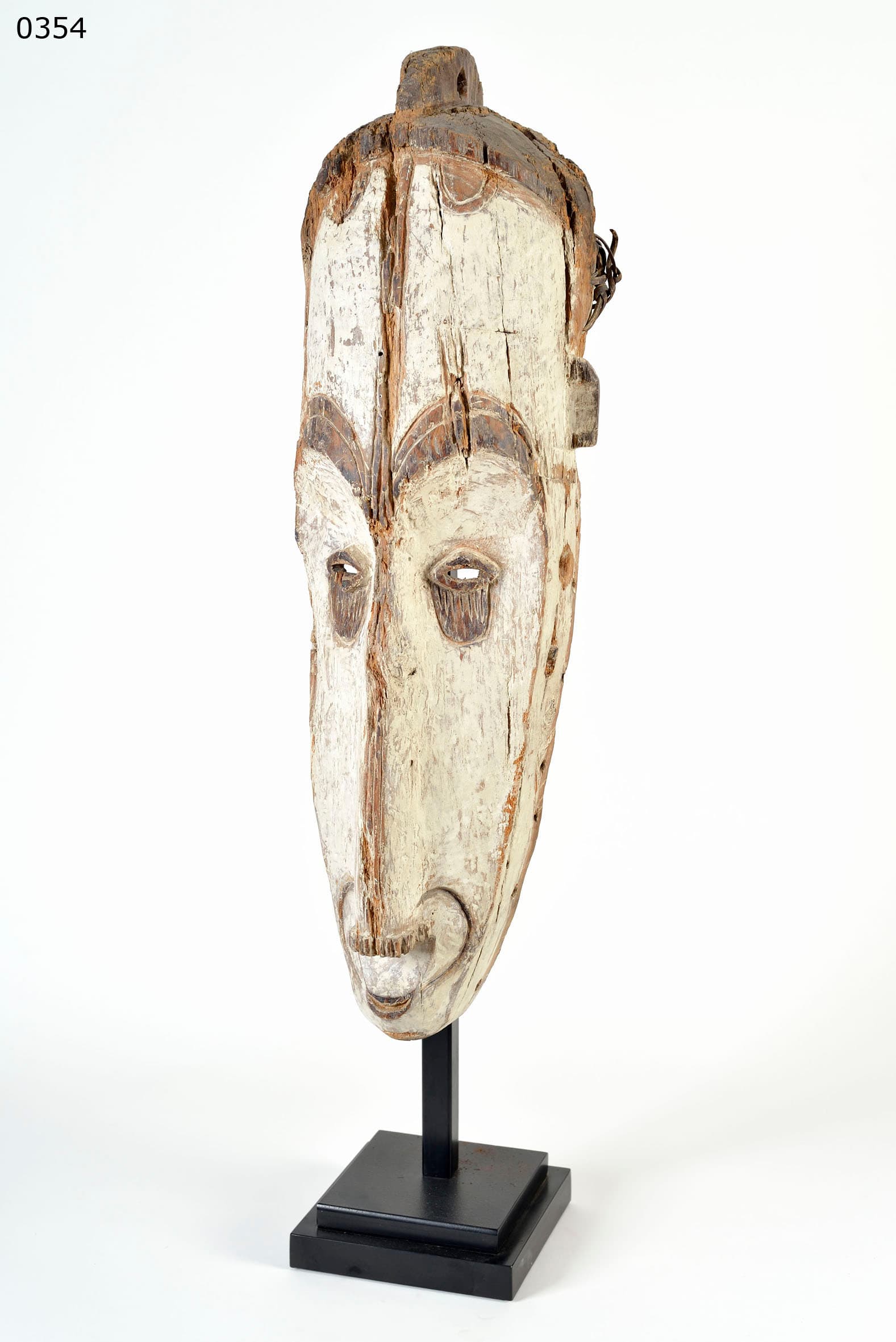
Eine sehr langgestreckte, äußerst minimalistische Fang Ngil-Maske (frühes 20. Jh., 60 cm) aus Gabun - vollständig mit strahlend weißem Kaolin-Ton überzogen, mit durchgehend geschwungener herzförmiger Brauenlinie, winzigen geschlitzten Augen und einer bemerkenswert langen, schlanken Nase.
1. Der Höhepunkt des gabunischen Minimalismus
Die Fang Ngil-Maske ist eine der ikonischsten, weltweit einflussreichsten und brutalsten minimalistischen Formen in der gesamten afrikanischen Kunst.
- Anklänge an die Moderne: Die Form hat die europäischen Modernisten des frühen 20. Jahrhunderts, darunter Modigliani, stark beeinflusst.
- jahrhunderts, darunter Modigliani. Mathematische Symmetrie: Der Künstler verzichtet auf jeglichen Naturalismus zugunsten extremer dramatischer Verlängerung und absoluter mathematischer Symmetrie - die hoch aufragende, kontinuierliche Linie der Stirn, die in die verlängerte Nase übergeht, schafft ein Antlitz kühler, gefühlloser, unantastbarer Autorität.
2. Der Terror der Ngil-Gesellschaft
Dies ist eine Maske des absoluten Justizterrors.
- Inquisitorische Polizei: Die Ngil (Gorilla) Geheimgesellschaft fungierte als primäre Polizei und inquisitorische Kraft unter den Fang - getragen von Männern, die als Agenten der Ahnen agierten, wurden die Masken ausschließlich nachts getanzt.
- Tod-weiße Beleuchtung: Das strahlend weiße Kaolinpigment steht für die Farbe des Todes und der Geisterwelt. Die Maske, die aus dem pechschwarzen, nur von Fackeln beleuchteten Dschungel auftaucht, sollte Verbrecher, Hexen und Eidbrecher in Angst und Schrecken versetzen und zu einem sofortigen, zitternden Geständnis führen.
3. Charakteristische Kaolin-Patina
Die Beschaffenheit der Oberfläche spricht für ein hohes Alter und eine traditionelle Verwendung.
- Rubbed Clay, Not Paint: Das weiße pemba Kaolin ist keine moderne dicke Farbschicht, sondern ein trockener pulverförmiger Ton, der tief in die poröse Holzmaserung eingerieben wurde.
- Rauch- und Schweißflecken: Das Pigment ist stark abgenutzt, durch Rauch, Schweiß und Zeit befleckt - besonders an den Rändern und der verlängerten Nase, wo die Maske wiederholt angefasst wurde. Das dunkle oxidierte Holz zeigt Gebrauchsspuren, die eine traditionelle Nutzung nahelegen.
Zusammenfassung
Diese Fang Ngil-Maske, ein eindrucksvolles Beispiel afrikanischer minimalistischer Abstraktion, gilt als Instrument traditioneller richterlicher Macht. Ihre ausgeprägte, langgestreckte Geometrie und die charakteristische, rauchfarbene Kaolinpatina machen sie zu einem bedeutenden Zeugnis dieser Schnitzkunst.
KI-unterstützt erstellt aus Sammlungsgutachten, Objektfotografie und eigener Recherche, redaktionell geprüft. Fehler sind möglich — Hinweise darauf sind uns willkommen. Zum Verfahren →