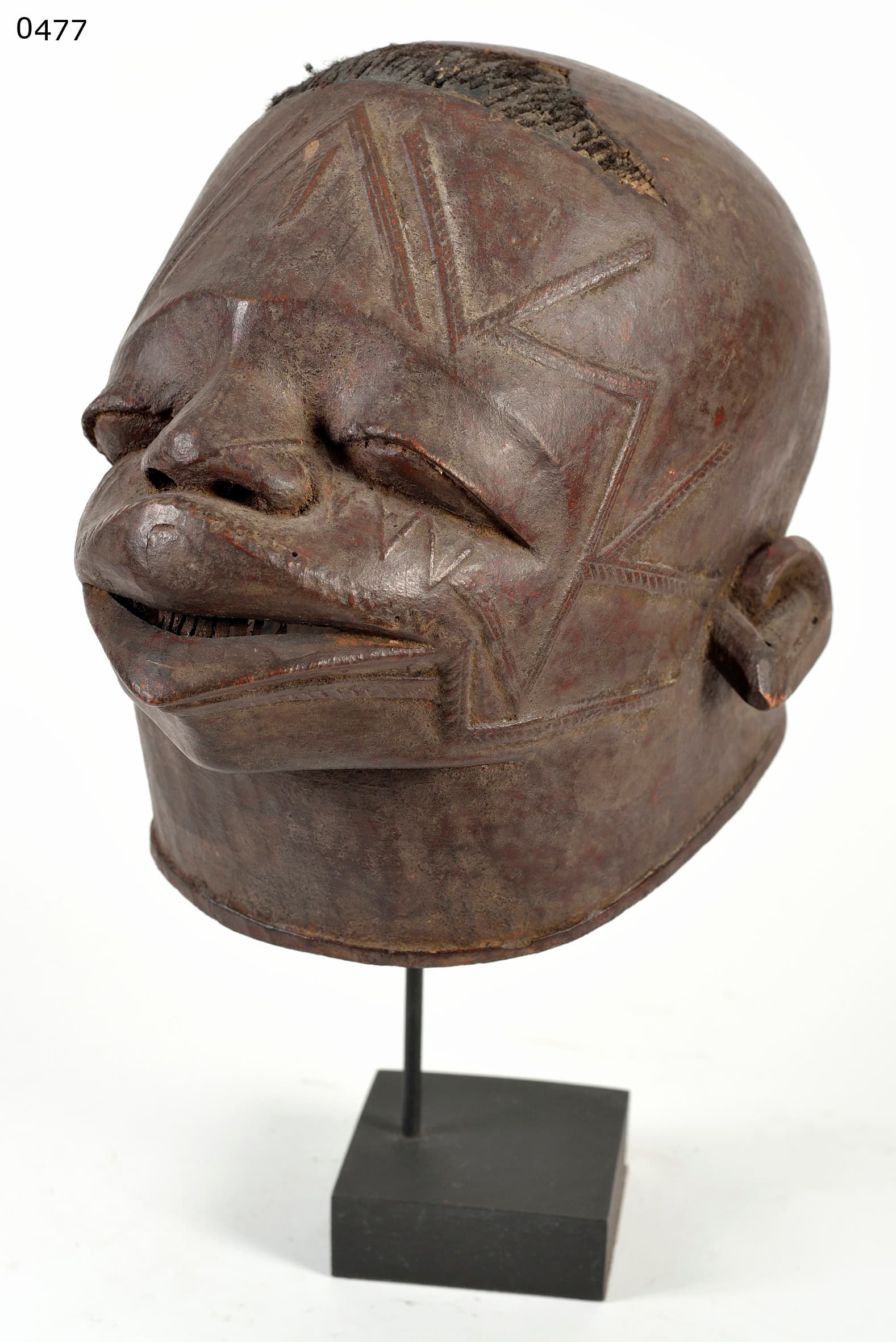
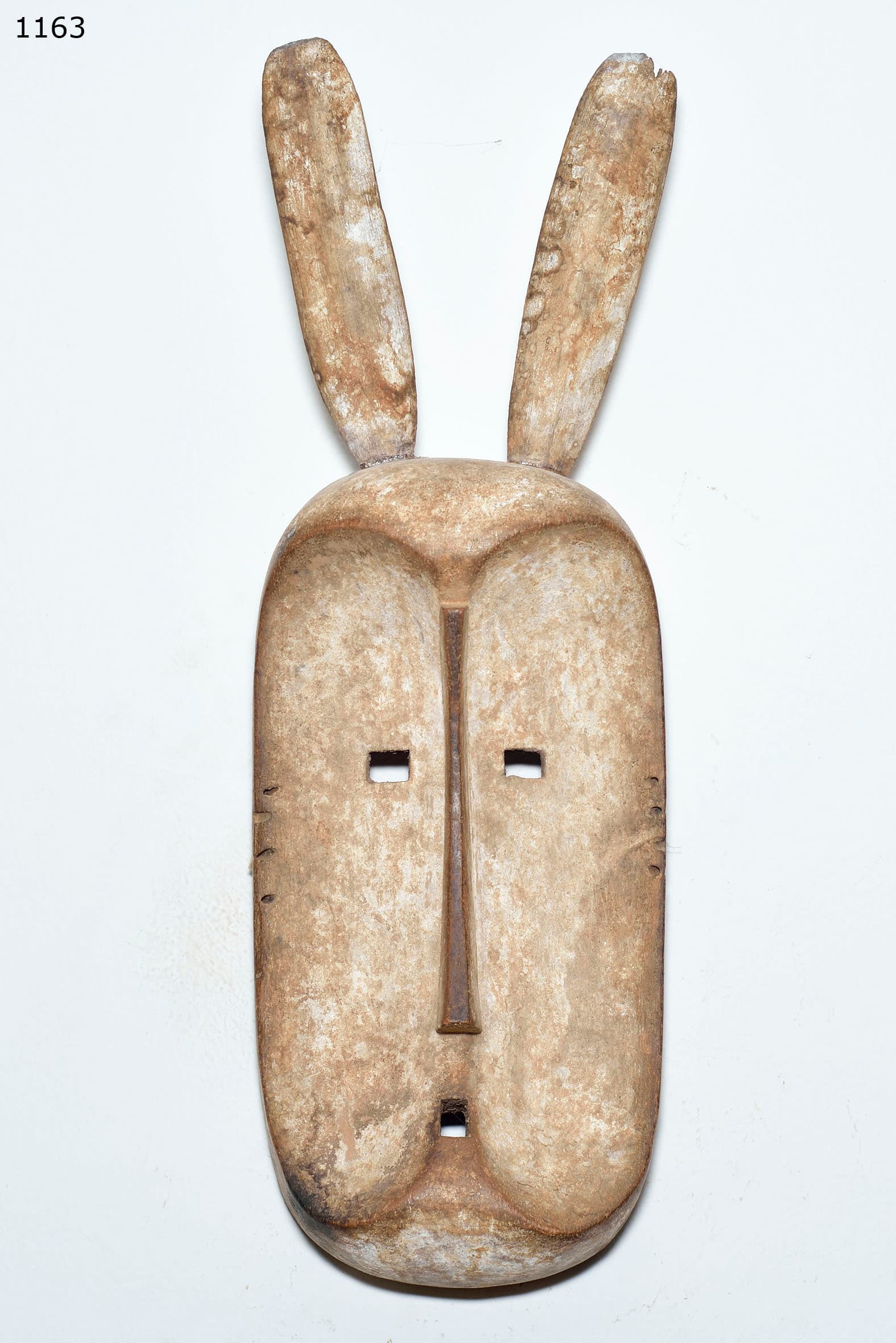
Diese kleine Gesichtsmaske gehört zu den Maskentraditionen der Rovuma-Region an der Grenze zwischen Tansania und Mosambik, einem Gebiet, das sich die Makonde mit ihren Nachbarn Makua, Yao und Mwera teilen. Sammler und Museumskataloge fassen diese eng verwandten Werkstätten als Makonde-Komplex zusammen, weil einzelne Stücke selten eine sichere Zuschreibung an ein einzelnes Volk erlauben.
1. Applizierte Wachs-Tätowierungen
Das aussagekräftigste Merkmal ist der Wangenschmuck. Die Punktreihen sind nicht geschnitzt. Es sind kleine Tropfen aus geschwärztem Bienenwachs, auf das Holz gedrückt, die die erhabenen Gesichtstätowierungen (dinembo) wiedergeben, wie sie in der Region bis zur Mitte des 20. Jahrhunderts getragen wurden. Ein Band aus demselben dunklen Material zieht sich über die Stirn. Aufgesetzter Wachsschmuck dieser Art ist ein Kennzeichen der Schnitzkunst des Makonde-Komplexes und gehört nicht zur Chokwe-Tradition Angolas, der die Maske früher zugeordnet war.
2. Form und Oberfläche
Das Gesicht ist ein kompaktes Oval von 18 cm Höhe mit gewölbter Stirn, schmalen Schlitzaugen in flachen, konkaven Augenhöhlen, langer gerader Nase und vorstehendem rechteckigem Mund. Kleine blockartige Ohren mit durchbohrten Läppchen stehen vom Kopf ab; Ohrdurchbohrung und Ohrpflöcke waren in der Region verbreiteter Körperschmuck. Die Oberfläche trägt ein mattes rotbraunes Pigment mit dunkleren Akzenten an Mund und Brauen. Abrieb am Rand und in den Augenschlitzen spricht eher für Gebrauch als für reine Zierde.
3. Gesichtsmasken im Makonde-Komplex
Die Makonde sind vor allem für die Helmmaske lipiko bekannt, die bei den mapiko-Initiationstänzen oben auf dem Kopf des Tänzers getragen wird. Gesichtsmasken, die die Vorderseite des Kopfes bedecken, bilden eine zweite, weniger erforschte Gruppe, häufiger bei den tansanischen Makonde und ihren Nachbarn Makua und Mwera; die Makonde selbst betrachten sie mitunter als übernommene Form (Kingdon 2002; Israel 2014). Sie traten im selben Rahmen von Initiations-, Ernte- und Totentänzen auf, getragen mit einem Stoff- oder Faserkostüm, das den Tänzer verhüllte.
Zusammenfassung
Die in Wachs applizierten Tätowierungspunkte, die durchbohrten Blockohren und das kleine ovale Format verorten diese Maske im Makonde-Komplex der Rovuma-Region und nicht in Angola. Die Maske war bei Aufnahme in die Sammlung als Chokwe katalogisiert; die Zuschreibung wurde im September 2026 nach dem Hinweis eines Lesers korrigiert.
KI-unterstützt erstellt aus Sammlungsgutachten, Objektfotografie und eigener Recherche, redaktionell geprüft. Fehler sind möglich — Hinweise darauf sind uns willkommen. Zum Verfahren →