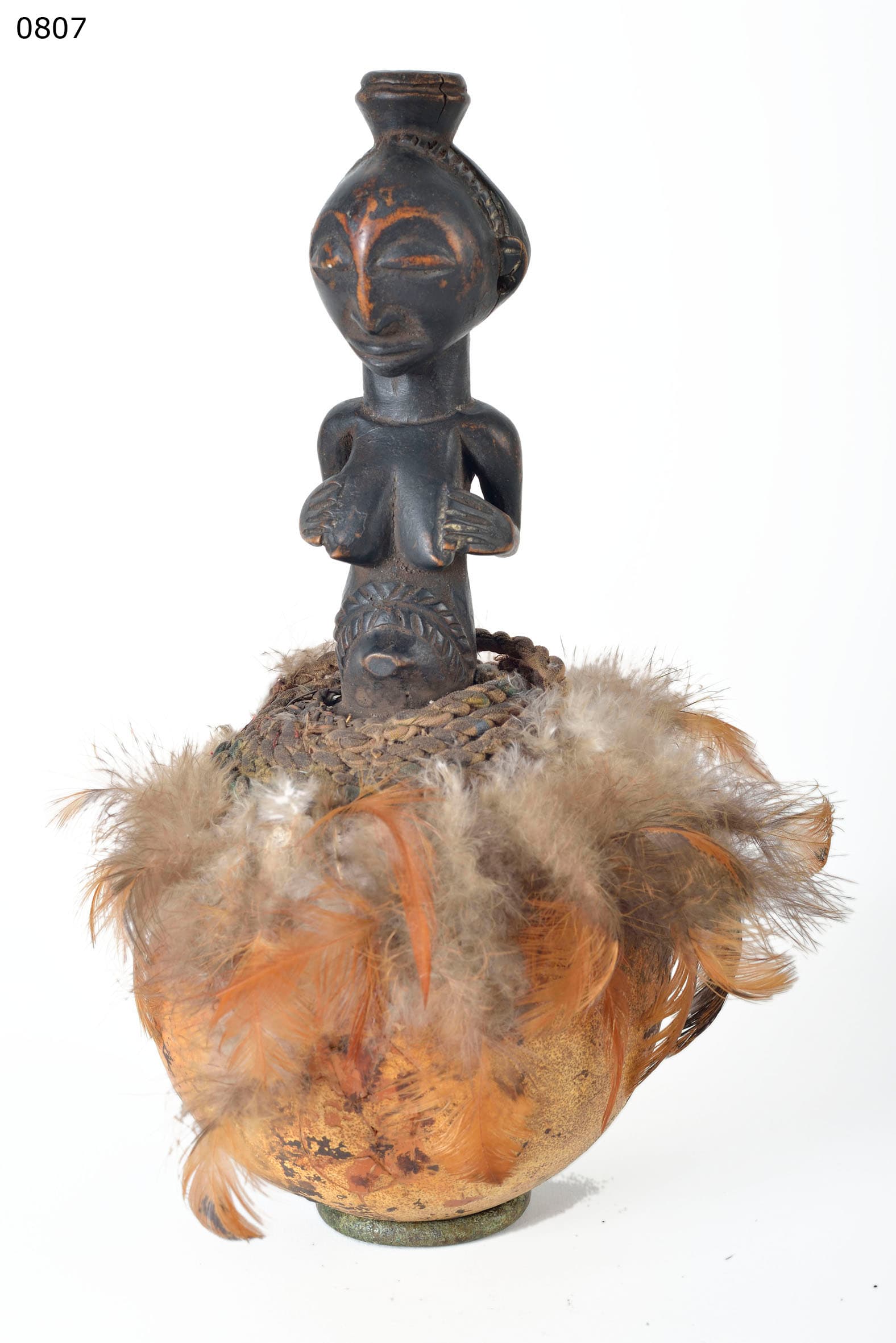
Ein elegant proportionierter Hemba Singiti (wohl 1. Hälfte 20. Jh., 56 cm) aus der DR Kongo - eine männliche Figur, die mit den Händen auf einem runden, vorgewölbten Bauch steht, das Gesicht ein Bild großer Gelassenheit mit geschlossenen, niedergeschlagenen Augen, gekrönt von einer aufwändig geschwungenen, kreuzförmigen Frisur, das dunkle Holz hochglanzpoliert, die Figur trägt eine echte organische (Stoff/Leder) Umwicklung um die Taille.
1. Die Bände Singiti Ideal und Klassischer Hemba
Die Hemba (historisch mit den Luba kategorisiert) werden allgemein für die Herstellung der Singiti gefeiert - die als ein Höhepunkt der klassischen idealisierten afrikanischen Porträtkunst gelten.
- Erhabene volumetrische Ausgewogenheit: Ausgewogenheit der abgerundeten, anschwellenden Volumina - von der gewölbten Stirn und den gelassenen Augen mit schweren Lidern bis hin zum stolz aufgeblähten Bauch und den muskulösen Schenkeln.
- Aristokratische Kreuzfrisur: Die hochkomplexe, nach hinten geschwungene, kreuzförmige Frisur ist ein Markenzeichen der hochrangigen Hemba-Aristokratie - akribisch geschnitzt, was traditionell die Eleganz und kultivierte Anmut des Stammesgründers signalisieren sollte.
2. Bvidye und das Mausoleum der Könige
Diese Skulptur wird als Singiti interpretiert - ein physisches Gefäß für den Geist eines Ahnenhäuptlings (fumu).
- Gräbermausoleum: Wurde traditionell nicht in einem gewöhnlichen Haus aufbewahrt, sondern in einem speziellen Gräbermausoleum oder Schrein neben den Statuen seiner Vorgänger.
- Nabelkontinuität: Die Haltung - die Hände umrahmen den Nabel - ist in der Luba-/Hemba-Kosmologie zutiefst symbolisch und steht für die Kontinuität der Abstammungslinie, die vergangene, gegenwärtige und künftige Generationen durch das Nabelzentrum des Ahnen verbindet. Dem Glauben nach wohnte der Geist des Häuptlings (bvidye) in dem Holz und leitete den aktuellen Herrscher in Fragen des Krieges und der Gerechtigkeit.
3. Spiegelpolitur und Intimpflege
Die Oberfläche zeigt eine dichte und charakteristische Patina.
- Tiefe Spiegelpolitur: Eine ausgeprägte, dunkle, hochreflektierende Politur - eine Patina, die auf einen langwierigen Entstehungsprozess hindeutet.
- Jahrzehntelange pietätvolle Pflege: Dies spricht für eine über lange Zeit fortgeführte Pflege im 20. Jahrhundert - Schreinwächter wuschen die Statue wiederholt, rieben sie mit feinem Palmöl ein und polierten sie mit weichen Tüchern, um den Ahnen zu ehren und seine Haut glänzend zu erhalten. Das Überleben der organischen Hüftumhüllung ist vereinbar mit einer längeren Aufbewahrung in einem traditionellen Heiligtum.
Zusammenfassung
Der Hemba Singiti gilt als ein bedeutendes Zeugnis der klassischen afrikanischen Porträtkunst, und diese Figur zeigt die charakteristischen, heiteren Züge dieser Tradition. Ihr ausgewogenes volumetrisches Gleichgewicht und ihre glänzende Politur machen sie zu einem bemerkenswerten Objekt für anspruchsvolle ethnografische Sammlungen.
KI-unterstützt erstellt aus Sammlungsgutachten, Objektfotografie und eigener Recherche, redaktionell geprüft. Fehler sind möglich — Hinweise darauf sind uns willkommen. Zum Verfahren →