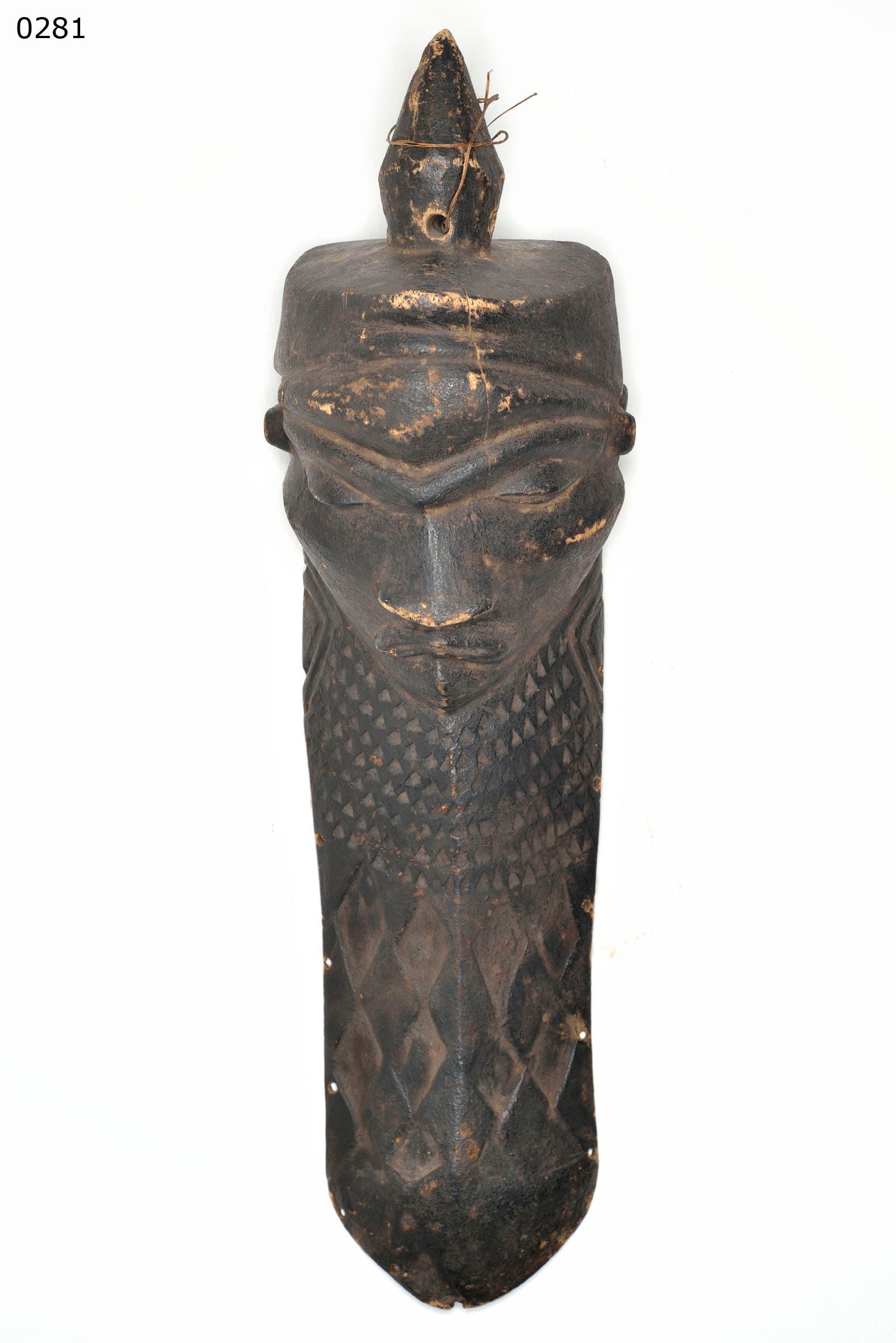
Eine auffällige rechteckige Pende-Architekturtafel (1. Hälfte 20. Jh., 91 cm) aus der Demokratischen Republik Kongo - ein hochrelief geschnitztes Gesicht in der Mitte, das die klassische Pende-Einheitsbraue und dreieckige Nase zeigt. Die Platte, die das Gesicht umgibt, ist mit Hunderten von ineinandergreifenden geometrischen Dreiecken sorgfältig geschnitzt, die abwechselnd in verblassten Rot-, Weiß- und Schwarztönen bemalt sind.
1. Architektonische Polychromie und die Mbuya-Ästhetik
Die Pende sind für ihre ausdrucksstarken Mbuya-Masken bekannt; dieses Objekt veranschaulicht die Übertragung dieser Porträtkunst auf groß angelegte Architektur.
- Klassische V-Braue + dreieckige Nase: Der Künstler hat ein klassisches Pende-Gesicht - die schwere, durchgehende V-förmige Braue, die nahtlos in die scharfe, dreieckige Nase übergeht - in Hochrelief aus dem schweren Holz geschnitzt.
- Geometrischer Wandteppich: Die umgebende Tafel zeigt ein komplexes kongolesisches geometrisches Design - tief eingeschnittene, ineinandergreifende Dreiecke, die ein rhythmisches Zusammenspiel aus Farbe und Schatten schaffen.
2. Der Kikumbi und die Einweihung Prestige
Eine massive, 91 cm große, verzierte Tafel hatte über die reine Dekoration hinausgehende Bedeutung als architektonisches Element.
- Sturz für die Häuptlings- oder Initiationshütte: Diente wahrscheinlich als Türsturz oder Türrahmen für die Wohnung eines Häuptlings oder eine Kikumbi (die heilige Initiationshütte für junge Knaben) - das geschnitzte Gesicht fungierte als Wächter der Ahnen, der über die Schwelle wachte.
- Geometrischer Schutz durch Schuppentiere/Leoparden: Die komplizierten geometrischen Dreiecke (Minganji-Motive) sind zutiefst symbolisch - sie stellen oft Schuppentiere oder Leopardenflecken dar und stehen für die gefährliche Schutzmagie der Wildnis, die den heiligen Initiationsraum vor weiblichem Eindringen und Hexerei bewahrt.
3. Umweltbedingte Austrocknung und verblasste Pigmente
Die Patina spricht für eine Exposition im frühen 20.
- jahrhunderts. Exterior Mounted Exposition: Da es vermutlich auf der Außenseite einer Struktur montiert wurde, ist das Holz trocken und oxidiert - mit stabilisierten Austrocknungsrissen, die in Längsrichtung über die Platte verlaufen.
- Sonne + Regen Gebundene Pigmente: Natürliche erdbasierte rote, weiße und schwarze Pigmente sind aufgrund von Witterungseinflüssen verblasst und abgeblättert und fest mit der Struktur des gealterten Holzes verbunden – ein charakteristischer Alterungsprozess.
Zusammenfassung
Dieses architektonische Pende-Paneel zeigt eine harmonische Verbindung von hochreliefierten Ahnenporträts und polychromem geometrischem Design. Die ausgeprägten Spuren von Umwelteinflüssen und die verblassten einheimischen Pigmente stützen eine Zuordnung zum Kontext kongolesischer Initiationsriten.
KI-unterstützt erstellt aus Sammlungsgutachten, Objektfotografie und eigener Recherche, redaktionell geprüft. Fehler sind möglich — Hinweise darauf sind uns willkommen. Zum Verfahren →