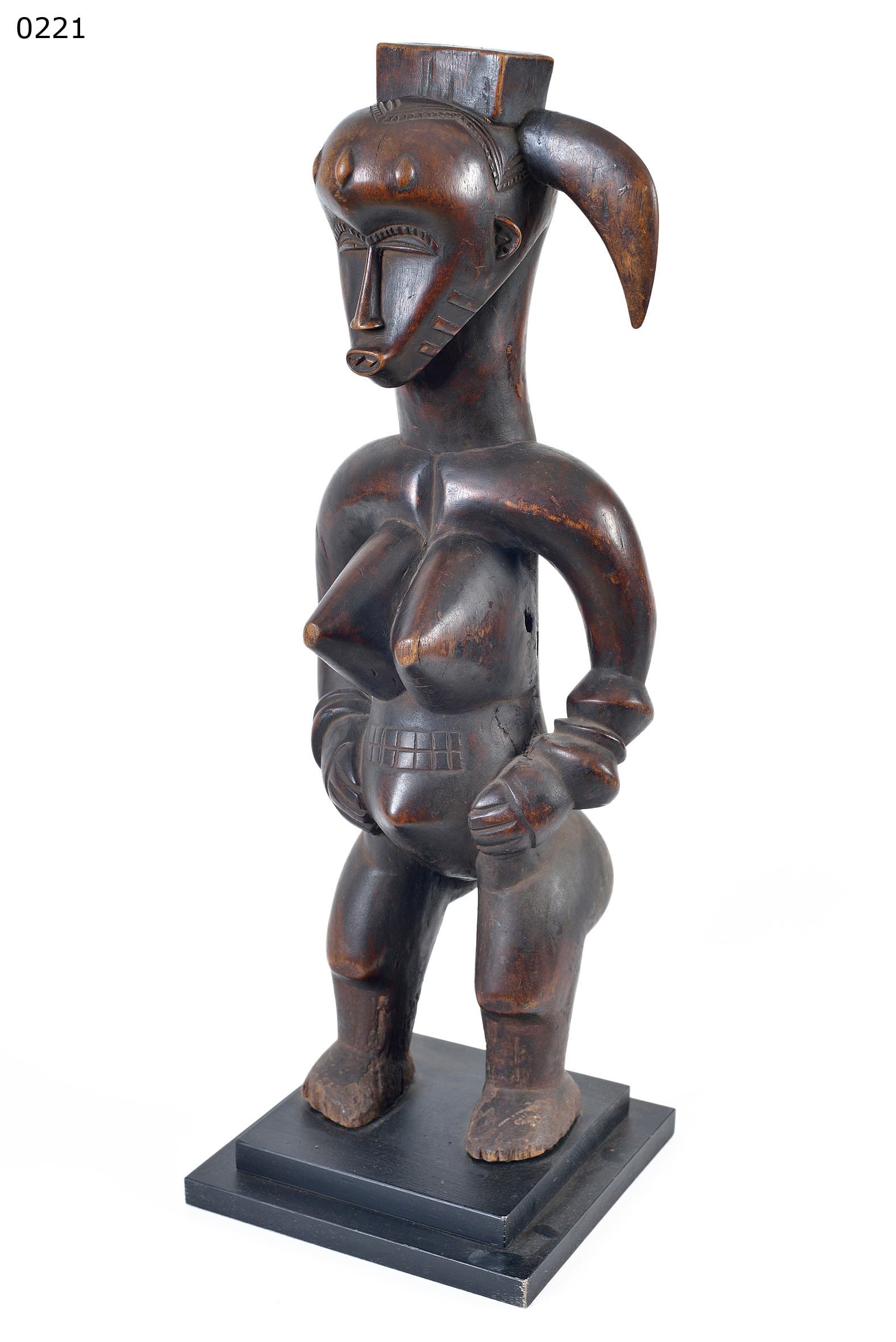
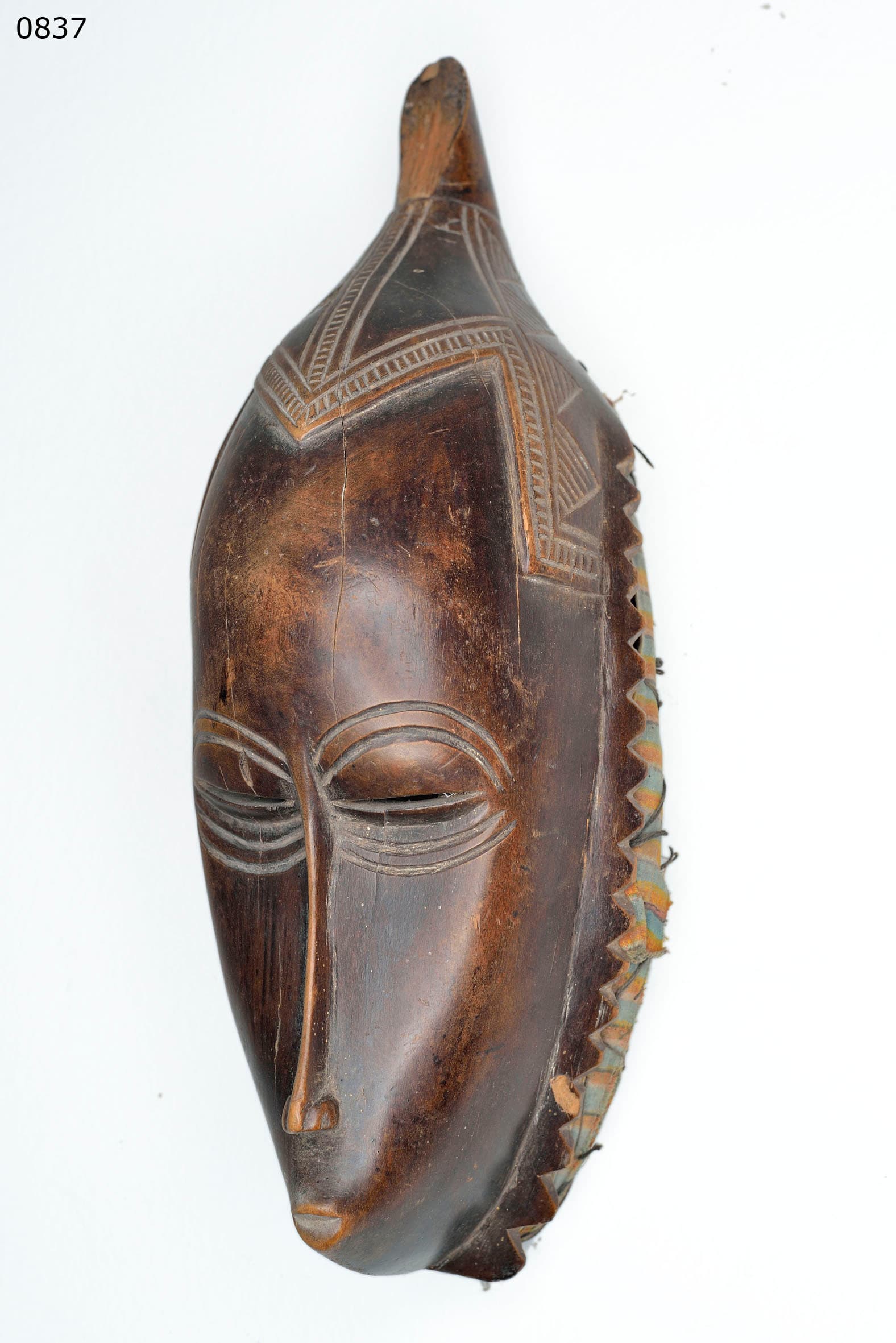
Dieses Paar geschnitzter hölzerner Webstuhlrollen hat eine stabile U-förmige Basis, wobei die kleinere ihre ursprüngliche, durch Reibung abgenutzte hölzerne Rolle beibehält und die größere mit einem eleganten, gehörnten zoomorphen Endstück und eingeschnittenen geometrischen Mustern versehen ist. Beide Stücke weisen eine dunkle, stark oxidierte Holzmaserung mit glatten, bearbeiteten Highlights auf.
1. Ästhetischer Stil und regionale Eigenheiten
Das Volk der Guro von der Elfenbeinküste, das eng mit den Baule verwandt ist, ist bekannt für seine Fähigkeit, kleinen Gebrauchsgegenständen eine bemerkenswerte skulpturale Anmut zu verleihen. Dieses Paar gilt als ein charakteristisches Beispiel für ihre stilistische Bandbreite. Die größere Rolle zeigt einen stilisierten Tierkopf - wahrscheinlich eine Antilope oder eine Buschkuh - mit geschwungenen, eleganten Hörnern und einem fein geschnitzten Gesicht, das durch die rhythmischen, eingeschnittenen Kreuzschraffuren auf dem Joch ausgeglichen wird. Die kleinere Rolle verzichtet auf eine buchstäbliche Darstellung und bevorzugt eine straffe, architektonische Geometrie, die sich ganz auf das Gleichgewicht und das Gewicht der strukturellen Form konzentriert.
2. Rituelle Funktion und Geheimbund-Kontext
In der traditionellen westafrikanischen Gesellschaft ist das Weben von Baumwolle mit schmalen Streifen ein hoch angesehener, ausschließlich männlicher Beruf, der spirituell mit dem Akt der kosmischen Schöpfung gleichgesetzt wird. Diese Litzenrollen werden über dem Webstuhl aufgehängt, um die Schnüre zu halten, die die Kettfäden abwechselnd führen. Indem der Weber die Rollen mit zoomorphen Totems oder abstrakten Ahnenzeichen versieht, stellt er sicher, dass sein Webstuhl vor böswilligen Buschgeistern oder Hexerei geschützt ist, die die empfindlichen Fäden reißen lassen könnten. Das rhythmische, sich wiederholende Klacken der hölzernen Rolle wird als die physische Stimme des führenden Geistes angesehen, der die Hände des Webers unterstützt.
3. Physische Patina und Altersnachweis
Die Einordnung dieser Werkzeuge in das frühe bis mittlere 20. Jahrhundert wird durch ihre spezifische, funktionsbedingte Abnutzung gestützt. Die kleinere Rolle hat ihre ursprüngliche Holzspule bewahrt, die durch eine intensive Reibung an groben Baumwollschnüren tief gerillt und asymmetrisch abgenutzt ist. Beide U-förmigen Rahmen weisen glatte, abgestumpfte Abnutzungserscheinungen an den Innenwänden auf und sind an den Aufhängelöchern langgestreckt. Das Tropenholz ist im Laufe der Zeit stark oxidiert und hat sich von einer polierten Oberfläche in eine trockene, strukturierte und erdige braune Patina verwandelt, was auf eine langjährige Nutzung und Umwelteinflüsse hindeutet.
Zusammenfassung
Diese Guro-Litzenrollen sind feine Beispiele westafrikanischer Gebrauchskunst, die zoomorphe Eleganz mit handwerklicher Arbeit verbinden. Ihre detailreiche Miniaturschnitzerei und die ausgeprägte, von der Reibung der Schnur abgenutzte Patina machen sie zu bemerkenswerten Zeugnissen der Textilproduktion an der Elfenbeinküste.
KI-unterstützt erstellt aus Sammlungsgutachten, Objektfotografie und eigener Recherche, redaktionell geprüft. Fehler sind möglich — Hinweise darauf sind uns willkommen. Zum Verfahren →