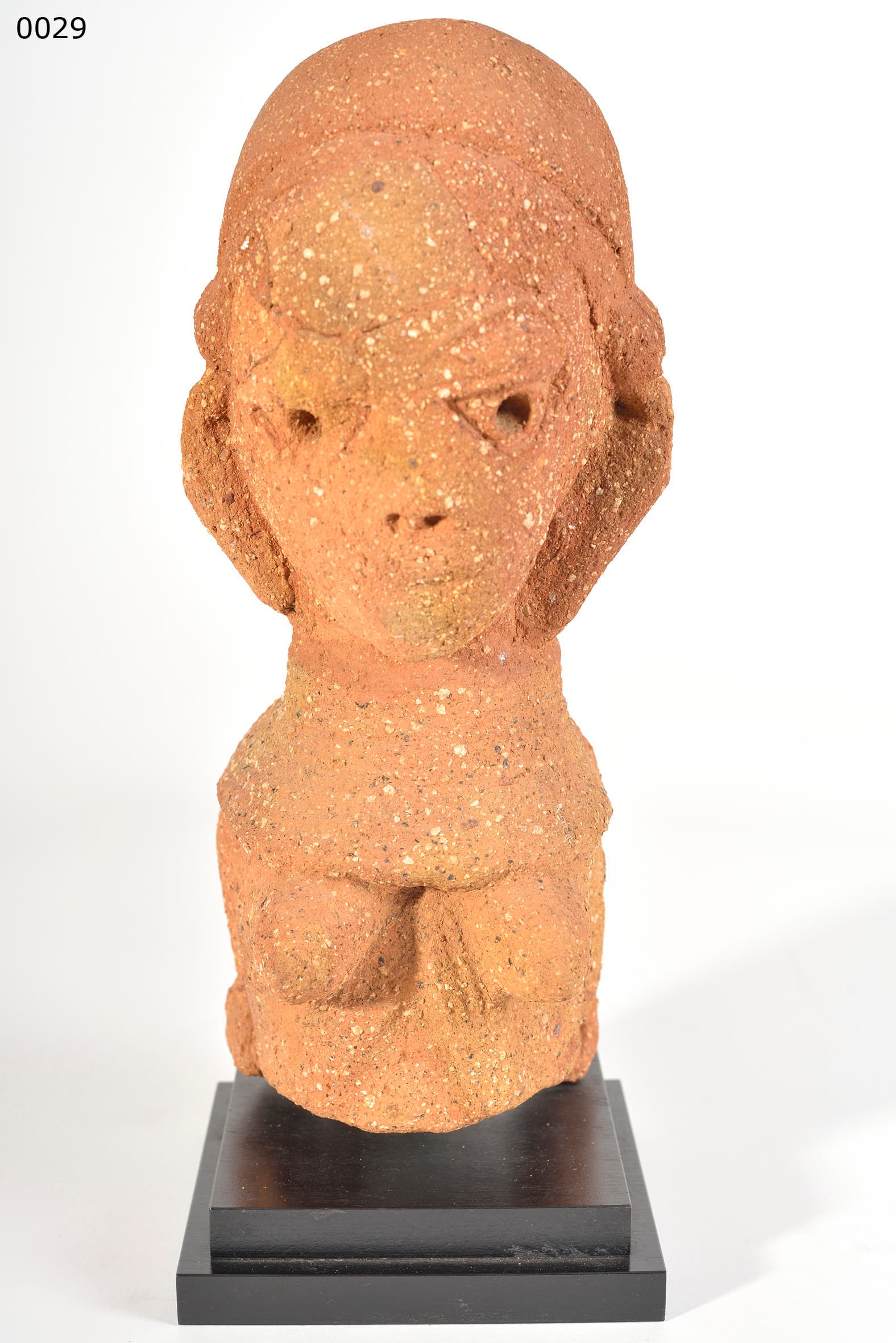
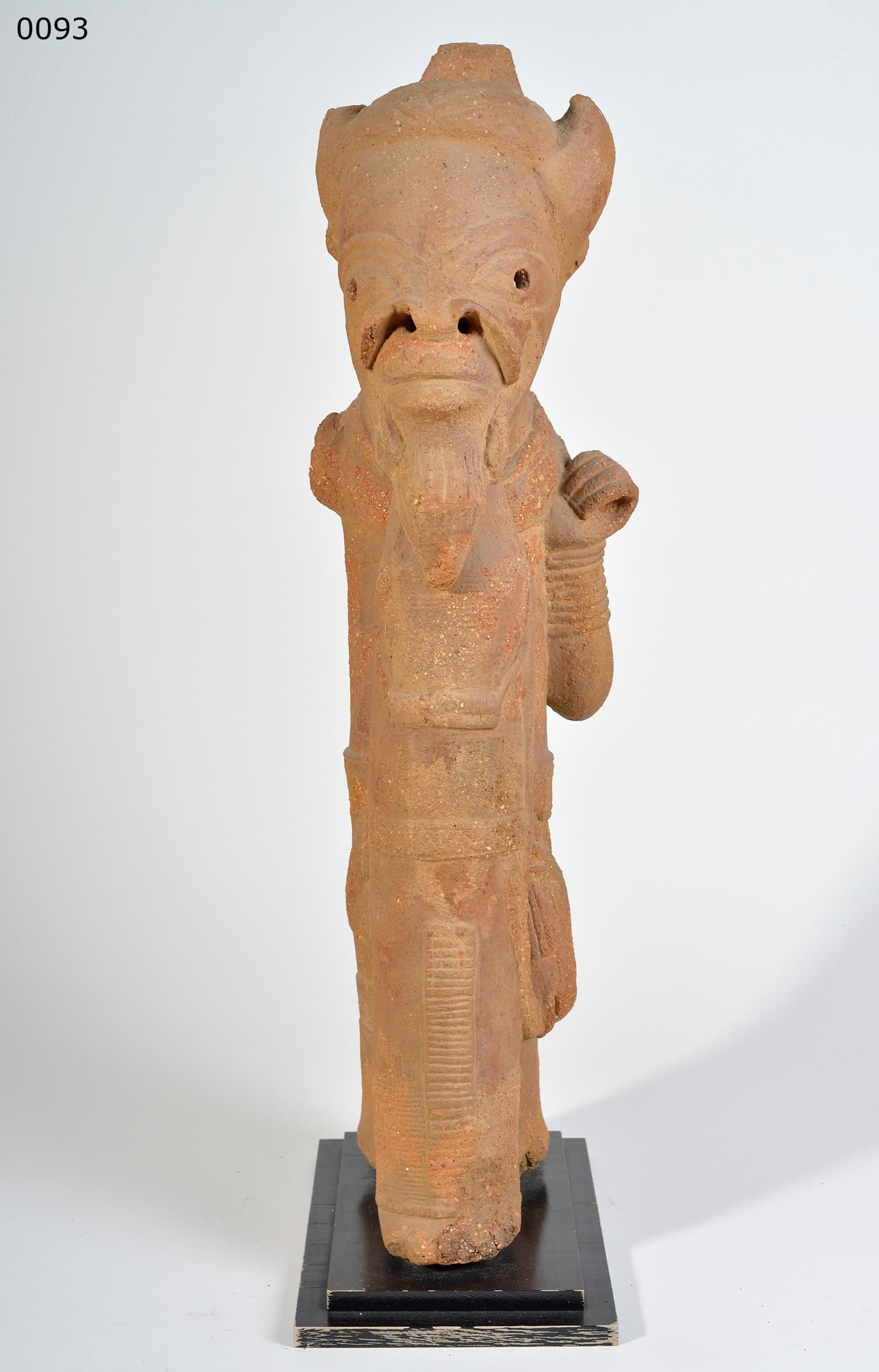
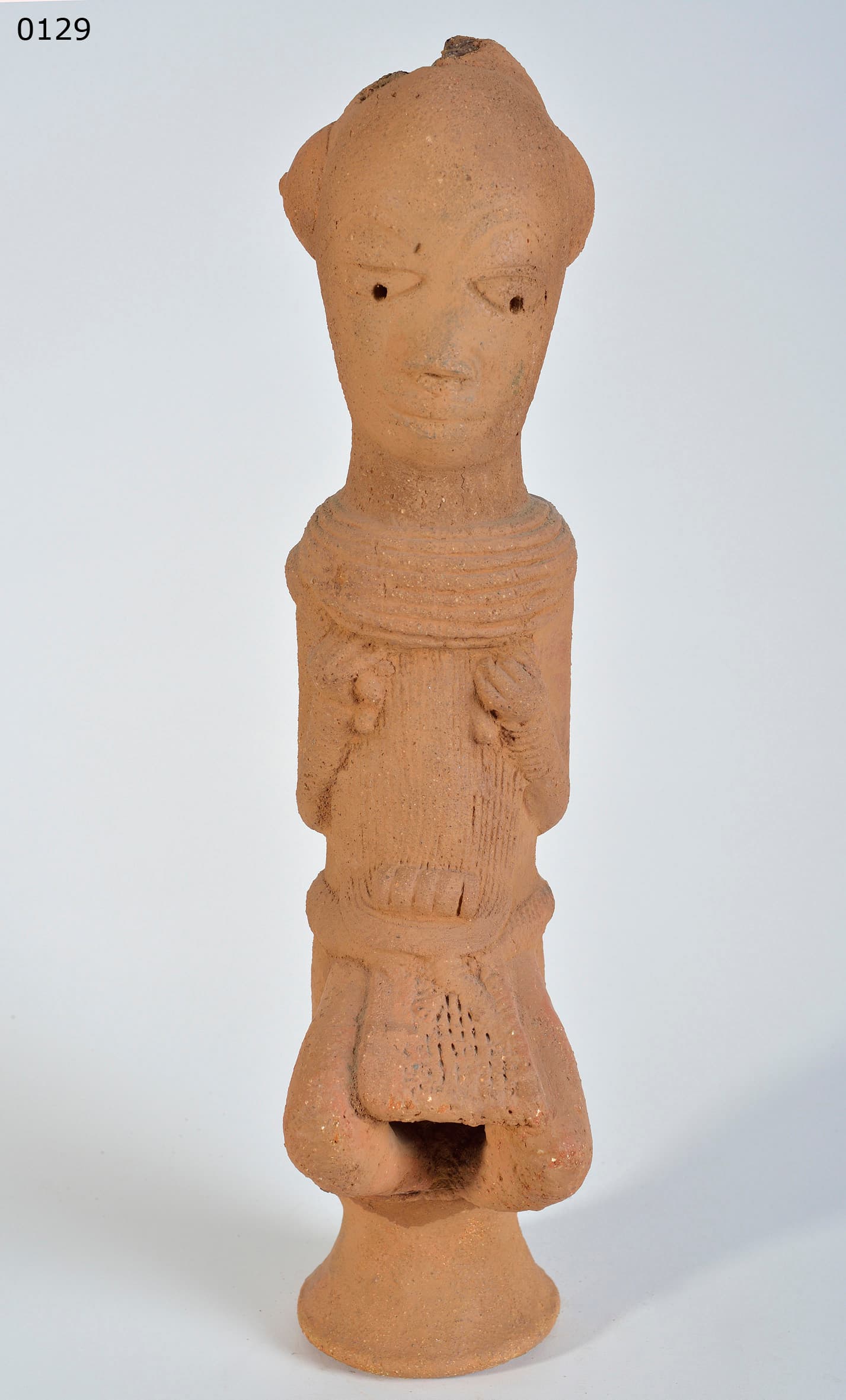
A highly unusual Nok terracotta (~2000 years old, 18 cm) from Nigeria — a heavily textured padlock-shaped mass of clay with a top loop handle, covered entirely in applied nodules, the coarse iron-age clay bearing a thick sandy calcified patina. Paired with 0319.
1. The breadth of the Nok iron age aesthetic
While the Nok culture (1500 BC – 500 AD) is most famous for life-sized highly naturalistic human heads, its aesthetic vocabulary included a vast array of abstract, symbolic, and miniature forms.
- Rare Abstract Typology: This piece represents a rare purely abstract typology within the Nok corpus.
- Nodular Interpretation: The heavy nodular surface and loop handle suggest it may have functioned as a symbolic weight, a stylized agricultural implement, or an abstract representation of disease (such as a pustule-covered torso).
2. Agricultural veneration and the ritual fragment
The contextual function of varied Nok objects was deeply tied to early agrarian communities transitioning to iron technology.
- Medicinal or Rain-Making Use: Highly abstract items like this may have been utilized in specific medicinal or rain-making rites.
- Rarity of Intact Finds: Because they were often ritually broken or buried in active agricultural zones, finding a relatively intact cohesive form like this is a remarkable archaeological anomaly.
3. Quartz-grog and 2000-year calcification
Material composition and weathering provide physical evidence consistent with an ancient origin.
- Coarse Quartz Grog: Nok potters heavily tempered their clay with coarse quartz grog — highly visible on the eroded surface of this piece.
- Slow Acidic Interaction: The thick white calcified crusts and root marks across the terracotta are the result of centuries of acidic soil interaction in the Jos Plateau — a slow-acting chemical process consistent with an ancient origin.
Summary
A rare and fascinating non-figural variant within the Nok corpus, this abstract piece sits alongside classical Nok heads as evidence of the culture's typological diversity. Its raw heavily grogged clay and ancient soil calcifications are consistent with an age of approximately 2,000 years.
Written with AI assistance from the collection appraisal, object photography and our own research; editorially reviewed. Mistakes are possible — corrections are welcome. How we work →