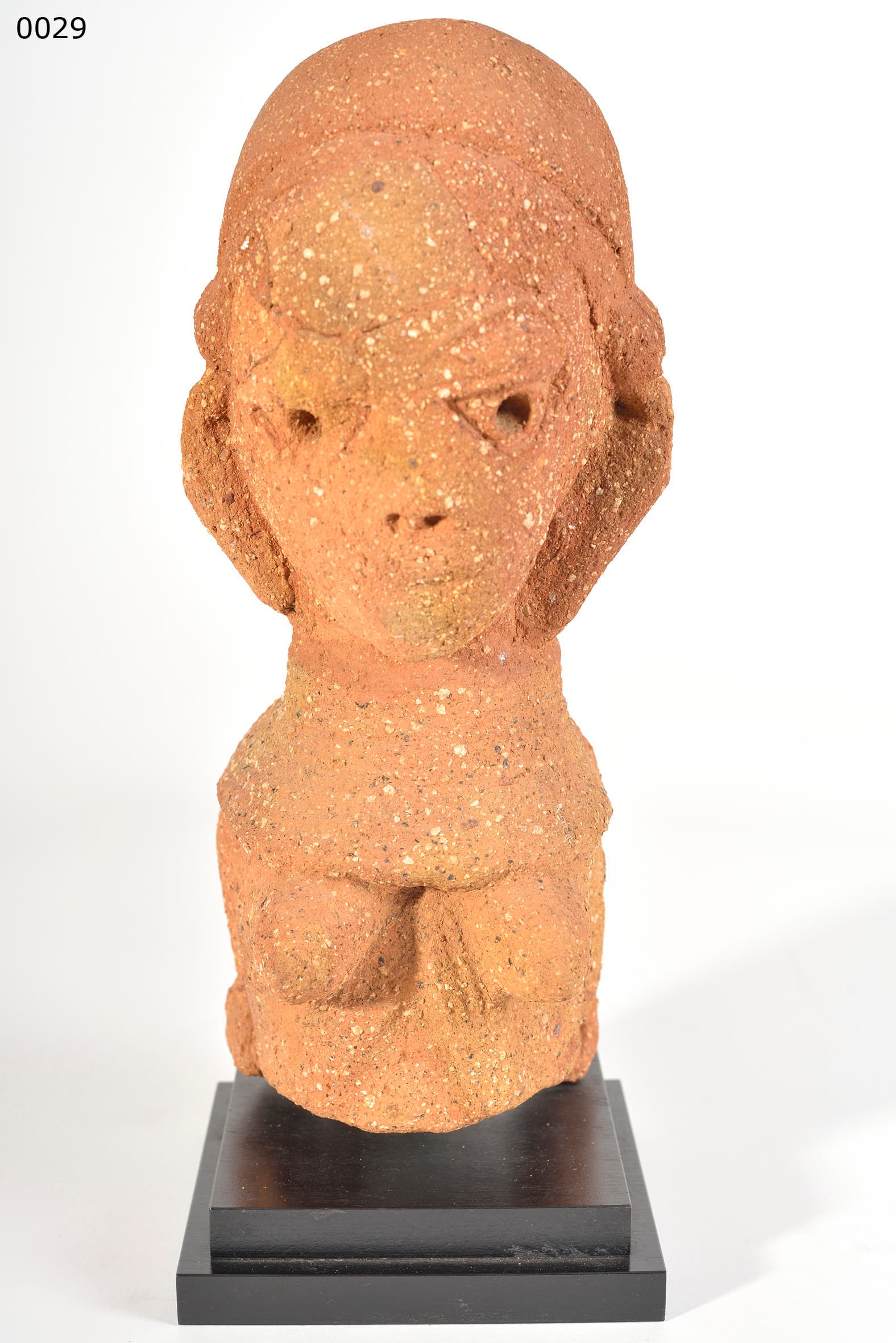
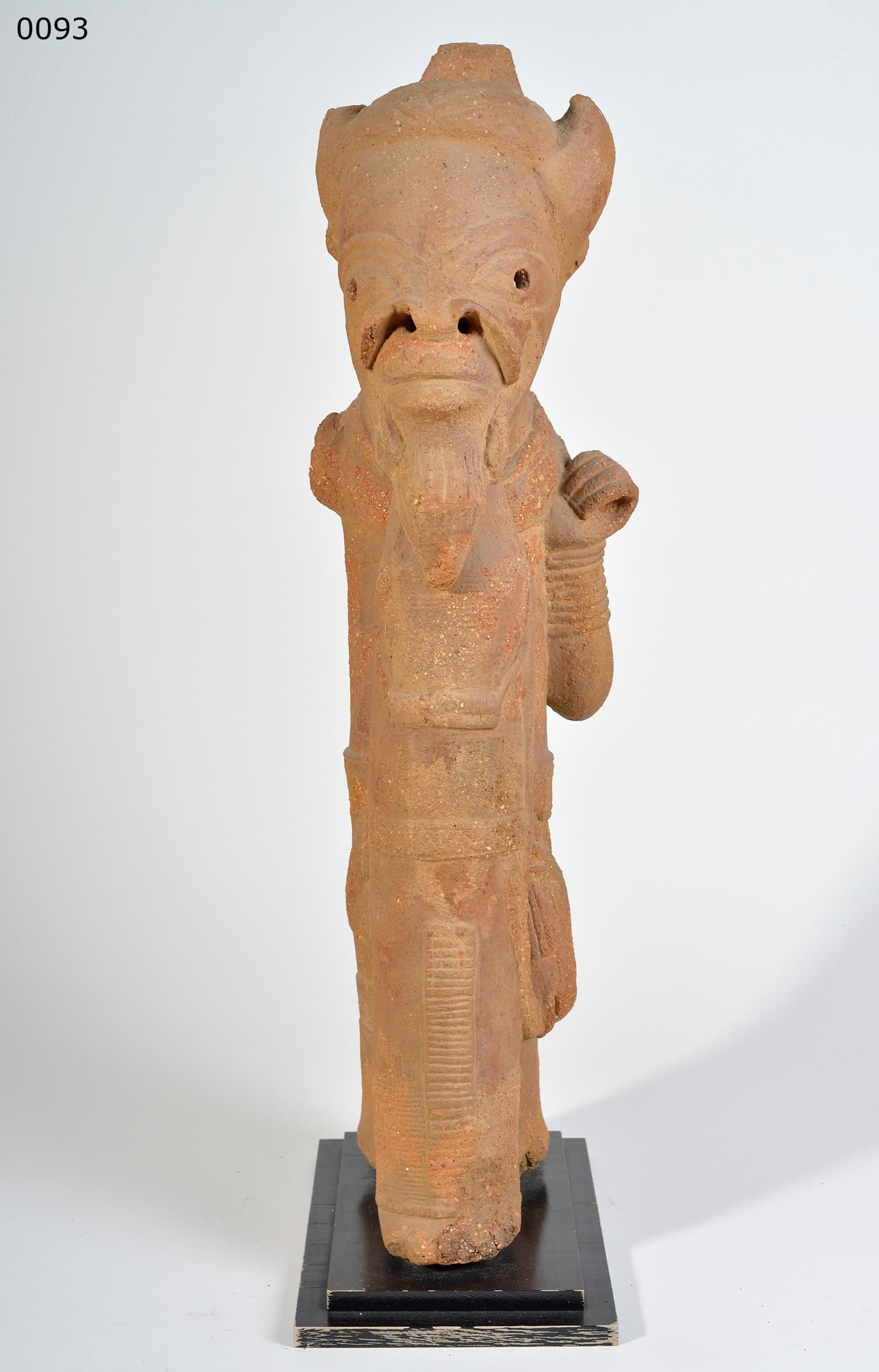
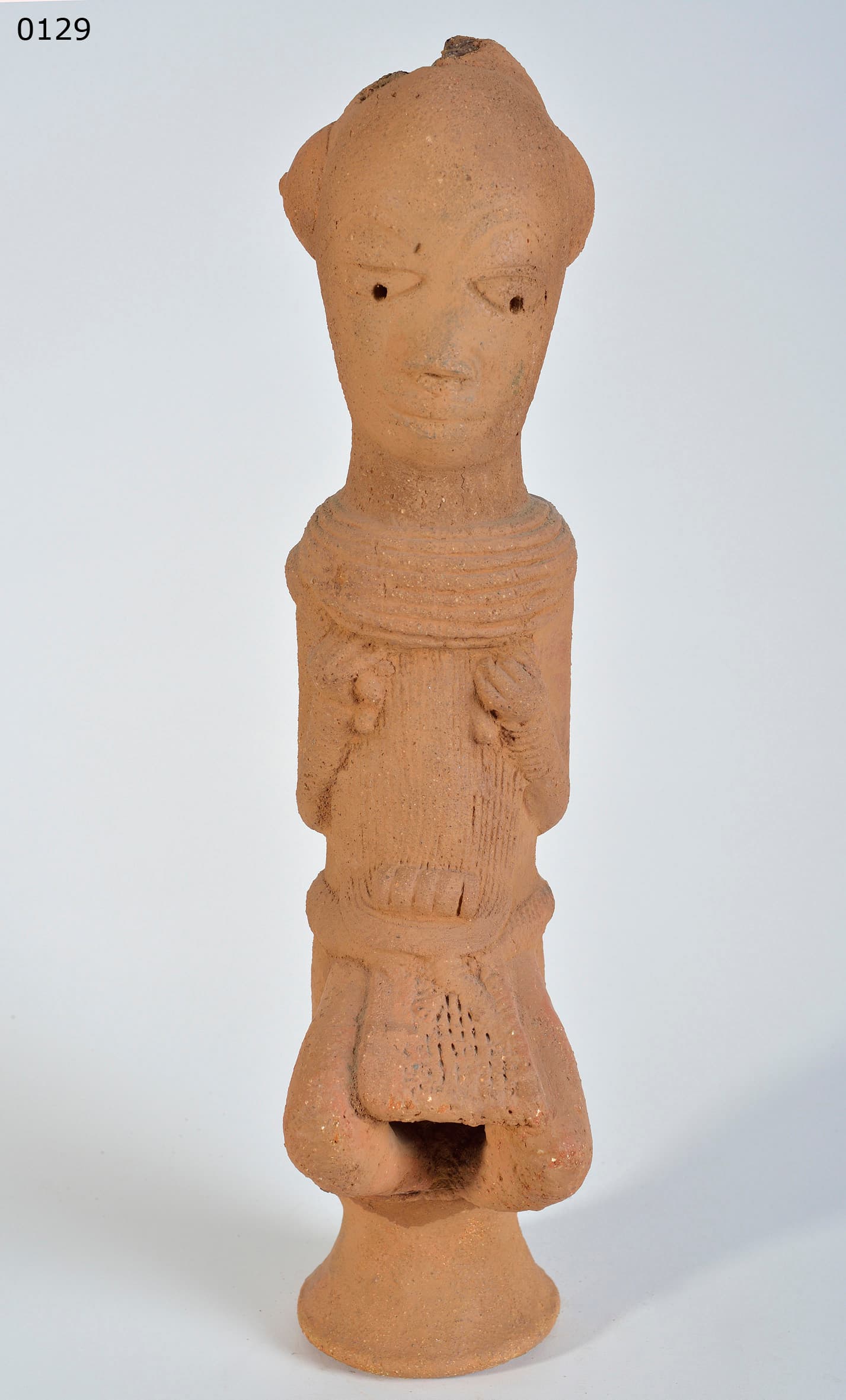
A massive conical Nok terracotta head (~2000 years old, 28 cm) from Nigeria — a highly elongated tapering profile with distinct animalistic or stylized human ears at the top, the face minimally defined by deep circular pierced eyes, a broad nose, and a small horizontal mouth, the coarse pale-orange clay deeply weathered with extensive calcification and soil encrustations.
1. Morphological variation in the Nok iron age
While the classical Nok style is known for its triangular pierced eyes, the 2,000-year-old Nok complex (and the related Katsina / Sokoto regional variants) encompassed a wide spectrum of extreme stylization.
- Extraterrestrial Elongation: This head demonstrates an almost extraterrestrial elongation — the artist deliberately stretched the cranium into a soaring cone, moving far away from human naturalism into profound stylized abstraction.
- Technical Pierced Pupils: The deeply pierced circular pupils are a technical hallmark — utilized both for intense visual expression and to allow heat to escape from the thick clay during firing.
2. Deities, disease, and agricultural shrines
Heads of this scale and extreme stylization were not portraits of ordinary individuals — they were likely representations of high-ranking deities, legendary ancestors, or personifications of natural forces.
- Agricultural Shrine Placement: In the early Iron Age communities of the Jos Plateau, such massive figures were placed in central agricultural shrines to guarantee successful harvests.
- Wilderness-Bridging Spirit: The almost zoomorphic quality of the ears suggests a spirit entity that bridges the gap between the human community and the untamed wilderness — commanding both the weather and agricultural fertility.
3. Subterranean calcification and grog tempering
The immense antiquity of this object is confirmed through its geological condition.
- Visible Quartz Grog: The clay is heavily tempered with large visible particles of quartz grog — a vital technical requirement for ancient African potters to prevent massive thick-walled sculptures from shattering in open-pit fires.
- Crystalline Calcification: The surface is heavily degraded, lacking its original slip, and entirely covered in a thick white calcified crust of mineral deposits — a slow chemical reaction occurring over 2,000 years of deep burial in the acidic Nigerian soil.
Summary
This monumental terracotta head showcases the breathtaking avant-garde abstraction possible within the ancient Nok civilization. Its towering conical form and thick 2,000-year-old geological calcification establish it as an archaeological antiquity of the highest global significance.
Written with AI assistance from the collection appraisal, object photography and our own research; editorially reviewed. Mistakes are possible — corrections are welcome. How we work →