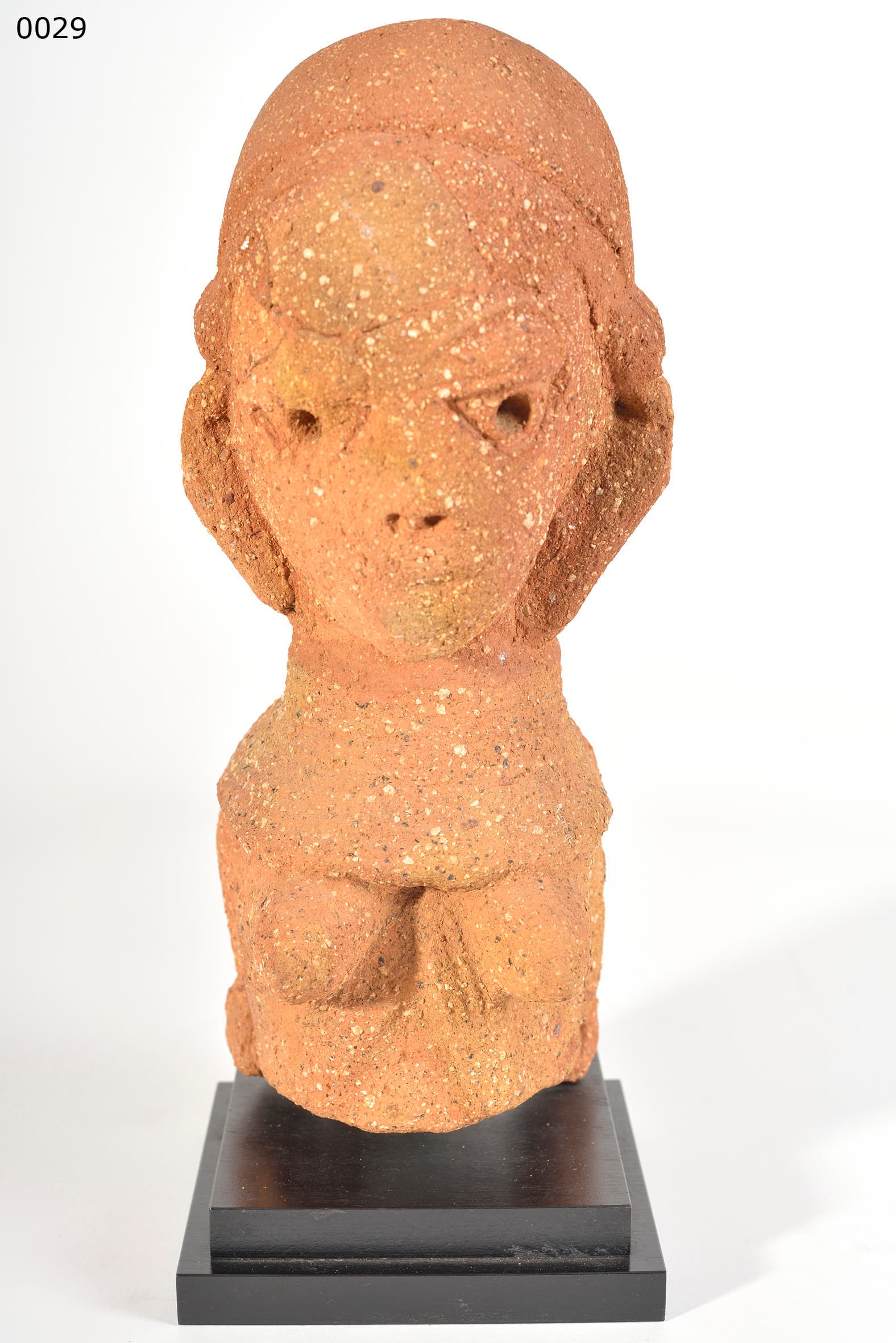
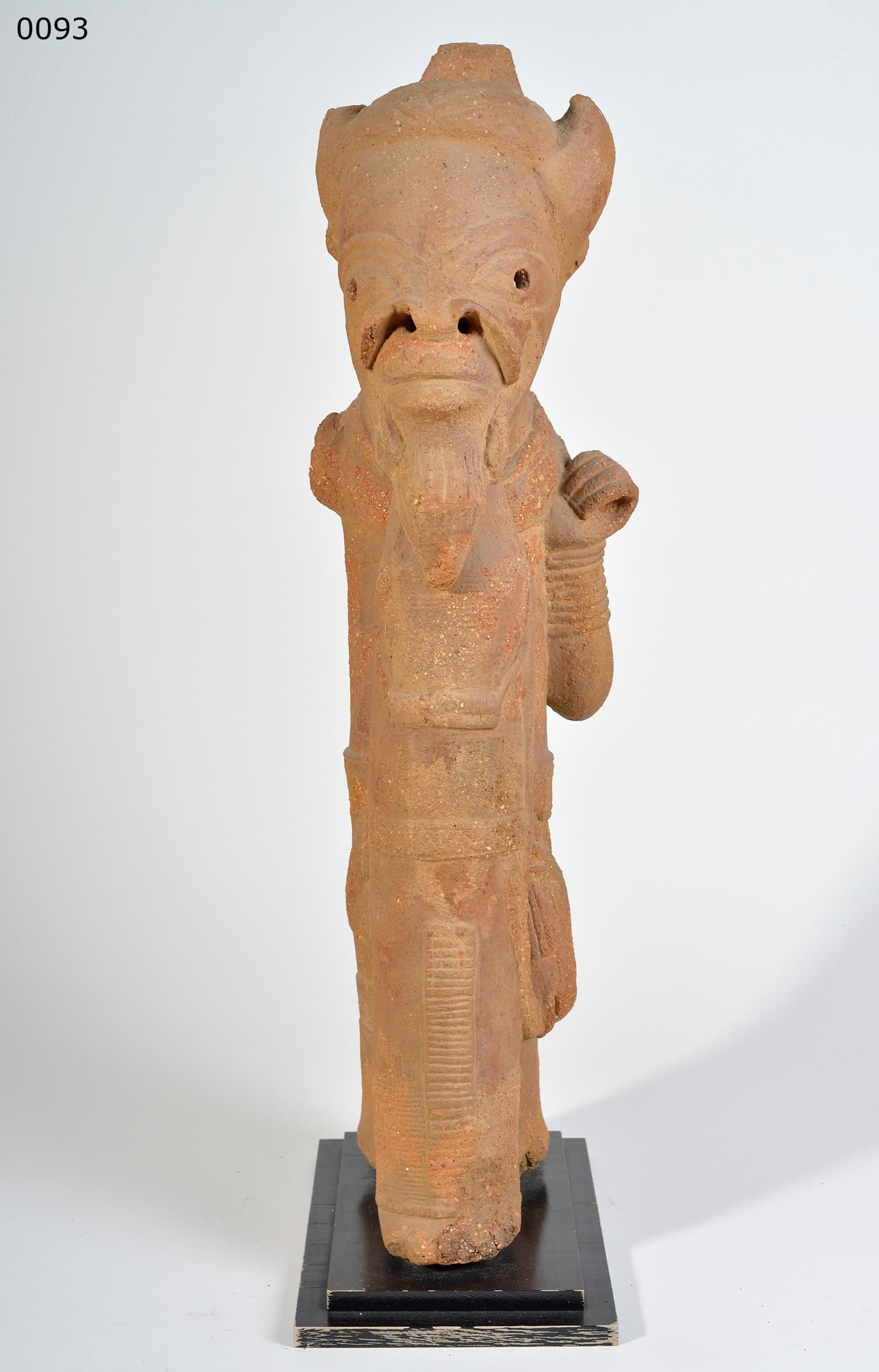
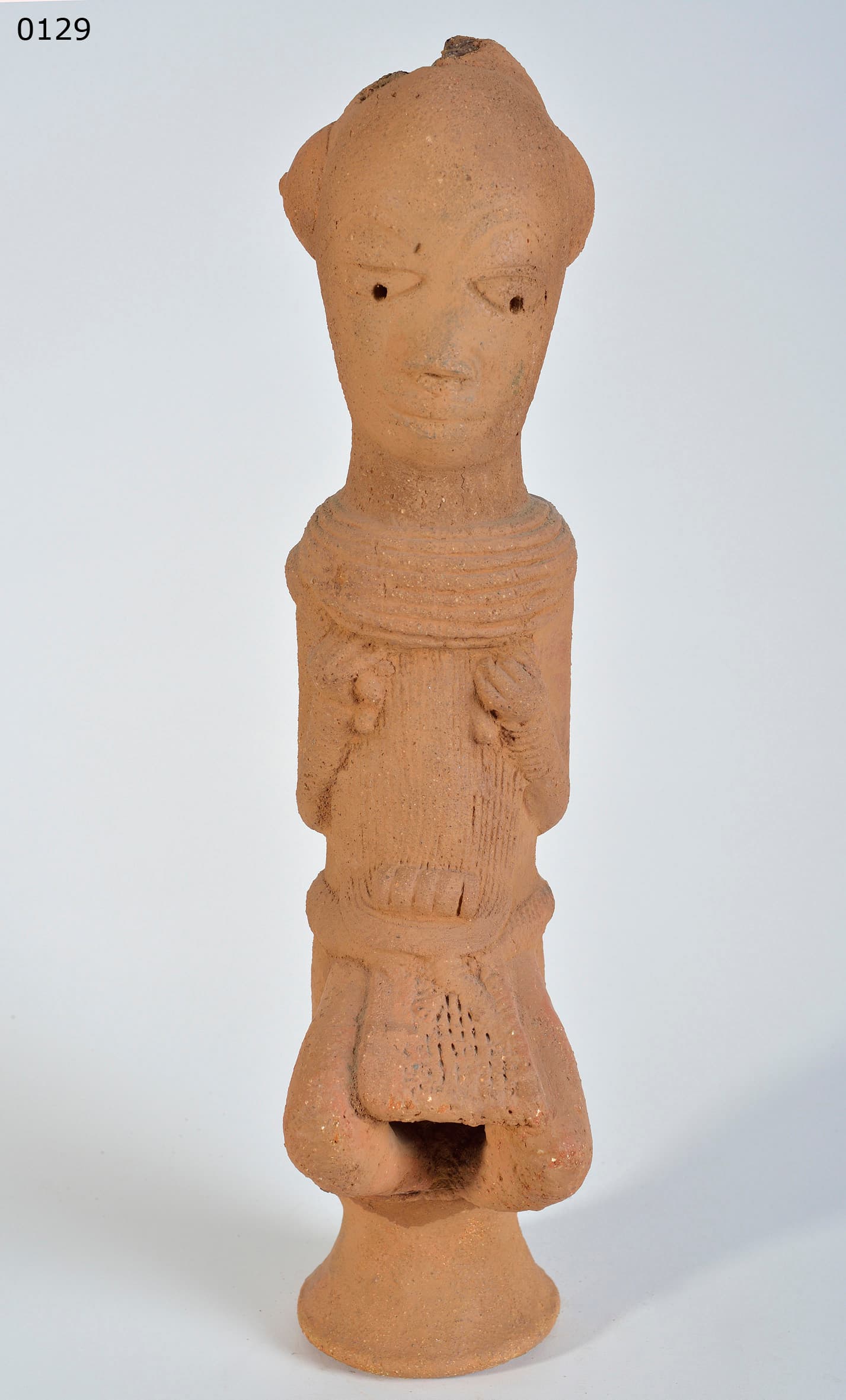
An ancient Nok terracotta bust (~2000 years old, 22 cm) from Nigeria — a truncated fragment with a heavy brow, classic Nok pierced triangular eyes, and heavy flared lips. Coarse grog-tempered clay body covered in thick pale earthen calcification. Part of a trio of Nok pieces in the collection (0456, 0458, 0459).
1. The morphological genius of the African iron age
The Nok civilization (c. 1500 BC – 500 AD) produced the foundational blueprint for sub-Saharan sculptural abstraction.
- Heavy Brow Typology: This fragment represents the more blocky volumetric Nok head type — defined by a heavy overhanging brow that shadows the deeply pierced triangular eyes.
- Engineering Through Piercing: The deep subtractive piercing was both stylistic — creating dramatic dark voids — and a brilliant engineering necessity, allowing heat to escape during firing to prevent the thick-walled clay from shattering.
2. The standard fragmented bust
This is the most commonly encountered form in the Nok corpus — a bust fragment separated from a once-complete full-figure sculpture.
- Agricultural Shrine Origin: Originally the crowning portrait of a massive full-bodied ancestor figure, positioned in open-air agricultural shrines of early iron-smelting communities.
- Ritual Decapitation: Petitioned for rainfall and fertility; archaeological consensus suggests that when shrines were abandoned, figures were intentionally broken — the head fragments (the seat of spiritual essence) were preserved or cached separately from the body.
3. Millennium-old calcification and quartz grog
The physical geology guarantees immense antiquity.
- Grog-Tempered Coarse Clay: The clay is heavily tempered with large chunks of quartz grog, visible across the eroded surfaces — the essential Nok pottery technique to prevent open-pit firing failures.
- Deep Burial Crystalline Crust: Two millennia of deep burial in acidic Nigerian soil has stripped the slip and entombed the fragment in a hard white crystalline calcification bonded permanently to the porous terracotta.
Summary
This Nok bust represents the classic fragmentary survival pattern of the West African Iron Age — a brow-heavy ancestor portrait rescued from the destruction of its shrine. Its deep 2,000-year-old calcification and grog-tempered structure establish it as an archaeological antiquity of the highest global significance.
Written with AI assistance from the collection appraisal, object photography and our own research; editorially reviewed. Mistakes are possible — corrections are welcome. How we work →