Overview
The Aghem people, frequently identified in historical, colonial, and museological literature by the exonyms Wum, Yum, or Bafum, represent a critical, albeit historically under-documented, locus of cultural and artistic production within the North-West Region of the Republic of Cameroon 1 (). Geographically situated in the Menchum Division, the Aghem occupy a strategic transitional plateau at an elevation of approximately 1,100 meters, perched near the rugged edge of the western highlands 2 (). This terrain is defined by a hilly, volcanic landscape punctuated by several small crater lakes, most notably Lake Wum and the historically volatile Lake Nyos, located approximately 25 kilometers to the east. Positioned 80 kilometers north of the regional capital, Bamenda, the Aghem territory functions as a pivotal geographic and cultural crossroads, connecting the central Grassfields chiefdoms with the middle Benue River valley trade routes extending north into present-day Nigeria, and south toward the Atlantic seaport of Douala 2 ().
Linguistically, the Aghem speak a language of the same name—Aghem (or Wum)—which is classified within the Ring subgroup of the Grassfields branch of the Southern Bantoid language family, a subset of the broader Atlantic-Congo and Benue-Congo phyla. This linguistic affiliation firmly embeds the Aghem within the deep historical and cultural continuum of the Bamenda Grassfields, a region renowned globally for its highly centralized chiefdoms, profound historical dynamism, and extraordinary sculptural traditions. The approximate native-speaking population was cited at roughly 27,000 individuals at the turn of the millennium, though modern demographic shifts and regional instability have likely altered this figure. Neighboring peoples include the Kom to the east, the Bafut to the south, and various smaller Ring and Fungom-speaking communities to the north and west.
| Demographic and Geographic Profile | Details |
|---|
| Autonym | Aghem |
| Common Exonyms | Wum, Yum, Bafum |
| Geographic Location | Menchum Division, North-West Region, Cameroon |
| Elevation & Terrain | ~1,100 meters; Volcanic plateau, savanna transition |
| Language Family | Niger-Congo > Atlantic-Congo > Benue-Congo > Southern Bantoid > Grassfields > Ring > West > Aghem |
| Approximate Population | ~27,000 (cited 2000) |
| Neighboring Peoples | Kom (East), Bafut (South), Fungom/Ring groups (North/West) |
The political and social organization of the Aghem is structured around a federation of localized chiefdoms, unified under the supreme authority of the Fon (head chief or king) 2 (). Unlike the massive, highly centralized monarchies of Bamum or the sweeping hegemony of the Kom, the Aghem federation historically operated as an aggregate of middle-range polities. These constituent chiefdoms were characterized by complex internal power dynamics that balanced patrimonial authority with populist constraints, a socio-political order sustained by an intricate network of powerful, gender-segregated regulatory associations 4 ().
Within the canon of African art, the Aghem occupy a position of outsized significance relative to their geographical footprint and demographic size. The group's sculptural output—most notably its commemorative royal figures, elaborately carved architectural elements, and the fearsome, expressionistic masks associated with the Kwifon regulatory society—is widely celebrated by scholars and connoisseurs as a masterclass in formal distortion and dynamic tension 3 (). Positioned at the stylistic confluence of the central Grassfields and the Benue River valley, Aghem master-carvers developed a distinct, highly aggressive idiom that pushed physical features to an extreme "expressionistic paroxysm". This deliberate geometric distortion distinguishes their work sharply from the more restrained, volumetric naturalism of their Bamileke and Kom neighbors. Consequently, authentic field-used Wum objects remain exceedingly rare and represent foundational masterpieces in the permanent collections of premier global institutions, including the Metropolitan Museum of Art, the Art Institute of Chicago, and the Ethnologisches Museum Berlin.
Cultural Context
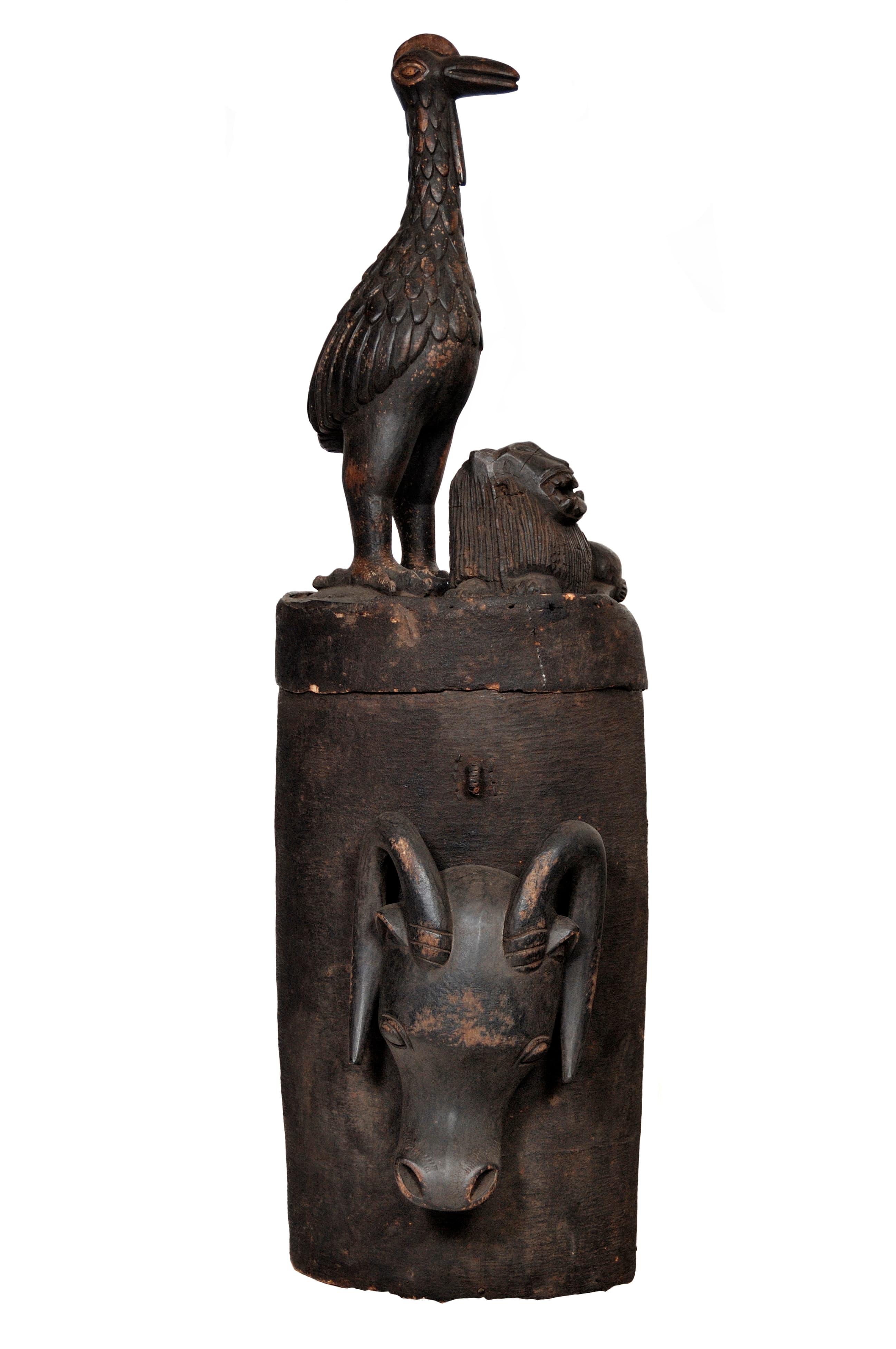
The socio-cultural architecture of the Aghem is deeply anchored in a worldview that intertwines absolute political authority, rigorous land stewardship, and an unwavering, perpetual allegiance to lineage ancestors. In the traditional Aghem cosmology, the highest spiritual and moral allegiance is reserved for these lineage forebears, whose continuous mediation is believed to secure the fertility of the land, the efficacy of the rains, and the overall prosperity of the living 2 (). This ancestral veneration is physically manifested in the ontology of the human head, particularly the skull, which the Grassfields cultures universally recognize as the ultimate repository of wisdom, life force, and dynastic legitimacy. In recognition of this profound significance, representations of the head permeate Aghem material culture, appearing not only in monumental sculpture and architectural pillars but also heavily integrated into decorated utilitarian items such as pipes, drinking horns, and stools 2 ().
At the apex of the Aghem political hierarchy sits the Fon, the paramount chief, who serves as the primary intercessor between the living populace and the royal ancestors. However, the administration of the Aghem Federation is far from an absolute autocracy. Instead, it operates through a highly sophisticated, pluralistic socio-political order characterized by powerful regulatory institutions that guide, legitimize, and sometimes fiercely check the executive power of the traditional rulers. Visual art functions directly within this social order as the primary mechanism for projecting supernatural authority, enforcing social regulation, and facilitating ancestor mediation.
This regulatory framework is strictly demarcated along gender lines, creating parallel spheres of authority. The male-centered domain is dominated by the Kwifon (also widely known in the region as Ngumba), alongside the mbai, and njong societies. The Kwifon serves as the ultimate executive arm of the government, functioning as a secret regulatory association tasked with law enforcement, the administration of justice, and stringent social control 7 (). Visual art is weaponized by the Kwifon to project an unassailable occult authority; its agents utilize terrifying masquerades to seek the guidance of supernatural forces, physically obscure the identities of its human enforcers, and visually broadcast the absolute, unyielding power of the state.
Conversely, the socio-administrative landscape relies heavily on female-centered institutions, most notably the Kefa'a and Foumbei societies. These institutions are predominantly oriented toward social cohesion, agricultural fertility, and conflict resolution. The Zhehfuai (Queen Mother) wields immense influence within this structure. While political power and land management were historically articulated as a predominantly male activity overseen by traditional rulers (dengkeghem), the Kefa'a served as a critical counterbalance. These female societies possessed the collective authority to diffuse messages across the chiefdom, perform essential agricultural rites, and negotiate social peace, particularly during severe crises such as the farmer-grazier conflicts of the twentieth century. The material culture of these female societies, though less focused on the monumental wooden masks of the Kwifon, is rich in performative objects, specialized musical instruments, and the extensive use of ritual substances like camwood.
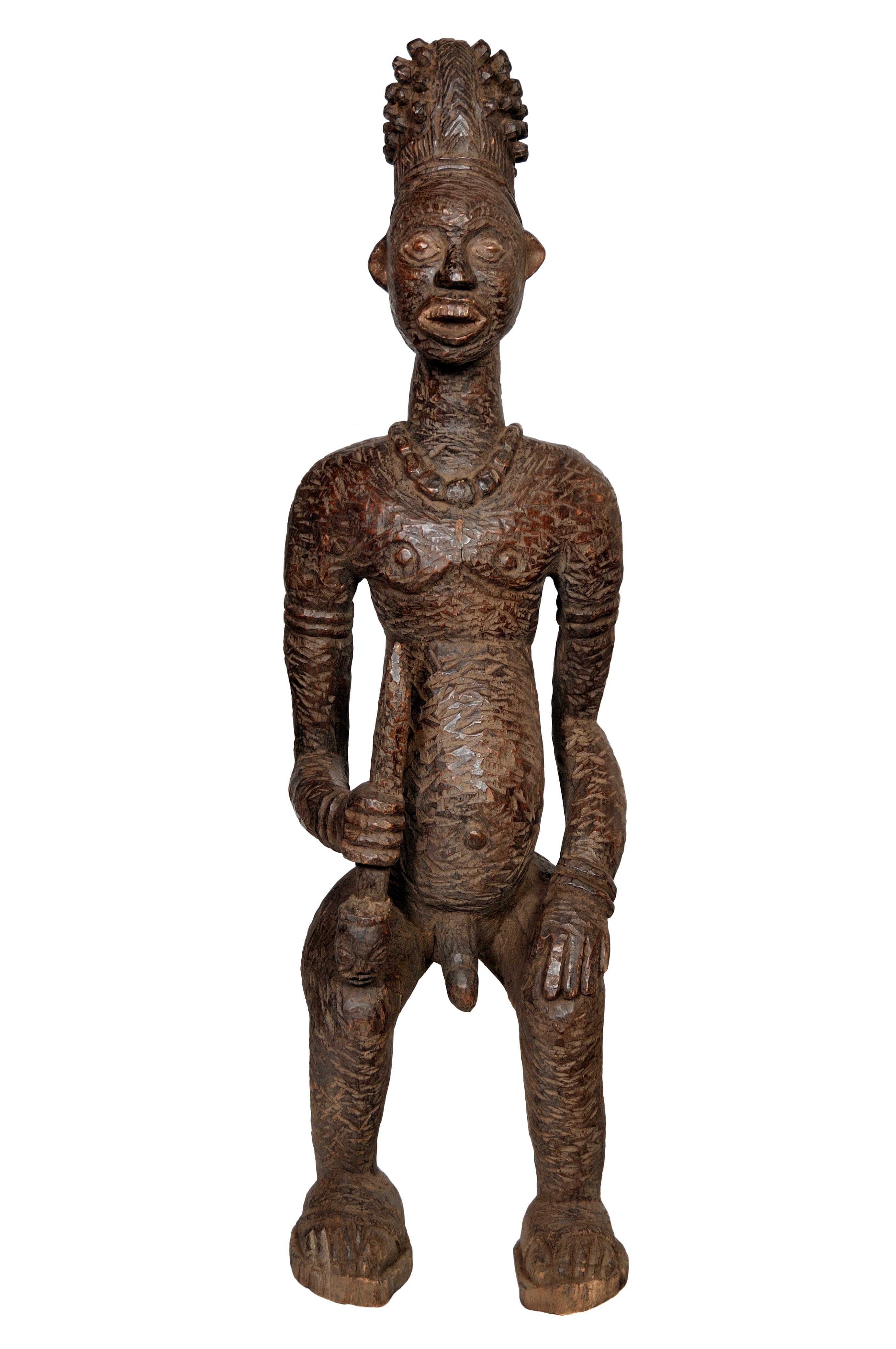
The material vocabulary of kingship—the prestige arts—is lavish, highly visible, and heavily codified. To underscore his divine right and separate his physical person from the common populace, the Fon and his highest retainers surround themselves with symbols of wealth, predatory prowess, and cosmic power. Investiture stools, which literally and metaphorically symbolize the seat of royal power, are central to the coronation process and the physical elevation of the ruler. Beaded and ivory objects further elevate the royal personage. As documented in commemorative portraiture across the Grassfields, the Fon is typically adorned with specific prestige markers: a woven, tufted prestige cap signifying his high office, elaborate collars of leopard claws or teeth symbolizing unparalleled predatory strength, and royal metal bangles 9 (). He is frequently depicted interacting with objects of ritual consumption—specifically, holding a carved buffalo-motif drinking horn in one hand and a beaded calabash for palm wine in the other, substances believed to possess life-giving properties that continuously recharge his sovereign energy.
Aesthetic Markers
The formal vocabulary of Aghem sculpture operates within the broader stylistic traditions of the North-West Province but is definitively distinguished by its aggressive, unapologetic intensity. If the art of the neighboring Kom or Bamum kingdoms is often characterized by a measured, volumetric naturalism and a serene composure, classical Aghem sculpture is defined by a profound and highly disruptive expressionism 3 (). Master-carvers in the Wum region deliberately pushed specific facial features to their absolute limit—a visual paroxysm designed to instil awe, project supernatural vitality, and communicate the terrifying, unyielding authority of the societies that commissioned them.
The defining facial canon of Aghem mask production is dominated by exaggerated, hyper-dimensional geometry. The visual mapping of this canon relies on a specific set of geometric and physiological exaggerations: exophthalmic spheres set in deep concave orbits, concentric hyper-inflated volume in the cheeks, forward-projecting dilated nostrils, sharp angular geometry of the ears, and an overall asymmetric tension. Eyes are typically rendered as massive, bulging, exophthalmic spheres set deeply within profoundly excavated, concave eye sockets (orbites profondes). This extreme contrast between the protruding globe of the eye and the cavernous shadow of the socket creates a stark, arresting gaze that dominates the viewer. Below the eyes, the cheeks are highly rounded and immensely swollen, often carved to suggest tight concentric circles or heavily inflated volumes (joues gonflées en cercles concentriques). The nose is equally forceful, characterized by broad, forward-projecting, deeply dilated nostrils that visually suggest aggressive respiration or the rapid intake of spiritual forces. The mouth is frequently carved open, baring teeth, while the ears are rendered with sharp, angular geometry, standing in stark formal contrast to the bulbous, organic forms of the cheeks and eyes.
A hallmark of the most authentic, master-carved Aghem objects is the presence of a slight, highly deliberate asymmetry. Rather than a flaw in execution or a lack of technical skill, this asymmetry is a highly intentional aesthetic device utilized by the carver to heighten the dynamic tension and kinetic energy of the form. Despite this slight imbalance across the vertical axis, the works achieve a masterful equilibrium, with each exaggerated trait asserting an equal claim over the three-dimensional space, preventing the sculpture from appearing static or lifeless.
The surfaces of Aghem wooden sculptures bear the cumulative physical record of their ritual lives. Authentic, field-used pieces are frequently covered in a thick, dark, and highly encrusted patina (épaisse patine sombre, croûteuse). This rich crust is the result of decades of sacrificial libations, the pouring of palm wine, the smearing of organic matter, and the application of ritual medicines by the Kwifon or lineage heads. On the most salient, protruding parts of the sculpture—the tips of the nose, the crests of the concentric cheeks, the bulging eyes—this dark crust is often worn away by repeated handling during performances, revealing a brilliant, glossy sheen that accentuates the sculptural topography. Additionally, the pervasive use of red camwood powder is a major aesthetic and ritual marker across the region. Ground from bark, this brilliant red powder is applied directly to wooden sculptures (and the bodies of the Fon and Zhehfuai themselves) to signify purification, life force, and the transition into heightened states of authority. On commemorative figures, this red base is sometimes overlaid with contrasting white chalk dots designed to mimic the spots of the leopard, the ultimate symbol of royal power 13 ().
Beyond monumental wood carving, the Aghem aesthetic canon extends into highly refined utilitarian arts, particularly basketry, which exhibits its own strict formal vocabulary. Wum baskets are structurally and visually distinctive, seamlessly combining two entirely different traditional techniques 14 (). The upper section of the standard Wum utility basket is executed using a twilled (woven) technique, creating a flexible, patterned receptacle. Conversely, the main body and the base are constructed using a tight coiling and sewing method, which renders the lower portion incredibly rigid and entirely waterproof. Unlike the baskets of the neighboring Bamileke, which feature plaited rings at the base to facilitate balancing the vessel on a woman's head, Aghem baskets are characterized by their unusually tall, rigid bases. This architectural elevation serves an aesthetic and highly practical function, raising the contents—typically food or ritual substances—safely off the earthen floor, protecting them from moisture, insects, and spiritual contamination.
Ritual Practices
The lifecycle and functional context of Aghem art are inextricably bound to the performative demands of initiation, social regulation, agricultural cycles, and the commemoration of the dead. Objects within this tradition are rarely intended to be viewed in static, silent isolation; they are highly kinetic agents, mobilized through complex choreographies, shrouded in specialized costumes, and accompanied by distinct, overpowering polyrhythmic soundscapes.
The most formidable context of use belongs to the Kwifon regulatory society. Operating largely in secrecy to maintain social control and execute justice, the Kwifon employs specific masquerades to interface with the public. Chief among these is the Mabuh (also documented as Mambu) mask 3 (). Rendered in the intense expressionistic style described above, the Mabuh functions primarily as a herald or runner mask. It does not act as the ultimate judge or executioner; rather, it is the voice and the vanguard of the Kwifon, physically announcing the approach of the society's members and aggressively driving away women, children, and non-initiates from the path. During high-stakes events, such as the funerals or commemorative celebrations of important village men and senior Kwifon members, the Mabuh character—dressed in a dense, rustling costume of plant fibers and feathers—precedes the arrival of the far more terrifying and spiritually dangerous nkock (or executioner) masks. The bulging, kinetic energy of the Mabuh carving perfectly mirrors its frantic, space-clearing physical performance.
Rites of passage represent another critical context for material and performative culture. The transition into adulthood for Aghem men is marked by the Duoa (or Tschong) initiation ceremonies 16 (). These rigorous manhood dances require initiates to undergo physical and spiritual trials, culminating in their formal incorporation into the adult socio-political body. While the Duoa is fundamentally an all-male rite of passage, it is highly interdependent on female participation; women provide the essential solo musical accompaniments that stimulate the initiates to execute the demanding, polyrhythmic choreography required by the dance. During these initiations, the application of camwood is mandatory. An initiate is not considered fully cleansed of his past iniquities or "born into a new life in manhood" until his body has been ritually rubbed with the red powder, transforming his physical appearance into a state of sacred readiness.
Women's societies utilize their own distinct ritual practices, centered primarily on the stewardship of the land and the ensuring of agricultural abundance. The Ih'neem ritual, overseen by the Zhehfuai (Queen Mother) and the elders of the Kefa'a society, is the paramount agricultural ceremony 19 (). Typically occurring in October, this ritual initiates the planting of corn. It requires the gathering of a highly prized, traditional edible fungus known as ketschughe, harvested from the bark of dead trees deep within the Kom-Wum forest reserves. This substance is prepared into a sacred sauce consumed by the women. The rite demands that the Zhehfuai make the first agricultural bed and plant the first seeds before any other woman in the chiefdom is permitted to begin planting her own farm. If a new Queen Mother or female family head is being coronated, or if a new member is being initiated into the upper echelons of the Kefa'a, the women shave their heads and heavily anoint themselves—and the cylindrical instruments used to produce their ritual music—with camwood powder, visually marking their elevated, sacralized status.
The ultimate expression of royal continuity and dynastic endurance is found in the funerary and commemorative practices surrounding the Fon. Following the death of a king, commemorative figures—carved during his lifetime upon his enthronement—are brought out of the palace shrines for public display. These statues, which depict the Fon and occasionally his primary queen, are not naturalistic portraits but idealized, commemorative effigies designed to underscore his power, wealth, and privilege. Displayed in the palace courtyard alongside the figures of his predecessors, these sculptures serve as a monumental, visual ledger documenting the dynastic lines of leadership. They stand as permanent, tangible guarantees that the Fon's potent energy remains to oversee the well-being of the kingdom even after his physical demise.
Historical Context
The ethnogenesis and historical development of the Aghem chiefdoms represent a highly complex narrative of migration, assimilation, and political crystallization that has been the subject of extensive, revisionist anthropological debate. Until the latter half of the twentieth century, conventional historiography—summarized by scholars tracing the peopling of the Western Cameroon Grassfields—posited a relatively simplistic, wave-based migration theory 20 (). According to these early models, the high plateaus were populated by successive waves of migrants, with the Aghem specifically theorized to have arrived relatively recently (around the 17th century) from the north-west, an area broadly designated in colonial texts as 'Munshi' country.
However, subsequent and far more rigorous anthropological research, driven largely by the theoretical frameworks of Igor Kopytoff, has entirely reshaped the scholarly understanding of Aghem origins 5 (). Kopytoff famously deployed the Aghem as a primary case study for his groundbreaking "internal frontier" thesis. He argued compellingly that the Aghem chiefdoms did not evolve slowly from simple, acephalous bands into complex states, nor were they the result of a single, uniform mass migration. Instead, they crystallized as middle-range polities out of an "institutional vacuum"—a geographic and political frontier zone lying at the fringes of older, fully formed Grassfields kingdoms. The Aghem region effectively became a dynamic repository for immigrants, political refugees, displaced royals, and individuals fleeing succession disputes or witchcraft accusations from surrounding areas.
These frontiersmen brought with them the deeply ingrained political culture of the Grassfields. Operating in this new, autonomous space, they rapidly constructed "mini-polities" modeled on the kingdoms they had left behind. Consequently, the Aghem recognize that while a distinct Aghem language and custom exist, it is a pragmatic, historical product of synthesis rather than an essentialist, primordial ethnicity. The formal federation of Aghem chiefdoms, which established control over the region's agricultural lands, coalesced around 1800. The varying sizes of the component chiefdoms within Wum—ranging from nearly 2,000 individuals in the largest (Kesu) to under 200 in the smallest (ChereGha) at the turn of the twentieth century—were the direct result of differing "population policies," as leaders aggressively sought to build their "wealth-in-people" by absorbing wives, slaves, and wandering foreigners.
| Historical Period | Key Developments & Artistic Output |
|---|
| Circa 1800 | Coalescence of the Aghem Federation; absorption of frontier populations ("wealth-in-people"). |
| Late 18th – Early 20th C. | "Classical" period of art production. Apex of expressionistic carving style, heavy ritual use of Mabuh masks, and extensive sacrificial patination. |
| 1905 – 1910 | German colonial contact and extraction. Major museum collections seeded (e.g., Hans Glauning and Menzel expeditions). |
| Circa 1940 | British mandate period; negotiated entry of Fulani pastoralists, triggering long-term farmer-grazier conflicts and disrupting female land tenure. |
| Mid-to-Late 20th C. | Disruption of traditional regulatory power, monetization of the local economy, and emergence of export/tourist carving workshops. |
| Early 21st C. | Heritage heavily threatened by chronic government neglect, industrialization, and violent separatist conflicts in the North-West Region. |
Direct contact with European colonial administration drastically altered the region's political and material landscape. The German colonial period initiated the systematic documentation and extraction of Aghem material culture. Major museum collections, such as those housed in the Ethnologisches Museum Berlin, were seeded during this era; the renowned Hans Glauning expedition collected seminal Aghem Mabuh masks in 1905, followed by his successor, Menzel, in 1910. The subsequent British mandate period introduced further demographic shifts, most notably the negotiated entry of Fulani (Mbororo) pastoralists into the Wum region around 1940. Authorized by the colonial District Officer and Aghem traditional authorities—but critically, without the consultation of the Aghem women who actually farmed the land—this influx led to decades of intense farmer-grazier conflicts, profoundly disrupting the agricultural rites and social balance overseen by the female regulatory societies.
The periodisation of Aghem art reflects these profound historical ruptures. The "classical" production period—representing the apex of the expressionistic style, characterized by heavy ritual use, profound patination, and strict adherence to the Kwifon and royal canons—dates from the late eighteenth century through the early twentieth century (circa 1920s). By the mid-to-late twentieth century, the disruption of traditional regulatory power, the monetization of the local economy, and the global demand for African art spurred the emergence of a robust market and export production. While modern workshops continue to carve in the Wum style, these pieces generally lack the deliberate asymmetry, the deeply encrusted sacrificial patinas, and the extreme, uninhibited geometric paroxysm that define the classical, field-used masterpieces of the Aghem federation. Today, the preservation of Cameroon's classical heritage is under severe threat from chronic government neglect, industrialization, and violent separatist conflicts, leading to international debates regarding import restrictions and the safeguarding of the region's remaining material legacy 24 ().