Overview
Geographical distribution and demographic dynamics
The historical and current settlement area of the Bangwa (correctly referred to as Nweh or Ngwe) forms a geographical, ecological and cultural transition zone on the western edge of the Cameroonian grasslands. Administratively located in the district of Lebialem in the present-day Southwest Cameroon region, the Bangwa inhabit the steep, inaccessible foothills of the high plateau that mark the topographical boundary to the lower-lying rainforest areas of eastern Nigeria and western Cameroon (Lockhart 1994: 12). This specific topography had a decisive influence on society, as it offered isolation on the one hand and enabled control over neuralgic trade routes on the other. Historical demographic surveys often proved to be highly flawed. The British colonial official H. Cadman attempted a census in 1922 ("Bangwa Assessment Report"), but it failed due to the systematic refusal of the local authorities: the chiefs had large parts of the population hidden in the forests in order to minimise the British tax burden (Cadman 1922: 405; Lockhart 1994: 25). While the older ethnographic literature put the population at around 100,000 individuals, recent information from Bangwa representatives from 2017 puts the population at around 148,000 (Campfens 2019: 76). This data must be viewed in the context of a massive general increase in Cameroon's population to almost 30 million inhabitants in 2024/2025, which is accompanied by a significant rural exodus (World Bank 2024). A growing urban Bangwa diaspora in centres such as Muyuka, Douala and Yaoundé is leading to a recontextualisation of traditional identities in urban areas.
Linguistic categorisation and the genesis of nomenclature
The linguistic classification locates the Bangwa language (Ngwe or Nweh) within the southern bantoid language family, specifically as part of the western Bamileke dialect continuum (Ethnologue 2016). The ethnonym "Bangwa" is a historical foreign term (exonym) that goes back to the German merchant and colonial agent Gustav Conrau. When Conrau was the first European to enter the area in 1898, he derived the term from the local word stem "Ngwe" ("above") and formed it into "MbaNgwe" ("the people from above"). In the nomenclature of the German and later the British colonial administration, this term was corrupted to "Bangwa" and administratively solidified (Conrau 1899: 14; Brain 1967: 1). The preferred self-designation (endonym), however, is Nweh. From 1921, the British mandate administration grouped the nine independent chiefdoms of the region (including Lebang/Fontem, Fotabong, Fonjumeter and Foto) into a unit of local self-government (Local Government), primarily in order to administratively distinguish them from the neighbouring forest communities of the Banyang and Mbo on the basis of their "grassland culture".
Social structure: hierarchy and bilateral kinship
In contrast to the acephalous social structures found among some neighbouring peoples in the Cross River region, the social structure of the Bangwa is characterised by a strict, pyramidal hierarchy. The system is organised in the form of paramount chiefdoms. At the top is the sacral king (Fon or Fwa), whose authority is supported by an aristocracy of sub-chiefs, ritual specialists (such as the earth priests) and nobilities. A historical stratum of former slaves and their descendants formed the foundation of society, whereby social mobility was remarkably permeable through the accumulation of wealth; descendants of slaves could rise to the highest ranks (Brain 1967: 35). The kinship system defies simple unilinear categorisation. Although titles, social status and the ritual custody of ancestral skulls are passed on in a strictly patrilineal manner to a determined main heir (who functions as a "patrigroup head"), there are no expansive patrilineal clan structures with exogamous marriage restrictions. Kinship is traced bilaterally, with half-brothers not sharing any common property, resulting in a highly individualised and competitive social dynamic (Brain 1972: 95; Lockhart 1994: 23).
Subsistence economy and interregional trade networks
The economic basis of the Bangwa is agriculture, which is strongly gendered. Women are responsible for the cultivation of staple foods such as maize, yams and peanuts, as they are considered to have a ritual affinity for the fertility of the land, while men are responsible for clearing and hunting. However, their position as economic middlemen was far more influential in the historical development of Bangwa power. In the 19th century, they controlled the trade routes between the grasslands and the coastal regions. The transregional slave trade formed the backbone of the economy and enabled the accumulation of European prestige goods (glass beads, brass, textiles), which visually materialised the power structures (Brain 1967: 12; Harter 1992: 5).
Research controversies on cultural classification
The scientific categorisation of the Bangwa is the subject of an ongoing research controversy that illustrates the complexity of frontier societies. Author A (Robert Brain 1967, 1971) argues vehemently in favour of a cultural and dynastic proximity to the Banyang (Ekoi forest cultures) settling in the west. Brain relies on the founding myths of various Bangwa dynasties, which refer to forest hunters who merged with grassland nomads, as well as the intensive exchange of masked alliances (such as the Kwifon). Author B (Elikias de Latour 1991: 16-17) and historical British reports (Cadman 1922), on the other hand, classify the Bangwa strictly as a subgroup of the Bamileke grassland cultures on the basis of linguistic evidence, the dedicated skull cult and the architecture of the ruling structures. The source situation is ambiguous, as the Bangwa utilised historically fluid identities to exercise economic monopolies in both cultural areas. The British Museum in London documents this hybrid culture through extensive holdings of everyday and ritual objects of the Bangwa, which combine influences of both forest and savannah aesthetics (British Museum, Inv. E_Af1973-36-1).
| Classification parameters | Argumentation in favour of Banyang (forest culture) | Argumentation in favour of Bamileke (grassland culture) |
|---|
| Main proponents (research) | Robert Brain (1967) | E. de Latour (1991), H. Cadman (1922) |
| Founding myth | Origin traced back to forest hunters hoarding leopard skins | Origin from the north (Lake Chad region) |
| Sociopolitics | Import of dance societies and secret societies from the forest region | Sacred kingship (Fon), skull cult, gong societies (Lefem) |
| Linguistics | Loanwords through intensive trade contact | Clear affiliation to the Banoid Ngwe/Bamileke dialect continuum |
Cultural context
Religious system and cosmology
The cosmology of the Bangwa is dualistically structured and operates at the interface between a distant, abstract creator deity and an immanent ancestral world. God (Deus Otiosus) is regarded as the irrevocable cause of all existence and the final moral authority. Individuals are conditioned from birth to avoid immoral actions so as not to provoke the wrath of God and thus divine retribution (disease, drought) (Ndemanu 2018: 4). However, as the Creator is considered too distant for direct requests, the ancestors (the "living-dead") are at the centre of daily ritual practice. They act as essential intermediaries. The material basis of this ancestor worship is the cult of the skull. The designated heir of a lineage becomes the custodian of the paternal skulls. If a skull cannot be physically secured (e.g. through death in a foreign country), a complex substitution ritual is required in which earth from the site of a libation is consecrated as a metaphysical replacement for the skull (Brain 1967). The cosmological structure is differentiated from neighbouring peoples by specific concepts of incarnation and liminality. In Bangwa ontology, it is believed that sacred kings do not die, but merely "disappear". Their physical remains are buried in the strictest secrecy in specific palace rooms in order to maintain the illusion of the immortality of the office (Ndemanu 2018: 5).
Ritual authorities and the bipolar system of secret societies
Socioreligious life is regulated by a bipolar system of secret societies that both concentrates and controls power.
The Troh (night society) represents the executive, punitive and fear-ridden power. The inner nine members of the Troh are considered the true "kingmakers". They administer the Ordal (divine judgement) through poison and carry out executions. Their power is fuelled by their mastery of sorcery and metamorphosis; in Bangwa cosmology, sorcery is an ambivalent force that is essential for the protection of the realm. It is believed that the king and the leaders of the Troh assume the form of leopards, elephants or snakes at night to watch over the borders while the population sleeps (von Lintig 2016: 80).
The Lefem (Gong Society), an exclusive covenant of the aristocracy that operates in the daylight and is responsible for the preservation of ethical values, ancestor worship and peaceful succession (Brain & Pollock 1971: 125), acts as the antipole pole. The Lefem members gather in the sacred grove, where they play giant double gongs that acoustically manifest the presence of the royal ancestors.
The role of women and the Tanyi/Anyi complex
A distinctive feature of Bangwa culture that structurally distinguishes it from many more restrictive patrilineal grassland societies (such as the Kom or Oku) is the institutionalised ritual authority of twins and their parents. The birth of twins is seen as a direct theophanic manifestation, an intrusion of the divine into the worldly order. Fathers of twins (Tanyi) automatically become earth priests; they are responsible for performing ritual sacrifices at sacred waterfalls or prominent rock formations. Mothers of twins (Anyi or Njuindem, literally "woman of God") attain the status of powerful diviners and earth priestesses. They often perform rituals in trance states and divinise with the help of cowries (Brain & Pollock 1971: 124). The royal mother (Mafo) also has far-reaching authority; she presides over her own female secret societies and has veto rights in matters of succession. Female ancestors are venerated in separate rites, which emphasises the strong bilateral kinship component.
Research controversies on iconography (The Njuindem discourse)
The exact function of these female authority figures in the art canon is at the heart of one of the most prominent debates in African art history: the interpretation of the iconic figure of the so-called "Bangwa Queen" (now in the Musée du quai Branly, Paris, formerly Fondation Dapper).
Author A (Robert Brain in Bangwa Funerary Sculpture, 1971: 124) explicitly identifies the sculpture as a representation of a Njuindem - a dancing earth priestess and twin mother who protects the realm through states of trance. He relies on the rattle in the figure's hand and the dynamic dance pose.
Author B (Andreas Schlothauer 2015: 20 and Bettina von Lintig 2017: 94) rejects this classification as a colonial-historical and ethnographic "mistake". They argue in favour of interpreting the figure exclusively as a canonical lefem ancestor sculpture (a deceased royal princess or high-ranking wife), which served as a guardian figure in the palace shrine and does not depict any specific priestly functions in this world. Von Lintig criticises the romanticised Western interpretation as a "wild dancer" and places the statue strictly within the power-political cult of remembrance of the Lefem covenant, which demands obedience and dynastic stability. The Metropolitan Museum of Art (Met) in New York, which is home to the male counterpart of this famous figure (Inv. 1978.412.576), institutionally supports Author B's interpretation and contextualises such statues primarily as "visual archives of family history" that were accumulated on ancestral altars (Metropolitan Museum 2011).
Aesthetic features
Canonical object typology and canon of proportions
The visual corpus of Bangwa is dominated by two fundamentally different types of sculpture, which materially translate the socio-political duality of society (Lefem vs. Troh).
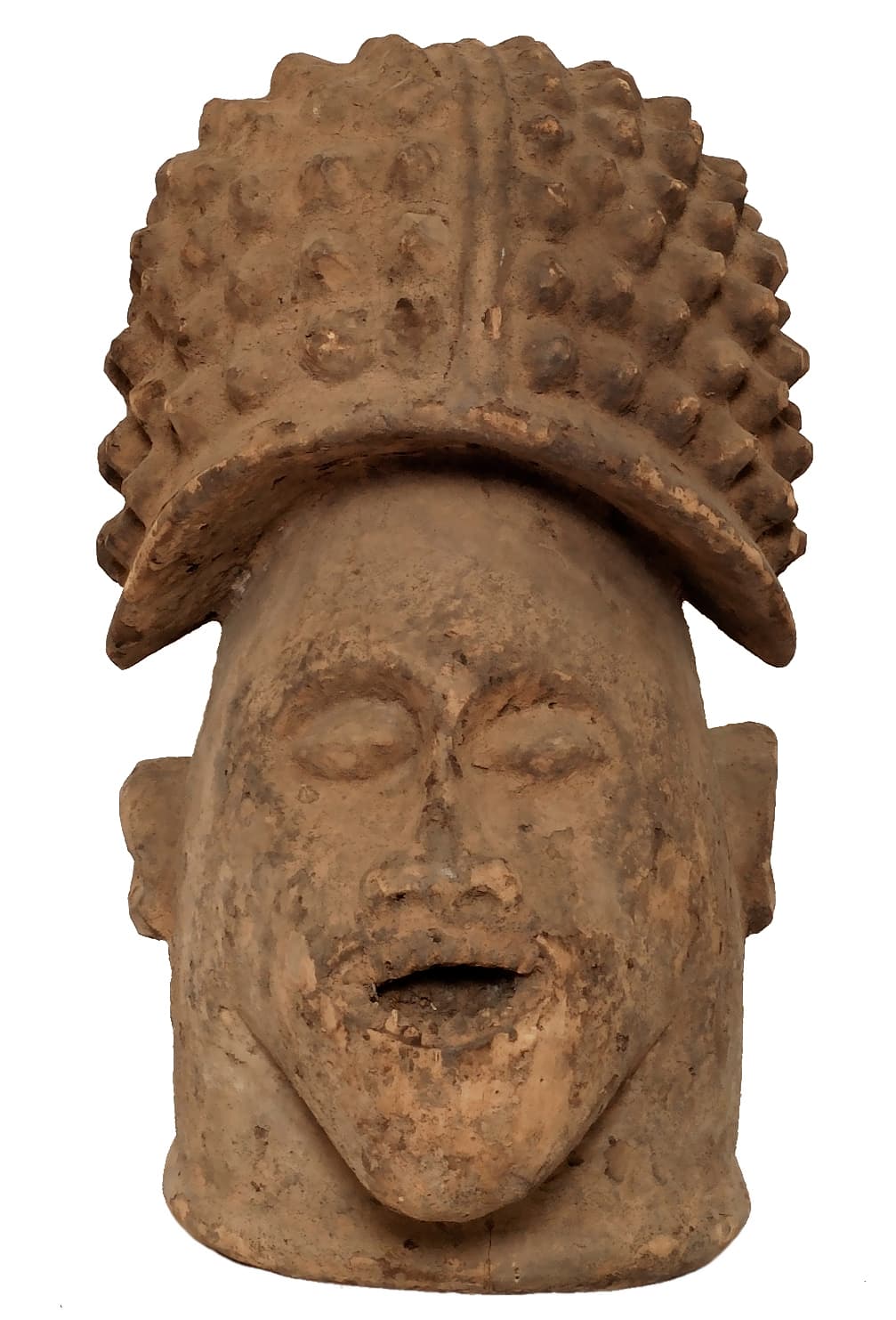
The first and most famous type comprises the royal memorial figures (lefem statues). These sculptures, often between 80 and 110 cm high, depict rulers (Fwa/Fon), royal mothers and nobilities. In contrast to the strict, frontal symmetry and columnar nature of the neighbouring Bamileke centres (such as Bandjoun or Bafoussam), the proportional canon of the Bangwa is characterised by an extreme, almost expressionistic asymmetry and torsion. The figures seem to be frozen in a dynamic movement: The knees are strongly bent, the upper body is often angled, and the head turns dramatically to the side or back of the neck. The iconography is densely coded with status symbols. The indispensable insignia include shaggy prestige caps (sometimes with bulbous outgrowths that refer to the cefardim horns, which symbolise power-political connections to the surrounding area), complex leopard claw necklaces (as a metaphor for the king's animalistic doppelganger), ivory bracelets as well as calabashes and tobacco pipes. The prominently open mouth, often with filed teeth, functions as a central visual evocation of the 'breath of life' or the lordly call, which visualises the ruler's vitality post mortem (von Lintig in Joubert 2016: 72; Clarke 2016). The genitalia are often strongly accentuated to guarantee the virile procreative power and metaphysical fertility of the kingdom.
A completely different canon of forms manifests itself in the masks of the Troh night society. These masks, conceived partly as helmets and partly as monumental top masks, elude the naturalistic formal language. They are carved in blocks, often Janus-faced (two-faced) and appear terrifying due to their reduced facial features and voluminous cheeks. Some have four pairs of eyes (owl eyes), which iconographically symbolises the all-seeing Clairvoyance (clairvoyance) of the witcher aristocracy (von Lintig 2016: 81).
Choice of material, patina development and authenticity
The materiality of the objects encodes their intended use. Sacred objects are carved from dense, resistant local hardwoods. The formation of the patina is a central criterion for distinguishing between a profane, unused wooden core and a ritually "activated" object. Lefem figures accumulate a greasy, black-brown patina over decades. This results from repeated anointing with palm oil (as an offering), red camwood powder and permanent storage in the smoky, sooty roof trusses of the palace huts, which impregnates the wood (Harter 1986). Troh masks, on the other hand, show a massive, barky crust patina (Attic patina), which results from the application of specific herbal "medicine", sacrificial blood, kaolin and copal (Brain & Pollock 1971: 42).
For private collectors, forensic forgery criteria are relevant to the market: Authentic Bangwa objects often show deep heartwood cracks (due to natural, slow drying in roof trusses) and specific, inactive termite feeding marks. Counterfeiters try to simulate this patina with chemical stains, shoe polish or superficial flaming. Modern provenance research uses UV fluorescence analyses and computer tomography (CT) to detect machine tool marks inside the sculptures, the lack of deeply penetrating soot particles in the wood cells or artificially induced termite damage (Baias 2023).
Documented master hands and workshops
Contrary to the Western topos of the anonymity of African artists, specific master hands are documented for the Bangwa corpus. The most famous historical sculptor is Efuetlacha, anchored in the research literature as Ateu Atsa (ca. 1840-1910), active in the Fontem Valley. Pierre Harter (1990) and subsequent researchers (such as C. Geary) identified his individual signature on the basis of the specific treatment of the eye and ear areas as well as the extreme dynamic torsion of the body (Harter 1990: 70-77). His works were part of the Pierre Harter and Helena Rubinstein collections and can be found today in global institutions such as the Cleveland Museum of Art (Inv. 1987.62) and the Yale University Art Gallery. For the mid-20th century, Brain and Pollock documented the sculptor Atem (active in the 1960s). Atem cultivated a bohemian lifestyle; he preferred to carve modern, colourful straw masks and financed his extravagant lifestyle through commissioned work as far away as Yaoundé (Brain & Pollock 1971: 38).
| Characteristics | Lefem statues (memorial figures) | Troh masks (night society) |
|---|
| Material / Surface | Hardwood, greasy soot/palm oil patina | Hardwood, massive encrusted patina (blood, medicine, kaolin) |
| Iconography | Realistic-expressive, asymmetry, insignia (caps, calabashes, claws) | Abstract, block-like, animal-hybrid, often Janus heads, owl eyes |
| Status / function | ancestral commemoration, dynastic legitimisation, fertility | execution of punishment, defence against witchcraft, metamorphosis (leopard) |
| Historical masters | Ateu Atsa (ca. 1840-1910) | Breath (active 1960s) |
Ritual practice
The ritual performance of ancestor figures and masks forms the centrepiece of the institutional Bangwa religion. It serves the material reconnection of the community to its transcendental origins and the constant renewal of socio-political contracts.
The life cycle of a lefem memorial figure often begins during the lifetime of the ruler, who commissions it from a master carver in the forests far from the village in order to maintain a monopoly on the likeness (Brain & Pollock 1971: 123). After completion, the sculpture is still a profane object. It is hidden in the chambers of a selected, high-ranking royal wife in the palace grounds and secured by guards.
The ritual activation and highest public effectiveness of the figure culminates in the so-called "Cry-Die", the massive, day-long burial and succession ritual for the deceased Fon. During this ceremony, the statue is brought out of the darkness and placed in the palace courtyard together with the portraits of earlier members of the dynasty. This physical accumulation of sculptures forms a concentrated symbol of dynastic continuity; it transforms the abstract concept of lineage into a visual archive that demands respect.
Subsequently, selected figures are periodically transferred to sacred natural sites (such as spectacular waterfalls or massive trees). There, the tanyi (earth priest) performs complex incantation rites. The primary offerings are palm wine, which is poured over the figures from royal pearl calabashes, and the blood of goats or chickens. These applications guarantee the fertility of the land, activate the statues as a temporary residence for the spirit of the "disappeared" king and bind the ancestral power to the territory (Metropolitan Museum of Art 2011; Warnier 2006).
The kinetic performance of the Troh night society stands in diametric contrast to the static, representative presentation of the Lefem figures during the day. The masks of this society are highly taboo and charged with destructive metaphysical energies. They are only used in complete darkness. Due to their massive spiritual danger - the masks embody witchcraft and animalistic metamorphosis - these massive helmet masks may not be worn directly on the head. Instead, they rest on the shoulders of the dancer, who often has to be led by another mask-wearer in a state of trance (von Lintig 2016: 75). Smaller Janus masks are placed on wooden poles in front of the secret assembly camps in the forest. They act as unmistakable barriers that prevent non-initiates from entering under threat of the death penalty (Brain & Pollock 1971: 42). The acoustic dimension - the roar of drums and rattles in the night - is an integral part of the performance in order to discipline the population through terror.
Deactivation and tolerance of decay
A radical difference to Western concepts of conservation can be seen in the way decay is dealt with. A final, ritual "deactivation" or disposal of sacred objects does not traditionally take place among the Bangwa. The accumulation of ancestral artefacts in the sooty roof trusses potentiates the power of the palace. Physical decay, especially through termite infestation, is tolerated as a natural process. Only when the ritual usability (e.g. in the case of masks) is completely lost are objects adapted or provisionally repaired by local craftsmen. A sale by the king was traditionally an absolute sacrilege and corresponded to the surrender of spiritual sovereignty, which is why early colonial collections were primarily based on looting. Important evidence of this ritual continuity and the material aesthetics of decay can be found in the collection of the Rietberg Museum in Zurich, whose holdings impressively document the dense, partly insect-eaten sacrificial patinas of Bangwa altar practice (Geary & Koloss 2008).
Historical context
Understanding Bangwa art production is inextricably intertwined with their violent colonial history and the resulting global market dynamics that transformed African cultural heritage into Western art commodities.
Colonial Encounter and the Conrau Case (1898-1899)
The relatively isolated existence of the Bangwa ended abruptly with the arrival of the German colonial agent and merchant Gustav Conrau in 1898. Conrau, who worked for the Hamburg company Jantzen & Thormählen, was looking for labour for the rubber and cocoa plantations on the coast of Cameroon. He initially concluded a blood brotherhood pact with the ruling King Fontem Asonganyi of Lebang. During this initially peaceful phase, Conrau was able to acquire an extensive collection of around 71 Bangwa artefacts, including around 40 statues (Schlothauer 2015: 24). The sources are ambiguous as to whether these objects were exchanged, handed over as diplomatic gifts or in some cases stolen under pressure; Conrau himself noted in letters to the Berlin Museum that he had acquired the "beautiful fetishes secretly" (Campfens 2019: 80).
the situation escalated catastrophically in 1899. Rumours of the deaths of almost all the Bangwa workers recruited at the coastal fevers reached the highlands. The Bangwa revolted, arrested Conrau and poisoned water points. Conrau died under circumstances that remain unexplained to this day (German historiography notes suicide, Bangwa oral history speaks of execution). The German Empire reacted with extreme brutality. From December 1899, imperial protection troops carried out devastating punitive expeditions (the "Bangwa Wars"). The palace in Lebang was burnt down, fields were destroyed and numerous sacred artefacts (Lefem figures) were confiscated as spoils of war, while King Asonganyi was forced to flee underground for years (Campfens 2019: 80; Chilver 1967).
Market history, provenance and price development
The holdings sent from Conrau to Berlin to the Königliches Museum für Völkerkunde (now the Ethnologisches Museum Berlin) experienced a highly volatile history. In the late 1920s, the Berlin museum "deaccessioned" numerous supposed duplicates under financial constraints. At least five of the most important statues - including the famous "Bangwa Queen" - ended up on the private art market via the Berlin dealer Arthur Speyer II (von Lintig 2017: 94).
Isolated from their ritual context, these objects were transfigured into formalist icons of classical modernism by Parisian avant-garde dealers (such as Charles Ratton) and revolutionary exhibitions (such as the African Negro Art exhibition at MoMA in 1935). The surrealist photographer Man Ray photographed the "Bangwa Queen" in 1933, which cemented her status as a masterpiece of world art. The figure was in the collections of Helena Rubinstein and Harry A. Franklin. in 1966, it was sold from the Rubinstein estate for 26,000 US dollars. in 1990, the French Fondation Dapper acquired the work at a Sotheby's auction for the then world record price of 3.4 million US dollars, a turning point for the African art market (Campfens 2019: 76; Schlothauer 2015).
Restitution debate and authenticity criteria in the 21st century
Today, the Bangwa corpus is at the epicentre of the international restitution debate, fuelled by Emmanuel Macron's keynote speech in Ouagadougou in 2017. Representatives of the Bangwa, above all the lawyer and royal descendant Chief Charles Achaleke Taku, have been vehemently demanding the unconditional return of the sacred statues from the Fondation Dapper, the Quai Branly and the Ethnologisches Museum Berlin for years.
The legal and ethical arguments are highly controversial (author vs. author). Conservative museum historians point to intertemporal law and argue that the acquisition by Conrau in 1898 was made through barter transactions and was therefore "legal at the time" by the standards of the time. Legal scholar Evelien Campfens (2019: 75-110) dismantles this argument: she argues in favour of a paradigm shift from property law to a human rights-based approach (Human Rights Law), anchored in the UN Declaration on the Rights of Indigenous Peoples (UNDRIP). As the statues represent inalienable spiritual heritage (heritage) of the Bangwa culture, a "voluntary" sale by King Asonganyi is unthinkable. Such a transaction under the massively asymmetrical power conditions of the approaching colonial war would have to be categorised as robbery (spoliation). The refusal of many Western institutions to enter into direct dialogue with the traditional Bangwa authorities prolongs this historical wound. For private collectors, this means that the provenance history of Bangwa objects today must not only be forensically verified in terms of materials, but is also subject to rigorous moral and ethical scrutiny.