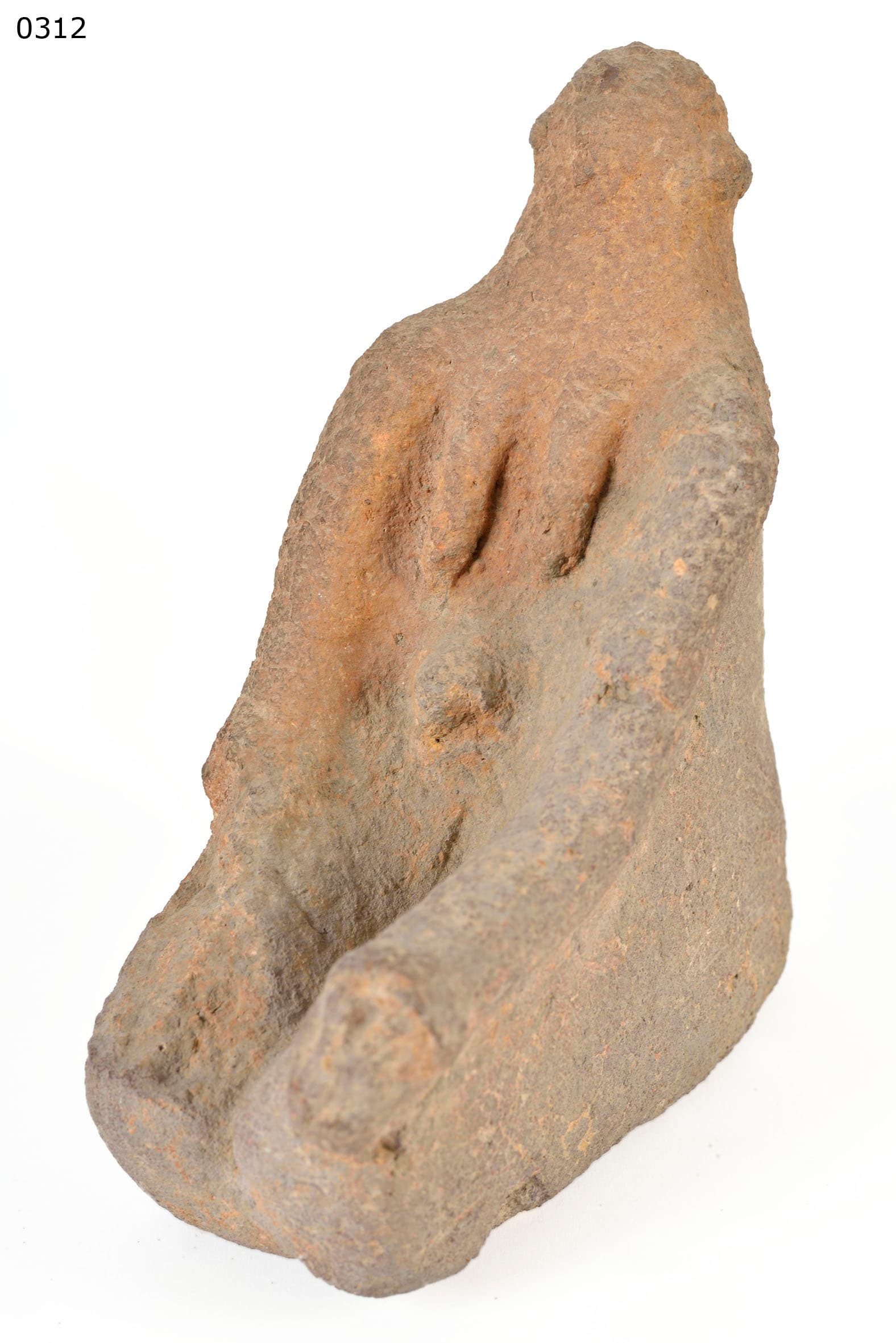
The Mambila are a Cameroonian and Nigerian people of the Mambilla Plateau, known for heart-faced polychrome masks and tadep guardian figures carved in soft, pigmented wood.
1. overview
The settlement area of the Mambila extends over a geostrategically and topographically highly complex contact zone on the border between south-eastern Nigeria and north-western Cameroon. The primary habitat of this ethnic group is the Mambilla Plateau named after it, which is administratively largely located in the Sardauna Local Government Area of the Nigerian Taraba State. This region is characterised by a pronounced highland climate; the plateau has an average altitude of around 1,600 metres above sea level, with significant elevations such as the Chappal Waddi (or Gang) mountain massif reaching heights of up to 2,419 metres and thus representing the highest topographical points in West Africa. A smaller, but culturally, historically and linguistically highly relevant fraction of the population settles beyond the modern international borderlines in Cameroon. These groups are mainly concentrated in the Adamawa region on the so-called Ndòm plain (often referred to in the literature as the northern Tikar plain) as well as in and around settlement centres such as Somié, Bankim, Banyo and smaller village communities on the Gashaka plain.
The current demographic data situation is variable depending on the survey method, definition of ethnicity and political interpretation of the boundaries. Based on censuses and linguistic extrapolations, the current total population of the Mambila is estimated to be between 100,000 and 130,000 individuals. Of these, the absolute demographic heavyweight lives on the Nigerian side of the plateau with around 99,000 members, while the Cameroonian population is estimated at around 30,000 to 73,000 people (depending on the inclusion of assimilated marginalised groups). The discrepancy between self-designation and foreign designation is a typical phenomenon of ethnographic nomenclature in this large African region. While the widespread exonym "Mambila" (usually spelt "Mambilla" or historically "Mambere" in Nigeria) functions as a colonial, administrative and museum collective term, the members of the ethnic group use more differentiated endonyms. In the Nigerian dialect groups, the people refer to themselves as "Nor" or "Norr", which in literal translation simply means "the people". In Cameroon, on the other hand, the collective term "Ba" dominates, which is used in the unmarked sense for the ethnic group, or "Bo ba bo" ("the Ba people"), in order to distinguish themselves specifically from the highland Mambila.
The linguistic classification of the Mambila is characterised by enormous complexity and forms the core of long-standing academic controversies. The Mambila language is assigned to the Mambiloid language family, which represents an early, highly differentiated branch of the northern Bantoid languages within the gigantic Niger-Congo phylum. The linguistic fragmentation on site is extremely high; the language does not exist as a monolithic block, but forms an extensive dialect continuum with over 20 documented varieties, some of which are difficult to understand.
| Geographical region | Documented main dialects of the Mambila language | ISO 639-3 code |
|---|
| Nigeria (Mambilla Plateau) | Barup, Bang, Dorofi, Gembu (Ju Naare), Hainari, Kabri, Mayo Ndaga, Mbamnga, Tamien, Warwar | MZK |
| Cameroon (Adamawa/Tikar plain) | Sunu Torbi (Torbi), Ju Ba, Langa, Somié dialect (Ndiba) | MCU |
The source situation regarding the exact linguistic classification is ambiguous and controversial in research. While established linguists such as Roger Blench (1993, 2011) firmly anchor the mambiloid languages within a broader "North Bantoid" hypothesis (often together with dakoid languages), Bruce Connell (2024) argues that the internal integrity of the mambiloid group and its exact status as a bantoid language must be considered in a more differentiated way due to extreme dialectal diversity (such as strongly fricative vowels in Len-Mambila). To make matters worse, isolated dialects such as Tep are perceived as mambiloid by their speakers, but differ linguistically to such an extent that they would have to be categorised as separate languages. This dense dialectal map is increasingly being systematically recorded in the archives of Western institutions - for example in the audio and cartography collections of the British Museum - in order to document the historical depth of colonisation.
In terms of social structure, both historical and contemporary ethnographic research documents a profoundly acephalous (free of domination) and strongly egalitarian social order, which stands in sharp contrast to the tightly organised kingdoms of the African continent. Fundamental field research, particularly the work of Farnham Rehfisch in the village of Warwar in the 1950s and later studies by David Zeitlyn in Somié, show that traditional Mambila society had no central tribal organisation, no overarching chiefdom and no institutionalised ruling caste. Instead, social authority was decentralised and lay in the hands of family heads, councils of elders and the leaders of powerful male secret societies. The kinship system is described as cognatic and multilinear; descent (lineage) is therefore not strictly unilinear (only through the father or only through the mother), which led to a high degree of social flexibility, but also to complex residential patterns (Rehfisch 1960; Zeitlyn 2005). Marriages were historically often organised as complex "sister exchanges", a practice that created far-reaching alliances between autonomous hamlets. Only in more recent history, forced by colonial influences and contact with neighbouring peoples, have administrative asymmetries developed: While the Nigerian Mambila have largely retained their informal structure with ritual but politically powerless "chiefs", the Cameroonian Mambila at the Tikar level increasingly adopted hierarchical elements of the neighbouring Tikar kingdoms, in which the status of an individual is defined by spatial and genealogical proximity to the chief.
The subsistence strategy of the Mambila is based on an agricultural economy with a high degree of division of labour, but organised in an egalitarian way, which is perfectly adapted to the climatic conditions of the highlands. Traditional cultivation is focussed on cereals, primarily locally adapted varieties of sorghum, millet, rice and maize. In the course of historical adaptation processes, this range was expanded to include bananas, yams, peanuts, pumpkins and various types of pepper. Animal husbandry is traditionally limited to small livestock such as goats, dogs and chickens, which often fulfil a dual function as a source of food and a sacrificial animal in ritual contexts. The so-called kurum are an outstanding social institution for securing subsistence. These are mutual labour cooperatives in which villagers join together to carry out labour-intensive tasks such as clearing land, planting and harvesting. These kurum groups are far more than economic alliances of convenience; they function as social epicentres in which agrarian labour is inextricably interwoven with ritual dances, feasts and masked performances. Gender roles in agriculture are surprisingly complementary: men and women share the physically demanding field labour and house building. Only highly specialised craft activities are strictly gender-specific. Cotton weaving, blacksmithing, wood carving and the production of the regionally rare terracotta sculptures are the exclusive preserve of men, while women have a monopoly on basket weaving and primary caring tasks.
The relationship with the neighbouring peoples, especially the semi-nomadic Fulani (often referred to as Fulbe in the literature), is characterised by a bipolar dynamic of economic symbiosis and historical experience of violence. On the one hand, there is an established, peaceful barter system: when the Fulani herdsmen move with their cattle herds to the lush grasslands of the Mambilla Plateau during the dry season, the Mambila systematically exchange their agricultural surpluses for the protein-rich dairy products of the nomads. On the other hand, this constellation harboured immense potential for conflict in the past. In the 19th century, during the expansion phase of the Islamic Fulani emirates of Banyo and Gashaka, the acephalous and fragmented Mambila villages were subjected to constant slave hunts and raids (Zeitlyn 1992). This historical threat often forced the Mambila to seek out inaccessible highlands as retreats and left them with a deep distrust of centralised, expansionist powers. Even today, sometimes violent land use conflicts between the arable Mambila and the pastoralist Fulani continue to flare up, exacerbated by demographic pressure and ecological changes (Buhrmester et al. 2020). Such conflict dynamics illustrate that, despite their relative geographical isolation, the Mambila never existed in a hermetic vacuum, but were always integrated into complex regional networks.
2. cultural context
In order to analyse the material art of the Mambila as it exists in collections today, a deep understanding of their religious and ontological system is required. As the ethnographer David Zeitlyn meticulously explains in his groundbreaking field research and detailed monograph Sua in Somié: Aspects of Mambila Traditional Religion (1994), the religion of the Mambila is characterised by a pronounced pragmatism, an immediate closeness to life and the deliberate absence of a dogmatically formalised theology. The Mambila do not have a class of full-time theologians who would systematise or philosophically abstract cosmological narratives. Intellectual and spiritual activity is instead focussed almost exclusively on solving immediate, everyday and social problems - healing illnesses, settling conflicts, securing the harvest and protecting against spiritual attacks.
Although the cosmological order recognises the idea of a distant creator god, who is often referred to locally as Nama or Chang, this entity, as Deus otiosus, hardly actively intervenes in people's daily lives and is therefore not a primary target of cult activities. Instead, the spiritual vacuum is filled by closer, often unpredictable powers. At the centre is the deeply rooted belief in witchcraft (locally called lɔp), which serves as a causal explanation for sudden misfortune, inexplicable illnesses or social dissonance. The ancestors play an ambivalent role. The source situation regarding the existence of a formal ancestor cult is ambiguous and controversial in the literature; while older reports (such as those by Paul Gebauer) often speak generally of "ancestor worship", more recent ethnographic analyses specify that the ancestors are respected, but not worshipped in the classical sense as in Asian or other African cultures. However, there is a belief that the ancestor spirits accompany the souls of the deceased into the afterlife at night, and there is a ritual practice of burying important chiefs and heads of families in the granaries in order to bind their vitality and prosperity in the family environment of this world.
The absolute epicentre of Mambila religious and ritual practice, however, is the Sua system (dialectally also Suaga, Shua or Shuaga). Zeitlyn defines Sua as a complex, polyvalent category of ritual acts that includes mask performances (Sua masquerades), complex oath rituals (Sua oaths) and specific purification and blessing rites. In a society without a central state judiciary or institutionalised police force, the Sua cult assumes the role of the supreme legal and moral authority. The Sua oath is sworn at the ritual altars to settle serious village disputes, convict thieves, pacify marital conflicts (such as the settlement between a husband and his wife's lover) and protect the family collective from illness. Anyone who breaks a sua oath exposes themselves to the deadly, supernatural sanction of the cult. The ritual authority over these processes is not vested in institutionalised priests in the Western sense, but is exercised situationally by the male heads of the family, experienced diviners and initiated members of the secret societies.
A structural analysis reveals serious differences between the religious system of the Mambila and the cults of their direct neighbours. Studies by researchers such as Richard Fardon (1990, 2006, 2007) on the Chamba and the cultures of the Cameroon grasslands (such as the Bamum, Bafut or Bali-Nyonga) make it clear that rituals and masquerades there primarily serve to legitimise and display centralised royal power (the Fon). In the grasslands, material culture is inextricably interwoven with courtly representation, tribute payments and the mystification of the ruler. Among the Mambila, on the other hand, the ritual system acts as an egalitarian levelling mechanism. The masks and altars do not serve to elevate an individual above the masses, but rather to heal collectively, to settle disputes on an equal footing and to regulate the abuse of power within the unstructured village anarchy.
The role of women in this religious matrix is characterised by asymmetrical access rules and tabooed spaces. The core area of material cult practice, in particular the production, handling and visual contact with the tadep figures and the suaga bea helmet masks, is strictly forbidden to women. The ban on seeing the masked dancers or the contents of the shrine is a central pillar in maintaining the mystical authority of the male secret societies. Nevertheless, it would be short-sighted to regard women as purely passive actors. Oral traditions and ethnographic marginal notes, including those of Zeitlyn, point to the existence of female initiation lines and hidden masquerades that operate outside of male hegemony and address specifically female fertility and life crises.
The indispensable basis of all ritual decision-making - be it the diagnosis of witchcraft, the identification of the causes of illness or the planning of agricultural cycles - is divination. The specific mambila system of spider or crab divination (ngam du) is one of the most fascinating epistemological concepts in West Africa. The divinator places a set of specially trimmed and abstractly patterned leaf cards (often supplemented by small stones or wooden sticks) in front of the burrow of a tarantula (or, in wetter habitats, a land crab). The positioning of the cards is changed by the nocturnal movements of the animal. The next morning, the divinator "reads" the shifted patterns as binary answers (yes/no, positive/negative) from the nature spirits or ancestors to the questions asked.
In analysing this divination system, there is a significant theological and iconographic controversy in research (author vs. author). David Zeitlyn argues on the basis of his ethnomethodological conversation analyses that the Mambila simply ignore the abstract symbols on the leaf cards in practice. For Zeitlyn, divination is a purely dialogical, pragmatic process of social negotiation; the Mambila do not resort to a deep, symbolic code, but use the mechanism primarily to generate socially accepted judgements (Zeitlyn 1993, 2020). This reading is fundamentally criticised by the anthropologist Anthony Buckley (1996) in a sharp scientific reply. Buckley criticises Zeitlyn's approach as reducing religion to pragmatism and overlooking the deep ritual symbolism - especially the botanical semantics. Buckley draws parallels with Victor Turner's work on the Ndembu and argues that the Mambila, like most African societies, have a highly complex, non-verbal sign system encoded in the use of specific plant medicines and animal attributes, which Zeitlyn inadmissibly marginalises in his linguistic analysis. This controversy clearly marks the limits of Western models of interpretation in deciphering oral traditions. Today, evidence of this divination and ritual system can be found documented in the audiovisual archives of the Royal Anthropological Institute and in fragmentary form in the collections of the Musée du quai Branly.
3. aesthetic features
The aesthetic canon of Mambila sculpture is one of the most distinctive, radical and expressionist formal languages produced in the border region between eastern Nigeria and north-west Cameroon. The material culture of the Mambila is quantitatively limited, but is characterised by a high degree of conceptual and formal coherence. The canonical object typology can primarily be divided into three central categories, each of which carries highly specific iconographic meanings and cultic functions: the anthropomorphic wooden figures (Tadep), the more abstract mark figures (Kike) and the zoomorphic helmet masks (Suaga bea or Suah dua) (Nicklin 1999; Schwartz 1972).
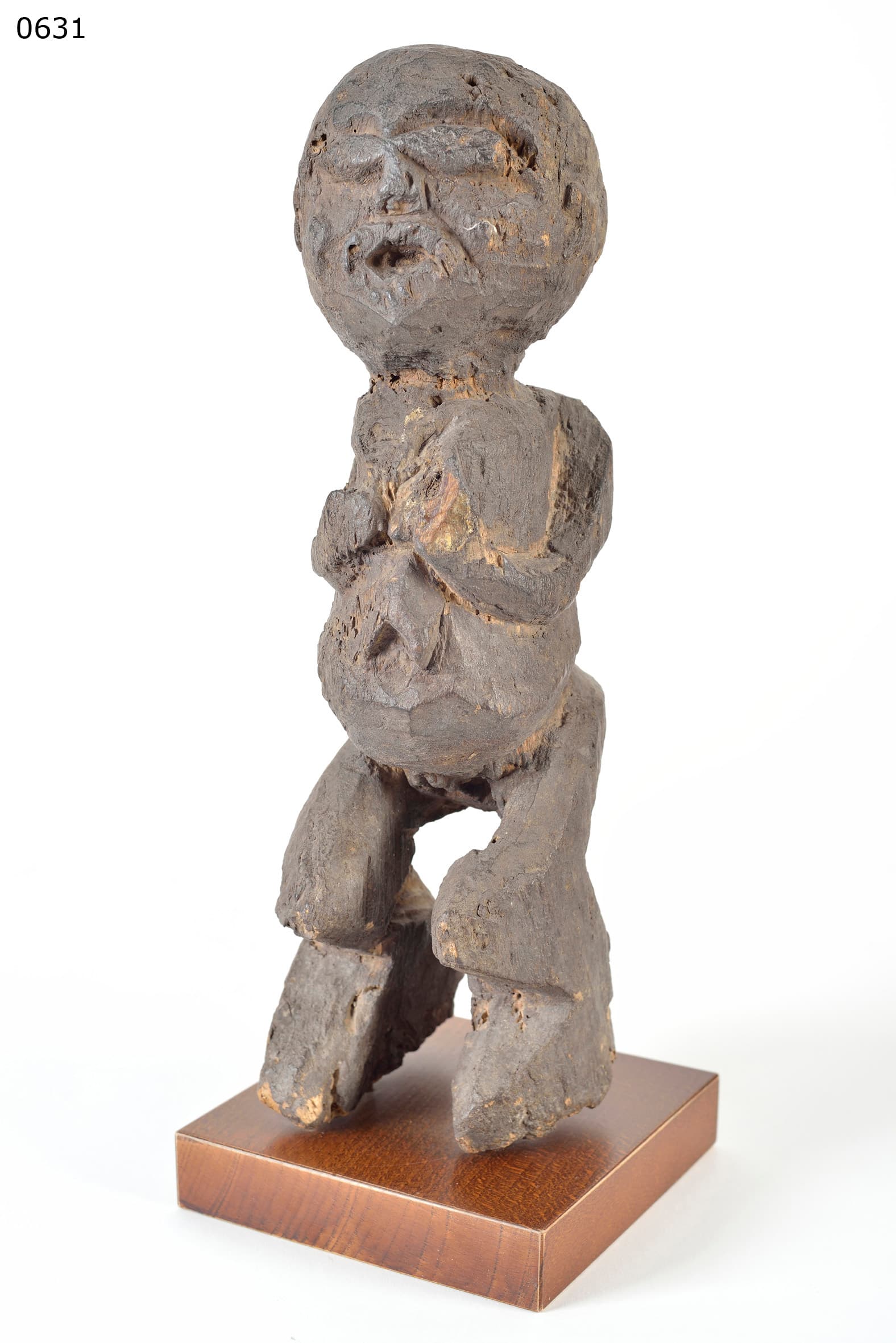
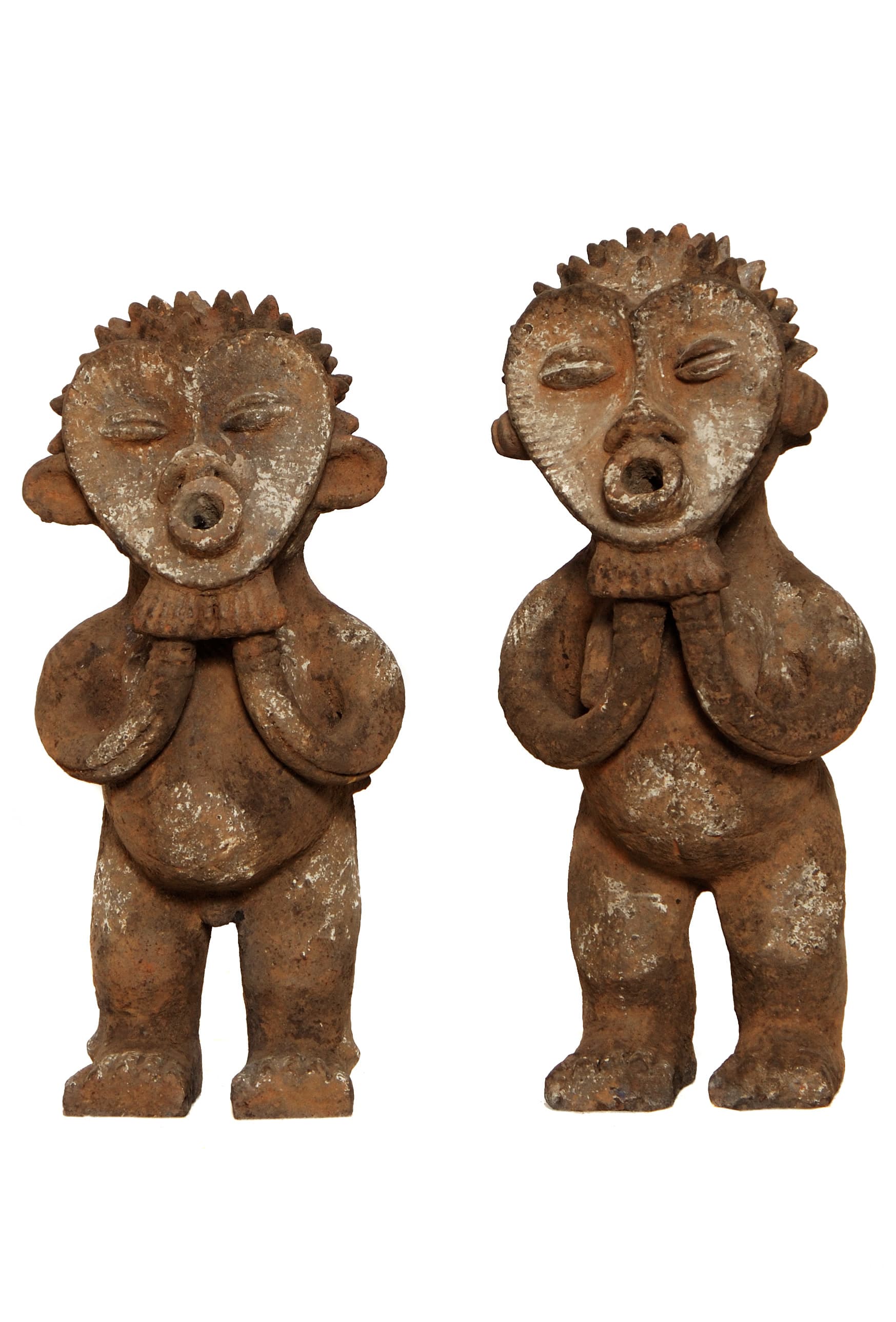
The most prominent object category are the tadep (in the plural often tadep dua), anthropomorphic guardian and altar figures. These statues defy classical ideals of symmetry and naturalistic depictions. The tadep are usually stockily proportioned; a massive, cylindrical or almost cubist torso rests on extremely angled, short legs that suggest a feather-like kinetic energy trapped in the material, as if the figure is on the verge of an explosive discharge. The most striking feature is the design of the head section: the face is deeply concave and framed by a concise, heart-shaped contour, the centre of which is dominated by a wide open mouth, often with carved teeth. Instead of sculpted hair, small wooden pegs are often driven into the skull in a circle to imitate the traditional hairstyle of the Mambila. A highly specific, almost exclusive iconographic feature of the mambila is the gesture of the arms: in the majority of tadep figures, the left arm, or more rarely both arms, is sharply bent, with the hand brought directly to the chin. This specific gesture is not an aesthetic coincidence, but rather unmistakably encodes the figure's affiliation to the suaga healing association in the mambila iconography (Nicklin 1999).
The second figurative category is formed by the kike. In contrast to the tadep carved from solid wood, kike figures are constructed from the soft, extremely light pith (pith) of the raphia palm, the pieces of which are often only provisionally bound together or fixed with wooden pins. In keeping with their fragile materiality, their style is even more abstract, rudimentary and archaic than that of the tadep. They function ritually as a complementary extension of the wooden figures, are often conceived as a male-female pair and flank the tadep in the ritual architecture, primarily associated with spiritual purification.
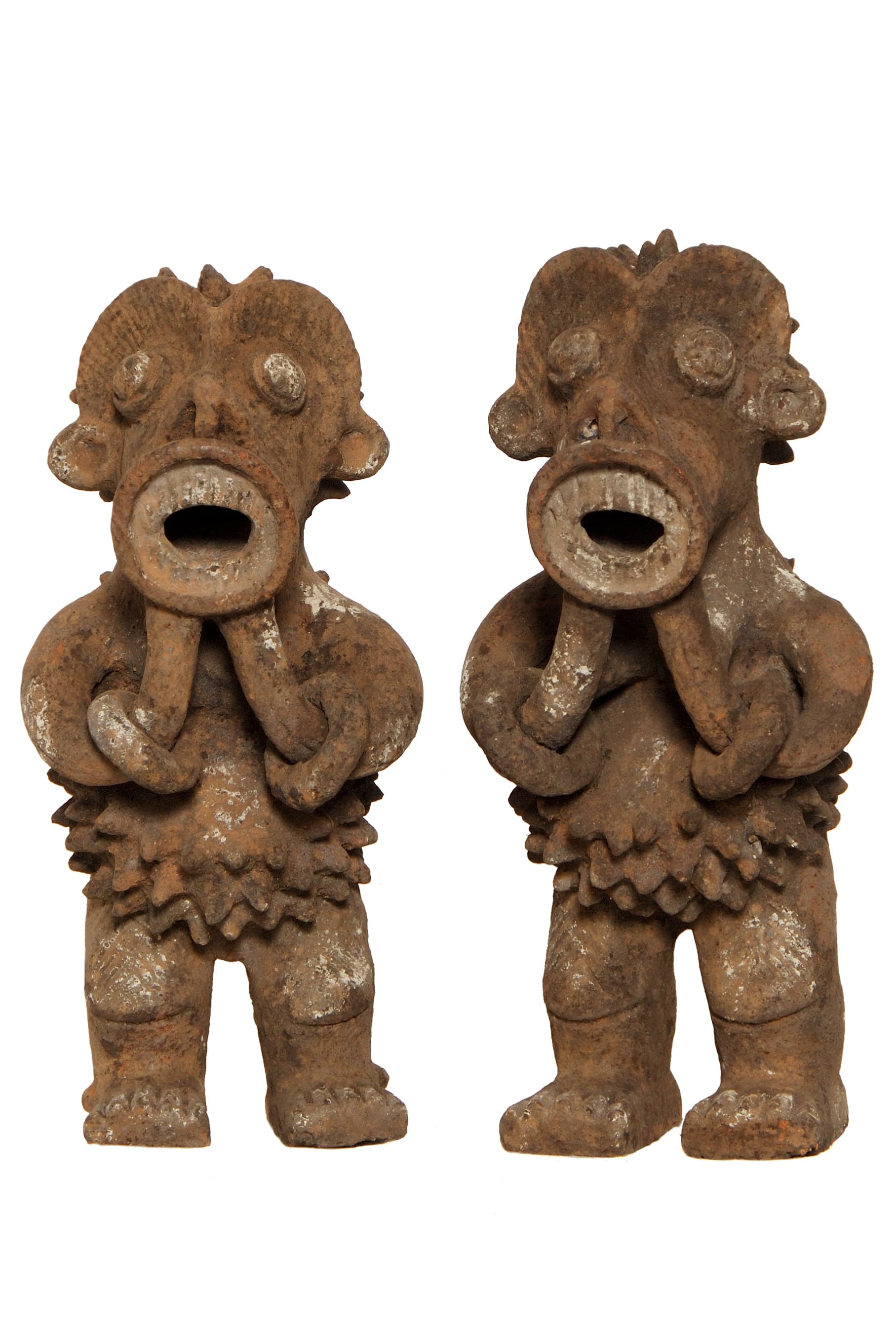
The performative sphere is dominated by the powerful suaga bea (or suah dua, translated as "large mask"). These are voluminous, horizontally worn helmet masks. Iconographically, they merge animal and human attributes into a theranthropic form. The most striking feature is the extremely elongated, snout-like jaw, which is wide open and resembles a massive beak or the mouth of an animal (often interpreted in the literature as a crow, in some southern variants as cattle or a bush cow). The eye area is no less radically designed: Short, cylindrical wooden tubes protrude vividly in front of small rectangular recesses, flanked by sharp, triangular ears at the rear edge of the skull. This repertoire is complemented by the Baltu, large-format wooden panels or woven screens painted with geometric patterns, which serve as architectural jewellery and visual barriers at the shrine huts.
The choice of materials for the Mambila sculptures is consistently focussed on softwoods, primarily the porous wood of the kapok tree (Ceiba pentandra) (Schwartz 1972). This type of wood is easy to carve, but is extremely susceptible to the tropical climate and insect infestation. The size of the figures varies considerably: they range from small, intimate hand amulets (approx. 15 cm) to monumental tadep main guards over 50 cm high, which are permanently installed in the storehouses. The colour spectrum, however, is strictly limited. The Mambila only use a ritual triad of natural pigments: Red (obtained from ochre earth or redwood powder), white (kaolin) and black (soot or plant extracts). These pigments are not applied homogeneously, but define geometric zones, emphasise the concave parts of the face or accentuate scar tattoos on the torso and legs.
The genesis of the patina, a decisive quality feature for private collectors, is not the result of purely manual polishing, but is the direct result of ritual accumulation. The difference between a profane carving fresh from the workshop and an activated ritual object is radical and binary in the Mambila ontology. An unused piece of wood has no power. Only through ritual charging - the filling of specially drilled cavities on the back or head of the figure with suaga medicine (a secret mixture of plants, earth and bones) - does the figure transform into an actor (Zemanek 2015). The surface of the figures is successively remodelled over the course of their "life cycle" through repeated offerings. This sacred patina consists of stratigraphic layers of coagulated chicken, sheep or goat blood, mixed with millet flour, the flour of the baobab tree, pulps of burnt medicinal herbs, charcoal and highly fatty palm or shea oil. The result is a deep black, partly brittle, organic crust that softens the original carving lines and gives the object an amorphous, lively depth.
There is a significant iconographic controversy among experts regarding the attribution of master hands and the differentiation of workshops (author vs. author). David Zeitlyn (1994) argues, based on decades of fieldwork in villages such as Somié, that the classification practice of Western museums, which often treat mambila pieces as a monolithic block, is flawed. He postulates that almost every Mambila village has a completely distinct style family (micro-styles), as the craft of carving was passed down strictly in family lines, usually from father to son (or even to daughter in the absence of male heirs). The analytical approach of forensic scientists and art historians such as Susanne Pfaff-Schnur (2003) stands in stark contrast to this. Conservation research focuses less on village micro-styles and instead analyses the mambila corpus more generally via forensic patina findings, wood analyses and weathering processes in order to ensure authenticity for the art market, as the original places of origin of historical pieces are rarely fully documented. For collectors, it is precisely these organic ageing processes - deep cracks in the heartwood, oxidation of the natural pigments and specific termite damage creeping into the end grain from below (as the figures often stood on the clay floor) - that are the most relevant forgery criteria for distinguishing them from colonial copies or recent souvenir works. Excellently documented reference pieces of this iconographic breadth, both Tadep figures and helmet masks, can be studied today in the Museum Rietberg in Zurich (e.g. from the von der Heydt Collection) and in the Metropolitan Museum of Art in New York (e.g. Tadep pairs and Suaga bea costumes).
4. ritual practice
The ritual activation, performance and daily use of the material art of the mambila are inextricably linked to the agrarian calendar and the need for legal and physical security within the village community. At the centre of this ritual practice is not a central temple, but the architecturally inconspicuous but spiritually highly charged sanctuary of suaga society. These altars or shrines are physically designed as granary-like huts strategically erected on massive wooden stilts. This design fulfils a dual purpose: profanely, it protects the sensitive ritual paraphernalia from the extreme humidity of the tropical plateau and from rodents; sacredly, it elevates the abode of the ancestral powers and the Suaga spirits above the polluted soil of everyday human life.
The construction and decoration of this altar ensemble follow a strictly curated visual order. The outer façade of the elevated warehouse is often framed by the painted Baltu wooden panels, whose abstract geometry of red, white and black triangular and diamond patterns already visually warns of entry into a taboo zone. The space directly in front of the storage door is the primary exhibition area. Here, net-like hammock structures made of robust raffia or banana fibres are stretched, in which the anthropomorphic Tadep and the more rudimentary Kike figures are placed. The figures hang in these nets in such a way that they are easily moved by the wind; a kinetic property which, according to the Mambila, symbolises the constant, watchful presence of the guardian spirits and serves as an active defence mechanism against intruding sorcerers or unauthorised glances (Hecht/Schwartz 1972). The largest, most powerful Tadep dua sculptures (main guardian figures), on the other hand, are not exhibited outdoors, but are stored in the dark interior of the granary. Access to this ensemble is strictly patriarchal: The head of the family (the eldest) is the guardian, while women are strictly forbidden from approaching the shrine or even looking at the figures under threat of massive mystical sanctions.
The lifecycle of a Mambila ritual object runs in sharp phases from profane creation to complete disintegration. When a carver completes a figure, it is merely a beautifully shaped piece of softwood. The actual "birth" of the statue as a fetishistic actor - the activation - is only carried out by the ritual specialist of the Suaga society. This specialist places highly effective magical ingredients (herbal essences, earth mixtures, sometimes bone splinters) in a specially created cavity, usually in the back, stomach or head of the figure, and seals it with resin or clay (Zemanek 2015).
Once activated, the figure's power must be maintained through constant offerings (feeding). The main occasions for these offerings are the major tawong festivals, which are celebrated biannually, usually in the months of June and December, and flank the agricultural cycle from planting to harvest. During these festivals, complex libations are performed at the Suaga shrines. The priests and elders sacrifice chickens, sheep or, more rarely, goats and apply the fresh blood directly to the face and torso of the tadep figures. This is combined with the application of thick pastes made from millet flour, baobab powder, crushed medicinal herbs, ash and fatty shea oil (shea butter). These layers bake hard in the African sun and over the years form the inimitable, deep patina that is so prized by collectors. Offerings are also initiated ad hoc: In cases of rampant disease, infertility, epidemics or after the successful resolution of a conflict through a sua oath, the altar is propitiated by renewed anointing.
The performative dimension of the mambila rituals manifests itself most impressively in the masquerade of the suaga bea (helmet mask). The performance is extremely physically demanding and requires the highest level of initiation. The male dancer of the kurum or suah society does not wear the often heavy wooden mask vertically in front of his face, but holds it horizontally on his head so that the long, beak-like animal jaw protrudes menacingly forwards. In order to completely negate the human nature of the wearer, the dancer's entire body is concealed under a massive costume consisting of a dense weave of banana and raffia fibres, into which countless bird feathers are often incorporated. There are subtle regional performative variations: While the dances on the southern plateau focus strongly on agrarian fertility and the rhythm of the harvest and are often accompanied by the kurum labour groups in the fields, sources from the more northerly territories report wilder, warlike masked performances linked to the initiation rites of the youths and demonstrating territorial power. During the dances, the mask acts as a vessel for uncontrollable nature spirits, which is why the dancer often has to be kept in check by attendants with sticks.
At the end of this ritual life cycle, the mask is inevitably deactivated. The Ceiba wood used by the Mambila is extremely susceptible to the harsh climate and the unstoppable termite attack. If a tadep figure loses its structural integrity due to insects, rot or weathering, there are no restoration efforts in the traditional culture in the western conservational sense. If the vessel is broken, the inherent suaga power is considered to have escaped or is ritually transferred to a newly carved substitute. The old object is simply disposed of - it remains on the floor of the shrine or is thrown into the bush, where it returns to nature. This utilitarian practice is the main reason why hardly any pre-colonial mambila artefacts exist today. Rare documented examples of complete masked costumes and figures heavily patinated by offerings from the early 20th century have survived through fortunate circumstances and are now a central part of ethnographic collections such as that of the Royal Museum for Central Africa (RMCA) in Tervuren.
5. historical context
The historical localisation of the Mambila operates at a highly complex interface between linguistic anthropology, local oral history and the analysis of incomplete colonial archives. The migration history of this people is the subject of intense and sometimes bitter dating controversies among experts. On the one hand, leading linguists such as Roger Blench and historians postulate on the basis of detailed glottochronological models that the Mambilla Plateau - due to its extreme linguistic diversity within the Mambiloid/Bantoid spectrum - must be regarded as the geographical epicentre, the "original homeland", of the enormous African Bantu expansion (Blench 1993; Zeitlyn & Connell 2003). According to this theory, the ancestors of the Mambila have been living in this inhospitable mountain region for an estimated 2,000 to 4,000 years, making them one of the oldest autochthonous populations in West Africa. However, the oral traditions and legends of many Mambila village elders radically contradict this. These narratives place the origin of the ethnic group much further north, in the Mandara Mountains of present-day Cameroon. According to the oral myths, the Mambila were only driven out of the plain in the 17th and 18th centuries by the massive expansion pressure of the Islamic Fulani (Fulbe) and sought refuge on the plateau, which is difficult to access. The source situation regarding these migrations is ambiguous; recent research assumes that both narratives have a true core and that native Bantoid populations on the plateau mixed with later splinter groups from the north fleeing from the Fulani slave hunters (Fardon 1983).
The formal colonial encounter brought a brutal caesura for the Mambila, which was to permanently shake not only their political autonomy but also their ritual art production. In the late 1880s, German colonial officials and traders (driven by the race for Africa and the influence of Chancellor Bismarck) first penetrated the Bamenda grasslands and the neighbouring Mambila territory in order to secure the lucrative trade routes (Rudin 1938). The German administration often relied on military repression, but ended abruptly with the First World War. Subsequently, the League of Nations carried out a momentous imperial division: the tribal territory was artificially carved up along geodesic lines. The western part of the Mambilla Plateau fell under British mandate (as part of Northern Nigeria), while the eastern sector, in particular the fertile Tikar Plain, was assigned to the French colonial administration in Cameroon. This division tore apart marriage and trade networks that had developed over centuries and led to asymmetrical developments: The French administration pushed for greater centralisation and supported local chiefs modelled on the Tikar kings, while the British left the traditional acephalous system largely untouched as part of their Indirect Rule, but undermined the authority of the secret societies through formal jurisdiction (Zeitlyn 1994).
The influence of this colonial history on local art production was fatal and led to a massive breakdown in tradition. The establishment of colonial infrastructure was followed by the arrival of radical Christian (especially Baptist) and intensified Islamic missionary endeavours in the 20th century. The traditional Sua rituals, the belief in witchcraft and especially the guardian figures were pathologised by the colonial rulers and missionaries as "pagan idolatry" and systematically suppressed (Dekar 1994). Numerous converted Mambila refused to take part in masquerades from then on, and the woodcarving guilds (which passed on their knowledge in a patrilineal way) could no longer find new recruits. New tadep figures or masks were simply no longer commissioned, as their function in the new religious structure had become obsolete (Zeitlyn 1994).
Paradoxically, it was precisely this local cultural collapse that marked the beginning of an unprecedented market history of mambila art in the West. One of the earliest and most important players was the German Baptist missionary Dr Paul Gebauer, who travelled through the Cameroon grasslands in the 1930s and 1940s. Gebauer recognised the aesthetic impact and the impending disappearance of the objects and began to systematically collect Tadep figures and masks, which he later transferred to North American museums such as the Portland Art Museum and the Metropolitan Museum of Art in New York (Gebauer 1979). He was followed by the linguist and missionary Dr Gilbert Schneider, who lived in the Nigerian Mambila village of Warwar between 1947 and 1951. Schneider documented the use of the objects photographically and compiled an enormous collection of almost 300 pieces, which was acquired by the Milwaukee Public Museum (MPM) in 1968 and is still the world's largest and most scientifically valuable Mambila collection outside Africa (Schwartz 1972).
However, the commercial breakthrough on the modern art market was initiated in Paris. Elite gallery owners and tastemakers such as Paul Guillaume and Charles Ratton recognised in the block-like, expressionist radicalism of the Tadep figures ideal correspondences to the formal language of Cubism (Sotheby's 2018). Mambila pieces found their way into legendary private collections early on, such as that of the American collector Earl Horter, and were presented to a broad Western public as early as 1935 in the groundbreaking exhibition African Negro Art at the Museum of Modern Art (MoMA) in New York. This early ennoblement led to an extreme price trend that continues to this day. On today's secondary market, authentic, well-documented Tadep guardian figures regularly realise high five- to six-figure euro sums at renowned auction houses such as Sotheby's, Christie's or Zemanek-Münster.
This enormous monetary appreciation has inevitably led to a massive counterfeiting problem. As carving for the Mambila's own ritual use almost completely disappeared in the late 20th century, specialised workshops in Cameroon and Nigeria began to reproduce objects explicitly for the Western antiques market (Pfaff-Schnur 2003). Distinguishing between a pre-colonial/early colonial ritual object and a masterful forgery requires the highest level of expertise. The authenticity criteria are primarily based on forensic material analysis. As research, including that of Susanne Pfaff-Schnur, shows, genuine ritual objects exhibit unmistakable signs of ageing: Deep, irregular heartwood cracks result from the permanent alternation of extreme humidity and heat on the plateau. A decisive criterion is termite feeding: as genuine figures in the shrines often had direct contact with the clay floor, the insects eat vertically upwards from below through the end grain of the legs. Forgers, on the other hand, often simulate insect damage horizontally or mechanically. The ultimate test is to analyse the patina. Genuine tadep exhibit a complex stratigraphy in which layers of blood, millet pulp and shea oil have migrated into the cellular structure of the soft wood over decades (Zemanek 2015). Fake patinas - often created by applying animal blood, bitumen, burnt sugar or coffee - remain purely superficial and flake off during forensic examination. Institutions such as the Musée du quai Branly - Jacques Chirac in Paris therefore invest heavily in scientific dating methods (dendrochronology, radiocarbon method C14) in order to verify the authenticity of their high-calibre collections beyond doubt.