Overview
The Tikar represent one of the most historically significant, artistically prolific, and genealogically complex ethnic groups within the geopolitical and cultural boundaries of the Republic of Cameroon. The autonym utilized by the core, linguistically unified populations residing on the Tikar plain is ɓwum twùmwù or lan twùmwù (the Tumu people), while their spoken language is referred to natively as lɛ' twùmwù. Ethnographic literature and historical administrative records rely heavily on a variety of exonyms and variant spellings to describe this group, most notably Tikari, Tige, Tigar, Tikali, Tingkala, Ndob, Ndome, Bandobo, and Twumwu.
Geographically, the original and undisputed Tikar homeland is situated in the western sector of central Cameroon, spanning an expansive plain bisected by the Mbam River. Due to modern colonial and post-colonial boundary demarcations, this ancestral territory is currently administered across three distinct provincial departments spanning three separate regions: the Mayo-Banyo Department within the Adamawa Region; the Mbam-et-Kim Department in the Centre Region (encompassing the Ngambe-Tikar Subdivision located northwest of Yoko and northeast of Foumban); and the Noun Department situated in the Western Region.
The core Tikar population is concentrated in six adjoining, historically entrenched kingdoms whose borders have largely remained static since the period of German colonial administration: Bankim (historically known as Kimi or Rifum), Ngambé-Tikar, Kong (Nkong or Boikouong), Nditam (Bandam), Ngoumé, and Gâ (Ntchi). These primary settlements are bordered geographically and culturally by the Bamum to the west and southwest, the Mambila to the north, the Kwanja to the northeast, and the Vute to the east.
| Tikar Kingdom (Capital) | Historical Name / Variant | Primary Spoken Dialect | Geographic Department |
|---|
| Bankim | Kimi / Rifum | Twumwu (Tumu) | Mayo-Banyo (Adamawa) |
| Ngambé-Tikar | Ngambe | Tige | Mbam-et-Kim (Centre) |
| Nditam | Bandam | Nditam | Mbam-et-Kim (Centre) |
| Kong | Nkong / Boikouong | Kong | Mbam-et-Kim (Centre) |
| Ngoumé | N/A | Mankim / Gambai | Noun (Western) |
| Gâ | Ntchi | Gambai | Noun (Western) |
Linguistically, the Tikar speak a language belonging to the Southern Bantoid branch of the Niger-Congo, Atlantic-Congo, Benue-Congo linguistic family. The language exhibits high regional variation and comprises several distinct dialects, notably Twumwu (spoken in the Bankim kingdom), Tige (spoken in Ngambe), Nditam, Kong, Mankim, and Gambai. A highly unique linguistic feature of the region is the Bedzan dialect, which is spoken by the Bedzan Pygmy populations who share the Tikar plain and maintain complex, deeply entrenched symbiotic relationships with the Tikar agriculturalists and royals.
Demographically, the exact population of the Tikar is a subject of profound ethnographic contention and requires strict definitional parameters. The linguistically unified population of the core Tikar plain numbers approximately 25,000 individuals. However, broader national census data and demographic aggregates frequently cite populations between 168,000 and 184,000. This massive demographic discrepancy is the direct result of the "Tikar Problem"—an anthropological and historical phenomenon wherein dozens of linguistically heterogeneous groups within the Bamenda Grassfields claim Tikar ancestry as a mechanism of political legitimation and dynastic prestige. The populations claiming descent from the original Tikar fondoms include, but are not limited to, the Nso, Kom, Bum, Bafut, Bamum, Mbiame, Wiya, Tang, War, Mbot, Mbem, Fungom, Weh, Mmen, Bamunka, Babungo, Bamessi, Bambalang, Bamali, Bafanji, Baba (Papiakum), Bangola, Big Babanki, Babanki Tungo, Nkwen, Bambili, and Bambui.
| Demographic Category | Defining Characteristics | Approximate Population |
|---|
| Core Tikar (Plain) | Speak the Tikar language (Southern Bantoid); reside in the six primary kingdoms along the Mbam River (Bankim, Ngambe, etc.). | ~25,000 |
| Extended "Tikar" Claimants | Linguistically heterogeneous Bamenda Grassfields groups claiming dynastic descent from Bankim for political regalisation (e.g., Nso, Kom, Bamum). | 168,000 – 184,000 |
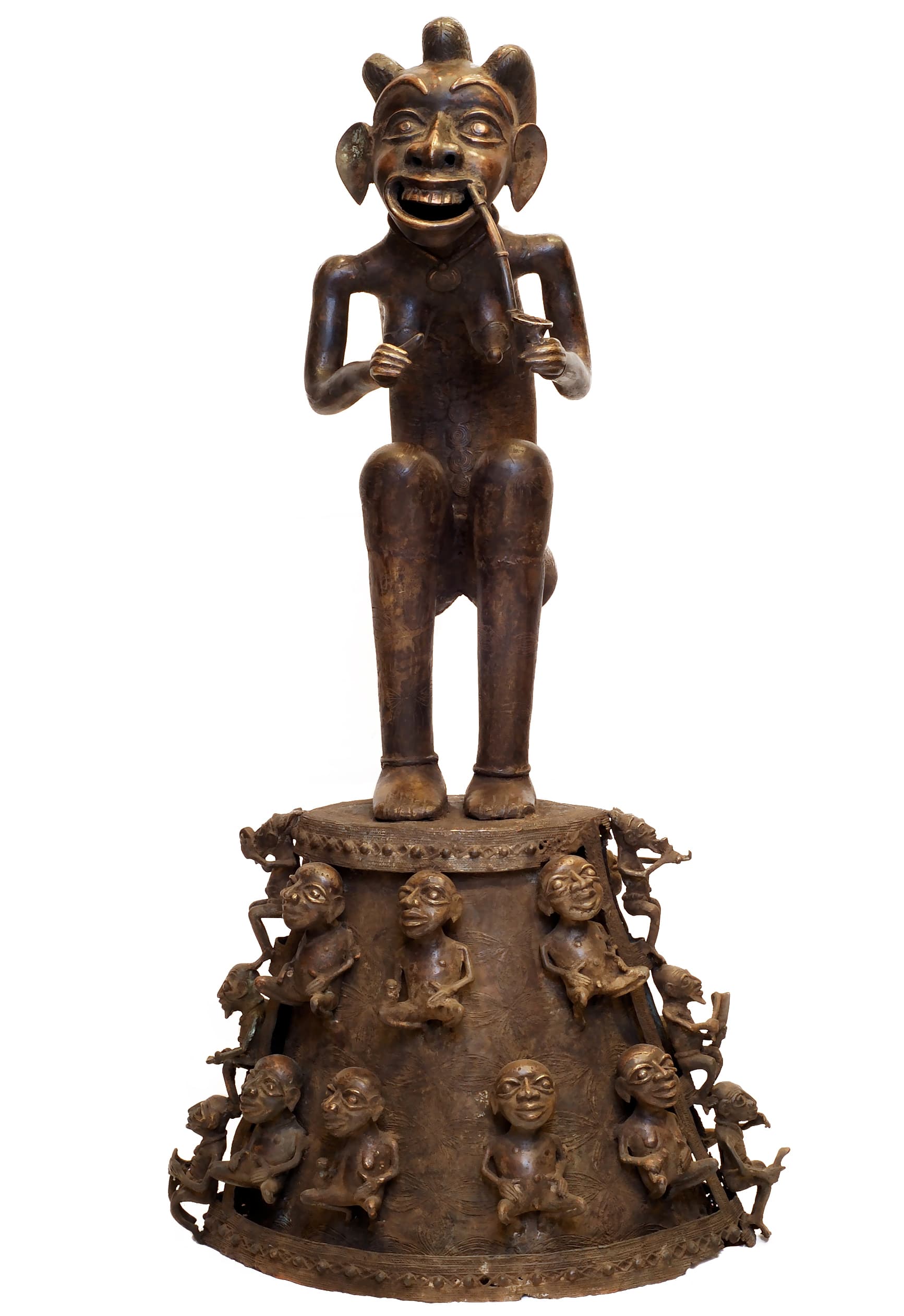
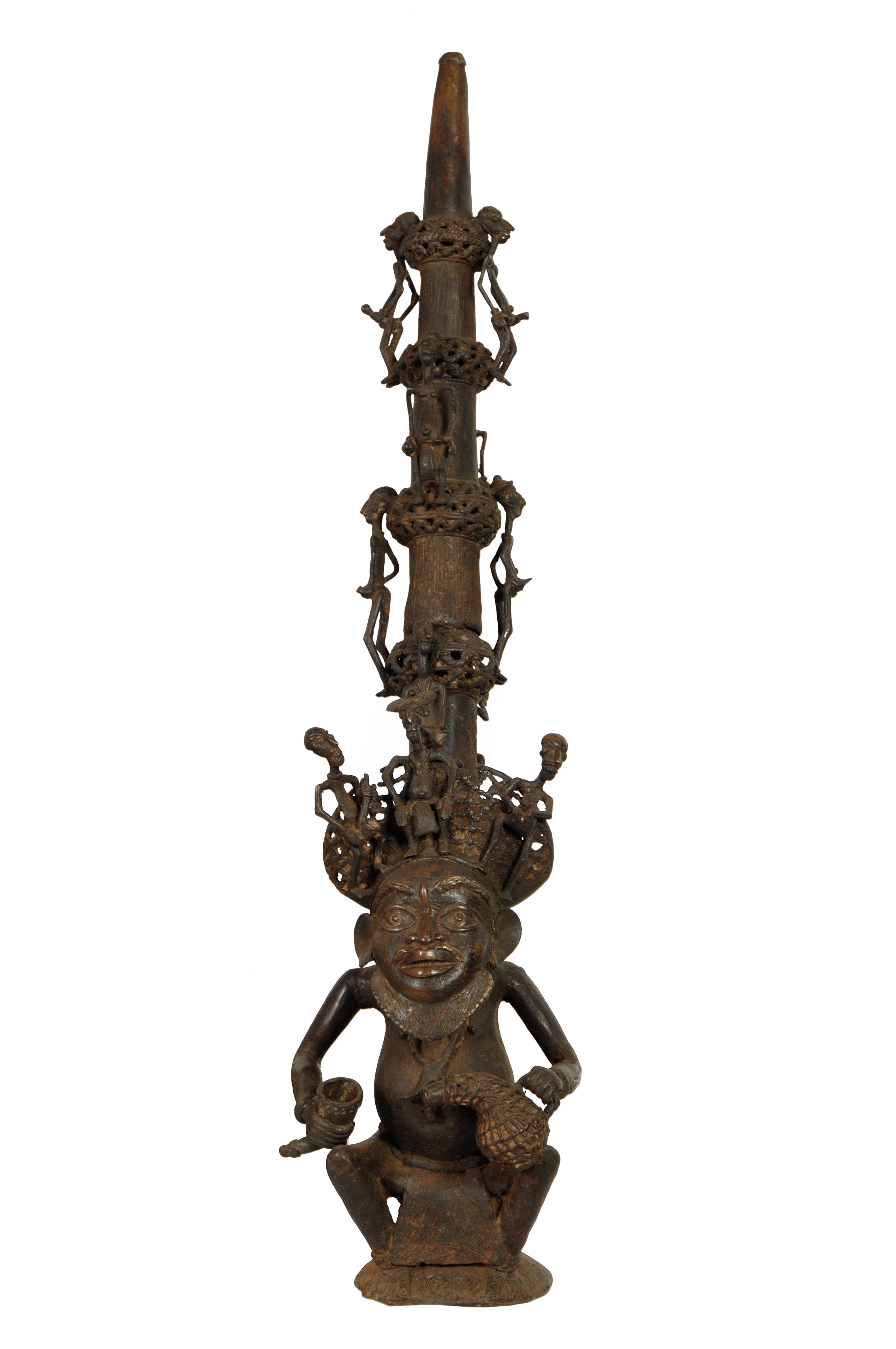
Within the canon of classical African art, the Tikar occupy a foundational and highly revered position. They are universally recognized as the master metallurgists of the Cameroon Grassfields, distinguished particularly for their virtuosity in lost-wax (cire perdue) bronze and brass casting. Pre-colonial Tikar sculptors generated a robust formal vocabulary of prestige regalia, intricately cast figural pipes, monumental currency torques, and ceremonial wooden masks that subsequently informed, directed, and dictated the aesthetic trajectories of the neighboring Bamum and Bamileke kingdoms. The aesthetic economy of the Grassfields relies fundamentally on the technical precedents established in the Mbam River valley. Consequently, Tikar material culture is indispensable for understanding the broader visual language of power, diplomacy, elite connoisseurship, and ritual authority throughout the West and Central African highland regions.
Cultural Context
The socio-political organization of the Tikar is governed by a rigid, highly stratified, and deeply hierarchical structure culminating in the institution of sacred kingship. At the apex of this social order is the king, known regionally as the Fon. Unlike the culturally and linguistically heterogeneous chiefdoms of the broader Bamenda Grassfields, which exhibit a wide spectrum of political decentralization and rely heavily on balancing power with independent village elders, the core Tikar kingdoms of the Mbam River plain operate as deeply centralized, absolutist monarchies. Anthropological analyses of Tikar political organization highlight the extreme concentration of power within the monarchy; the Tikar Fon traditionally held the ultimate power of life and death over his subjects and governed alongside a council of six selected senior ministers who, unlike in more balanced Grassfields polities, could not overrule the monarch's supreme decrees. This concentration of centralized authority generated a discrete, bounded tribal identity that stands in stark contrast to the fluid, idiosyncratic political communities of the western highlands.
The spatial and architectural manifestation of this centralized, absolutist power is the royal palace, known as the nto. The Tikar palace is an expansive, meticulously organized agglomeration of architectural units, audience halls, sanctuaries, and storehouses. Palaces were traditionally constructed using palm ribs plastered with thick clay, surmounted by domed roofs topped with heavy thatch, and interconnected by saddle-like roof sections that divided the complex into distinct functional areas. The palace serves not merely as a royal residence but as the cosmological, legal, and administrative epicenter of the kingdom. It houses the extensive living quarters of the royal wives, the barracks for the palace retainers, the ancestral shrines containing the physical remains of previous monarchs, and the heavily guarded headquarters of the kingdom's powerful secret societies. Succession within the Tikar royal lineage is strictly patrilineal, maintaining a continuous dynastic descent that connects the living monarch directly to the deified founding ancestors.
Despite the absolutist nature of Tikar kingship, the social order is carefully maintained, policed, and enforced by highly influential regulatory and initiation societies, the most prominent being the Kwifon (often referred to as Ngwerong in neighboring linguistic contexts). Translating conceptually to "assistant to the fon" or "father of the country," the Kwifon serves as a vital operational counterbalance to the supreme ruler, managing the day-to-day enforcement of royal decrees. Operating from independent, restricted lodges located within or immediately adjacent to the inner palace complex, the Kwifon is solely responsible for the administration of justice, the execution of capital punishments, the settlement of civil disputes, and the enforcement of social and agricultural law.
Another critical institution within the Tikar social hierarchy is the Nsoro society, an elite, highly restricted fraternity exclusively composed of proven warriors and senior royal ministers. Membership in the Nsoro was traditionally limited to men who had successfully killed an enemy in battle or demonstrated exceptional martial prowess, intertwining military violence with political elevation and social prestige. These societies functioned as the executive arms of the state, ensuring that the Fon's absolute power was effectively projected into the rural peripheries of the kingdom.
| Institution / Society | Primary Function | Membership Criteria | Associated Visual Art |
|---|
| Monarchy (Fon) | Absolute temporal and spiritual rule; supreme judicial authority. | Patrilineal royal descent. | Cast brass/bronze altars, figural pipes, zoomorphic prestige stools. |
| Kwifon / Ngwerong | State regulation, capital punishment, dispute settlement. | Appointed retainers, non-royals (to prevent dynastic usurpation). | Wooden helmet masks with blackened, encrusted patinas; iron double-bells. |
| Nsoro | Martial defense, execution of state violence, elite funerary rites. | Proven warriors (successful kills in battle), senior ministers. | Tungunga bi-lobed headcrests, martial regalia. |
Within this intricate socio-political framework, visual art functions primarily as a utilitarian instrument of statecraft, elite regulation, and ancestor mediation. Sculpture is not created for abstract aesthetic contemplation or individual expression; rather, it is a highly controlled mechanism designed to reflect, reinforce, and project the power of the king and the regulatory societies. Masterpiece productions in brass, bronze, wood, and ivory are legally restricted to the royal court and high-ranking titleholders, serving as unmistakable indices of prestige and hierarchical stratification. Masks controlled by the Kwifon function as the physical, terrifying embodiment of the society's policing authority; their public appearances serve to visually manifest the abstract concepts of justice, retribution, and state regulation.
Furthermore, commemorative portraiture—whether expressed in cast metal ancestor figures or elaborately carved terracotta and ivory pipes depicting former rulers—acts as a direct conduit for ancestor mediation. These objects are utilized in restricted palace shrines to visually guarantee dynastic continuity and to secure the blessings, fertility, and protection of the royal predecessors for the prosperity of the living kingdom. The production and display of art is, therefore, a deeply political act, tightly woven into the fabric of Tikar governance and spiritual survival.
Aesthetic Markers
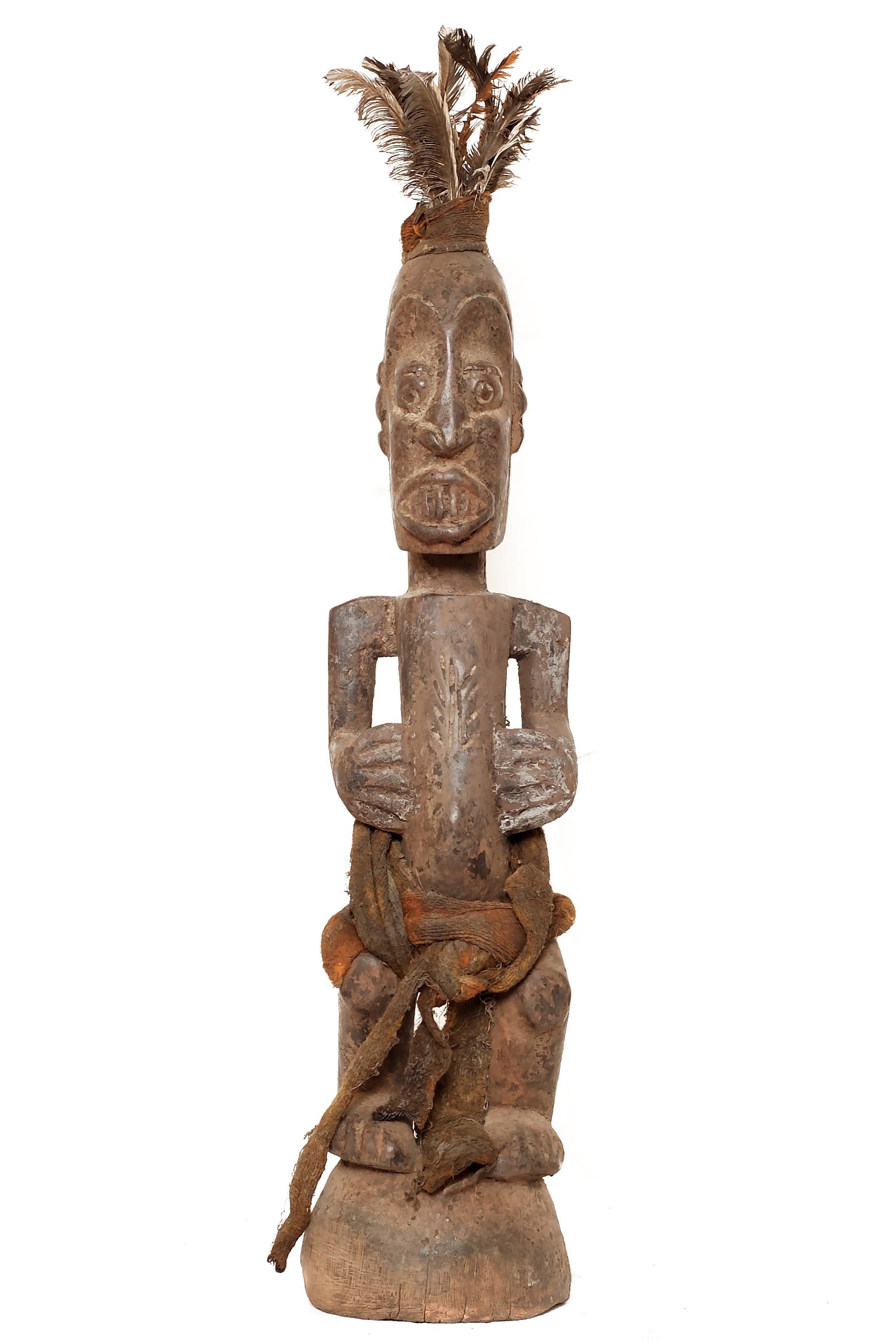
The formal sculptural vocabulary of the Tikar is characterized by a highly distinctive proportional canon that heavily prioritizes the head. In accordance with broader Grassfields cosmological beliefs, the head is revered as the metaphysical seat of wisdom, spiritual power, and individual destiny. Consequently, in Tikar figural sculpture, the head is frequently rendered as disproportionately large, spherical, and volumetrically dense, commanding immediate visual dominance over the torso and limbs.
The facial canon of the Tikar is highly standardized and immediately identifiable. Faces feature strongly defined, protruding arched brows that sharply frame large, circular, and often bulging eyes. Noses are executed with a strong, pronounced vertical ridge, creating a geometric anchor for the face, while the mouths are frequently depicted open, occasionally exposing filed teeth in a stylized grimace or an authoritative declaration.
A critical comparative aesthetic marker for connoisseurship lies in the volumetric treatment of the cheeks. While the neighboring Bamum kingdom, heavily influenced by Tikar precedents, developed this regional trait to an absolute extreme—producing figures with vastly inflated, balloon-like cheeks—authentic Tikar sculpture features cheeks that are distinctly rounded and volumetric, but noticeably less exaggerated and more schematically contained. This structural restraint results in a balanced sculptural synthesis that successfully avoids the extreme, almost caricatured plasticity of Foumban court art while simultaneously eschewing the harsh, expressionistic, and often aggressively asymmetrical angularity typical of Bamileke statuary. Posture in Tikar figural work is typically rigid, frontal, and highly symmetrical. Seated figures often feature diminutive hands grasping either side of the mouth or chin—a classical, widespread Grassfields gesture denoting extreme deference, deep contemplation, or the respectful reception of royal speech.
| Aesthetic Feature | Tikar Canon | Bamum Canon | Bamileke Canon |
|---|
| Facial Geometry | Rounded, contained volume; balanced spherical heads. | Extreme inflation; highly exaggerated, balloon-like cheeks. | Angular, expressionistic; sharp planes and asymmetrical dynamism. |
| Eyes & Brows | Large, circular, bulging eyes under strongly arched, protruding brows. | Similar to Tikar, but often overshadowed by cheek volume. | Highly stylized, often deeply recessed or sharply protruding. |
| Posture | Rigid, frontal, symmetrical; classic hand-to-chin gestures. | Formal, heavily adorned, heavily focused on royal regalia. | Dynamic, asymmetrical, conveying aggressive kinetic energy. |
| Surface (Metal) | Dense, horror-vacui tooling (cross-hatching, stippling) directly in wax. | Smoother surfaces with broader, less intricate geometric fields. | Metal casting is rare; primarily known for wood and heavy beadwork. |
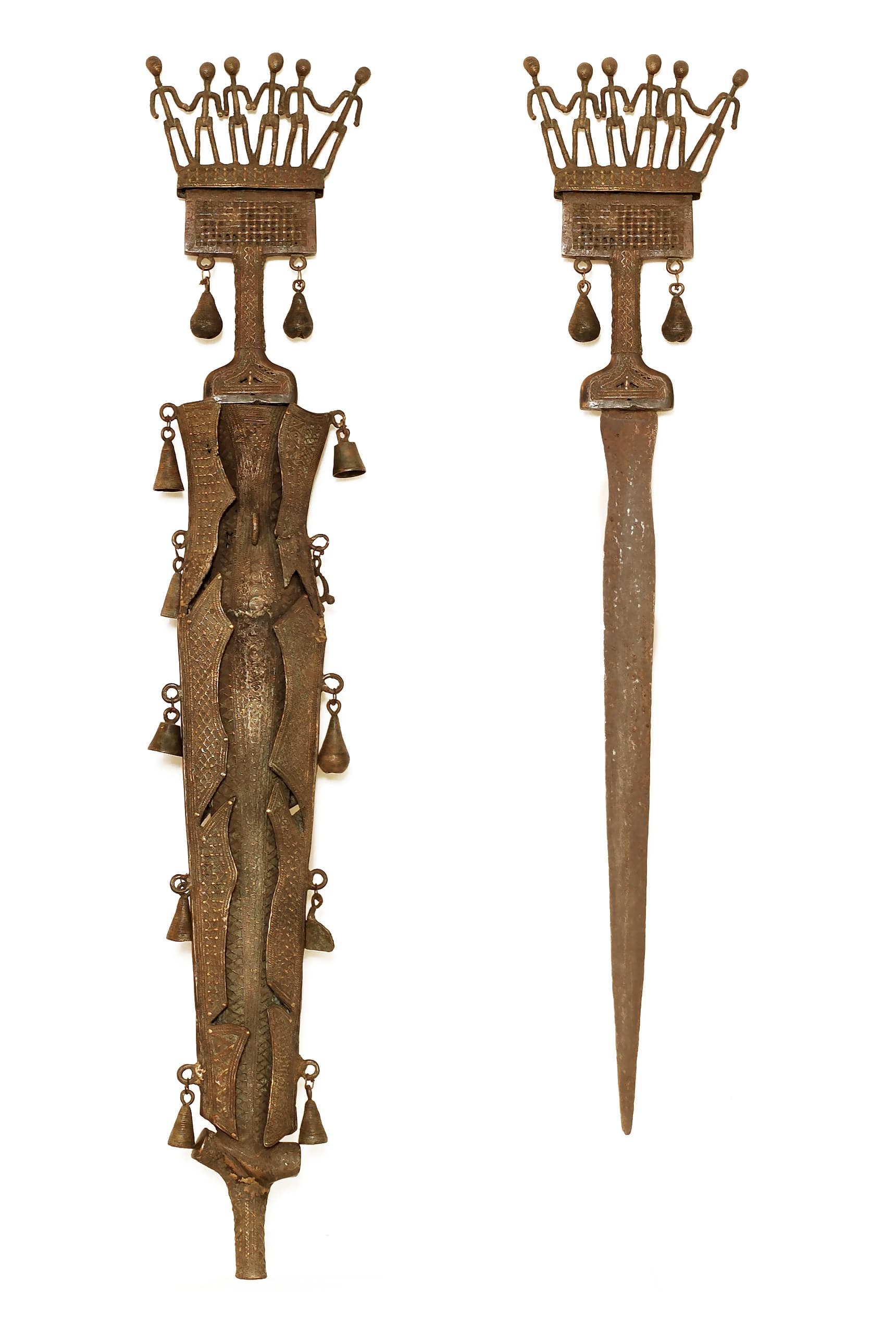
The absolute zenith of Tikar artistic achievement, however, is their unparalleled mastery of non-ferrous metallurgy, specifically the lost-wax (cire perdue) casting of brass and bronze. Tikar casters were historically recognized as the premier, foundational metallurgists of the region, ultimately transmitting their complex technological expertise to the Bamum court during the nineteenth century. The surface treatment of authentic, pre-colonial Tikar cast metal is exceptionally intricate and labor-intensive. Masterworks, such as monumental currency torques, royal power figures, and ceremonial bells, exhibit a complex, horror-vacui surface decoration. This involves the meticulous application of fine wax threads and pellets to the core model prior to casting, resulting in highly precise cross-hatching, stippled dots, and high-relief zig-zag patterns.
Zoomorphic iconography is frequently integrated seamlessly into these dense geometric fields. High-relief depictions of spiders (a universal Grassfields symbol of divine wisdom and earth divination), double-headed serpents, chameleons, leopards (the ultimate symbol of royal ferocity and absolute power), and frogs populate the surfaces of royal regalia.
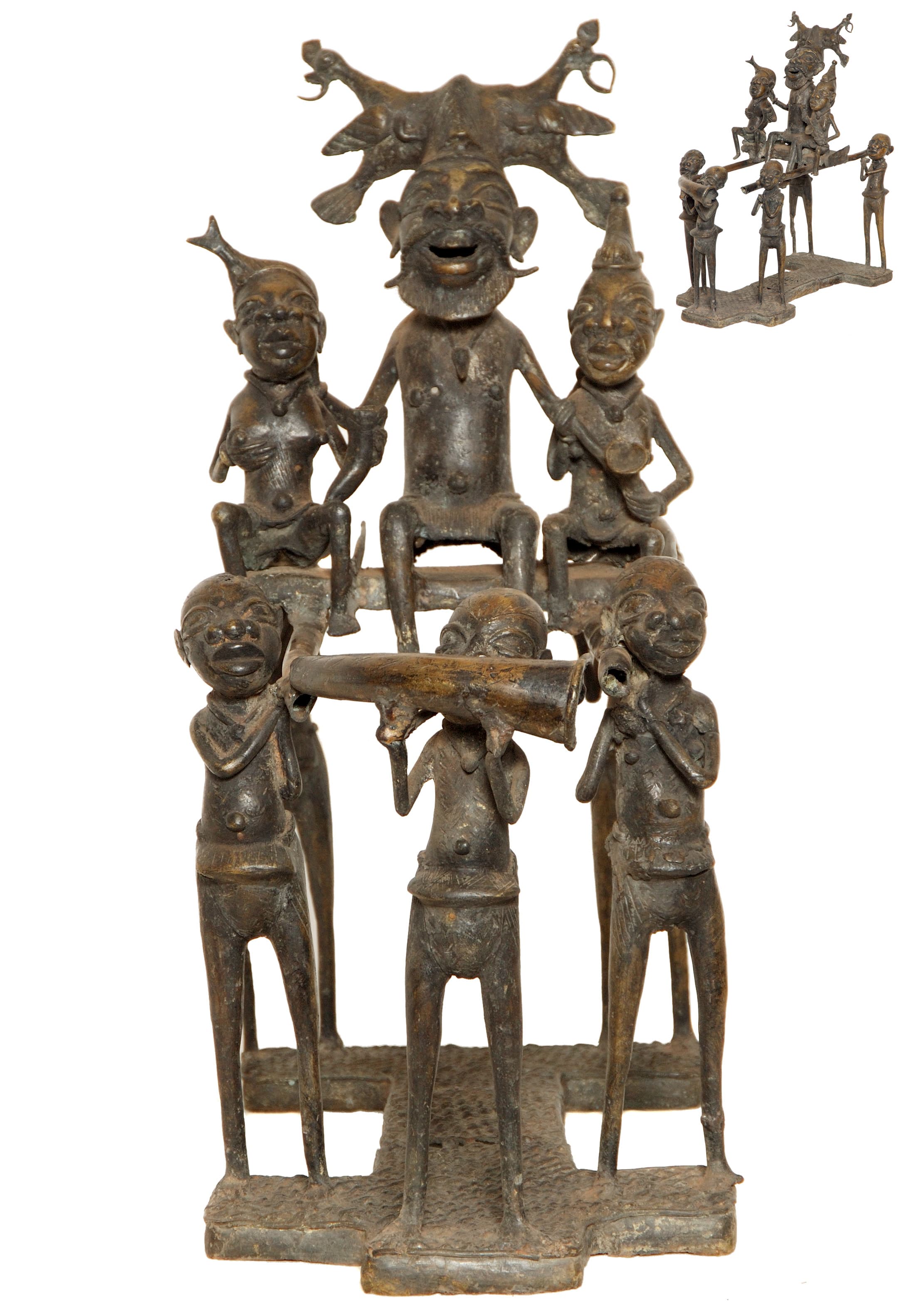
Technically, the sheer scale of Tikar brass casting represents a significant metallurgical triumph. Artisans routinely executed massive, heavy, yet perfectly hollow-cast armlets, towering pipe bowls, and multi-figure altarpieces, demonstrating total, uncompromising control over the internal refractory clay core and the precise, uninterrupted channeling of molten copper alloys through complex sprues. The coloration and patina of field-used Tikar metalwork are rich, nuanced, and distinct from modern reproductions. Authentic pieces possess a deep, oxidized dark brown to near-black foundational color, frequently accented by authentic, naturally occurring green verdigris in the recessed, unhandled crevices. On objects of high prestige or frequent regulatory use, continuous handling over generations imparts a polished, luminescent, and highly reflective wear on the high points of the cast relief.
In terms of carved wooden objects, particularly Kwifon helmet masks and Nsoro crests, the surface treatment relies heavily on an encrusted, glossy black patina. This surface depth is traditionally achieved through the deliberate, repeated ceremonial application of soot, palm oil, iron-rich earth, and organic libations, which are continuously burnished to create a formidable, menacing sheen that underscores the terrifying regulatory nature of the object. Subordinate prestige objects, including anthropomorphic terracotta pipe bowls, carved wooden amulets, and ivory finials, are occasionally dusted with vivid red camwood powder, a sacred substance intimately associated with ritual transitions, royal health, and the ancestral realm.
Ritual Practices
The ritual calendar of the Tikar is punctuated by elaborate, highly structured ceremonies, massive festivals, and fearsome masquerades that serve to consolidate royal authority, venerate dynastic ancestors, and ensure agricultural and martial prosperity across the plain. One of the most significant historical ceremonies is the Gaen festival, celebrated biennially in early December in the capital kingdom of Bankim. Functioning as the historical and ritual predecessor to the internationally renowned Bamum Nguon festival, the Gaen originated as a celebration of the supreme martial prowess of the Tikar warriors who historically dominated the Adamawa region. The climax of the Gaen involves a highly stylized, deeply symbolic performative ritual in which a designated "foreign" woman occupies the royal throne; the Tikar Fon then ceremonially confronts her, violently drives her from the seat, and reclaims the throne. This public reenactment serves to visually and spiritually cement the historical consolidation of Tikar sovereignty and the mythological subjugation of indigenous forest populations.
Parallel to this martial celebration is the Sweety festival, an annual ritual dedicated strictly to ancestral veneration and the securing of dynastic continuity. During the Sweety festival, the entire community calls upon the spirits of the deified Tikar forebears to bestow blessings, agricultural fertility, and martial protection upon the land. The visual focal point of this ceremony is the highly restricted appearance of the chief wearing a sacred, antique ivory collar fashioned from heavy elephant tusks. This specific object is removed from the depths of the royal treasury strictly for this singular annual event, its selective display underscoring the function of royal art as a rare, temporal bridge between the living monarch and the ancestral realm.
Masquerades are strictly controlled by the kingdom's regulatory and martial societies. The Kwifon regulatory society deploys an array of wooden helmet crests during nocturnal and diurnal festivals aimed at purifying and protecting the realm from witchcraft and social dissonance. The aesthetic demeanor of Kwifon masks fluctuates dramatically between menacing and jovial—often embodying both "hot" (aggressive, punitive, unpredictable) and "cool" (placid, restorative, judicial) spiritual states. The physical performance of the Kwifon is an auditory and kinetic spectacle; the masked dancers are accompanied by specialized orchestras utilizing sacred iron double-bells, the sharp, percussive sound of which signals the imminent presence of the society's ultimate, unseen, and absolute authority.
The Nsoro warrior society utilizes highly specialized masquerades, most notably the tungunga headcrests, which are danced exclusively during the funerary rites of the highest-ranking individuals: kings, state ministers, senior royal family members, and initiated warriors who have achieved verified kills in combat. These massive, bi-lobed wooden headcrests, often evoking the visage of a deceased king and his royal wives, are held atop the dancer's head and secured via a complex, hidden fiber superstructure concealed beneath a voluminous, kinetic raffia frill. The appearance of the tungunga is a rare, solemn event that confirms the deceased's elevated status within the martial and political hierarchy of the kingdom, facilitating their transition into the ancestral realm.
Among the Nditam Tikar specifically, the mliti mask serves a profound socio-regulatory function that diverges from standard regal validation. Described meticulously in anthropological literature by Séverin Cécile Abega as a violent, indisciplined, and matricidal entity born of incest, the mliti mask acts as a subversive pedagogical tool. Through its chaotic, aggressive, and transgressive public performance, the mask provokes a practical, community-wide meditation on the absolute necessity of structured matrimonial alliances, the strict observance of societal laws, and the catastrophic dangers of violating fundamental taboos. The historical adoption of such forest-spirit masks from neighboring, subjugated forest-dwelling groups like the Bebi highlights the dynamic, syncretic nature of Tikar ritual life occurring at the volatile savanna-forest ecotone.
| Object Typology | Primary Material | Ritual Context / Associated Society | Primary Function |
|---|
| Monumental Torques | Hollow-cast brass/bronze | Elite Royal Court | High-value currency; bride-price negotiations; prestige display. |
| Helmet Crests | Carved wood, blackened patina | Kwifon (Regulatory Society) | State policing, justice administration, spiritual purification. |
| Tungunga Headcrests | Carved wood, raffia superstructure | Nsoro (Warrior Society) | Solemn funerary rites for kings and proven warriors. |
| Figural Pipes | Terracotta, brass, ivory, wood | Royal Court / Diplomatic Envoys | Elite status markers; diplomatic exchange; ancestor veneration. |
| Mliti Mask | Wood, mixed media | Nditam Tikar Public Festivals | Pedagogical enforcement of matrimonial law via transgressive performance. |
Material objects function critically within all these ritual contexts, blurring the lines between the sacred and the economic. Monumental cast brass and bronze torques, often weighing several kilograms and featuring aggressive geometric spikes, are not merely decorative ornaments but serve as high-value, localized currency. These objects are crucial prestige items utilized in complex, inter-dynastic elite wedding negotiations, cementing alliances between rival lineages. Elaborate brass and terracotta pipes, sometimes reaching extreme lengths and featuring complex figural bowls depicting seated rulers, are deployed during highly formalized diplomatic meetings between neighboring Fons. The scale, material value, and iconographic complexity of the pipe directly index the geopolitical weight and ancestral backing of the owner. Even functional items, such as heavy cast bronze ceremonial bells, are utilized both as acoustic instruments by the Kwifon and as stationary altarpieces, featuring localized motifs of frogs and spiders that reinforce the omnipresence of earth spirits and the promise of dynastic fertility.
Historical Context
The genesis of the Tikar people is rooted in a rich, multi-layered oral tradition that traces their ancient nomadic origins to the Nile River Valley in present-day Sudan, near the historical iron-working kingdom of Meroë. According to widespread ethnographic accounts and localized royal myths, the proto-Tikar migrating from this eastern region brought with them highly advanced metallurgical knowledge (specifically iron-smelting and the foundations of lost-wax casting) alongside sophisticated equestrian traditions. Traversing the African continent westward towards the Lake Chad basin, these populations eventually descended into the Adamawa region of present-day northern Cameroon. They established their earliest fortified settlements in areas such as Ngan-Ha around 933 CE. However, this northern hegemony was short-lived; the Tikar were soon forced into a massive southward migration toward the Mbam River plain to avoid forced religious conversions and brutal military conflicts with invading Islamic Fulani cavalrymen pushing south to dominate the lucrative trans-Saharan trade routes. Settling in what is now Bankim (historically Kimi or Rifum), the militarized migrants intermarried with indigenous savanna agriculturalists and forest-dwelling hunter-gatherers, resulting in the ethnogenesis of the modern Tikar people and the establishment of their six core kingdoms.
A pivotal, continent-shaping moment in the dynastic history of the region occurred circa 1387 CE, following the death of the Tikar Fon, Tinki. A bloody, fractured succession crisis erupted in Bankim when the rightful heir to the throne, Nchare Yen, was bypassed in favor of his ruthless half-brother, Mveing. Fleeing the resulting internal purges and targeted assassinations, Nchare Yen, accompanied by his sister Princess Ngonnso and his brother Morunta (or Mbe), departed Bankim with a massive retinue of loyalists, artisans, and warriors. This dynastic schism led directly to the founding of the most powerful and artistically significant states in the Cameroon Grassfields: Nchare Yen marched west to establish the mighty Bamum kingdom at Foumban, while Princess Ngonnso traveled northwest to found the formidable Nso kingdom at Kumbo.
This shared dynastic origin myth lies at the very heart of the "Tikar Problem"—one of the most fiercely debated, complex subjects in Cameroonian historical anthropology. In the mid-twentieth century, colonial administrators and early researchers noted with bewilderment that dozens of linguistically, architecturally, and culturally distinct chiefdoms across the Bamenda Grassfields universally claimed descent from the Tikar of Bankim. Eminent British scholars, notably E. M. Chilver and P. M. Kaberry, famously declared this widespread phenomenon a "non-problem," arguing that the claims of Tikar ancestry were largely sophisticated political fictions rather than records of actual mass migration. They proposed that these myths were mechanisms of "regalisation"—strategic, retroactive fabrications utilized by ambitious Grassfields chiefs to legitimize their growing authority by linking themselves to the highly prestigious, sacred, and absolutist kingship model of the authentic Tikar.
Subsequent generations of scholars, including David Price, Jean-Pierre Warnier, and David Zeitlyn, expanded extensively on this thesis, demonstrating how dynastic claims to a foreign, superior origin are a classic African political strategy for enforcing territorialization, establishing social stratification, and centralizing power against rebellious local elders. In recent years, sex-specific genetic studies focusing on the Nso royal dynasty have definitively corroborated the "non-problem" theory. Modern DNA analysis of the Nso ruling class reveals pre-Bantu expansion remnant Y-chromosomes (the won nto′ modal haplotype) that are entirely absent in the actual Tikar population of the Mbam plain. Because the Tikar speak a Bantoid language linked to the Bantu expansion (carrying the E3a lineage), this genetic anomaly proves definitively that the founding fathers of these Grassfields states were local indigenous hunter-gatherers, rather than migrating Tikar royal elites.
| Historical Period | Defining Events & Artistic Output | Core Anthropological / Art Historical Focus |
|---|
| Pre-1387 CE | Migration from Sudan/Meroë; settlement in Adamawa and subsequent push to the Mbam plain (Bankim). | Ethnogenesis; introduction of iron-working and equestrian culture; intermarriage with indigenous groups. |
| 1387 CE – 1884 | Succession crisis in Bankim; founding of Bamum (Foumban) and Nso; Classical Tikar court art. | The "Tikar Problem" begins; strictly regulated palace art (massive brass torques, Kwifon masks); absolutist kingship. |
| 1884 – 1915 | German colonial administration; cessation of inter-tribal warfare; initial European collection of antiquities. | Disruption of traditional patronage; royal art begins to enter European ethnographic museums. |
| 1920s – Present | French mandate; rise of Mosé Yeyap's Foumban workshops; mass production for expatriate markets. | "Transitional Art"; stylistic cross-pollination; staged authenticity to satisfy tourist demand for "ancient" brass and wood. |
The late nineteenth and early twentieth centuries brought profound, irreversible transformations to the material culture of the region, triggered violently by the arrival of German colonial administrators and, subsequently following World War I, the French. The traditional, highly restricted patronage system, wherein art was produced exclusively for the palace and secret societies, was radically disrupted. The Bamum capital of Foumban, drawing heavily on the metallurgical techniques originally pioneered and taught by the Tikar, emerged as a massive, commercial production hub. By 1927, under the shrewd leadership of the Bamum courtier Mosé Yeyap, Foumban workshops began producing "transitional art"—objects specifically, intentionally manufactured to satisfy the voracious appetite of European tourists, missionaries, and colonial officials who demanded "authentic" African antiquities.
As documented extensively by David Zemanek in his comprehensive study Transitional Art of the Tikar from Cameroon, native artists began freely combining traditional iconographic elements with new, inventive stylistic features, breaking away from the strictures of royal regulation to create purely commercial export pieces. To artificially age these newly minted brass figures, wooden masks, and terracotta pipes, workshops employed brilliant tactics of staged authenticity. New objects were briefly danced in public festivities, such as the grand Christmas celebrations of 1929, to grant them a visible aura of legitimate ritual use before they were immediately sold to European collectors. Consequently, periodizing Tikar and Bamum art relies heavily on the difficult task of distinguishing between pre-1914 classical production, which strictly adhered to palace regulation and indigenous ritual logic, and the post-1920s explosion of high-quality, technically proficient, yet functionally sterile commercial workshop art.