Overview
The Babanki, who refer to themselves as Kedjom, are among the most socially, politically and artistically distinguished societies of the Cameroonian Grassfields in the North-West Region of present-day Cameroon. Their settlement area lies in the Tubah sub-district of the Mezam department on a volcanic high plateau at an altitude of between approximately 1,000 and 1,800 metres, characterised climatically by the alternation of wet and dry seasons and topographically by rugged hills and fertile valleys. A striking feature is the political division into the two independent kingdoms (fondoms) Kedjom Keku (Greater Babanki) and Kedjom Ketinguh (Lesser Babanki), which, according to traditional accounts, were founded around 1870 by a breakaway faction from Keku. Both Fondoms retain a shared cultural identity and, together with the neighbouring towns of Bambui and Bambili, form the core Kedjom region with a population of around 68,000, with recent censuses recording between 22,000 and 30,000 inhabitants for Kedjom Keku alone.
Linguistically, Kejom belongs to the Grassland Bantoid subgroup within the Niger-Congo family; the language is tonal and agglutinative with a complex nominal class system, showing close kinship to the languages of the Kom, Bafut, Nso and Bamessing. The exonym ‘Babanki’ is a product of colonial cartography — presumably derived from ‘Banki’, a term used by the Bali Chamba and Bamum, occasionally interpreted as ‘the people of the whirlwind’ in reference to pre-colonial military tactics — and has established itself as an art-historical technical term for the specific sculptural school of this region, whilst the self-designation Kedjom is increasingly emphasised today as an expression of cultural sovereignty.
Ethnographically, there is an ongoing classification debate. Early collectors and colonial officials broadly grouped the Babanki as ‘Tikar-related’, whilst more recent research by Christraud Geary and Pierre Harter has identified a distinct Babanki idiom that distinguishes the group stylistically and ritually from the Bamileke chiefdoms to the south. A second, controversial debate concerns the origin legend from the Bankim/Tikar region: Whilst classical monographs treat migration as a historical fact, more recent approaches, following Jean-Pierre Warnier (1985), interpret Tikar identity as a political charter — a dynastic narrative of legitimacy that reflects ritual affiliation with the supra-regional Grassfields elite rather than biological descent.
The social structure of the Kedjom is strictly patrilineal and centralised — in sharp contrast to the acephalic societies of Cameroon’s southern forest regions. At the apex stands the Fon (King) in a sacred dual role as political ruler and mediator to the ancestors; his power is not absolute, however, but is balanced by a complex counterweight of regulatory secret societies — foremost among them the Kwifon (also transcribed as Kwifoyn or Kwifor in some sources). Society is divided into three distinct categories: the royal family (Vu' ntuh) as descendants of reigning or deceased Fons with privileged access to pearl regalia and ceremonial offices; the notables (Tibaat) as holders of hereditary titles and leaders of sub-chapters of the secret societies; and the commoners as farmers and artisans. This tripartite structure governs access to land, ritual offices, objects of prestige and masked societies.
The basis of their subsistence consists of volcanically fertile fields (maize, yams, plantains, beans), small livestock farming and a highly specialised craft sector. The Kedjom developed into the most sought-after woodcarvers of the western grasslands, whose throne workshops in Kedjom Ketinguh supplied diplomatic gifts to neighbouring courts as far afield as the Bafut, Kom and Bamum (Northern 1984; Harter 1986). Relations with neighbouring peoples remain ambivalent: historical alliances with the Kom and Oku coexist with periods of ritual rivalry and territorial disputes. Geopolitically, the location on the Bamenda Plateau made the Kedjom a central hub for the interregional exchange of goods, ideas and artistic innovations.
Cultural Context
The Kedjom cosmological system unfolds as a highly structured order in which the visible world of the living communicates continuously with the invisible realm of the ancestors and nature spirits. Above all stands a distant creator god, whose workings, however, are primarily experienced through the ancestors — the ‘departed dead’; they act as guardians of moral order, and any violation of traditional taboos is regarded as a disturbance of the cosmic balance, which can only be remedied through ritual intervention by the secret societies. Within this framework, the Fon acts as the high priest (Nto'o) and guardian of the land; the palace (Ntoh) forms the spiritual and administrative epicentre, where sacred relics are kept and the most important offerings are made. Funeral rites are of particular significance, being strictly differentiated according to social status — in the Kedjom belief system, the souls of kings, priests and ordinary people face different fates in the afterlife.
The power structure of the Babanki is described in recent political-anthropological literature (notably by Nicolas Argenti and Francis Nyamnjoh, who use the image of the ‘intestines of the state’) through the hidden yet vital function of secret societies. The Kwifon represents the highest executive power — the ‘face of the ancestors’, an anonymous, masked force capable of disciplining even the Fon or, in extreme cases, deposing them. Its ritual masks are mostly simple wooden constructions, yet imbued with human hair, tree resin (leh) and sacrificial crusts; their visual restraint underscores their structural power. Parallel to this exists the Troh society, whose particularly deep-set eyes and puffy cheeks take shape especially during the liminal interregnum phases following the ‘disappearance’ of a Fon — in the Grassfields, one does not speak of the death of a king.
One dimension frequently overlooked in older literature is the nuanced gender hierarchy. Although women are excluded from the core rites of the Kwifon, distinct and highly influential female spheres exist: The Nfongwi — the Fon’s half-sister — plays an indispensable role in the enthronement and acts as the leader of the women in the chiefdom; older women’s associations also possessed the right to impose drastic sanctions on men in the event of breaches of the moral order. Women control large parts of agricultural production and oral tradition. Structurally, the Babanki differ from the southern forest peoples in that no masks worn by women exist — female ancestors, such as in the Ngoin mask, are embodied exclusively by initiated men.
The iconography of royal power is encapsulated in the doctrine of transmutation: the Fon is said to ritually transform into an elephant or leopard in times of crisis to protect the realm. Whilst this concept exists across the Grassfields among the Bamum, Bamileke and Kom, its ritual expression among the Babanki is less tied to the spectacular beaded elephant masks—which were popularised primarily by the Bamileke Kuosi society (Bandjoun, Bahouoc)—and is instead more deeply inscribed in the carved iconography of the throne sculpture and the Fon regalia. The performative order of the Babanki is instead upheld by the male leader mask Kam (also Akam), the female helmet mask Ngoin and the Troh masks, which together form a coherent ensemble (Northern 1984; Koloss 2000). Herein lies the fundamental controversy in Babanki religious studies between Hans-Joachim Koloss and Christraud Geary: Koloss interprets the mask performances primarily as stabilising, peace-making acts that reconstitute the cosmic order; Geary additionally recognises the masks as instruments of social distinction and the manifestation of inequality — objects of prestige that visibly cement hierarchies. More recent studies (Argenti 2007) expand the field to include the dimension of ‘traumatic memory’: mask rituals are interpreted as a ritual processing of historical ruptures — German colonial violence, the slave trade, the Anglophone crisis — the scars of which are inscribed in the facial expressions and dynamics of the performances. The source material for this most recent layer of interpretation remains ambiguous, as many Kwifon rites remain hidden from the gaze of external researchers even today.
Aesthetic Characteristics
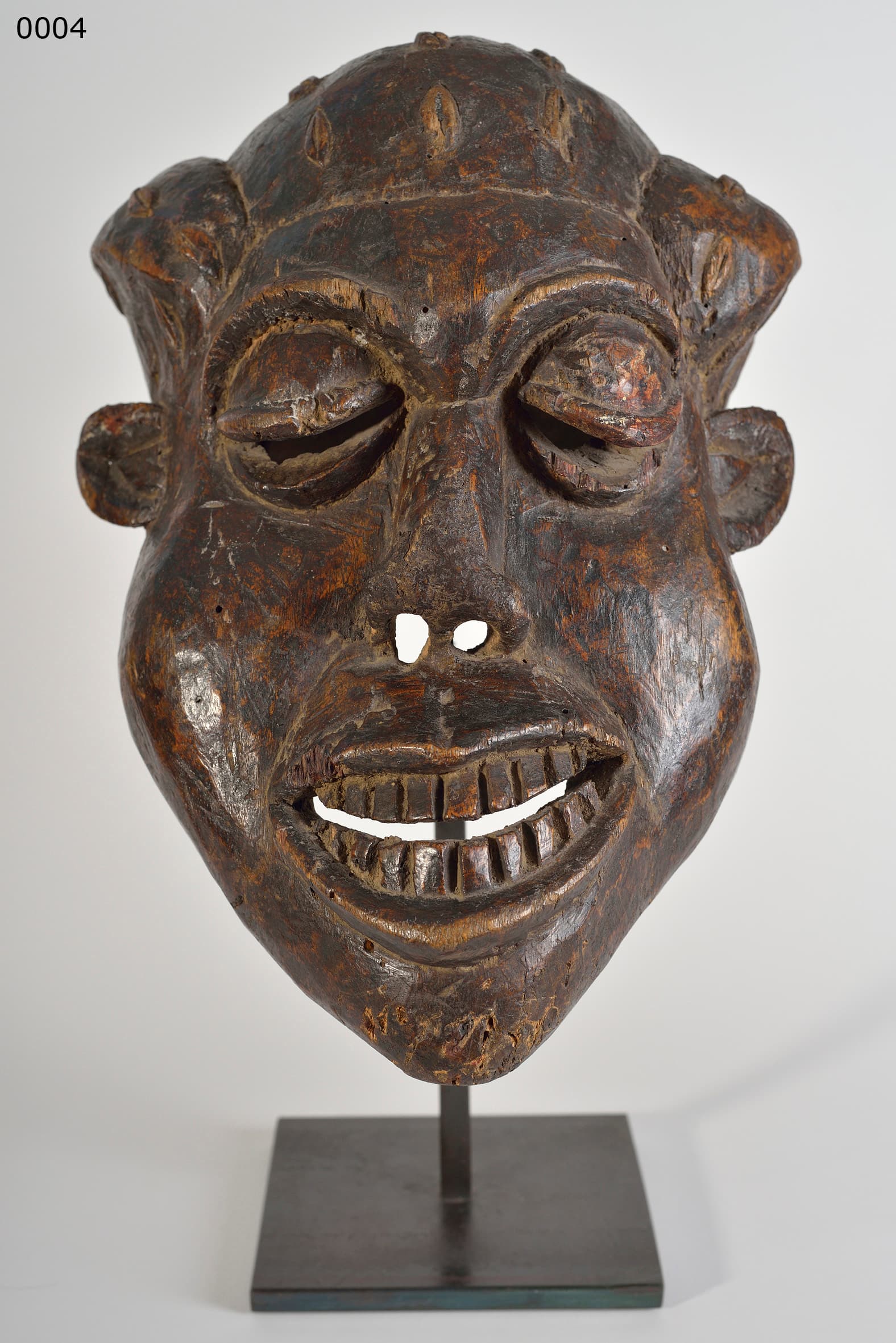
The aesthetics of the Kedjom are characterised by a specific set of proportional standards and iconographic richness, which make them distinctive within Grassfields art. The objects are not intended for mimetic representation, but rather for the manifestation of nsem (spiritual energy) and social status. The wooden mask in this collection — 36 cm high, dating from the first half of the 20th century — can be classified stylistically and chronologically within one of the most prolific workshop traditions of the Western Grassfields and can be read as an exemplary entry point into Kedjom sculpture.
The range of Babanki art encompasses several clearly distinct types: helmet masks, face masks, monumental door frames and supporting pillars for palace architecture, as well as figuratively carved caryatid thrones and stools. Stylistic identifying features include deep-set, almond-shaped eyes with prominent modelling — Pierre Harter coined the term ‘Babanki eyes’ for this —, voluminous cheek areas as an expression of vitality and breath, strong, broad noses as a symbol of strength, and open mouths with carved rows of teeth, representing the ancestors’ speaking, singing or breathing during ritual dances. Eye sockets and teeth are often highlighted with white kaolin pigment to create a sharp contrast to the dark-patinated wood. Iconographically, the composition of the figures frequently incorporates animal symbols: the frog stands for fertility and the continuity of the royal line, whilst the elephant and buffalo are exclusive symbols of royal power reserved for the Fon. The range of sizes is considerable — ritual masks are usually life-size, whereas royal caryatid thrones are carved from a single solid hardwood trunk (typically Canarium schweinfurthii) and stand over 1.5 metres tall to emphasise the ruler’s physical superiority.
The choice of material is ritually coded: for masks worn frequently, Kedjom carvers tend to prefer lighter woods that are easy to work, whilst throne caryatids and permanent ritual installations are carved from hard, weather-resistant species from a single trunk. The patina is not a passive ageing phenomenon, but the visible sign of ritual activation: decades of rubbing with palm oil, red camwood powder (Padouk) and ritual sacrificial substances — palm wine, soot, chicken blood, sacrificial flour — form deep, often crusty organic layers. In contrast, profane objects from the tourist market exhibit artificial ageing through staining or sugar burning, which, upon closer analysis, reveal no organic deep structure.
Unlike many African art traditions, in which carvers remain anonymous, Babanki research identifies masters by name. Particularly in Kedjom Ketinguh, a veritable palace academy was established under the sculptor-kings Aséh Yufanyi and his son Phonchu Aséh in the late 19th and early 20th centuries; Phonchu Aséh (reign extending into the 1910s) standardised the ‘Kedjom style’ and systematically exported works to neighbouring courts (Harter 1986; Northern 1984). It is likely that the mask in this collection was created within the direct or indirect sphere of influence of this workshop tradition. In addition, art-historical research has stylistically identified a ‘Master of the Prominent Eyes’, whose works are characterised by radical volumetry and an almost aggressive sculptural presence. This is where another scholarly controversy arises: Whilst Harter and Tamara Northern attribute the stylisation to individual master craftsmen, Jean-Paul Notué argues that master carvers circulated between the Fondoms and that the supposed individual styles rather reflect collective workshop conventions of an ‘interregional Grassfields style’ that transcended the boundaries of individual Kedjom dynasties.
For the curatorial classification of the 36-cm mask, forensic markers are decisive alongside stylistic analysis:
| Feature | Activated ritual object | Secular object / forgery |
|---|
| Patina | Organic layers (palm oil, camwood, palm wine, soot, blood) | Artificial stain, burnt sugar |
| Wear | Contact points on forehead/nape smoothly polished | Uniform, artificial roughening |
| Tool marks | Adze facets, irregular cuts | Smooth cuts from modern steel chisels |
| Repairs | Functional metal patches, cord bindings | Decorative ‘pseudo-repairs’ |
| Termite damage | Follows softer annual rings | Mechanical drill holes |
| Peroxide reaction | Manganese deposits react effervescently | Synthetic paints remain inert |
Xylotheque analyses provide further evidence: authentic Babanki sculptures use almost exclusively local species from the highland region, whilst forgeries often resort to more readily available lowland woods. The study of heartwood cracks, tool marks and specific patina layering remains the most important defence against the flood of ‘Aéroport art’ (Steiner 1994), which is now marketed worldwide as Babanki art.
Ritual Practice
The objects of the Kedjom are not passive works of art, but active, spiritually charged agents within a packed calendar of ceremonies and masquerades. In the Babanki’s understanding, a mask or a throne exists within a complete life cycle, which begins with the selection of the tree, continues through ritual activation and decades of performance history, and finally ends with a ritual deactivation.
The activation of a new mask or ritual object begins with the invocation of the ancestors by a divinator or the Kwifon council. The object is ritually ‘washed’ with a mixture of herbal extracts and the blood of a sacrificial animal — usually a chicken, or a goat for high-ranking pieces — to make it receptive to the spiritual presence. Other activation substances include palm wine, kola nuts and, for certain masks, tree resin with human hair applied to it. Occasions for such sacrifices include rites of passage, harvest festivals, agricultural crises or the installation of new dignitaries. The palace (Ntoh) and the secret meeting houses of the Kwifon form the physical centres where objects are kept during their dormant phase; access is strictly forbidden to women and uninitiated men.
The central performative ensemble of the Babanki is the Kam — Ngoin — Troh configuration. The Kam (also Akam) is the male leader mask, embodying the authority and knowledge of the ancestors; at its side stands the Ngoin mask, a female helmet mask representing the aristocratic women of the court — worn exclusively by initiated men. The dancer wears the helmet mask on his head and looks through a mesh at the lower edge, whilst a voluminous costume made of fabrics, raffia fibres and occasionally animal skins completely envelops the body; no part of the human identity must remain visible, as the performer becomes a vessel for the power of the ancestors. The dances are accompanied by the muffled tones of large slit drums and the metallic sound of the Kwifon’s double bells, which are regarded as the ‘heartbeat of the realm’; the choreography follows strict conventions controlled by the elders and begins slowly and majestically before gaining intensity under the influence of ceremonial palm wine. The Troh society, with its particularly deep-set eyes and puffy cheeks, appears primarily during the liminal phases of the change of kings and ensures the ritual transition of the Fon soul into ancestral status. A central occasion is the Teh Pfu Teh Vu'ntuh (the memorial service for deceased palace children) as well as the multi-year funeral ceremonies for high dignitaries.
Where elephant and leopard iconography appears on Kedjom objects, this usually occurs in the context of Fon throne iconography or in diplomatic gifts to Bamileke courts — an indication of the interregional exchange relationships that Notué posits in his workshop circulation thesis. The spectacular beaded elephant masks with isosceles triangular patterns, by contrast, remain primarily part of the Bamileke repertoire and are not the central medium of the Babanki doctrine of transmutation.
An object that loses its ritual integrity — through severe insect infestation, physical damage or the extinction of the ancestral line associated with it — is not simply discarded. A formal deactivation takes place through prayers asking the inherent power to leave the object. Historically, such pieces were deposited in sacred groves — in the case of Kedjom Keku, in the Abongphen forest — where they rotted or were ritually burned. It was the Western art market that first interrupted this cycle: objects that are ritually ‘dead’ acquire a paradoxical new ‘aesthetic life’ in European and North American collections — a shift that recent research (Argenti 2007) interprets as a distinct form of ritual transformation and which is constitutive of the ethical classification of any Babanki collection.
Within the Babanki, the two fondoms display stylistic nuances that are valuable for the spatial classification of individual collection pieces: Kedjom Ketinguh (Small Babanki) favours a slightly flatter treatment of the mask with affinities to the Oku style, whilst Kedjom Keku (Great Babanki) cultivates the monumental, volumetric style of the ‘Master of Prominent Eyes’. These micro-variations reflect the political shifts within the Grassfields and the workshop mobility documented by Notué.
Historical Context
The history of the Kedjom is a story of migration, consolidation, colonial disruption and the current process of coping with crises. Oral tradition situates the ancestors in the Tikar region (Bankim in present-day Adamaua), from where a migration across the Adamaua Plateau and the Ndop Plain led to the present-day settlement area. This arrival in the Bamenda Highlands is traditionally dated to the 18th century (Harter 1986), yet the question remains contentious: Whilst Harter posits an early settlement, Jean-Pierre Warnier (1985) and others argue that the present-day political structure only took its definitive form in the early 19th century under pressure from the Fulani jihads and the transatlantic slave trade.
Internally, a turning point shaped pre-colonial history: around 1870, a faction split from Kedjom Keku and founded Kedjom Ketinguh, which developed into the artisanal centre of the Grassfields in the late 19th century under the sculptor-kings Aséh Yufanyi and Phonchu Aséh. This workshop economy was not a naive production of ‘ethnographic’ objects, but a geopolitical instrument: throne sculptures, door frames and sets of masks flowed as diplomatic gifts and prestigious trade goods to neighbouring courts of the Bafut, Kom and as far as the Bamum.
With the German colonisation of Cameroon (1884–1916), the arrival of the Bamenda military station (founded in 1902) and the expeditions led by Hans Dominik marked a traumatic rupture. The ‘punitive expeditions’ and the pressure of forced labour policies led to massive expropriations; many of the Babanki objects now held in European collections — including pieces in the Ethnological Museum in Berlin, the Museum Rietberg in Zurich and the Royal Museum for Central Africa in Tervuren — came into Western hands in this context. Christian missionaries, particularly those of the Basel Mission, simultaneously pressed for the abandonment of traditional burial practices (house burials, shaft graves) and the destruction of sacred groves, which drove many secret societies underground — a shift from which, paradoxically, the later Western aura of ‘mystery’ surrounding the Kwifon objects first arose.
After the First World War, the British took over the North-West Region as part of British Southern Cameroons. Their system of ‘indirect rule’ sought to instrumentalise traditional power structures; In 1916, the colonial administration allocated land in the Kedjom territory to the Fulani cattle herder Ardo Sabga — a decision that triggered decades of ecological and territorial conflicts between the sedentary Kedjom farmers and the nomadic Fulani, and whose effects are still felt today. The experience of colonial violence was also mitigated by women: in the late 1950s, women of the Grassfields developed a powerful form of anti-colonial resistance through the Anlu movement — dressed in dried grass and ragged clothes, the iconographic vocabulary of ritual sanction, they boycotted colonial taxes and agricultural restrictions. Anlu is documented in gender-historical research (Eugenia Shanklin, Paul Nkwi) as an example of the recoding of traditional ritual means into modern political protest.
The Western reception of Babanki art proceeded in waves: Initial presentations in colonial exhibitions (Tervuren 1897, 1910) displayed the objects as “ethnographic curiosities” without ritual context. The aesthetic breakthrough came in the 1960s and 1970s through dealers such as Pierre Dartevelle and the systematic art-historical documentation by Pierre Harter. The exhibition The Art of Cameroon (Tamara Northern, 1984) marked the entry of Babanki art into the canon of world art; since then, market prices for authentic thrones and high-quality masks have multiplied — with the downside of a professionalised landscape of forgery workshops in Cameroon and Nigeria.
The post-colonial era from 1960 onwards saw traditional authorities increasingly marginalised by the Cameroonian central state; nevertheless, the Fon remained the most important moral authority at the local level. The Anglophone crisis, which has been escalating since 2016, has severely shaken the North-West and South-West regions — many Kedjom were displaced, and the continuity of ritual practice was massively endangered. This made the revival of the Kebenkendong festival in December 2025 in Kedjom Keku all the more significant: after more than a decade of crisis-induced hiatus, the diaspora and local population gathered under the leadership of the Fon and Kwifon for the ancestral rites — an act of resilience and cultural self-assertion.
The question of provenance is particularly complex for Babanki objects. Two research positions coexist. One emphasises colonial looting, unequal exchange and missionary pressure as a structural matrix of looted art — the collections in Berlin and Tervuren are currently subject to provenance investigations, and the Museum Rietberg has explicitly committed itself to critical provenance research. The other, prominently represented by agency-oriented collection research (Geary, Northern), points to kings such as Phonchu Aséh, who deliberately used their workshops for commercial purposes and sold works to European colonial officials and early collectors. A blanket classification does not do justice to either position; every piece — including the 36-cm mask in this collection — requires individual provenance research that takes into account both the asymmetrical power relations of the colonial era and the economic and artistic agency of the Kedjom carvers.