1. overview
The Bassa-Nge, often referred to synonymously in the linguistic and ethnographic literature as Nupe-Tako (Southern Nupe), form a demographically and culturally highly complex ethnic group in the Niger-Benue confluence area of central Nigeria. The geographical distribution of this group is primarily centred on the Bassa Local Government Area (LGA) in Kogi State. Here they colonise the strategically significant transition zone between the southern wet savannah and the tropical rainforest, with their settlement structure forming along the river courses, particularly on the left bank of the Niger and south of the Benue. The most important urban and ritual centres include Gboloko (the traditional residence town), Kpata, Eforo and the historic river port of Gbobe. There are also historical enclaves on the right bank of the Niger in the greater Lokoja area, which date back to the earliest phase of their migration.
Demographic surveys in this region are subject to systemic fluctuations. Based on the 2006 census data, the population of the Bassa-Nge was estimated at around 140,000 individuals. Extrapolations and demographic projections for the entire Bassa LGA assume a total population of 188,300 for the year 2022, with the Bassa-Nge forming the second largest demographic group after the Bassa-Komo. This numerical limitation classifies the Bassa-Nge as one of Nigeria's marginalised micro-ethnic groups, which explains their significant but often overlooked role in the art history of the Benue Valley.
Linguistically, the Bassa-Nge are clearly categorised, although the name has historically caused massive confusion. Their language, Nupe-Tako, is a dialect of Nupe and thus belongs to the Nupoid group within the Volta-Niger branch of the Kwa language family, which in turn is subordinate to the Niger-Congo phylum (Blench 2006: 306). This linguistic affiliation proves their historical separation from the nuclear Nupe language area, even if the language has undergone lexical modifications through decades of contact with neighbouring idioms. The group's self-designation often refers to its Nupe roots, while the exonym "Bassa-Nge" was historically characterised by foreign groups and colonial administrators.
The social structure of the Bassa-Nge is strictly hierarchical, centralised and patrilineal. At the top of the socio-political pyramid is the Etsu (a ruler title borrowed directly from the Nupe tradition), who resides as the first-class chief in Gboloko. This monarchical, state structure distinguishes them significantly from the historically more acephalous or semi-acephalous organised groups of the wider confluence region, such as certain Idoma or Igbo subgroups, and reflects the state-forming influence of the pre-colonial Nupe empire. The kinship systems are based on exogamous, patrilineal descent groups (lineages), which are summarised in resident clans (Ezi).
The subsistence strategy of the Bassa-Nge is based on a dual system. On the one hand, they practise extensive slash-and-burn agriculture, the main crops of which are yam, sorghum (Guinea corn), manioc, cotton and peanuts. On the other hand, a highly specialised river fishery has been established on the Niger. The river, revered in their cosmology as Ndaduma ("Father Niger"), functions not only as an economic lifeline, but also as a transcendent space that dictates socio-economic interaction with neighbouring peoples. The fishing yields of the Bassa-Nge, especially from centres such as Banda, are still an elementary component of the regional barter trade.
The relationship between the Bassa-Nge and their neighbouring peoples - primarily the Igala, Ebira (Igbira Mozum), Kakanda, Bassa-Komo and Oworo - is characterised by a remarkable historical syncretism. The sources show that the Bassa-Nge pursued a deliberate strategy of cultural adaptation after their arrival in the confluence area. They integrated themselves so deeply into the regional structure through inter-ethnic marriage alliances that historians speak of a successive "Igalaisation" ("Igalasiced") of certain Bassa-Nge subgroups (Achoba 2019: 14). For example, they extensively adopted the scarification patterns (tribal marks) of the Igala, which makes it difficult to visually differentiate the peoples.
In the ethnographic and museum classification of this ethnic group, there is a blatant controversy that continues to have an impact on research to this day and which must be explicitly highlighted. The colonial British administration (for example in the Assessment Reports of T.F.G. Hopkins 1933) subsumed three completely distinct groups under the erroneous umbrella term "Bassa": the Bassa-Nge, the Bassa-Komo and the Bassa-Kontagora. This nomenclatural blurring has led to serious misattributions on the international art market and even in established museum collections, such as the early inventories of the British Museum.
While ethnographers of the early 20th century lumped these groups together geographically, contemporary linguists and historians such as Roger Blench and Yakubu Habi argue resolutely that the Bassa-Nge and Bassa-Komo have no ethnogenetic similarities apart from the geographical coincidence of their settlement in the Bassa province. The Bassa-Komo originate from the Zozo region (Gumna) and crossed the Benue in the 1840s, while the Bassa-Nge only crossed the Niger in the 1850s. The source situation demands absolute editorial rigour here: collection attributions under the mere label "Bassa" are generally worthless and require a compelling iconographic re-evaluation.
2. cultural context
The ontological and religious system of the Bassa-Nge is an elaborate amalgamation of the nuclear Nupe cosmology and the locally adapted animism structures of the Benue Valley. The cosmological order postulates an omnipotent, formless creator god (analogous to the Nupe concept of Soko), who is, however, largely removed from everyday ritual life as Deus otiosus. Subordinate to him is a highly differentiated, active hierarchy of ancestor spirits (referred to as Akuci-Ndamzhi or Ibegu) as well as numinous nature and place spirits, among whom the village deity Ijile has a prominent protective function. These entities function as indispensable intermediaries between the profane, human sphere and the transcendent space. Ancestor worship forms the undisputed centre of gravity of the ritual practice of the Bassa-Nge.
The executive ritual authority manifests itself in esoteric secret societies, which are strongly gendered and reserved exclusively for male initiates. The most influential of these cults and the one most deeply rooted in the social structure is the Egbunu cult. The Egbunu, whose origins are directly rooted in the anti-witchcraft traditions of the Nupe Empire, functions primarily as a socio-religious control mechanism and as an instrument of ritual jurisprudence. This cult is led by high-ranking priests, the so-called Nomba, who have extensive pharmacological and divinatory knowledge. The initiatic structure requires that young men are introduced to the secrets of the masked alliances in strictly segregated age groups. These initiation rituals aim to inculcate moral values, bravery and unconditional loyalty to social norms.
Structurally, the religious practice of the Bassa-Nge differs in significant nuances from the cults of the neighbouring peoples. While the Igala, for example, use the Egwu Afia (a visual manifestation of royal ancestors) to resolve conflicts and legitimise their rule, the Idoma use the Alekwuafia for ordal trials - in which the accused must drink potentially lethal water, that has previously come into contact with the sacred masked garment - the Egbunu of the Bassa-Nge is far more directly linked to the historical witch-hunting paradigm of the Nupe (Kasfir 2011: 117; Weise 2011: 106). When social homeostasis is disrupted by suspicion of witchcraft, the egbunu masquerade occurs to name the culprits and bring them to a ritual tribunal on the isolated forest altar (kutimba).
The ethnological analysis of these religious institutions reveals one of the most striking research controversies in regional art history regarding the genesis of these ritual authorities. Siegfried F. Nadel (1954), the pioneer of Nupe research whose field diaries are still authoritative today, dated the origin of the Ndako-Gboya masquerade (the direct functional and historical equivalent of the Egbunu in central Nupe country) to the arrival of the mythical Nupe king Tsoede. He is said to have imported magical iron chains and ritual knowledge directly from Idah, the centre of the Igala empire, implying a strictly monocentric, royal diffusion (Nadel 1954: 189). In contrast, Sidney L. Kasfir (2011), based on extensive analyses of performative spaces and artefacts for the Fowler Museum at UCLA, argues that these mask cults are rather the result of transversal flows and fluid ethnic identities in the Benue Valley. Kasfir rejects the idea of a singular, monarchical myth of origin and postulates that ritual forms diffused organically and multidirectionally through decentralised artists' workshops and inter-ethnic networks.
The role of women in the cult of the Bassa-Nge is, as in many societies of the Middle Niger Corridor, paradoxical and characterised by deep ambivalences. On the one hand, the highest spiritual danger potential in the form of destructive witchcraft is primarily (though not exclusively) attributed to older women - a threat from which the Egbunu cult constantly seeks to purify society. On the other hand, it is female, often mythically exalted entities that are asked for fertility, protection and agrarian wealth as ancestors (Nna). Women are strictly excluded from active physical manifestation, i.e. the wearing of masks and the direct manipulation of sacred objects, under threat of draconian punishments. Nevertheless, they functioned as indispensable choristers in certain agrarian initiation and harvest festivals. Without the rhythmic and vocal accompaniment of female choirs, the masquerade could not unfold its kinetic ase (the performative life force). The source situation regarding exclusively female secret societies, analogous to the powerful Ofosi or Ohosi cult of neighbouring groups (such as the Abinu or Okun-Yoruba), is ambiguous among the Bassa-Nge and urgently requires further dedicated field research.
3. aesthetic features
The canonical object corpus of the Bassa-Nge is extremely limited compared to the massive quantitative output of neighbouring major ethnic groups such as the Yoruba, Igbo or Idoma. This fact makes authentic Bassa-Nge artefacts highly rare and sought-after desiderata on the international art market. The formal typology is primarily divided into four functional segments: the polyvalent Elebo wooden masks, compact anthropomorphic wooden sculptures, ritual vessel ceramics and a few iron sculptures and altar utensils.
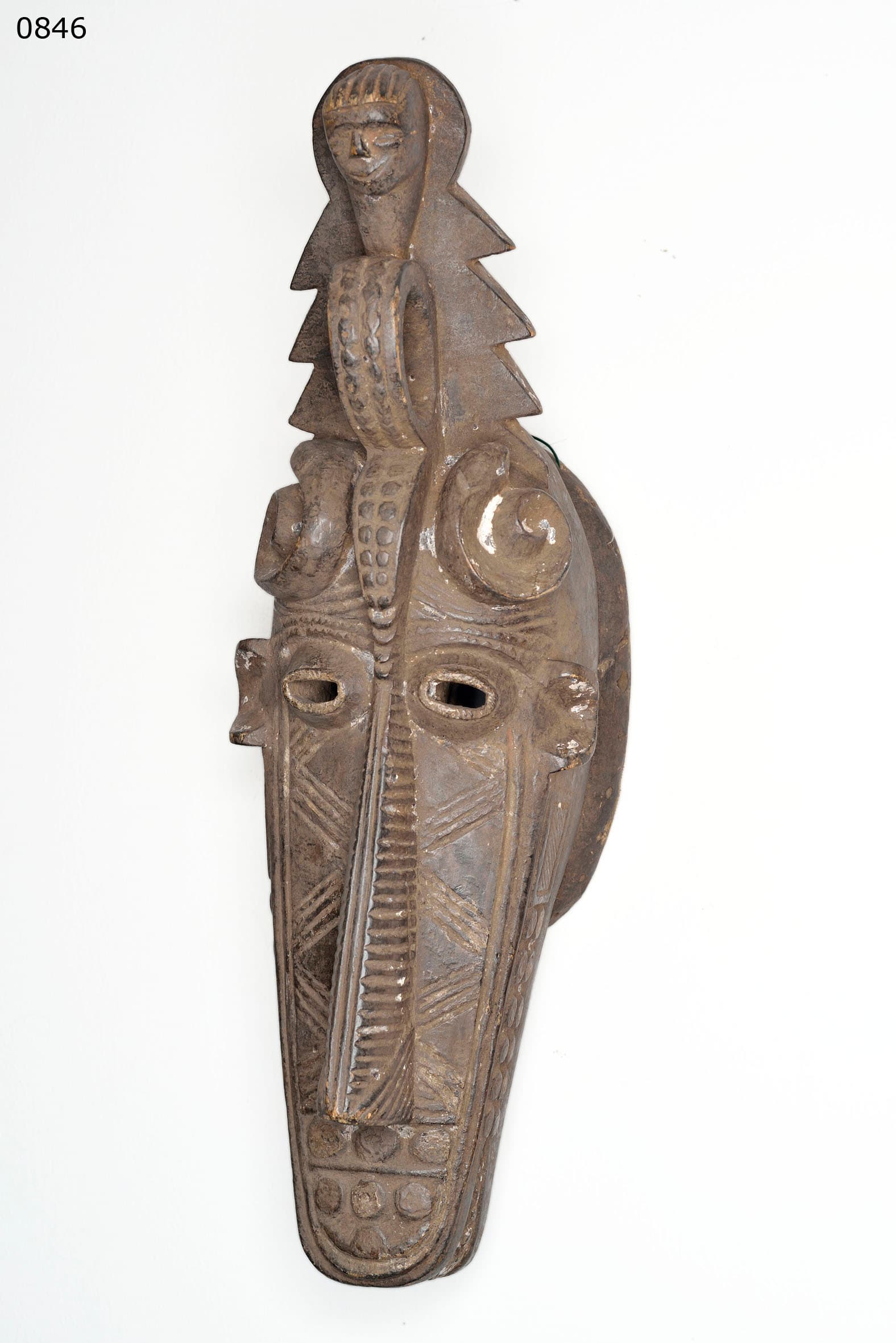
The most iconographically dominant and expressive group are the Elebo masks (literally: "the peepers" or "the seers"). Research has documented at least six socio-culturally active subtypes of this genre: Elebo Abure, Ekwuecici, Takete, Anogbongboro, Nna and Amda (Sanusi 2014). The formal language of these masks is characterised by radical abstraction and a reduction to essential geometric volumes.
The subtype Elebo Abure typically manifests itself as a helmet mask made of a light but resistant softwood. Its iconography is a drastic hybridisation of zoomorphic and anthropomorphic parameters. The lower half of the face elongates into the highly stylised features of an antelope with a horizontally stretched, flat snout, while the upper half applies a pronounced human forehead with vertically incised hairstyle patterns (Sanusi 2014: 42). This canon of proportions aims to visually fix the omniscient vision of the ancestors. A sharp contrast to this is the Elebo Ekwuecici mask ('servant of the dead'), which is characterised by deeply incised zigzag incisions and a central snake motif. The serpent, which descends from the top of the head to the bridge of the nose, directly encodes the unpredictable transit energy of the underworld and contact with the chthonic powers.
Another segment of Bassa Nge art that is highly prized by collectors are the anthropomorphic wooden figures. These sculptures range in size, rarely exceeding 40 centimetres, but exude an enormous monumentality. They are defined by a slight, almost archaic-looking recline of the torso, disproportionately large, rectangular feet, which lend the object stability, and strong arms that lie close to the torso. The head is often dominated by an extremely stylised, sometimes phallically elongated neck hairstyle, while the face is characterised by flat cheeks and upturned, attentive eyes (Christie's 2018: 147). Excellent examples of these figures can be found in the Musée du quai Branly (inv. no. 73.1974.1.1) and in the publications of the Fowler Museum curators.
The material culture of the Bassa-Nge also includes iron sculptures and ritual pottery. Blacksmithing historically benefited greatly from exchange with the Nupe centres (such as Bida), as documented by Marla Berns' research. The ceramic tradition was significantly analysed by Arnulf Stößel (1981) in his publication Nupe, Kakanda, Basa-Nge: Gefäßkeramik aus Zentral-Nigeria for the Biedermann Gallery. These objects, often blackened by preparation with carob liquor and tree bark, feature geometric patterns carved deeply into the clay and are sometimes used for ritual libations.
The most vehement iconographic controversy in confluence research is ignited precisely by the anthropomorphic sculptures. John Picton (1968) and later authors of the Central Nigeria Unmasked project (Berns, Fardon, Kasfir 2011) point out that the stylistic boundaries between the Bassa-Nge, the Igala and the Ebira are so permeable that an exact ethnic attribution is often problematic. While author A (such as the art historian François Neyt in early systematic catalogues) strictly attributes certain standing figures with sagittal crests to the Bassa-Nge, author B (Sidney Kasfir 2011) argues that these are rather supra-ethnic workshop styles of itinerant carvers. These operated in a contact zone and produced for both Ebira and Bassa Nge patrons. Consequently, the nomenclature of "documented master hands" is not to be applied to individual carvers known by name, but to regional workshops whose stylistic features diffused fluidly across ethnic borders.
The choice of material and the development of patina mark the decisive ontological difference between a ritually activated object and a profane (or purely entertaining) sculpture. Ritually activated masks or altar figures have a dense, encrusted sacrificial patina. This is created by repetitive applications of palm oil, chewing tobacco, crushed kola nut extract, animal blood and the specific cigbe medicine. Profane objects, on the other hand, which appear at secular harvest festivals, often remain transparent or are simply painted with kaolin, ochre or industrial pigments.
For private collectors, this results in distinct forgery criteria. Market-relevant forgeries (often from mass-produced workshops in Bamenda or Lagos) simulate age through artificial acid baths, burial in damp earth or rubbing with black shoe polish, which fluoresces strongly under UV light and remains soft. An authentic bassa nge patina has migrated organically into the epidermis of the wood, showing microscopic mineral layering in the pits (such as in the zigzag patterns of the Ekwuecici) and is associated with natural, deep heartwood cracks (desiccation cracks) that indicate decades of drying in the hot savannah winds.
4. ritual practice
The lifecycle of a Bassa Nge ritual object is a strictly regulated performative and material process that choreographs the transition from profane wood or iron matter to a numinous store of power and its eventual deactivation. The ritual practice oscillates spatially and energetically between the static earth altars deep in the Kutimba forests and the dynamic, kinetic performances of the masked groups in the village centre.
The process of activating a newly carved Elebo mask or an anthropomorphic altar figure does not begin in the woodcarver's studio, but necessarily in the sphere of the Nomba priest. After the raw wooden object has been handed over, it must be ontologically "charged" in order to serve as a vessel for the ancestral soul. This is done through the ritual application of cigbe - a highly potent, magical-pharmacological substance distilled from animal and botanical components (Weise 2011: 106). During the initiation of the object and its wearer, the priest sacrifices chickens and libates ritual beer (usually brewed from sorghum) over the cigbe shrine and the masked garment itself. Through this act, a spiritual metamorphosis takes place: the mask dancer is no longer seen as human, but as inseparable from the entity he represents; he physically 'becomes' an ancestor (Akuci-Ndamzhi) (Sanusi 2014).
In the specific practice of the Egbunu cult, which functions as a legal and spiritual controlling authority, there is a remarkable performative deviation compared to the Elebo dances. The actual, abstractly conceived Egbunu entity often remains hidden and does not dance itself. The ritual choreography and the visible intimidation of the population is performed by the so-called "Egbunu children" - young, strictly selected initiates. They do not necessarily wear wooden helmets or masks during their performances. Instead, their anonymity is guaranteed by radical body painting: Complex patterns of red and white pigment dots (dots) are applied directly to the bare skin, completely erasing individual human identity. These somatically masked actors escort the accused during trials to the Kutimba forest shrines, where individuals accused of witchcraft are tried.
In the ordal rituals (divine judgements) of the closely related cultural groups in the confluence area, whose practice spread to the Bassa-Nge, specific trials are imposed on the accused. A common procedure forces those accused of witchcraft to drink water in which the sacred cloth strips (afia) of the masquerade have previously been dipped (Kasfir 2011). Exitus or severe physical reactions after drinking this consecrated water are considered irrefutable proof of guilt.
In contrast to these hermetic, justiciable rites, the agrarian Elebo masks (such as the Elebo Takete) function as rhythmic beats of the subsistence economy. Their dynamic appearance on moonlit nights during the rainy season signals to the farmers that it is the best time to sow. At the same time, the masquerade serves as a nocturnal police force that sanctions theft in the fields or adultery in the village through physical punishment. In its activated form, an Elebo dancer never communicates in human language. He articulates himself exclusively through guttural sounds, which must be decoded by a ritual translator (interpreter) for the village community. Regional variants, for example in the eastern Gboloko district, emphasise the eschatological function of the snake-wearing Ekwuecici mask. This primarily appears at funerals and funeral marches to drive away evil spirits (and enemy sorcerers) and to guarantee the safe, undisturbed passage of the deceased into the ancestral realm.
| Mask subtype | Primary ritual function | Iconographic leitmotif | Kinetic execution |
|---|
| Elebo Abure | Ancestral protection, gaining favour | Antelope snout, human forehead | Ritual dance, day & night activation |
| Elebo Ekwuecici | mourning rites, spirit defence | zigzag pattern, central snake motif | funeral processions |
| Elebo Takete | Agricultural calendar, village security | Wood and raffia construction | Night patrols in the rainy season |
| Elebo Anogbongboro | Healing, Medical Intervention | Baboon Head, White Framed Eyes | Inpatient Consultation, Healing Dances |
| Egbunu children | jurisprudence, witch-hunting | red/white body paint (dots) | escort to the Kutimba forest shrines |
The deactivation and disposal of the objects marks the inevitable end of their ritual life cycle. In contrast to the Western conceptualisation of art, which aims to musealise and preserve permanence, physical decay is often an integral, accepted part of the material ontology in the African context. When an Elebo mask or altar figure loses its structural and thus kinetic integrity due to excessive termite (Isoptera) infestation, woodworm infestation or tropical rot, it is not simply disposed of profanely as rubbish. It must be formally "deactivated" in a final rite in order to release the residual energy.
Similar to the documented Aja rite of the neighbouring Okpella, in which the mask dancer, walking backwards, covers all footprints on the dance floor with twigs so that the released spirits cannot trace them back to the world of the living (Borgatti 2011), spent Bassa Nge masks are often deposited in the deep undergrowth of the Kutimba forests and handed over to the elements. The wood returns to the earth through decay, while the spirit is reincarnated in a fresh body through the ritual consecration of a new mask made by the sculptors. Only a few of these heavily degraded artefacts, which were actually in the process of disintegrating, were recovered at this late stage and historically ended up in Western conservation institutions such as the Royal Museum for Central Africa (RMCA) in Tervuren or the Rietberg Museum.
5. historical context
The genesis of the modern Bassa Nge identity and the structural evolution of their art production are inextricably linked to the massive geopolitical upheavals of central Nigeria in the early 19th century. The migration history of the group is well documented in colonial archives and oral traditions, although there are minor academic controversies between early colonial records and modern historians regarding the exact dating of the movements.
The historical nucleus of the migration lies in the aftermath of the death of the Nupe king Etsu Mu'azu in 1795, which was followed by an escalating, bloody dynastic fratricidal war over the succession to the throne between Majiya II and Jimada. After Majiya II had murdered his rival Jimada at Ragada with the help of invading Fulani jihadists, his son Idrisu fled south from the old capital Gbara with a population of around 15,000 loyal followers (Habi 2006: 23). While Yakubu Habi (2006) explicitly dates this mass exodus to around 1820, historians such as F. Achoba (2019) and T.F.G. Hopkins (1933, Assessment Report) argue that the crossing of the Niger and the final settlement in the confluence area was only completed in the 1840s to 1850s under the continuing pressure of Fulani expansion. These refugees, who settled at the confluence of the Niger and Benue rivers and called the area "babo sa umo ge" ("here it is good") in their language, formed the historical entity of the Bassa-Nge.
The colonial encounter in the second half of the 19th century catalysed serious socio-economic and ritual transformations. With the establishment of the Royal Niger Company in the strategically immensely important Bassa-Nge river port of Gbobe, local producers were abruptly integrated into the transcontinental trade cycle. At the same time, British jurisdiction and imperial ethics collided head-on with the indigenous legal systems. In 1921, the British colonial administration officially banned the witchcraft rituals of Ndako Gboya and Egbunu by decree (Weise 2011: 104). This criminalisation forced the cults underground (into the Kutimba forests) and paradoxically led to a secularisation of mask performances in public spaces over the decades. Masks, which used to decide over life and death, increasingly mutated into instruments of "cultural display" at public holidays or state receptions.
The market history of Bassa Nge art in the West is characterised by extremely long phases of complete ignorance, followed by selective, euphoric discoveries. Until well into the 20th century, the rare objects of this micro-ethnicity remained in the shadow of the celebrated, imperial courtly art of Benin or the expressive Yoruba woodcarving. In fundamental overview works, such as Ekpo Eyo's Two Thousand Years of Nigerian Art (1977), the masks of the Bassa-Nge were briefly mentioned as a relevant typology alongside Epa and Gelede masks, but hardly analysed in depth from an art-historical perspective. Although early ethnographers such as S.F. Nadel brought back isolated field objects for the British Museum, it was only through specific material studies, such as Arnulf Stößel's publication Nupe, Kakanda, Basa-Nge: Vessel Pottery from Central Nigeria (1981), that an academic awareness of the distinct aesthetics of central Nigeria was established.
The absolute breakthrough for the region's international art historical reputation, however, was the monumental travelling exhibition Central Nigeria Unmasked: Arts of the Benue River Valley (2011), edited and curated by Marla C. Berns, Richard Fardon and Sidney Kasfir. This exhibition, which started at the Fowler Museum at UCLA and was later transferred to the Musée du quai Branly, freed Bassa Nge art from taxonomic obscurity. The first substantial collectors and dealers to bring these artefacts to Europe (often under false labels such as "Igala") were pioneers such as the gallery owner Maine Durieu and the collector couple Durand-Dessert in Paris. At auctions (such as Christie's 2018), authentic, pre-colonial figurines with outstanding provenance now fetch prices that reflect this historical reassessment.
For private collectors, the authenticity criteria (forensics) for Bassa Nge works are of absolutely critical importance in view of the current market dynamics. As the international market is flooded with mass-produced replicas from Cameroon and southern Nigeria, forensic analyses focus on the organic and ritual ageing of the material. Genuine, pre-colonial or early colonial masks not only exhibit the sacrificial material described, but also show unfalsifiable erosion patterns: the loss of substance on the non-visible backs, which is evidence of termite damage, the presence of indigenous, autochthonous repairs (using iron staples or rattan bindings) and the natural shrinkage behaviour of the heartwood (radial cracks) are almost impossible to replicate convincingly synthetically. Leading museum institutions such as the Metropolitan Museum of Art (Met) in New York now use CT scans and C14 analyses to validate the density of the wood fibres and the micro-mineral layering of the patina in order to isolate the auratic original from the commercial copy. The identification of genuine Bassa Nge masterpieces therefore requires a profound understanding of their fractured history, characterised by migration, ritual secrecy and colonial ruptures.