The Mumuye are a north-eastern Nigerian and western Cameroonian people south of the extensive Benue River valley, known for their visual culture, strictly acephalous social structure, and lineages identified with totemic nature spirits.
Overview
The geographical distribution of the Mumuye extends primarily across the difficult-to-access, topographically complex Adamawa region in north-eastern Nigeria, south of the extensive Benue River valley, as well as across neighbouring border areas in western Cameroon. The settlement area is concentrated in the present-day Nigerian state of Taraba, where the Mumuye are the largest ethnic group in terms of numbers, particularly in the administrative zones and urban centres of Zing, Yorro, Jalingo, Ardo-Kola, Lau, Gassol, Bali, Gashaka and Pantisawa. There are also significant diaspora communities in the neighbouring Nigerian state of Adamawa. Until well into the 20th century, the specific topography of the region - characterised by barren hill ranges and seasonal flood plains - meant that the Mumuye communities remained largely isolated, especially during the intense rainy season from May to October. This geographical barrier function not only prevented early penetration by the British colonial administration, but also significantly delayed the ethnographic and art-historical recording by Western researchers, which is why the visual culture of the Mumuye was not systematically documented until after 1959.
Demographic surveys and population estimates on the Mumuye group show considerable historical fluctuations. Ethnologue figures from the early 1990s recorded around 400,000 people, while current modelled estimates put the total at roughly 900,000 to 930,000, spread across Nigeria and Cameroon; since Nigeria's census does not record ethnicity, all such figures remain approximate. Linguistically, the Mumuye language, which is divided into various local dialects, belongs to the Adamawa subgroup within the extensive Adamawa-Ubangi language family, which in turn forms a branch of the Niger-Congo macrofamily. Semantic and morphological studies of the Mumuye language indicate complex processes of word formation and meaning expansion, which enable speakers to articulate metaphorical and symbolic concepts - for example in ritual communication - in a highly differentiated manner.
The classification and nomenclature of ethnicity are subject to a fundamental research paradigm that is the subject of controversial debate in contemporary ethnology. The sources are ambiguous with regard to the original self-designation (endonym) of these groups. The scholarly consensus is that the term "Mumuye" historically represents an exonym that was presumably coined by neighbouring, hegemonic Fulani groups. This external label was subsequently adapted by the British colonial system in order to gain administrative control over various loosely related but linguistically similar groups. As Richard Fardon explains in his publications for the Fowler Museum at UCLA, historically there was no homogenous entity of the "Mumuye". Rather, the identity was only adopted by the local groups post-colonially as a political instrument to claim autonomy and visibility in the Nigerian state system. In this context, Fardon criticises the "one tribe, one style" paradigm of Western art history described by Sidney Littlefield Kasfir, which artificially presses complex historical networks into rigid ethnic categories.
The social structure of the Mumuye is strictly acephalous and organised in segments. In contrast to the highly centralised, hierarchical systems of neighbouring kingdoms (such as the Jukun), there is no royal authority or dynastic rule among the Mumuye. The social basis is formed by extended family communities that live together in small, often isolated villages or hamlets (dola). The political administration of these dola is the responsibility of a committee of respected persons, the so-called council of elders, which usually elects a primus inter pares as village head. The kinship system is based on patrilineal lines of descent. A special feature of social cohesion is the identification of individual lineages with totemic nature spirits, which are metaphorically embodied in animal forms (such as the bush buffalo). Through these totemic alliances, families not related by blood can also establish political and ritual networks, which stabilises the decentralised power structure of society.
In terms of subsistence strategies, the Mumuye primarily act as marginal farmers under extreme climatic conditions. Agricultural yields in the savannah landscape of the Adamawa Plateau are severely limited. During the extended dry season between October and March, the landscape resembles a barren bush steppe. The primary staple food is millet, which is used to produce flour and local beer, supplemented by the labour-intensive cultivation of yams. The extreme uncertainty of crop yields forces the communities to strongly ritualise the agricultural cycle, in which apotropaic pleas for rainfall and agricultural success are central. Food is supplemented by hunting, which is subject to strict territorial regulations; each village has exclusive hunting grounds, the entry of which is sanctioned by strangers.
The relationship between the Mumuye and their neighbouring peoples - including the Chamba, Jukun, Verre, Mama, Bata and Fulani - is historically characterised by a dichotomy of cultural exchange and violent conflict. On the one hand, ritual overlaps, such as the use of similar helmet masks by the Verre, demonstrate a dense intercultural transfer in the Benue Valley. On the other hand, the acephalous Mumuye suffered for centuries from the expansive slave hunts of the Jukun Empire and the military attacks during the Fulani jihad. The awareness of this historical vulnerability is reflected in the village isolation, the defensive structures of the tsafi huts and the defensive mask symbolism. The early ethnological categorisation in the British Museum, which erroneously assigned Mumuye objects to the Chamba, illustrates the osmotic boundaries of these interacting cultural groups and the need for a differentiated, micro-historical approach.
Cultural context
The religious system of the Mumuye manifests itself in a highly complex cosmological order that combines animistic, totemic and transcendental elements into a coherent structure of meaning. The ontological apex of this system is a singular creator deity called La (in some regions also referred to as Kpanti La), who is conceptualised as omniscient, omnipresent and omnipotent. However, the theological structure of the Mumuye religion is characterised by a pronounced transcendence of this supreme being: La does not intervene directly in people's profane affairs and is therefore not invoked directly through prayers or sacrifices. Instead, the ritual interaction is based on a dense network of spiritual intermediaries, ancestral spirits and local nature beings who act as executive organs and agents of the creator deity.
Ancestor worship plays a central but specifically materialised role. In contrast to many other sub-Saharan cultures, in which wooden ancestor figures form the centre of worship, the ancestor cult of the Mumuye is primarily a cult of relics. The spiritual connection to the deceased is maintained through the ritual preservation and consultation of ancestral skulls (zoepi). These physical remains form the nucleus of the village shrines. Paradoxically, the iconic wooden sculptures of the Mumuye do not directly represent ancestors, but serve as vessels for tutelary (protective) auxiliary spirits that communicate with the ancestral skulls. This differentiation is crucial for understanding the ritual mechanics.
Control over this spiritual network lies in the hands of highly specialised ritual authorities. Since there is no central ruler, spiritual and executive power is exercised by priests, diviners, healers and the so-called "forge doctors" (lo). These actors are organised in institutionalised secret societies, which form the religious and legal foundation of society. The two dominant cult societies are vadosong, which is cosmologically associated with water, healing and purification, and vabong (or vabon), which represents the element of fire and controls the mask rituals, social sanctions and initiation processes. The vabong covenant acts as the supreme legal authority, intervening in conflicts, theft or antisocial behaviour and dispensing justice through performative mask appearances.
The central initiation and transition rituals are strictly bound to age groups and genders. Male initiation, which marks entry into the vabong bond, begins for boys at around the age of ten. This liminality rite takes place in spatial isolation within special shrine huts (tsafi), in which the wooden iagalagana figures and masks are also kept. The initiation process includes physical and psychological tests, including systematic flagellation (ritual flogging) and the revelation of the secret cult emblems (vaa or vaka). In the course of these rites, which are supervised by masked beings, the novices learn the esoteric knowledge of the ancestors, the interpretation of magical objects and the social norms of the elders. Women also undergo specific, albeit less institutionally organised, initiation rites before marriage, which include in particular the application of scarification marks (ornamental scars). A classic pattern is three horizontal cut lines that divide the face into thirds - a motif that is directly reflected in the formal language of the masks and sculptures. In addition to the initiations, there are periodic community rituals such as the Ushavuko festival, which is celebrated twice a year to promote social cohesion.
The role of women in the cult of the Mumuye, which is characterised by strict taboos and mechanisms of exclusion, is a highly complex area of tension. Active participation in the vabong ceremonies and access to the tsafi huts are forbidden to women and non-initiates under threat of drastic sanctions. The ethnographic material proves that even accidentally or secretly looking at the secret cult emblems (vaa / vaka), their costumes or musical instruments is considered a serious sacrilege that can result in illness, disaster or death in the local belief system. This gender-specific exclusion serves to reinforce patriarchal authority structures and can be observed comparatively throughout West Africa. Ethnographic studies explicitly draw parallels here to the Orò cult of the Yoruba, in which women are also excluded from observing the cult objects under the strict threat of sanctions (summarised in the principle "Obinrin o kii wo oro" - women are not allowed to see oro). Despite this exclusion on the macro-ritual level, women do act as healers on the micro-ritual level, as evidenced by field photos from the 1970s documenting female divinators interacting with iagalagana figures.
In the ethno-religious research literature, there is intensive discussion about the structural differences between the Mumuye system and that of neighbouring peoples. A central research controversy (author vs. author) concerns the interpretation and function of the vertical mask appearances. Arnold Rubin, who researched the region in the 1960s, emphasised the universal character of the masks as social control instances and healing companions. More recent analyses, based among other things on the field documentation by Jan Strybol for the Royal Museum for Central Africa (RMCA) in Tervuren, differentiate this and prove a fundamental structural deviation: in contrast to the mask rites of the neighbouring Jukun or Wurkun, whose performativity is inextricably linked to the agricultural cycle (sowing and harvesting), the sukuru masks of the Mumuye are decoupled from agricultural rites. Their appearances take place exclusively in the context of funerals, to punish thieves or for the ritual enthronement of new village chiefs. This functional separation of agrarian and status rites marks a decisive unique feature of the Mumuye cosmology within the Benue region.
Aesthetic features
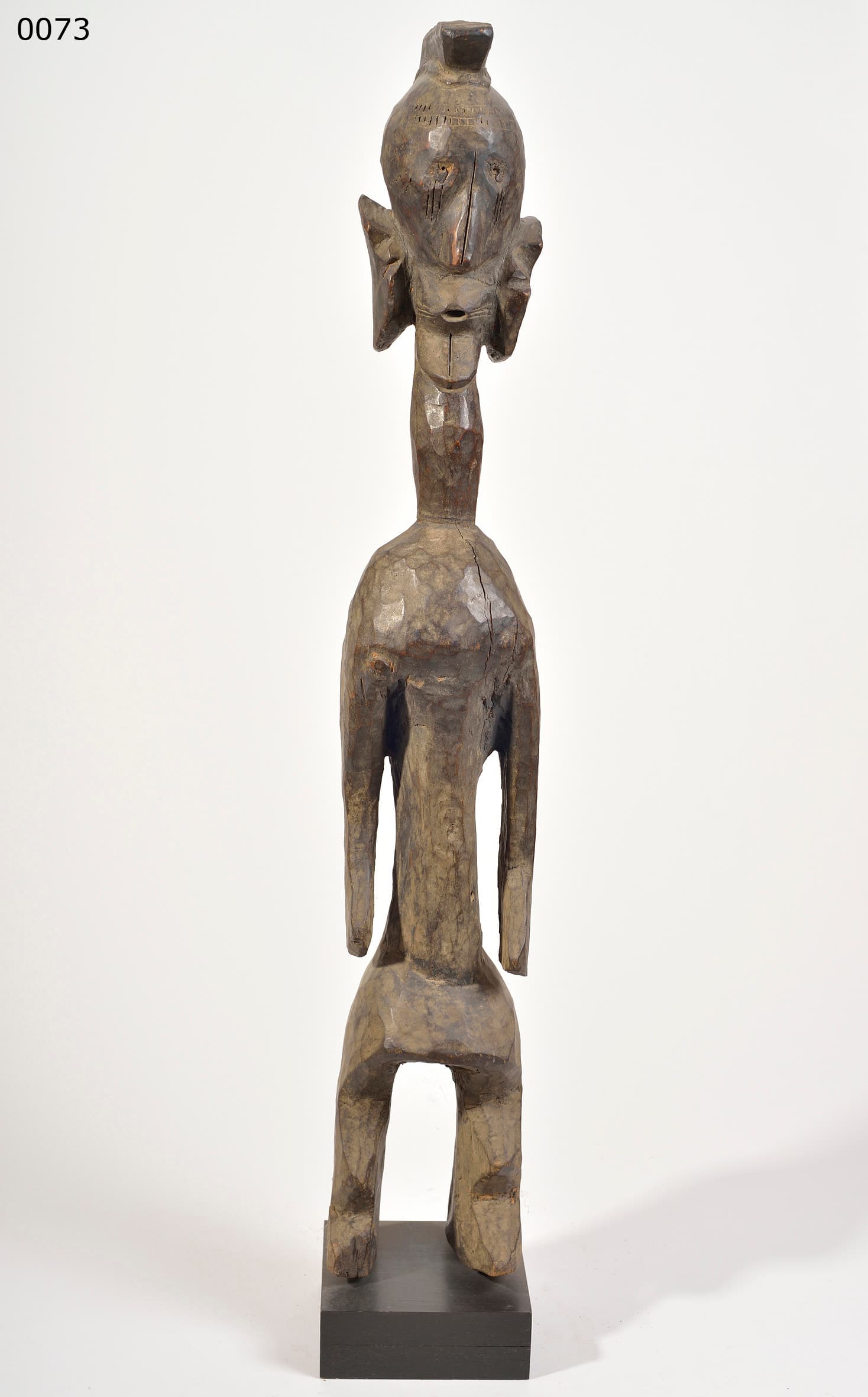
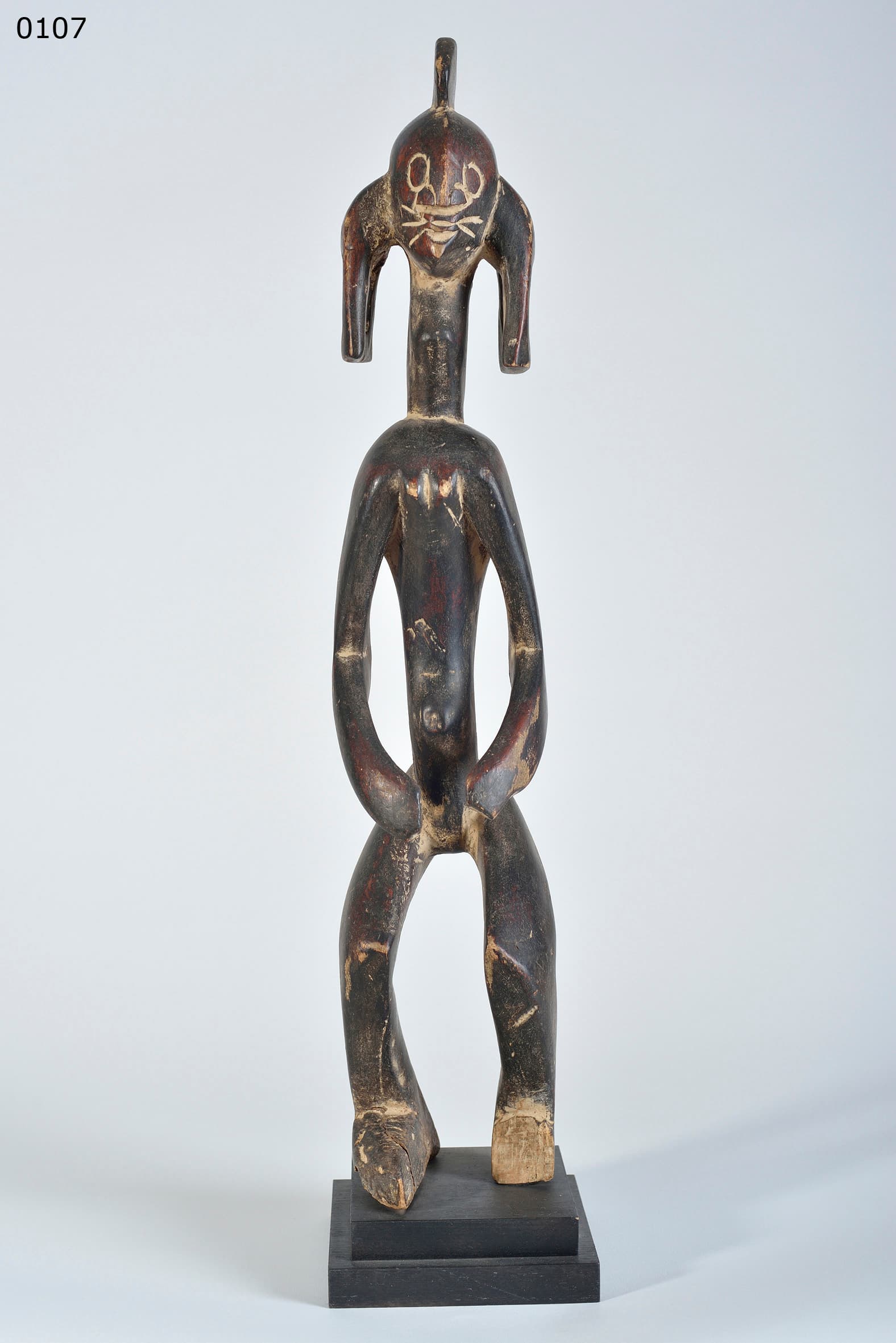
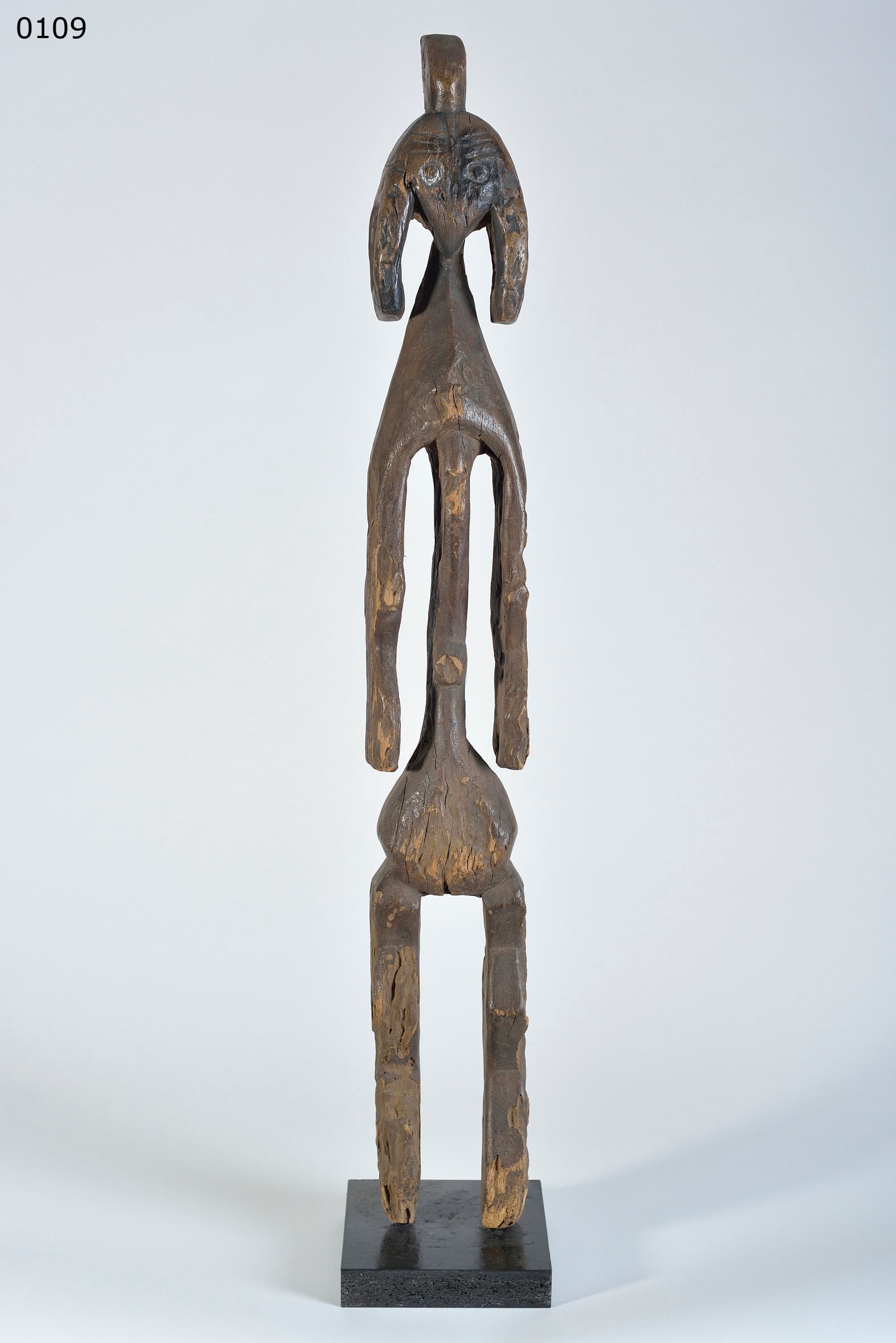
The sculptural canon of the Mumuye is celebrated in the international reception of African art as the pinnacle of sub-Saharan abstraction. The iconic iagalagana standing figures (also known as lagana or janari) form the artistic centre of this canon. These statues exhibit a radically deconstructivist typology that interprets the human body not as an anatomical mimetic, but as a rhythmic composition of cylinder, cone and spiral. The iconographic foundation of this canon of proportions is the strongly elongated, tubular torso, which is often dominated by a striking, conical navel. The neck is massive and overlong to support the often relatively small, oval head. The facial features are minimalistically reduced, but have significant details: helmet-shaped hairstyles reminiscent of sagittal crests or lateral horns (often interpreted as an image of the bal initiation helmets), prominent, flat protruding ears whose large lobes are reminiscent of the use of ear plugs, and deep-set eye sockets, which are occasionally accentuated with white pigments (kaolin).
The lower extremity usually forms a block-like, angular base whose legs are often carved in a broken zigzag or flexed-knee stance, which is often interpreted in African art history as a sign of vital, potential energy and ritual vigilance. However, the undisputed unique formal feature of the iagalagana is the construction of the arms. These are elongated like ribbons or loops, detach themselves completely from the shoulders and wind downwards parallel to the torso, where the abstracted hands usually grasp the hips or abdomen. In some examples, movable, separately carved arm constructions were documented. This filigree arm guidance creates a pronounced empty space between the torso and limbs.
The most striking iconographic controversy (author vs. author) in Mumuye research culminates in the analysis of this empty space. The Belgian art historian Frank Herreman, supported by the theses of Jean-Yves Coué (2016/2017), argues that the "negative space" between the torso and arms is the primary, intended sculptural design feature of the Mumuye sculptors. Herreman defines these hollow spaces not as the mere absence of wood, but as positively delineated, visually present volumes that dynamise the sculpture. This approach is vehemently criticised by the anthropologist Richard Fardon. Fardon (2011) argues that the overemphasis on "negative space" is a construct of Western art criticism - a Eurocentric projection that was largely inspired by the British sculptor Henry Moore, who made sketches of Mumuye figures in the British Museum in the 1920s. Fardon warns against evaluating indigenous ritual objects primarily through the lens of Western, modernist aesthetics (such as Cubism or Expressionism), as this distorts the actual ritual materiality.
In addition to the standing figures, the typology of the Mumuye includes a specific category of masks. A rare subtype is the sukwava, a compact yoke or shoulder mask characterised by a strongly elongated neck and a tiny head with disproportionately large ears. Far more present are the sukuru vertical masks, which can reach heights of between 80 and 160 centimetres. These masks, which are worn on the head, depict therianthropic (animal-human) beings or liminal figures that are often categorised as "old woman" or "bush woman" (sukulu). Their iconography combines feminine body adornments (ear plugs, scarification marks) with bird-like, beak-like mouth parts.
The iagalagana vary enormously in size, ranging from small, personal protective amulets about 20 centimetres high to monumental shrine figures 1.60 metres tall. The sculptors traditionally chose extremely dense and resistant tropical hardwoods, such as detarium senegalense. The authenticity and ritual charge of a figure manifests itself physically in its patina. A profane, merely carved object differs from an activated ritual object by the presence of an organically grown crust. This patina results from years of libatory practice (pouring beer, porridge, blood or vegetable juices over it), intensive physical handling (sweat, skin fat) and storage in the smoke-filled microclimate of the tsafi huts. In addition, activated objects often have artificial modifications, such as applied beads, brass wire, leather straps or cowrie snails.
| Object type | Morphological characteristics | Primary ritual function |
|---|
| Iagalagana (large format) | Negative space, band-like arms, navel relief, flexed-knee stance. (approx. 80-160 cm) | Divination, oath taking, status marker of the elders, rain making. |
| Iagalagana (small format) | More compact spirals, reduced details. (approx. 20-50 cm) | Personal protective amulets, medical companion figures. |
| Sukuru (vertical mask) | Sagittal crest, large ear lobes, bird-like profile, scarification marks. | Funerary rites, theft sanction, enthronement. Worn on head. |
| Sukwava (yoke mask) | Elongated neck, tiny head, helmet-like structure. | Initiation rites (Vabong), historical pre-war dances. |
Although the names of African artists have rarely been documented historically, Mumuye research has been able to identify specific master hands and workshops. In 1970, the American art historian Arnold Rubin documented the name of the sculptor Lenke from the village of Zing as part of his field research. Lenke, who had learnt the craft from his brother Mai Shera and his father Zuganu, created over 150 vertical masks and 500 bush cow masks (vaa-bong) over the course of his thirty-year career. Rubin was also able to photographically record the work of a carver named Nyavo, although stylistic variations within his attributions led to scholarly controversy. The Metropolitan Museum of Art (New York) also holds an outstanding large-scale figure (Inv. 1983.189) attributed to an anonymous genius, the "Master of the Pantisawa Workshop", whose style is characterised by radical scaling and delicate wrist details. These sculptors usually worked as itinerant craftsmen who carried out their commissions directly in the courtyards of their patrons.
The market relevance of the Mumuye sculptures has generated a massive forgery problem since the 1970s. As modern radiometric methods such as TL dating cannot be applied to wood, the forgery criteria are primarily based on stylistic and material anomalies. Forgeries, which are often produced in the workshops of Foumban (Cameroon) or Douala, betray themselves through an artificial and evenly applied patina (which does not show the typical irregular layers of genuine ritual use), a lack of authentic heartwood cracks (caused by decades of drying out) and the absence of natural termite feeding marks. Stylistically, modern copyists tend to exaggerate the characteristic spiral and zigzag motifs of the arms and legs, which causes the subtle proportions of the originals to slide into caricature.
Ritual practice
The lifecycle of a sacred Mumuye object is a highly regulated process that begins with the commissioning of a carver - often on the advice of a divinator - and involves a profound ontological transformation from a profane material to a metaphysical entity. After its completion by itinerant sculptors in the patrons' courtyards, the wooden figure is initially considered materially valuable but spiritually inactive. The ritual activation, as documented by E.S. Lilley for the British Museum in 1922, takes place through a top-secret act of impregnation. The newly carved sculptures are taken to a remote sacred grove in deep darkness. There, the priest places the wooden object in close physical proximity to the exhumed skulls (zoepi) of the recently deceased elders. Through this contact, which usually lasts a full day, the spiritual essence and authority of the ancestors is transferred to the figure, which from then on acts as an incarnated tutelary guardian spirit.
After this sacralisation, the figure is returned to the village. The use of the altar is spatially determined: The objects are hidden deep inside the windowless tsafi huts, which are inconspicuous from the outside and form the core of the village shrine complexes, or placed in specialised huts of the blacksmith-doctors and healers. The way they are positioned is striking: the figures are rarely placed on platforms, but are often arranged in pairs and placed directly in the rammed earth floor of the huts in order to establish a direct physical connection to the earth and the chthonic powers.
In contrast to the static reliquaries of other West African cultures, the ritual practice of the Mumuye is characterised by an extremely dynamic, performative handling of the sculptures. They serve as mechanical instruments in divination (fortune-telling) and the art of healing. The most fascinating regional variant, which was intensively documented by Jan Strybol (RMCA Tervuren) in the 1970s, is the use of the figures as janari - as "speaking figures". In this practice, specific figures have deep holes in their nostrils. The divinator or healer inserts a so-called "snail flute" - an instrument consisting of two round discs glued together with a black substance - into these recesses. By exhaling through the flute into the figure in a controlled manner, a whistling, unearthly sound is produced, which is interpreted by the community as the direct voice of the spirit.
In addition to diagnosing illnesses, the iagalagana also act as judicial authorities. In legal proceedings, in particular the investigation of theft or adultery, the mouth of the figure is smeared with the highly effective herbal juices of medicinal plants. The accused must appear before the figure and swear an oath. In serious conflict settlements, opposing parties are forced to physically kiss the statue treated with medicine, which is believed to have catastrophic health consequences in the event of perjury. This intense, haptic interaction explains the thick, shiny patina of use, which is mainly concentrated on the face and chest area of authentic pieces. Everyday sacrificial practice (libation) is the responsibility of the family elders; every time food is prepared, a portion of millet porridge or beer is ritually applied to or in front of the sculpture in order to nourish and favour the guardian spirit.
The mask-based performance organised by the vabong secret society follows a completely different ritual grammar. The vertical sukuru masks, masterfully crafted by carver Lenke, are massive in size (up to 1.60 metres). The structure of the performance is visually stunning: the dancer does not carry the heavy wooden construction on his shoulders like a yoke, but balances it directly on his head. In order to keep his bearings, he looks through a concealed recess cut into the supporting wooden board of the mask. The dancer's body is completely concealed by a dense costume of dyed raffia fibres, which perfects the illusion of a therianthropic spirit from the bush. These masks are not activated periodically at harvest time (as is the case with the Jukun), but on an event-related basis: they appear at the funerals of high-ranking elders to guide the soul into the afterlife, serve to enthrone new village chiefs or carry out flogging (flagellation) as a physical punishment for initiation rites and antisocial behaviour. The colour coding of the masks conveys specific meanings: White pigments signal ritual happiness and purity, red tones stand for beauty, while deep black patina symbolises the mask's ability to bring rain ("to get water for them").
There is a profound hermeneutical controversy among scholars regarding the functional attribution of the iagalagana figures (author vs. author). The pioneer of Benue research, Arnold Rubin, initially read the standing figures as classical ancestor figures in his first writings (1969). In his seminal essay of 1985, he revised this thesis and interpreted them monocausally as "healing companions of the shaman-smith", which served purely apotropaic and divinatory purposes. However, this restrictive definition was deconstructed by the Belgian research group led by Jan Strybol, Frank Herreman and Jean-Yves Coué. Strybol's field research (1970-1972) proved the multivalence of the objects: He documented that the sculptures were not only used magically and medically, but also explicitly functioned as political status markers. Village elders used the figures as personal confidants, held them in their hands during important diplomatic consultations and simulated a silent dialogue with them in order to project authority, prestige and spiritual legitimacy. An object could thus be both a magical healing instrument and a political sceptre at the same time.
The deactivation and disposal of a ritual object historically took place without any sentimental attachment to the artefact as a "work of art". As soon as a sculpture lost its metaphysical vessel function - its "effectiveness" - due to extreme, structural termite damage, fungal infestation or the breakage of essential morphological elements (such as the fragile ribbon-like arms), it was profaned. The deconsecrated figure was either burnt, left to decay naturally in the bush or disposed of in deep ravines. This pragmatic attitude of the Mumuye towards the wooden support explains the rapid readiness to commercialise these objects in the crisis-ridden 1960s, when traditional values were eroding.
Historical context
The historical location of the Mumuye is characterised by an ongoing dialectic of isolation and asymmetrical experiences of violence, which significantly shaped the material culture of the region. The migration history of the ethnic group cannot be fully reconstructed scientifically; the sources are ambiguous with regard to the exact dating of the settlement in the Benue Valley. However, the prevailing anthropological doctrine assumes that the Mumuye were only forced into their present, inaccessible hilly landscape as a result of massive military pressure. The expansive Fulani jihads (holy wars), which destabilised and Islamised large parts of northern Nigeria from the late 17th to the early 19th century, are considered the primary catalyst for this refugee migration. In the retreat areas of the Adamawa Plateau, the Mumuye remained in defensive isolation for centuries. Nevertheless, they did not escape the hegemony of the powerful Jukun empire, to which they were subject to tribute for long periods and which systematically exploited the acephalous Mumuye villages as a reservoir for slave hunts. This traumatic experience of constant threat materialises metaphorically in the defensive, sometimes threatening aesthetics of their masks and sculptures, which are primarily geared towards the protection of the community (apotropaem).
There is an art historical controversy regarding the dating of the wooden sculptures. The expert Bernard de Grunne points to the theory that a so-called "proto-Mumuye style" may have existed, which has stylistic links to ancient, pre-Islamic Jukun traditions and could be dated to between 1500 and 1700 AD. However, the majority of researchers (including Richard Fardon and Arnold Rubin) date the surviving "classical" carving art significantly later and place the explosive heyday of production primarily in the period between 1900 and 1970.
The British colonialisation at the end of the 19th century initially only marginally affected the Mumuye due to their geographical remoteness. The British administrative system of indirect rule, which was based on existing local power structures (such as emirs), was difficult to apply in the Mumuye's acephalous, leaderless societies. Consequently, the exonym "Mumuye" was established by the colonial officials primarily as an administrative collective term, without deeply interfering with socio-religious structures such as the vabong confederation. Until the systematic mapping of the region in 1959, the cultural fabric of the Mumuye remained largely intact, and their artworks were de facto non-existent in Western collections - with the exception of the pieces acquired by E.S. Lilley for the British Museum in 1922.
The catastrophic break that marked the end of authentic ritual art production and established the market in the West was the Nigerian Civil War (Biafra War) between 1967 and 1970, which caused massive famine, destruction and extreme poverty in Eastern Nigeria. At the same time, the aggressive advance of missionary Islamic and Christian groups, coupled with the promise of urbanisation, undermined the traditional value system. This singular crisis led to an unprecedented civilisational exodus: to ensure their physical survival, the Mumuye desecrated their tsafi shrines and sold the centuries-old iagalagana and masks. As Nigerian legislation strictly prohibited the export of sacred antiquities, highly organised smuggling networks were established. Muslim middlemen, so-called "runners", transported the sculptures across the border to neighbouring Cameroon via Jalingo. The centre of this illegal art trade was the town of Foumban in the Cameroonian grasslands, from where the objects were smuggled to the European art market via Douala.
The breakthrough of Mumuye art in the West was sudden and resembled an art historical sensation. in 1968, the Majestic Gallery in Paris presented the first collections of these completely unknown sculptures in Europe. The radically reduced, abstract formal vocabulary perfectly captured the zeitgeist of Western modernism and suggested a direct aesthetic relationship to Cubist and Expressionist artists. Collectors and dealers such as Jacques Kerchache or Ewa and Yves Develon ripped up the stock. When Arnold Rubin published his fundamental studies in 1969 and definitively categorised the works as Mumuye (and no longer Chamba), the prices for these objects exploded in the auction houses of Paris and New York. Today, an iagalagana is considered a must-have in high-calibre collections at the Musée du quai Branly or the Metropolitan Museum.
This immense demand, coupled with the vacuum left by the outflow of originals, evoked a complex problem of forgery. Richard Fardon and Bernard de Grunne identify four specific waves of object production that dominate today's market:
- Pre-1968: Authentic pieces historically used in ritual.
- Early 1970s: Autochthonous replacement carvings by the Mumuye, which were intended to ritually compensate for the loss of the originals, but were often degenerate in terms of craftsmanship.
- 1970s to 1980s: Commercial copies for the market, carved by local craftsmen.
- Post-1980s: Cameroonian forgeries (from Foumban), made by non-Mumuye sculptors who caricaturise the style.
Since thermoluminescence dating (TL) is physically impossible for wood and the radiocarbon method has too large a tolerance range (plateaus) for artefacts from the 19th/20th century, the authenticity criteria of forensics are based on detailed visual and tactile material analyses. An authentic object is verified by an organically layered patina encrusted by libations, deep heartwood cracks caused by decades of maturation of the tropical woods and genuine, structurally logical traces of termite damage, which forgers can often only inadequately imitate with artificial drill holes and acids. Auction catalogues from Sotheby's or Christie's also often refer to the specific wear patina (patina of use) on the gripping surfaces of high-priced lots, which has been caused by decades of tactile contact between the diviners and elders and the sacred wood.
To summarise, it can be said that Mumuye art is a unique phenomenon in African art history. Isolated from external influences, they developed an abstract canon of proportions that did not serve as mere decoration but as a highly functional instrument for metaphysical crisis management and social structuring. The rapid transition of these sacred instruments from the secrecy of the village tsafi huts to the illuminated showcases of Western museums exemplifies the asymmetrical dynamics of the post-colonial art market, in which the loss of cultural identity was conditioned by the aesthetic gain of the globalised art world.