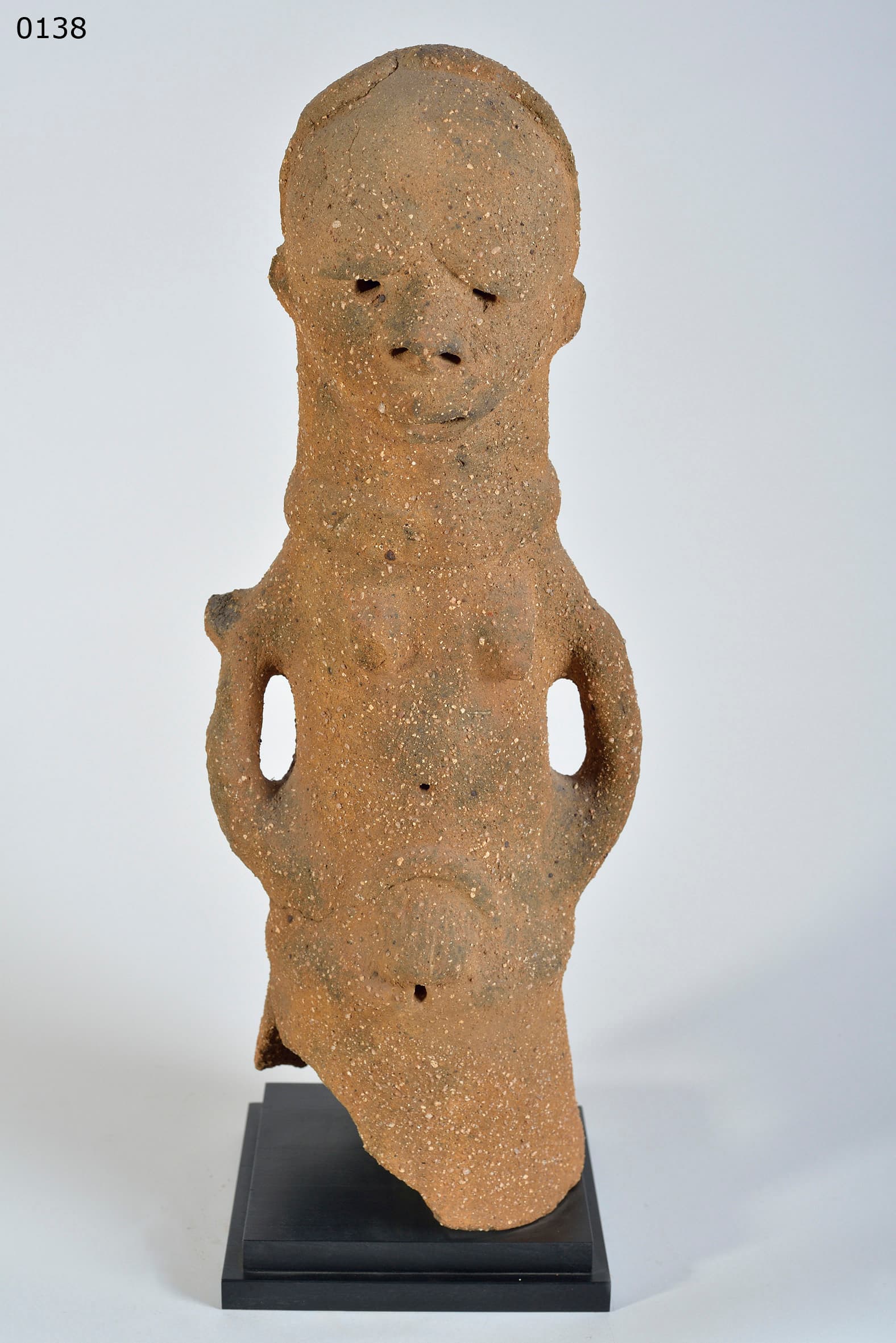
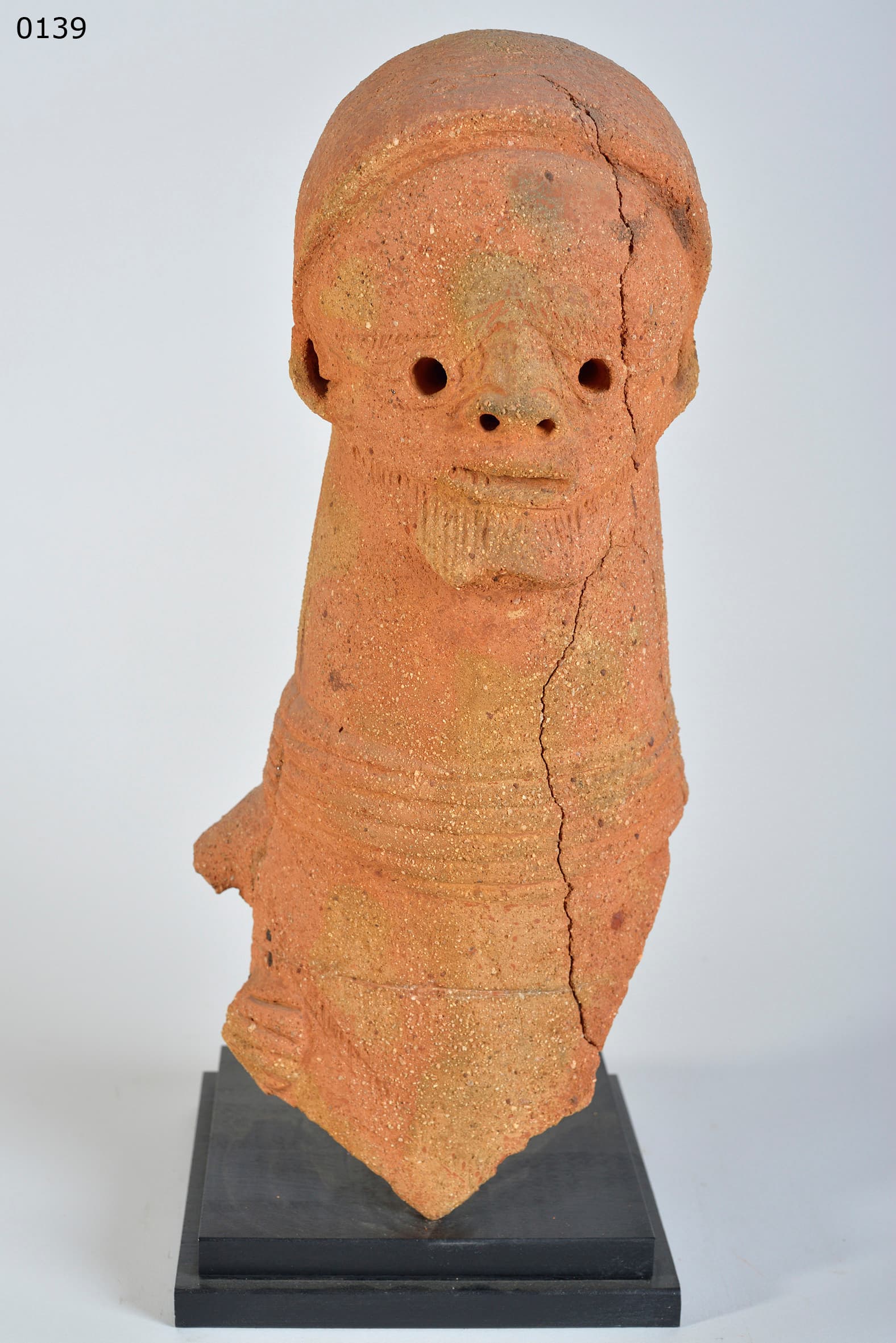
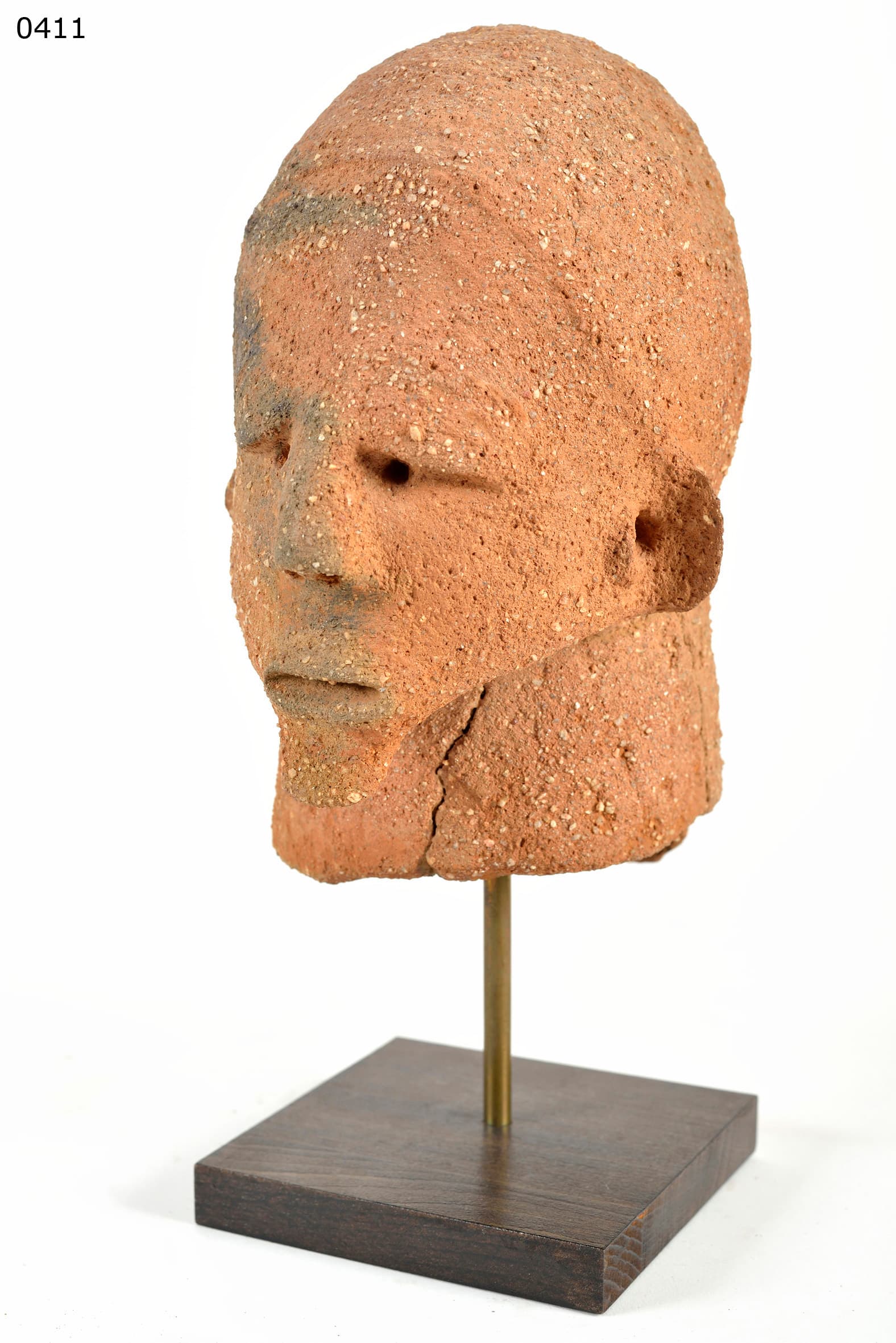
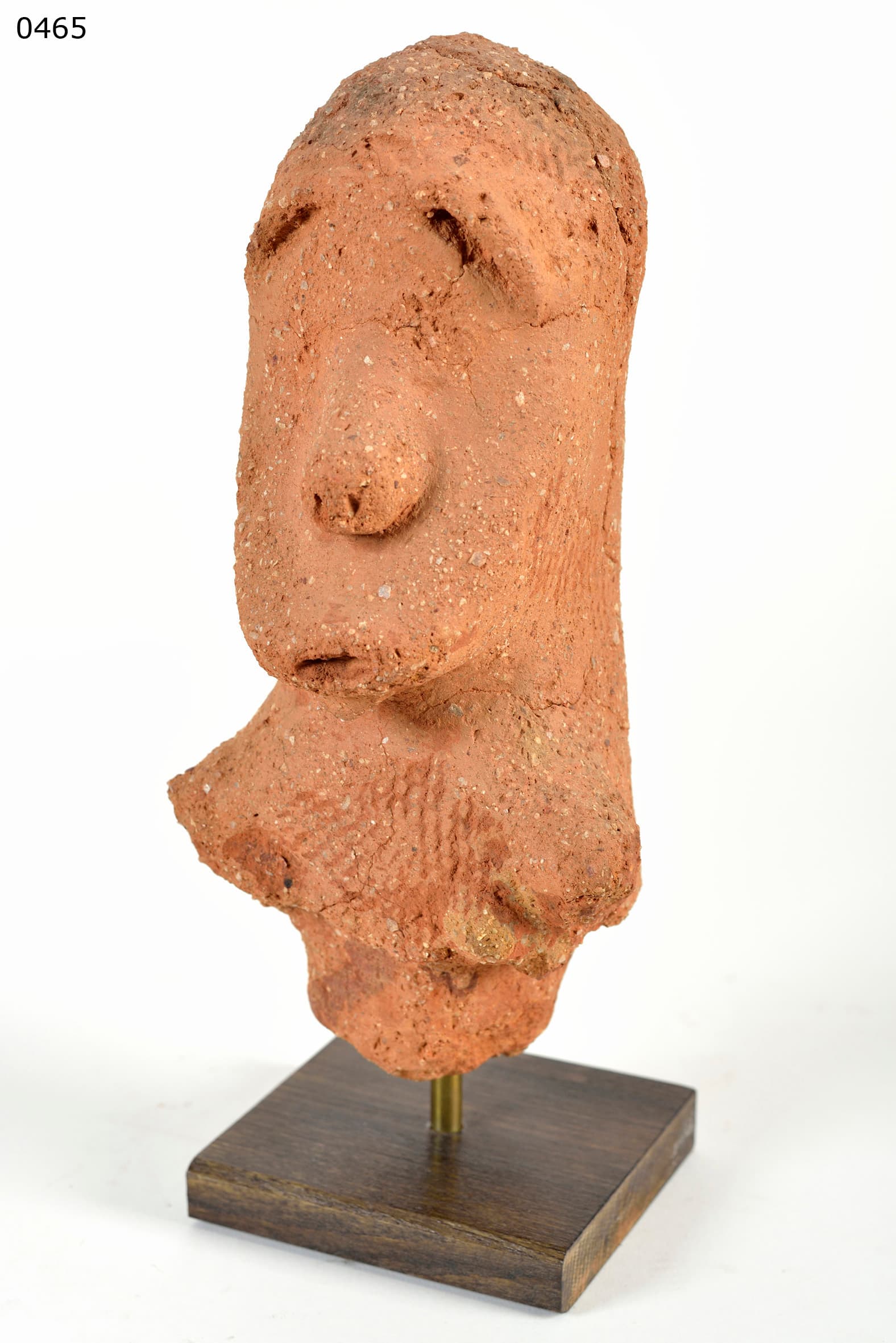
The Sokoto are a north-western Nigerian people in the catchment area of the Sokoto River, known for their monumental terracotta sculptures, highly standardised iconography, and highly developed metallurgy.
Overview
The archaeological entity known as the Sokoto culture represents one of the most important but least systematically researched Iron Age terracotta traditions in sub-Saharan Africa. The geographical distribution of this highly complex material culture is concentrated primarily in the north-west of the present-day state of Nigeria, particularly in the catchment area of the Sokoto River (also known as the Kebbi River), the extensive plains of the Niger Basin and the regions around the present-day Kainji Reservoir and Yelwa. As the Sokoto culture is a purely archaeological construct, defined primarily by stylistic classification of chance finds and illegal looting, current demographic population estimates are not applicable to the ancient creators of these artefacts. The populations predated the recent distribution of the recent Hausa and Fulani groups in this region by more than a millennium. For this reason, a reliable linguistic categorisation of the historical actors into the Niger-Congo or Nilo-Saharan language phylum is currently impossible, although isolated hypotheses postulate a linguistic relationship to the ancestors of today's Dakakari or Jukun.
The nomenclature of the culture illustrates the methodological limits of African archaeology: there is no surviving self-designation (endonym) of these people. The established foreign designation (exonym) "Sokoto" goes back to the modern Nigerian federal state and the historical caliphate region of the same name and serves merely as an auxiliary geographical construct in research and on the Western art market. Due to the lack of intact stratigraphy, the chronological location of the corpus is based almost exclusively on the thermoluminescence dating (TL) of looted objects and on a few radiocarbon dates (C14) from rescue excavations in the 1960s (Kainji Rescue Archaeological Project). These dates place the heyday of the Sokoto terracottas in a broad temporal corridor between 500 BC and AD 500, making them direct contemporaries of the world-famous Nok culture of central Nigeria. Isolated archaeological features, such as at Baha Mound near Yelwa, have yielded deep stratigraphic C14 dates of 2140 ± 110 BP (Before Present), demonstrating very early and long-lasting settlement continuity in this microregion.
The reconstruction of the social structure is the subject of intense academic debate, as the material legacy sends contradictory signals. On the one hand, the monumentality of the terracotta sculptures, the extremely high degree of standardisation of the iconography and the logistical specialisation required for ceramic production and iron smelting imply a highly stratified, hierarchical social order. The existence of 'master workshops' would require the presence of an elite that could support such highly specialised artisans. On the other hand, monumental architectural remains or centralised palace complexes that would indicate an expansive state or kingship are still missing. This supports the counter-thesis of an acephalous, network-based social structure in which decentralised settlement chambers linked by complex kinship systems and ritual alliances coexisted. The kinship system cannot be reconstructed beyond doubt archaeologically, but ethnographic analogies to neighbouring, historically more deeply rooted groups point to possible matrilineal traits in the craft tradition, as clay processing was traditionally a female domain in West Africa.
The economic subsistence of these populations was remarkably diversified and formed the backbone of cultural flourishing. Archaeobotanical and taphonomic analyses of analogous Iron Age contexts in the region attest to the systematic cultivation of pearl millet (Pennisetum glaucum) and black-eyed peas (Vigna unguiculata), complemented by the targeted use of wild resources such as Canarium schweinfurthii. This agrarian basis was complemented by highly developed metallurgy. The Sokoto culture was one of the earliest iron-smelting societies south of the Sahara. Finds of slag, blowpipes (tuyeres) and the remains of racing furnaces demonstrate a profound mastery of pyrotechnological processes, which were essential both for agriculture (iron chopping) and for military conflicts (iron spikes). Furthermore, finds near the river, such as harpoons and net sinkers, indicate the systematic exploitation of limnic resources, while glass beads and crucibles point to far-reaching trade networks.
The relationship with neighbouring peoples, especially the Nok culture in the south and the Katsina culture in the east, forms the core area of current scholarly discourse. The classification controversies must be explicitly highlighted here, as they dominate the interpretation of the entire corpus. The source situation is ambiguous and divides research into two camps. The Belgian art historian Bernard de Grunne postulates the central hypothesis of a common Iron Age "Middle Georgian sculptural tradition". A dates and interprets (in this case de Grunne) the styles of Nok, Sokoto and Katsina as merely regional dialects of an overarching, homogeneous cultural system that was linked by intensive trade and migration. While de Grunne sees a macro-cultural unity, B (the German prehistorian Peter Breunig) takes the diametrically opposed view: Breunig argues vehemently in favour of independent, distinct workshops and local traditions. Based on many years of field research at Goethe University Frankfurt, Breunig emphasises that despite the geographical proximity and temporal overlap, the iconographic boundaries between Nok and Sokoto are so sharply drawn that separate socio-political and religious identities must be assumed. This fundamental research controversy is of enormous relevance for private collectors, as it determines whether an object is evaluated as a local masterpiece of an isolated culture or as a provincial variation of a Nok centre. Museum institutions such as the British Museum in London, which maintains reference collections on West African archaeology, are constantly faced with the challenge of contextualising these fluid or hard boundaries in their exhibition narratives.
Cultural context
The cosmological order and the religious system of the Sokoto culture defy direct historical interpretation, as the civilisation was scriptless and no uninterrupted oral tradition (oral history) exists to the present day. The reconstruction of the sacred is therefore necessarily based on the semiotic analysis of the terracotta sculptures themselves as well as on the structuralist comparison with neighbouring cultures in the region that have been researched in greater depth. The religious system of Sokoto society was in all likelihood animistic and ancestor-centred, with a sharp distinction between an unapproachable creator deity and active natural and spiritual beings intervening in everyday human life. The fact that the formal repertoire focuses almost exclusively on the human body - and here with extreme overemphasis on the head - indicates a cult that understands the human presence (or its spiritual essence) as the cosmological centre.
In large parts of West Africa, the head is historically regarded as the seat of the soul, destiny and spiritual power (comparable to the ori concept of the Yoruba), which is why the drastic enlargement of the head in the canon of proportions of the Sokoto figures does not represent a lack of anatomical knowledge, but a conscious theological statement. The depictions of figures with elaborate, helmet-like hairstyles, multiple neck rings and specific postural gestures refer to a pantheon of deified ancestors or mythological founding figures who were invoked by ritual authorities. These authorities - priests, divinators or dignitaries of early secret societies - acted as intermediaries between the sphere of the living and the metaphysical realm. In this context, the figures themselves presumably do not represent profane portraits of living individuals, but are to be interpreted as idealised receptacula (vessels) into which the spiritual presence incarnated temporarily or permanently through ritual invocation.
The role of women in the Sokoto cult is an area where archaeological evidence and ethnographic analogy form fascinating intersections. If we assume that the Iron Age labour structures were subject to similar gender restrictions as those of the historical ethnic groups of the region, women are of paramount sacred importance. Among the Dakakari, who inhabited the geographical region of the ancient Sokoto area in the 19th and 20th centuries and whose funerary ceramics show formal reminiscences of Sokoto sculpture, only women were authorised as potters to produce ritual funerary ceramics. Among the Yoruba, working with clay and making terracotta shrines is traditionally the responsibility of priestesses, while men are responsible for wood and metalworking. Transferring this paradigm to the Sokoto culture, it was high-ranking female initiates who manifested the canonical formal language of the gods and ancestors in clay, supervised the transformative ritual of firing and thus acted as the primary theological exegetes of the community. This hypothesis contrasts strongly with the often male-dominated narrative of early African metallurgy.
Central initiation and transition rituals (rites de passage) have left no explicit narrative scenes in Sokoto art, which distinguishes it structurally from other traditions. However, some figures exhibit physical anomalies or specific postures that are interpreted in research as indicators of healing rituals or stages of initiation. What distinguishes this religion structurally from neighbouring peoples is the subject of another massive research controversy (author vs. author). The sources are ambiguous with regard to the exact primary location of the terracottas in the ritual space. Bernard de Grunne consistently interprets the Sokoto sculptures as collective shrine and altar figures ("shrine figures"), which were placed above ground in the central sanctuaries of the villages to serve the entire community for agricultural and fertility rites. He argues that the cylindrical, often bottomless bases of the figures were ideally designed to be placed in soft clay altars.
In stark methodological contrast to this is the interpretation of prehistorians such as Musa Hambolu and Peter Breunig, who favour a decidedly funerary function (burial rituals) based on the findings in the related Nok culture and in analogous excavations. Breunig and Hambolu point out that highly fragmented terracottas were found in artificial mound structures (such as at Baha Mound or Yelwa), which could indicate ritual depositions in the context of burials of high-ranking individuals, similar to the grave markers of later periods. This iconographic controversy - collective fertility shrine versus individual funerary cult - touches the foundation of our understanding of Sokoto social structure. Collections such as those of the Fowler Museum at UCLA, which house excellent holdings of West African utilitarian and ritual ceramics, often show in their didactic presentations precisely this area of tension between altar and grave, which ultimately cannot be conclusively resolved in the case of isolated looted objects without stratigraphic findings.
Aesthetic features
The visual identity and canonical object typology of Sokoto culture are characterised by a rigorous formal strictness that enables immediate identification on the art market and sharply distinguishes the corpus from the more fluid, dynamic forms of Nok sculpture. The aesthetic spectrum comprises almost exclusively anthropomorphic representations, which take the form of full figures, busts and - due to taphonomy and destruction - isolated heads. The choice of materials testifies to profound geological knowledge: the local clays were systematically leavened with coarse quartz, crushed rock and feldspar in order to cushion the enormous structural stress during the drying and firing process of the often massive, thick-walled hollow bodies.
The proportional canon of Sokoto art is defined by an extreme macrocephaly (emphasis on the head). The head often takes up a third to a quarter of the entire body length and rests on a cylindrical, highly stylised and static torso. The extremities are usually close to the body, the arms run parallel to the torso or are bent and folded across the chest or stomach. This statuesque, block-like unity of the silhouette stands in stark contrast to the often asymmetrical poses of the Nok figures, which reach more freely into the space. The range of sizes of the Sokoto objects is considerable and varies from small, amulet-like votive figures of around 10 centimetres to monumental, almost life-size constructions that may have measured over 120 centimetres when intact.
The iconographic significance is revealed in the diagnostic facial features, which are the absolutely unique feature of the Sokoto typology. While Nok heads are characterised by triangular eyes with deeply perforated (pierced) pupils, Sokoto heads always have round or oval eyes whose pupils are not pierced, but raised and sculpturally modelled as spheres. Another unmistakable feature are the extremely prominent, heavy eyebrow arches, often in an uninterrupted line, which dominate the face like an architectural cornice and give the figures a severe, almost majestic expression.
The hairstyles and insignia function as complex semiotic markers of social or spiritual status. Almost canonical for Sokoto is the concentrically fluted hairstyle, which surrounds the skull like a ribbed helmet and required a high degree of precision in the cutting of the grooves. Male figures are extremely often characterised by distinctive, stylised beards that run along the often open mouths. The neck area is almost always elongated by the wearing of multiple, heavy and close-fitting neck rings (torques), indicating metallurgical status symbols in the real lives of the elite.
The state of surface aesthetics, the patina development, is primarily a taphonomic process. In the ritually active state, the figurines were covered with a fine clay slip (slip), which guaranteed a smooth surface and was possibly a carrier for plant pigments, oils or sacrificial blood. These organic applications made the essential difference between a fired but profane ceramic object and a sacredly activated ritual object. However, over two thousand years of storage in acidic West African soils have almost completely eroded this slip. What Western collectors today value as a "beautiful, pockmarked antique patina" is in fact the bare, weather-exposed lean structure (quartz and rock) of the inner clay core.
The identification of documented "master hands" is a highly ambivalent field in Sokoto research. Bernard de Grunne, analogous to his work on the Djenné-Jeno corpus and the Luba carvers, has applied the art-historical approach of stylistic analysis (Morelli method) to African terracottas in order to isolate individual "masters" or workshops on the basis of micro-stylistic details (such as the exact guidance of the eyebrow line or the fluting of the beards). This attempt to canonise nameless archaeological producers has met with reservations among prehistorians, as without stratigraphic contexts for finds, chronological developments can easily be misinterpreted as individual manuscripts.
For the market player, forgery criteria are extremely relevant to the market. As the Sokoto style has not yet achieved the full differentiation and the highest prices of the finest Nok pieces on the global market, completely new creations (total forgeries) are rarer. The main problem is posed by highly sophisticated pasticci: African forgery workshops use authentic Iron Age shards of inferior quality found during looting and glue them together with modern clay and synthetic resins from the region to create seemingly intact, monumental full figures. As the core material is antique, these hybrid objects may have thermoluminescence drilling at certain points. The assessment therefore requires the use of computed tomography (CT) or X-ray analysis to visualise internal glue joints, density fluctuations and modern reinforcements in the hollow interior. Reference examples of unmanipulated, authentic Sokoto quality, which serve as a benchmark for forensic experts and collectors, can be found published in detail in the catalogue essays and inventory catalogues of the Museum Rietberg in Zurich.
| Diagnostic criterion | Nok tradition | Sokoto tradition |
|---|
| Eye morphology | Triangular shape, slightly arched eyebrows | Roundish to oval, heavy and strongly emphasised continuous eyebrows |
| Pupil design | Deeply perforated (pierced), shadow effect | Sculptural, raised and undrilled |
| Hairstyle / headgear | Varied, asymmetrical knots, various hats | Characteristically helmet-like, concentrically fluted texture |
| Body silhouette | Varied, expansive poses (kneeling, riding) | Cylindrical, static, blocky, extremities often close-fitting |
| Surface structure (taphonomy) | Often remains of smoothing slip, variable patina | Heavily eroded slip, visible quartz and feldspar levelling |
Ritual practice
The reconstruction of the ritual practice in which the Sokoto terracottas were embedded is like an archaeological puzzle in which the material fragments have to be pieced together into a holistic picture of altar use using ethnographic analogies from the West and Central African region. The terracotta sculptures were not static works of art for aesthetic contemplation, but dynamic instruments within a highly performative and processual religion. The "lifecycle" of such an object - from formless material to ritual disposal - reflects the cosmological notion of transformation, accumulation of power and entropy.
The cycle began with the extraction of the clay. In animistic systems, earth (loam/clay) is never profane matter, but the territory-specific property of earth deities and local nature spirits. The digging of the clay most likely required propitiatory offerings to appease the spirits of the earth. The subsequent firing process, probably in an open field fire at temperatures around 600 to 800 degrees centigrade, was the first critical threshold rite. Fire was understood as a transformative, purifying element that transformed the soft earth with its feminine connotations into a permanent, indestructible form.
After cooling down, however, the newly carved (or freshly fired) object was merely an empty shell. The formal perfection merely served to qualify the object as a worthy vessel for metaphysical entities. The decisive phase was the activation. The figure was installed on an altar structure - presumably within an enclosed courtyard, a shrine house or on a sacred tree. Activation took place through the transfer of spiritual energy (Ashe in Yoruba terminology), which was materially realised through the continuous application of offerings (libations). Based on archaeobotanical findings from the direct catchment area of the Sokoto culture, it can be assumed that these offerings consisted of locally brewed fermented drinks (beer from Pennisetum glaucum), porridges made from black-eyed peas (Vigna unguiculata) and vegetable oils (for example from the fruits of Canarium schweinfurthii). On serious occasions - such as droughts, epidemics or in the run-up to military conflicts - this ritual diet was undoubtedly supplemented by the blood of sacrificial animals (chickens, goats, possibly dogs). The rough terracotta absorbed these organic substances, which over the years led to a thick, encrusted layer of spiritually charged patina that increasingly obscured the sculptural details of the object while maximising its metaphysical power. The activated ritual object was thus an accumulation of prayers, blood and food, a living actor in the social fabric of the community.
An equally important but often misunderstood phenomenon in the Western art market is deactivation and ritual disposal. The overwhelming majority of Sokoto, Katsina and Nok terracottas were not found intact, but in a highly fragmented state. While early archaeological interpretations succinctly attributed this to natural soil erosion, agricultural destruction or the collapse of ancient house roofs, modern research is increasingly focusing on the concept of intentional ritual fragmentation (intentional breakage). Objects that had accumulated spiritual power over decades posed an enormous danger if the associated priest died or the sanctuary was abandoned. They could not simply be left in the profane space.
The practice of intentional destruction served to release the inherent energy and "kill" the vessel. This concept of deactivation through violence is widespread in sub-Saharan Africa; profound ethnographic parallels can be found, for example, among the CongoMinkisi or certain mask cults, as documented in detail in the anthropological holdings and publications of the Royal Museum for Central Africa (RMCA) in Tervuren. After the break-up, the concept of enchainment came into effect: the fragments were not thrown away indiscriminately, but deposited in a highly structured manner. Some fragments, especially the heads, may have been passed on to successors as relics to maintain the ritual chain, while the majority of the fragments were interred in specific patterns on ritual waste mounds, so-called mounds (such as the massive Baha Mound). These mounds, which grew over generations through the layering of ashes, bones, sacrificial remains and terracotta shards, themselves mutated into sacred landmarks in the topography of the Sokoto culture. They marked the end of the objects' lifecycles and physically anchored the ancestors' presence in the landscape before they were stripped of their layers thousands of years later by illegal looters.
Historical context
The historical context of Sokoto sculpture is characterised by a massive temporal and epistemological vacuum between its ancient creation and its turbulent reception on the Western art market in the late 20th century. The migration history of the peoples who colonised the Sokoto river system is closely linked to the climatic fluctuations of the Holocene and remains the subject of academic dating controversies. One school of thought dates the origin of the populations to the central Sahara and postulates that the increasing aridification (drying out) of North Africa in the 2nd millennium BC forced pastoral and farming cultures, together with their pearl millet agriculture, southwards into the Niger Basin, where they founded the Iron Age cultures of Sokoto, Katsina and Nok. Another line of research, however, favours autochthonous developments and points to the long local chronologies that suggest an independent emergence of iron metallurgy on the edge of the Jos Plateau. As the civilisation that created these terracottas collapsed or was assimilated around 500 AD for reasons that are still unclear (climatic shifts, epidemics or over-exploitation of the forests through resource-intensive iron smelting), there was never a direct colonial encounter between the creators of this art and European powers.
The influence of colonial history on the art production of the Sokoto culture is therefore non-existent. However, British colonial rule in Nigeria (from 1900 onwards) had a massive influence on the discovery and subsequent exploitation of this ancient heritage. It was the colonial tin mining industry on the Jos Plateau that first unearthed Nok terracottas in the 1920s and 1940s by the British archaeologist Bernard Fagg. The specific discovery of the Sokoto materials came later, driven by post-colonial infrastructure projects, namely the construction of the Kainji Dam on the Niger River in 1968, which triggered the Kainji Rescue Archaeological Project, in which British and Nigerian archaeologists hastily mapped ancient mounds before they sank into the floods.
The dramatic market story in the West began in the 1980s. When the first publications on early African terracottas began to circulate in Western collecting circles, this generated a huge demand that could not be satisfied by legal excavations. Since Nigeria had already imposed a strict embargo on the export of antiquities in 1979 with the National Commission for Museums and Monuments (NCMM) Act, procurement shifted completely to criminal activity. In the 1990s, the situation escalated into an unprecedented "gold rush". Driven by extreme rural poverty in northern Nigeria and the lure of international traders, thousands of farmers left their fields to systematically rummage through archaeological sites in the regions of Kaduna, Katsina and Sokoto in illegal excavation teams. Local middlemen organised the smuggling in convoys of lorries, hiding the fragile terracottas deep in metal suitcases under agricultural goods and transferring them across the porous borders to Lome (Togo) and Cotonou (Benin). From there, the artefacts were flown to Brussels, Paris and New York, where they were presented in galleries as elite discoveries of African art history, leading to a steep rise in prices, with intact pieces quickly fetching six-figure sums.
This unregulated market reached its diplomatic low around the turn of the millennium in the run-up to the founding of the Musée du quai Branly in Paris. Between 1998 and 1999, the French state, with the explicit personal support of President Jacques Chirac, acquired three outstanding sculptures (two Nok and explicitly one Sokoto) for astronomical sums via the Brussels-based dealer Samir Borro. This purchase was made in blatant disregard of the fact that the International Council of Museums (ICOM) had placed precisely these classes of objects - Nok, Sokoto and Katsina - prominently on the Red List of African Archaeological Cultural Objects at Risk. The Nigerian NCMM protested strongly and demanded the return of the illegally exported state artefacts. It was not until 2000, after a change of government in Nigeria under President Olusegun Obasanjo, that a highly controversial diplomatic compromise was reached: France nominally recognised Nigeria's right of ownership, but was allowed to keep the Sokoto and Nok terracottas as a "25-year loan" and exhibit them in the prestigious Pavillon des Sessions of the Louvre. In the academic world (including experts such as Prof. Shyllon), this agreement is still regarded as a fall from grace, as it gave the global looting industry quasi-state legitimacy and cemented the incentive for further looted excavations.
For today's private collectors, the problem of forgery and the search for authenticity criteria manifest themselves as a direct consequence of this unbridled market history. Since archaeological terracotta can neither show the heartwood cracks of historical wooden sculptures nor clear traces of termite feeding, the identification of forgeries concentrates on mineralogy and thermophysics. African forgers in Togo and Nigeria have developed extremely sophisticated methods to outsmart the standard forensic method of thermoluminescence (TL). As the TL process measures the age of the last firing, forgers use smashed original shards of inferior Sokoto pots (which are 2000 years old), partially grind them up and reconstruct high-priced, stylistically perfect statues ("pasticci") using modern resins, clay and plaster. If the TL drill hole happens to hit an antique fragment, the entire forgery is falsely certified as antique. Modern forensics therefore requires the use of computer tomography (CT scans) and UV fluorescence to visualise glue lines, irregular density distributions in the clay core and modern reinforcements. The assessment of the patina (sinter deposits, mineral encrustations and microscopic root erosion) remains essential, as artificially applied slip, which is often fixed with organic adhesives, fluoresces strongly under UV light and thus reveals the modern intervention. The market for Sokoto terracottas today therefore demands that collectors not only have a profound knowledge of the iconographic controversies, but also a critical approach to radiological expertise in order to separate the authentic antique artefact from the industrially produced pastiche.